Why Is the Moon Red During a Lunar Eclipse? The Real Physics
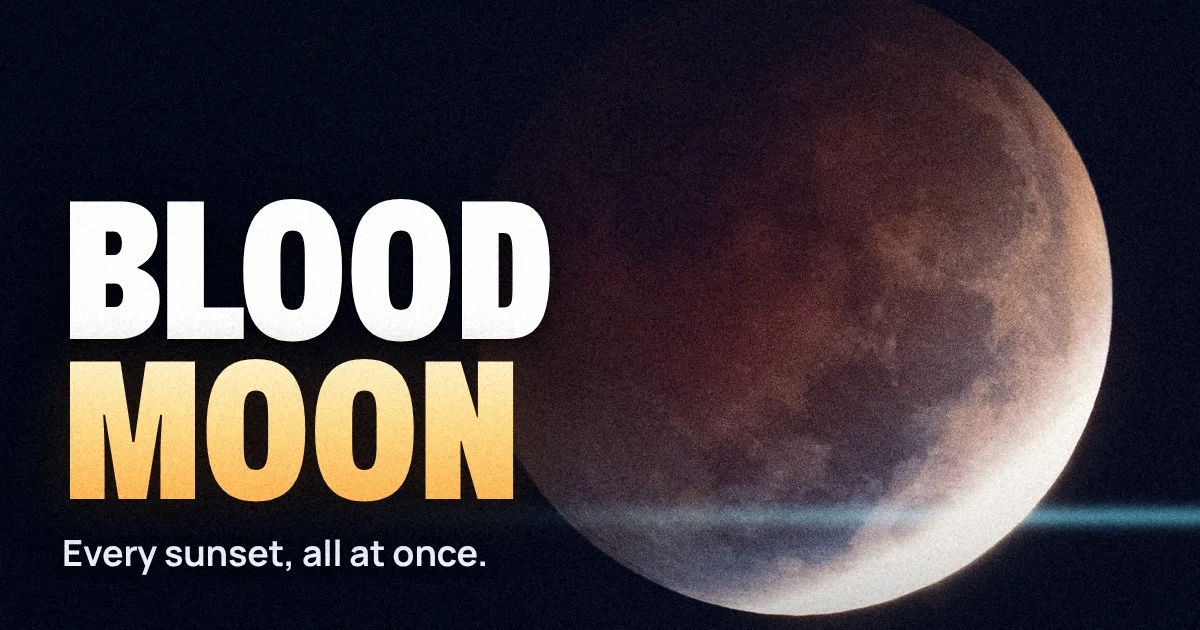
On 9 December 1992, people stood outside for a total lunar eclipse and struggled to find the Moon at all. It was there, fully above the horizon, but so dark that many observers gave it a 0 on the Danjon scale: "Moon almost invisible". Ten years earlier, a photographer named Richard Keen shot two eclipses with the same telescope, film and exposure. The 1972 eclipse came out 400 times brighter than the one in December 1982. The Moon had not changed. Earth's atmosphere had, because two big volcanoes had just loaded the stratosphere with haze.
That tells you where the colour of a "blood moon" really comes from. It is not a property of the Moon. It is a picture of every sunrise and sunset happening around Earth at that instant, projected onto a screen 384,000 km away. Most explanations stop at "it's like a sunset". That is roughly right, but it skips the part that actually puts light in the shadow (refraction), and the part that makes the edge of the shadow blue (ozone). Both are worth working out.
Why isn’t the eclipsed Moon just black?
If Earth had no air, its shadow would be a clean, black cone, and a totally eclipsed Moon would all but vanish from the sky. We know what that looks like in principle, because the Moon itself is airless: when the Moon eclipses the Sun, its shadow on Earth is sharply defined and the Moon's night side is dark.
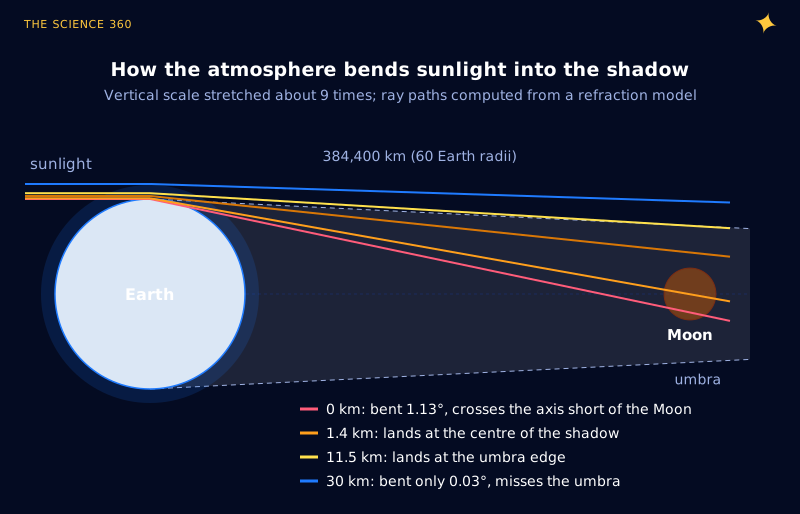
Earth's atmosphere changes this because air has a refractive index slightly above 1. At sea level it is about 1.00028, and it falls off with height roughly as the air density does, with a scale height of about 8 km. A ray of sunlight that skims past Earth's limb passes through denser air near the ground than above, so it bends gently toward the planet, like light through the edge of a very weak lens. It does this twice: once on the way in, once on the way out.
How much does Earth’s atmosphere bend sunlight?
Here is the first worked calculation. For a ray grazing a planet with an exponential atmosphere, the total bending is approximately the surface refractivity times a geometric factor that measures how long the ray spends in the dense air near its closest approach.
Step 1. Total bending of a ray that grazes the surface
Check against the textbook value: refraction at the horizon is about 34 arcmin = 0.57°. A ray that passes all the way through the limb gets it twice: .
Step 2. Bending needed to reach the centre of the shadow at the Moon
So the lowest rays are bent more than enough. They cross the shadow's axis at about 6,371 / 0.0198 ≈ 322,000 km, short of the Moon, and spread out again on the far side. Rays passing a little higher are bent a little less, because refraction falls with air density, by a factor of e for every 8 km. The ray that lands exactly on the centre of the Moon's disk passes about 1.4 km above the ground.
How far out does this light reach? The edge of the umbra is set by geometry. From the Moon's distance, Earth's disk is about 1.9° wide and the Sun's is about 0.53°. The angular radius of the umbra seen from Earth is the Moon's horizontal parallax minus the Sun's apparent radius:
Step 3. Size of the umbra at the Moon
Moon's parallax about 57.0 arcmin, Sun's radius about 16.0 arcmin:
The Moon is about 31 arcmin across. In kilometres:
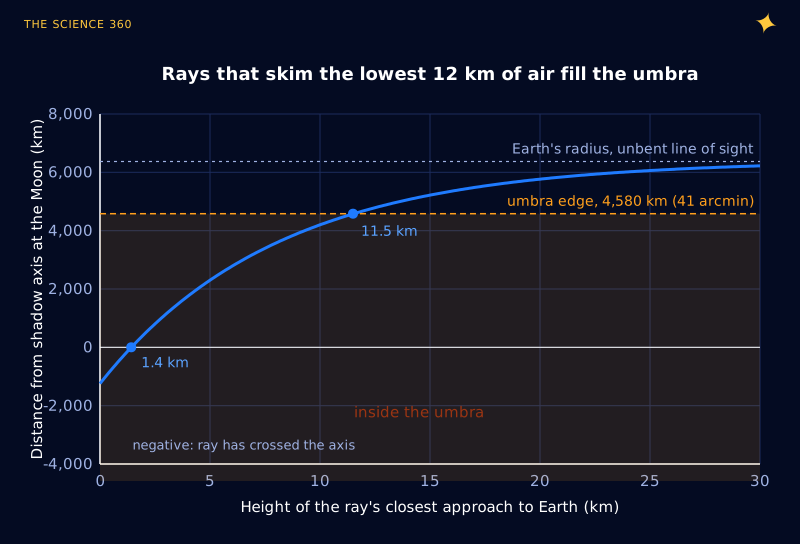
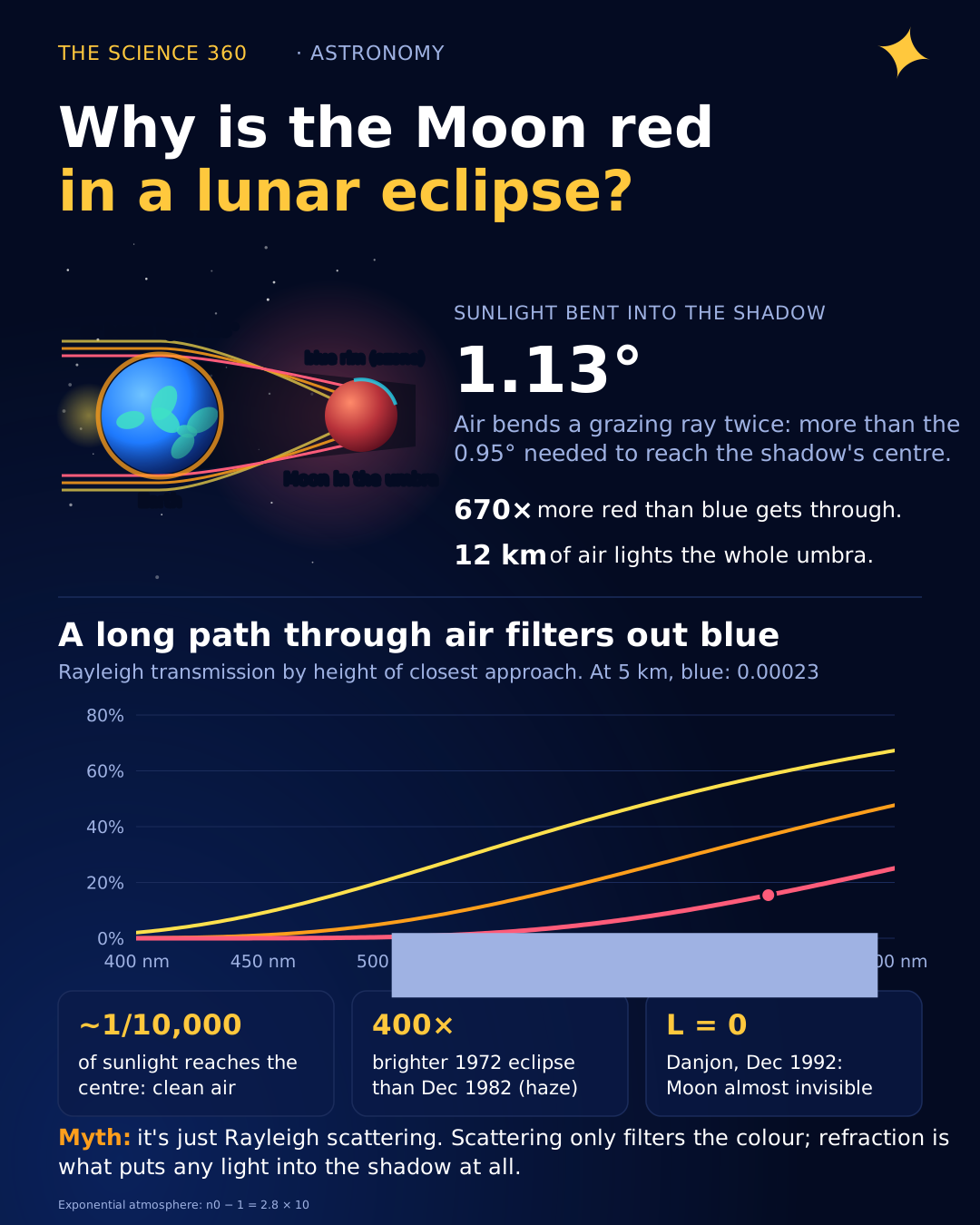
Figure 2 is the most useful single fact about eclipse colour. The light inside the umbra all comes through the lowest 12 km of air, along the band of Earth where the Sun is rising or setting. That is the dirtiest, cloudiest, most humid part of the atmosphere, and the ray takes the longest possible path through it.
Why does that light come out red?
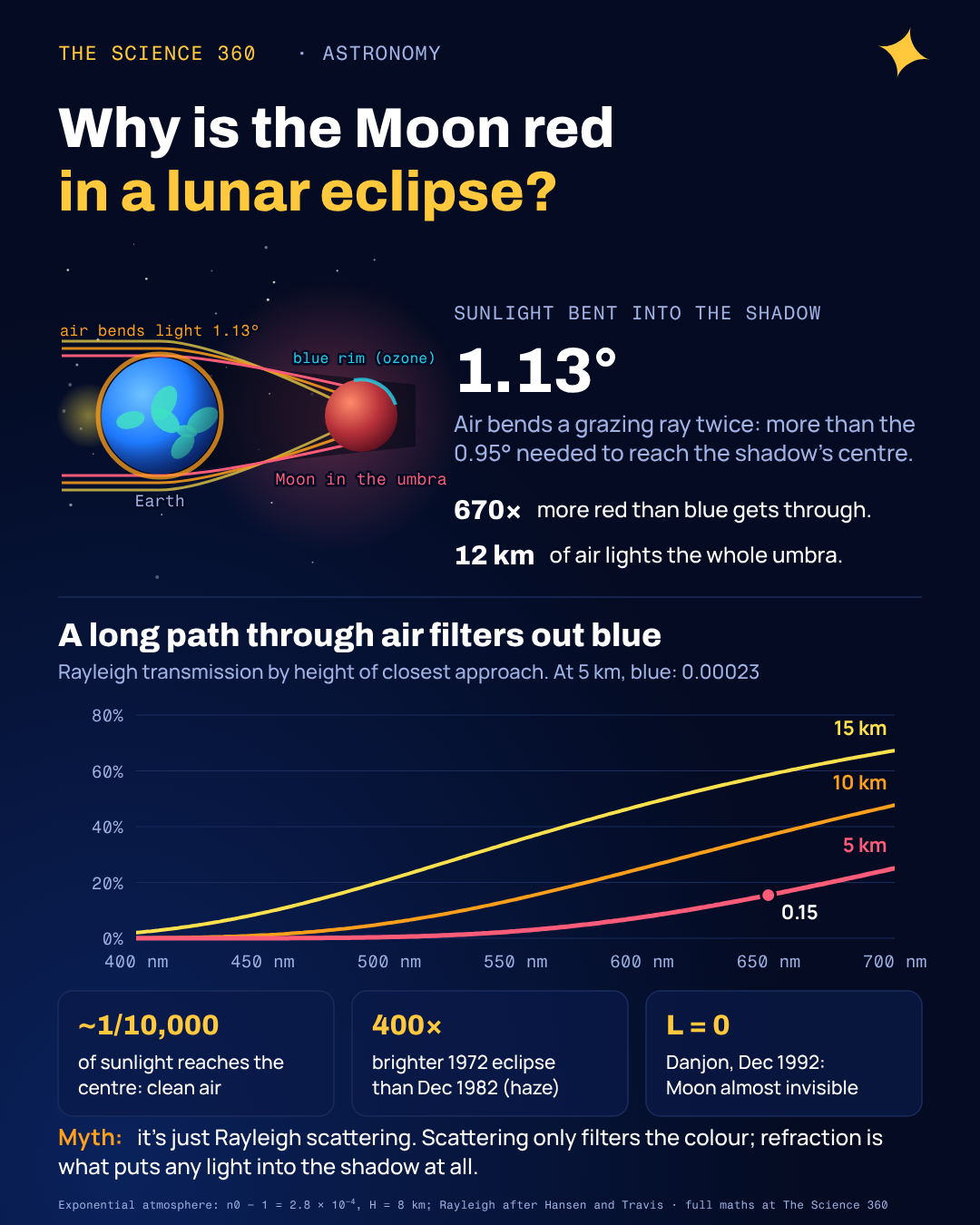
Air molecules scatter light with a strength proportional to . That is Rayleigh scattering, and it is why the daytime sky is blue: blue light at 450 nm scatters about 4.4 times more strongly than red at 650 nm. Scattered light is not destroyed, but it is knocked out of the narrow beam heading for the Moon, so for our purposes it is lost.
For straight-up sunlight the effect is small: the vertical optical depth of the whole atmosphere at 550 nm is only about 0.1. The grazing ray is a different story. Integrating the air density along a tangent path gives about 70 times the vertical column for a ray skimming the ground, and that factor drops by e for every 8 km of height.
Step 4. Transmission for a ray passing 5 km above the ground
Vertical Rayleigh optical depth: 0.221 at 450 nm, 0.097 at 550 nm, 0.049 at 650 nm. Slant optical depth: 8.4 (blue), 3.7 (green), 1.9 (red).
Red gets through about 670 times better than blue.
A sunset at your location involves a path of roughly 38 air masses. The eclipse light does the equivalent of a sunset through each side of the planet, and the lowest rays see nearly twice that. That is why the eclipsed Moon is usually redder and deeper in colour than any sunset sky you have seen.
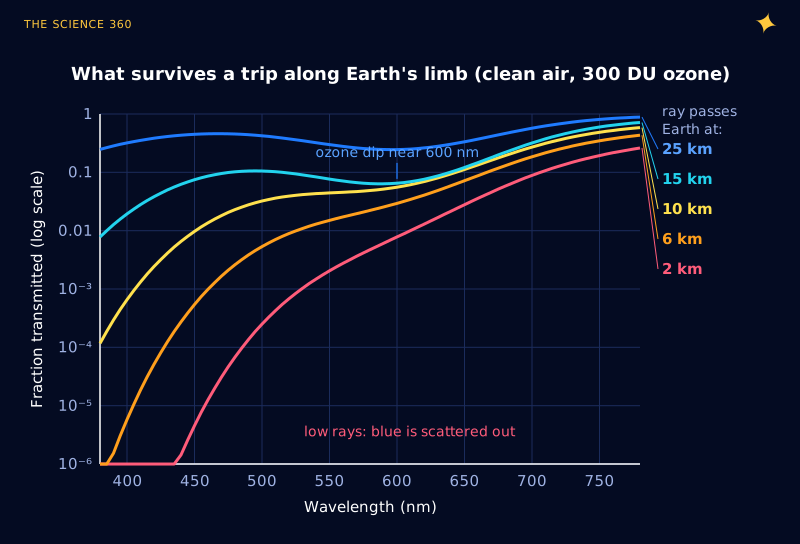
The misconception: “it’s just Rayleigh scattering”
Many explainers say the Moon is red because of Rayleigh scattering and stop there. Scattering alone would only make the shadow redder. It cannot put light into the shadow. Refraction does the delivering; scattering does the filtering. Without refraction you would get a black disk no matter what the air did to the colour, and with refraction but no scattering you would get a faint, roughly white Moon.
There is a third ingredient that is easy to miss: spreading. A thin ring of air around Earth's limb, a few kilometres high, gets fanned out over a disk thousands of kilometres across at the Moon. For the 5 km ray, each kilometre of height at Earth maps to about 510 km of distance at the Moon (because the bending changes so fast with height). The ring of light is also squeezed toward the axis.
Step 5. Dilution of the light, ray passing at 5 km
It lands at this distance from the axis:
Red light reaching the Moon from this ray: of full sunlight.
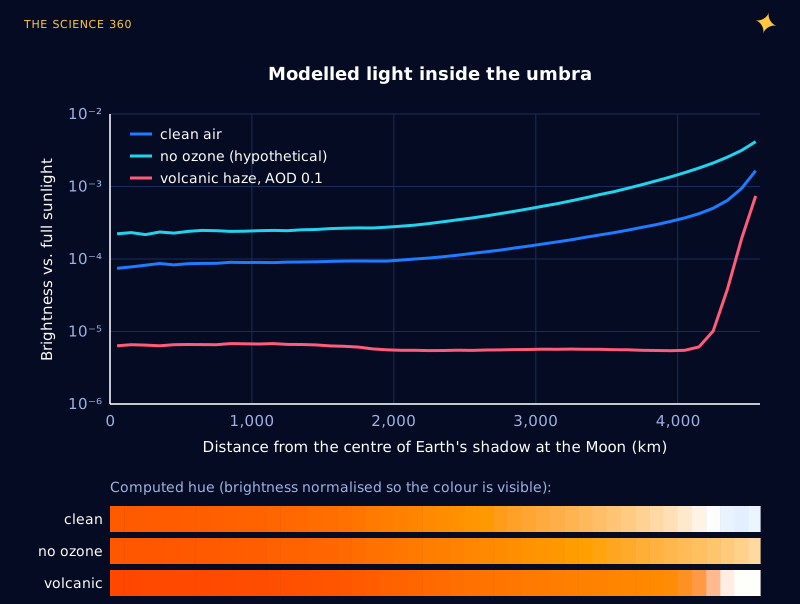
Add up all the heights and average over the Sun's disk and you get Figure 4. In a perfectly clean, cloud-free atmosphere the middle of the umbra receives about 1/10,000 of normal sunlight. That is a drop of about 10 magnitudes, so a full Moon of magnitude −12.7 would shine at around −3. Real eclipses are fainter, because clouds block a good share of the limb (Keen's brightness model assumes about 50% cloud cover) and because there is always some haze. Treat the clean-air numbers as an upper limit.
What makes the edge of Earth’s shadow turquoise?
Look at the top colour strip in Figure 4. The centre of the shadow is deep orange-red, but the last few hundred kilometres before the umbra edge turn pale blue. That is the turquoise fringe that shows up in good eclipse photographs, and it has nothing to do with Rayleigh scattering. It comes from ozone.
Ozone has a broad, weak absorption in the visible called the Chappuis band, centred near 602 nm in the orange. Its peak cross-section is about 5.2 × 10⁻²¹ cm2 per molecule, tiny compared with its ultraviolet absorption. Straight up, with a typical ozone column of 300 Dobson units, it takes out only about 4% of orange light. But ozone lives mostly between 15 and 35 km, so rays that pass Earth at 10 to 25 km travel through 30 to 50 times the vertical ozone column while seeing very little Rayleigh scattering. Those rays lose orange and yellow but keep their blue, and they land near the umbra edge. Gedzelman and Vollmer's ray-tracing study of the 2007 and 2008 eclipses, using satellite ozone data, reached the same conclusion and found the bluest part of the rim was on the side of the shadow fed by high-ozone Arctic air.
Two honest caveats. First, the band is subtle; most people never see it by eye, and it is easier in photos with a moderate exposure. Second, simple models like ours tend to overpredict its width compared with what is measured, so treat the strip in Figure 4 as showing the mechanism, not a calibrated image. Ozone also dims the whole eclipse: in our model, removing it makes the centre of the umbra about 2.8 times brighter.
Why are some eclipses darker red than others?
Because the light inside the shadow is a sample of the whole terminator band of the atmosphere, every eclipse is different. Astronomers record this with the Danjon scale, a five-step visual rating introduced by André Danjon:
| L | Description (NASA wording) |
|---|---|
| 0 | Very dark eclipse. Moon almost invisible, especially at mid-totality. |
| 1 | Dark eclipse, gray or brownish in coloration. Details distinguishable only with difficulty. |
| 2 | Deep red or rust-coloured eclipse. Very dark central shadow, while outer edge of umbra is relatively bright. |
| 3 | Brick-red eclipse. Umbral shadow usually has a bright or yellow rim. |
| 4 | Very bright copper-red or orange eclipse. Umbral shadow has a bluish, very bright rim. |
It is a subjective scale and two observers can disagree by a step. Notice that it builds in the geometry of Figure 4: the outer umbra is always brighter than the centre, and the brightest eclipses are the ones that show the blue rim.
The biggest swings come from volcanoes. A large eruption puts sulfate aerosol into the stratosphere, at the heights the eclipse light has to pass through, and it stays there for a year or two. Keen's analysis points out that because of the grazing path, the dimming of the eclipsed Moon is roughly 40 times the vertical aerosol optical depth. Our model agrees: with a stratospheric aerosol optical depth of 0.1, the centre of the umbra gets about 13 times darker (2.8 magnitudes) and most of the shadow goes uniformly dim.
Step 6. Why a thin haze matters so much
Vertical aerosol optical depth = 0.1 (straight-up sunlight loses only 10%). Slant path factor through a stratospheric layer: about 30 to 40.
In magnitudes:
Full ray-trace model: 2.8 magnitudes at the centre (some light at each point comes from rays with shorter haze paths).
The dark eclipses of the last century line up with eruptions: December 1963 after Agung (which Keen calls the darkest since 1816), December 1982 after El Chichón, and December 1992 after Pinatubo. That is also why eclipse brightness has been used as a cheap, century-long record of volcanic aerosol, older than any satellite.
Does the atmosphere make Earth’s shadow bigger?
Yes, slightly, and astronomers have known for over 300 years. Philippe de La Hire noticed that the umbra had to be enlarged by about 1/41 to match eclipse timings. Since Chauvenet in 1891 many almanacs have enlarged Earth's radius by 1/50 when predicting eclipses, while the French almanac has used Danjon's method since 1951, which adds a fixed layer of about 75 km instead. Crater timings show the measured enlargement varies from eclipse to eclipse, which makes sense: the effective "edge" of Earth depends on how much cloud and haze sit along the limb that night.
When can you see the next red Moon?
The most recent total lunar eclipse was on 3 March 2026. The partial eclipse of 28 August 2026 does not reach totality, and 2027 has no total lunar eclipse. The next one is on 31 December 2028 (1 January 2029 in time zones east of Greenwich), the first of a run of total eclipses in 2028 and 2029. When it comes, watch the edge of the shadow in the first and last minutes of totality. If the rim looks bluish while the centre is copper, you are looking at stratospheric ozone from 384,000 km away.
FAQ
Why is a lunar eclipse called a blood moon?
Because the totally eclipsed Moon turns a deep red or copper colour. The light reaching it has been bent into Earth's shadow by the atmosphere, and on that long grazing path through the air almost all the blue and green light is scattered away, leaving mostly red. The name is popular rather than scientific.
Why isn’t the Moon completely black during a total lunar eclipse?
Earth's atmosphere acts like a weak lens. Sunlight skimming the limb is refracted by up to about 1.1 degrees, which is more than the 0.95 degrees needed to reach the centre of the shadow at the Moon's distance. So the umbra is never empty of light; it is filled with dim, reddened sunlight, roughly ten thousand times fainter than direct sunlight in a cloud-free model.
Why are some lunar eclipses darker than others?
The light that reaches the Moon passes through the lowest 12 km or so of Earth's atmosphere along a path about 40 to 70 times longer than straight up. Clouds, dust and especially volcanic sulfate haze in the stratosphere absorb it. After the 1991 Pinatubo eruption the December 1992 eclipse was so dark that many observers rated it 0 on the Danjon scale.
What is the blue band at the edge of Earth’s shadow?
It is light that passed through the stratosphere, high enough to avoid most scattering, where ozone absorbs strongly in its Chappuis band near 600 nm. Removing orange and yellow while leaving blue gives a turquoise tint near the umbra's edge. It is subtle and shows best in photographs.
Is the Moon red during a solar eclipse too?
No. In a solar eclipse the Moon is between us and the Sun and we see its unlit night side, which is dark. The red colour only appears in a lunar eclipse, when the Moon sits inside Earth's shadow and is lit by sunlight filtered through Earth's atmosphere.
Related on The Science 360
Sources
- NASA Goddard eclipse site, "Danjon Scale of Lunar Eclipse Brightness" (scale definitions, volcanic darkening): eclipse.gsfc.nasa.gov/OH/OHres/Danjon.html
- R. A. Keen, "Earth (and Lunar) Based Observations of Volcanic Emissions to the Stratosphere: An Update Through 2011", NOAA ESRL Global Monitoring Annual Conference 2013 (1972 vs 1982 brightness ratio of 400, dark eclipses of 1963, 1982, 1992, dimming about 40 times aerosol optical depth, 50% cloud assumption): gml.noaa.gov slides PDF
- S. D. Gedzelman and M. Vollmer, "Simulating irradiance and color during lunar eclipses using satellite data", Applied Optics 47(34), H149 (2008): pubmed.ncbi.nlm.nih.gov/19037336
- F. Espenak, "Enlargement of Earth's Shadows and Lunar Eclipses" (La Hire 1/41, Chauvenet 1/50, Danjon 1/85 method): eclipsewise.com/oh/oh-help/LEshadow2.html
- Wikipedia, "Danjon scale" (December 1992 eclipse rated L = 0 after Pinatubo): en.wikipedia.org/wiki/Danjon_scale
- Wikipedia, "Chappuis absorption" (ozone visible band, peak near 603 nm, about 5.2 × 10⁻²¹ cm2): en.wikipedia.org/wiki/Chappuis_absorption
- timeanddate.com, "Why does the Moon look red during a lunar eclipse?" and next lunar eclipse listings: timeanddate.com/eclipse/why-does-moon-look-red-lunar-eclipse.html
- Space.com, total lunar eclipse of March 2026 guide: space.com
- J. E. Hansen and L. D. Travis, "Light scattering in planetary atmospheres", Space Science Reviews 16, 527 (1974), Rayleigh optical depth formula: doi.org/10.1007/BF00168069
Method note: all model figures use a spherical Earth, an exponential atmosphere (scale height 8 km, surface refractivity 2.8 × 10⁻⁴), Rayleigh scattering, a Gaussian ozone layer peaking at 22 km with 300 DU, and optionally a stratospheric aerosol layer at 20 km. Clouds, terrain, limb darkening and Earth's oblateness are ignored, so absolute brightness is an upper limit and colours are indicative.
Header image: NASA/Joel Kowsky (image NHQ202211080005), regraded for this article.