Why Is a Rainbow 42 Degrees? Descartes' Math Explained
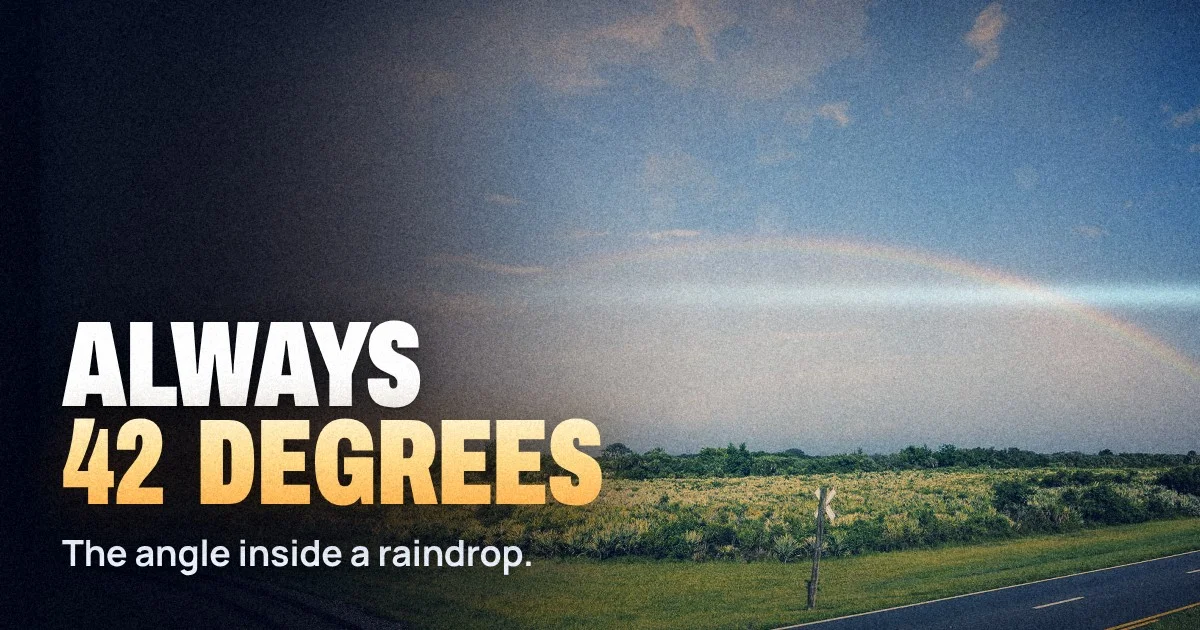
Stand with your back to a low Sun and a rain shower ahead, and hold your arm straight out. A fist at arm's length covers about 10°. From the shadow of your head, the point directly opposite the Sun, count a little over four fists up and you will hit the red edge of the rainbow. Count five more and, if you are lucky, the secondary bow. Every observer, every shower, every century: 42° and 51°. Drop size does not change it, distance to the rain does not change it, and nor does how hard it is raining.
Most pages that come up for this question tell you the angle is "determined by refraction and reflection" and move on. That is true and explains nothing, because refraction and reflection send light out of a drop at every angle from 0° to 42°. The real reason is a turning point: a maximum in the exit angle, where a large bundle of rays all leave in nearly the same direction. René Descartes found it in 1637 by tracing rays by hand. We can do it in a few lines.
What happens to light inside a raindrop?
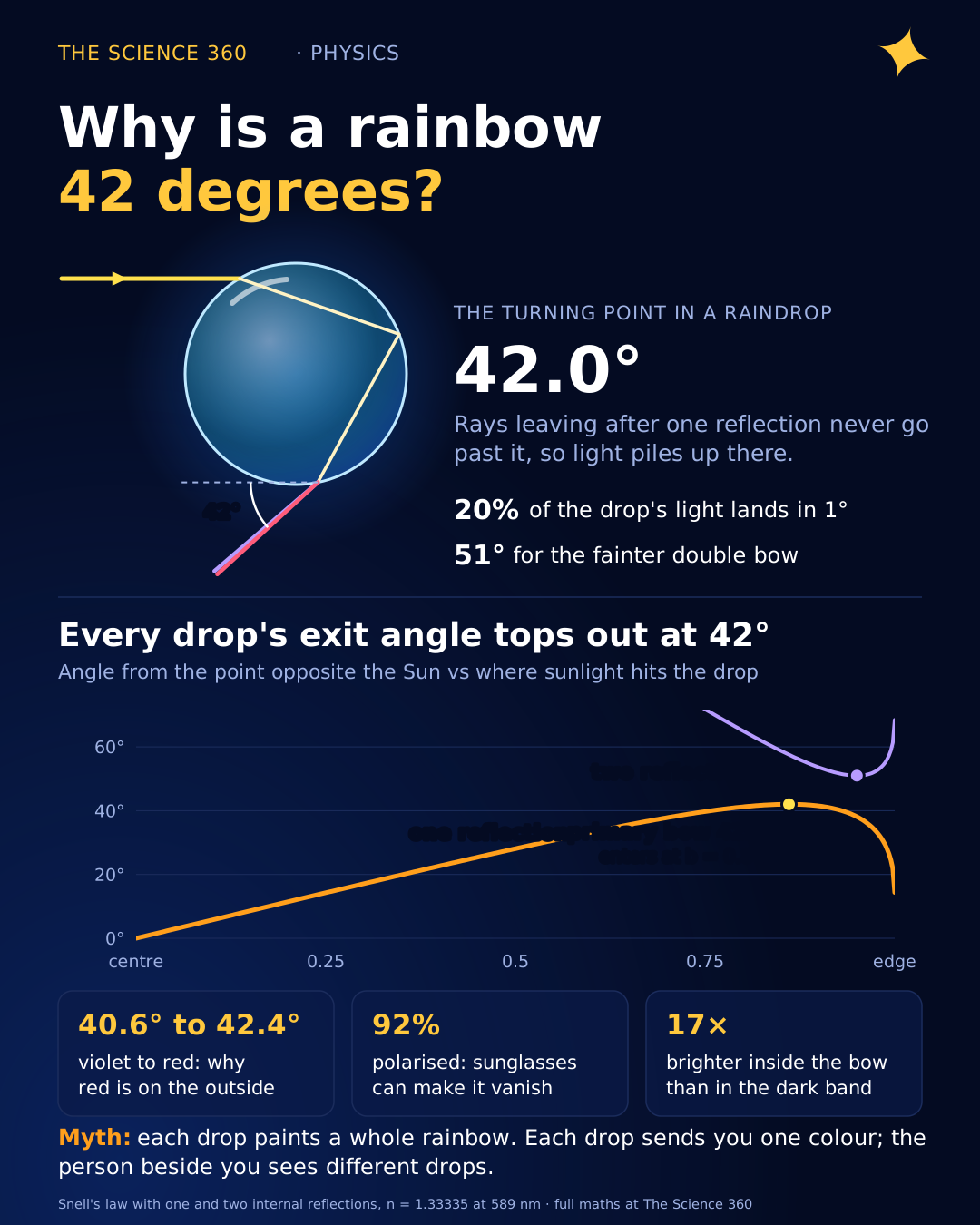
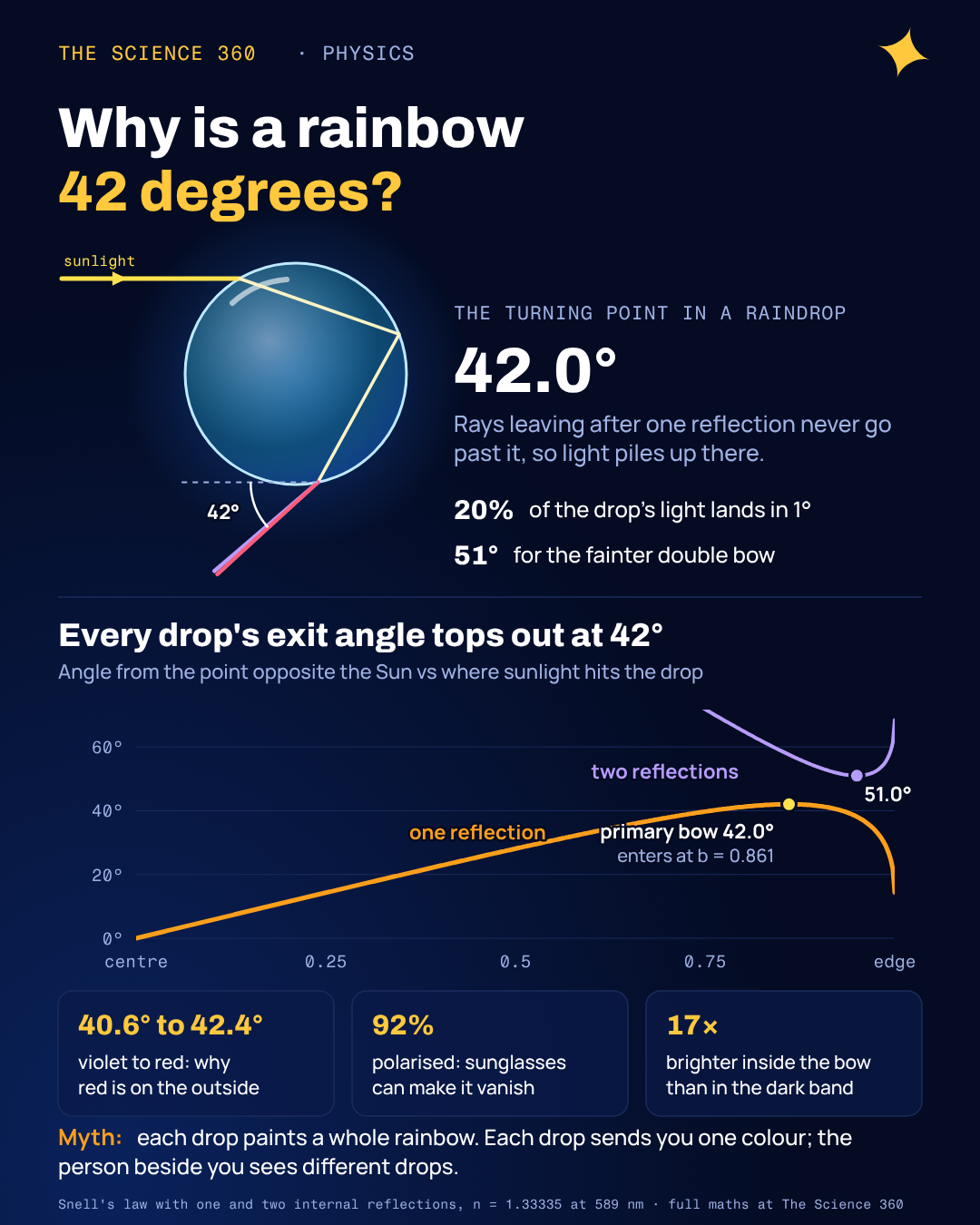
A falling raindrop smaller than about 1 mm across is very nearly a sphere, and somewhat bigger drops are close enough. Parallel rays of sunlight hit it all over its face. Label each ray by its impact parameter : 0 for a ray aimed at the centre, 1 for one that just grazes the edge. Each ray refracts as it enters (Snell's law, , where is the angle of incidence and the angle inside the water), crosses the drop, reflects off the back surface, crosses again and refracts out.
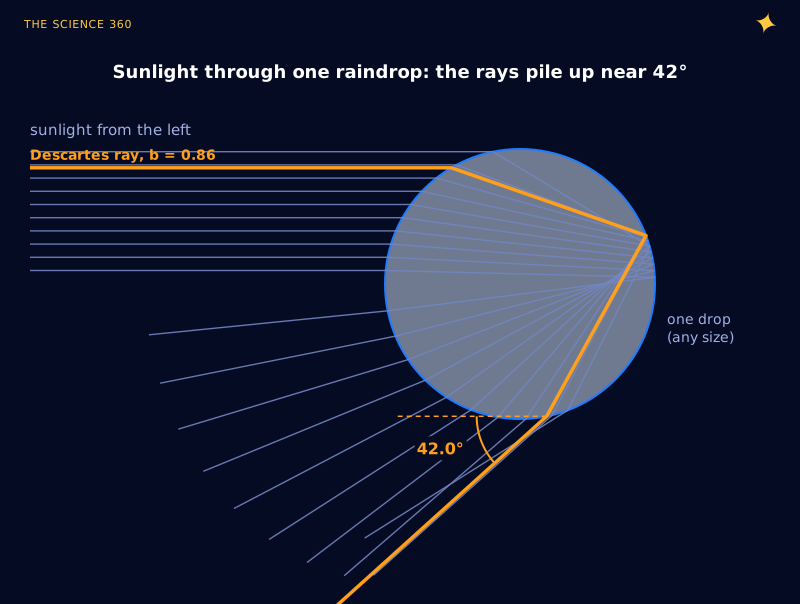
Add up the turning. Entering, the ray is deflected by (i − r). The internal reflection turns it by (180° − 2r). Leaving, it turns another (i − r). The total deviation from its original direction is:
Angle from the antisolar point:
For a ray through the centre, and : it comes straight back toward the Sun. As grows, grows, but not forever. Refraction bends steeply-hitting rays more, and eventually the term wins and falls again. In between is a maximum.
Where does the 42 come from? The worked calculation
Set . From Snell's law, , so , which is zero when . Squaring and using gives a clean result:
Condition for the turning point (one internal reflection)
Numbers for yellow light, 589 nm, water at 20 °C
(Daimon and Masumura, 2007), so .
The ray that does this enters at , about 86% of the way from the centre to the edge. That is the Descartes ray in Figure 1.
Now the reason it matters. Move the entry angle 5° either side of the Descartes ray and the exit angle changes by only about 0.55°. Move it 10° and the exit changes by about 2.2°. Compare that with rays near the centre of the drop, where every extra degree of entry angle moves the exit by about a degree.
How much light piles up near the maximum
Rays with exit angle between 41.03° and 42.03° enter between and . Share of the drop's cross-section in that ring:
Share that exits between 30° and 31°: 2.6%. Light per degree near the bow is about 8 times higher, before any other effect.
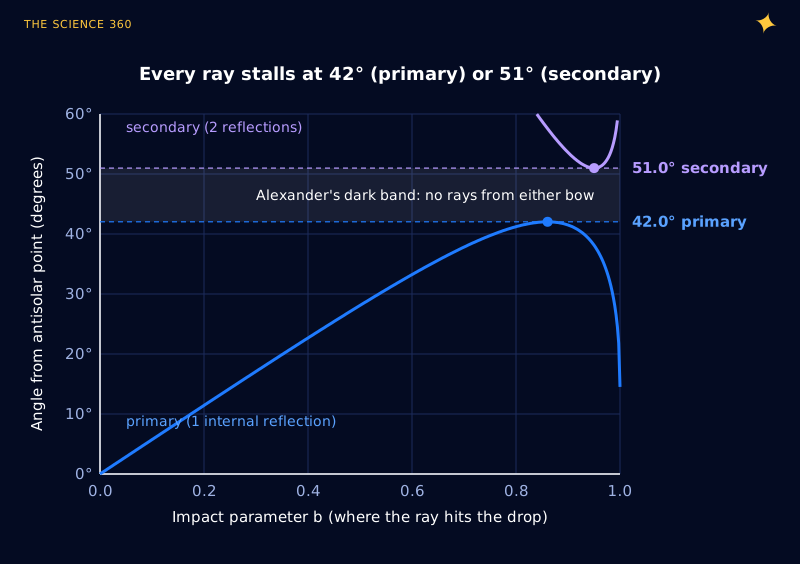
In optics this kind of pile-up is called a caustic, the same thing as the bright curve on the bottom of a coffee mug in sunlight. Geometrical optics actually predicts infinite brightness exactly at the maximum; the wave nature of light (and the Sun's 0.53° width) smooths it out. Descartes called the rainbow angle the angle of minimum deviation, because 42° from the antisolar point is the same as a minimum of 138° in total deviation. Both descriptions are the same turning point.
The misconception: “each drop makes a rainbow”
A popular picture shows a single drop splitting white light into a neat fan of colours, as if each drop were a tiny prism projecting a rainbow. That is not what you see. Each drop sends you exactly one colour, or none, depending on its position. The drops that look red to you are the ones sitting on a cone of half-angle about 42.3° around the line from the Sun through your head. The drops that look violet sit on a slightly narrower cone, about 40.6°. Your rainbow is assembled from millions of different drops, and the person next to you sees a rainbow made of different drops.
Two consequences follow. A rainbow is not at any particular distance: it is a direction, like the Sun. And you can never reach its end, because the cone moves with you. The circle shape comes from the symmetry of the cone: every point 42° from the antisolar point is equivalent, so the bow is a circle centred on the shadow of your head.
Why is red on the outside?
Water's refractive index rises toward the blue, so blue light bends more on entering and leaving. Put (405 nm) into the same formula and the maximum drops to 40.6°. Put (700 nm) and it rises to 42.4°.
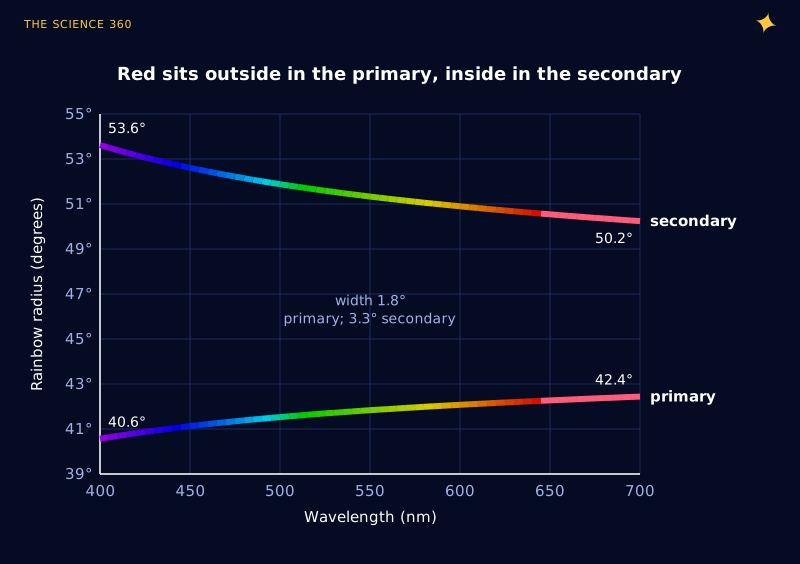
Since each colour's bow is a maximum, the sky just outside 42.4° gets no once-reflected light of any colour, and the sky just inside 40.6° gets some of every colour. So the outer edge is a sharp red, while the inner edge fades into a whitish glow. That brightening inside the bow is real and easy to see once you look for it: the sky inside a rainbow is noticeably lighter than outside.
Why is a double rainbow at 51 degrees, and why the dark band?
Rays that reflect twice inside the drop turn by another . The deviation becomes , and its turning point is now a minimum in angle from the antisolar point.
Secondary rainbow, two internal reflections, n = 1.33335
Angle from the antisolar point:
Because the secondary bow is a minimum, the light piles up on its inner edge and spreads outward, the opposite of the primary. Colours reverse, with red on the inside. Each internal reflection keeps only around 5% of the light at these angles, so the secondary is much fainter.
Between 42° and 51° neither family of rays arrives. That strip is Alexander's dark band, named after Alexander of Aphrodisias, who described it around 200 AD. It is not totally black, because light reflected off the outside of drops goes in every direction. Figure 3 shows how big the contrast is.
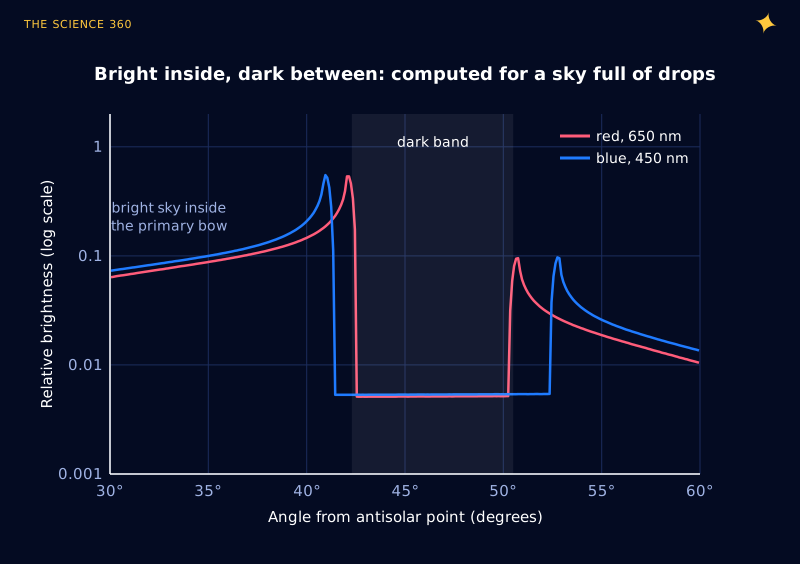
In the model, the sky between 30° and 38° is about 17 times brighter than the dark band, and the sky beyond the secondary bow is about twice as bright as the band. You can check the first part with your own eyes on the next good rainbow.
Why is rainbow light polarised?
Here is a detail almost nobody mentions. At the Descartes ray, the light hits the back of the drop at 40.2° from the normal. The internal Brewster angle for water, at which light polarised in the plane of incidence is not reflected at all, is . The rainbow ray reflects close to that angle, so most of the light polarised in that plane leaks out of the back of the drop and only the other polarisation is reflected toward you.
Fresnel calculation for the Descartes ray
Fraction surviving two refractions and one reflection: 8.8% (s-polarised) versus 0.34% (p-polarised).
Degree of polarisation:
That polarisation is tangential to the bow. Secondary bow (two reflections): 81%.
Published values are a little higher, around 96% for the primary and 90% for the secondary, because the full calculation averages over the whole caustic and includes wave effects. Either way, a polarising filter or polarised sunglasses rotated the right way will make a rainbow almost vanish. Try it.
Why can’t you see a rainbow when the Sun is high?
The centre of the rainbow circle is the antisolar point, which is below the horizon by exactly the Sun's elevation. The top of the primary bow is therefore 42° minus the Sun's elevation above the horizon. With the Sun at 42°, the top of the bow touches the horizon. Above that, on flat ground, there is no primary rainbow at all.
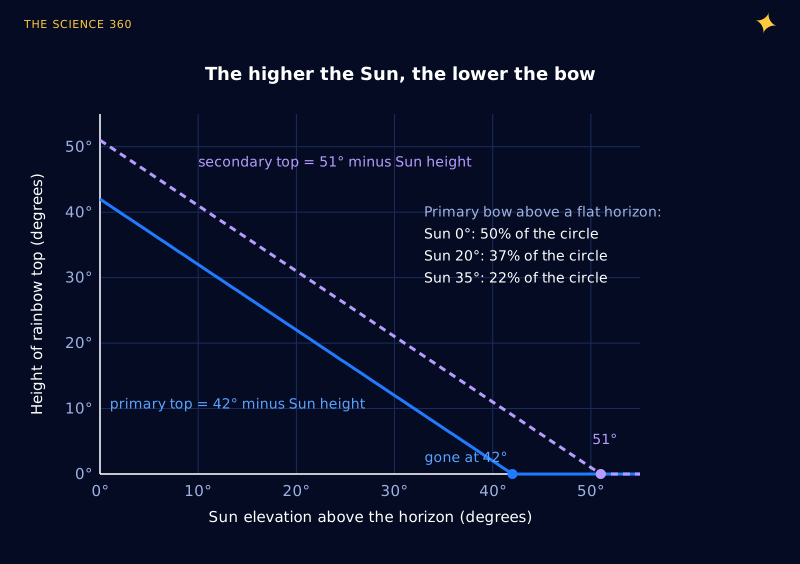
In summer at mid-latitudes the Sun is above 42° for several hours around noon, so there is a rainbow-free window in the middle of the day. In winter at higher latitudes the Sun may never get that high, and a rainbow is possible at any hour. From a plane or a mountain top, where you can look down below the horizon, you can see much more of the circle, and occasionally all of it.
Does drop size change the rainbow angle?
The 42° does not depend on drop size at all, because the geometry above scales: a big sphere and a small sphere bend rays identically. What drop size changes is how much the wave nature of light blurs the result. With drops around 1 mm or smaller, faint extra pastel bands called supernumerary bows appear just inside the primary, which is interference between pairs of rays leaving at the same angle from either side of the Descartes ray. Thomas Young used them to argue for the wave theory of light, and George Airy worked out their theory in 1838. With the tiny droplets in fog, diffraction smears the colours together so thoroughly that you get a broad, nearly white fogbow, still centred near 42°.
FAQ
Why is a rainbow always 42 degrees?
Light that enters a spherical raindrop, reflects once inside and comes back out leaves at an angle that depends on where it hit the drop. That angle has a maximum of about 42 degrees from the antisolar point for water's refractive index of 1.333. Near the maximum, a wide range of rays leave at almost the same angle, so light piles up there and forms a bright ring.
Why is the secondary rainbow at 51 degrees?
The secondary bow is made by rays that reflect twice inside the drop. Their exit angle has a minimum of about 51 degrees from the antisolar point, so light piles up there instead. The second reflection loses more light, which is why the secondary bow is fainter, and it reverses the order of colours, putting red on the inside.
Why is the sky darker between a double rainbow?
Once-reflected light can only reach angles up to 42 degrees and twice-reflected light only down to 51 degrees, so no light from either path reaches the band between them. Only weak reflection from drop surfaces lights it. That darker strip is called Alexander's dark band.
Why can’t you see a rainbow at midday?
The rainbow is a circle 42 degrees around the point directly opposite the Sun, which is below the horizon by the Sun's elevation. When the Sun is higher than about 42 degrees, the whole primary bow is below the horizon. From an aircraft or a high cliff you can still see it, sometimes as a full circle.
Is the rainbow angle exactly 42 degrees?
No. It depends on wavelength because water's refractive index does. Using measured data for water at 20 °C, the primary rainbow is at 42.4 degrees for 700 nm red and 40.6 degrees for 400 nm violet. The Sun's half-degree disk and diffraction by the drops blur it further.
Related on The Science 360
Sources
- M. Daimon and A. Masumura, "Measurement of the refractive index of distilled water from the near-infrared region to the ultraviolet region", Applied Optics 46, 3811 (2007), via the refractiveindex.info database (20.0 °C dispersion formula): refractiveindex.info
- Wikipedia, "Rainbow" (Alexander's band, Theodoric of Freiberg 1307, Descartes 1637, supernumeraries with drops about 1 mm or less, polarisation 96% primary and 90% secondary): en.wikipedia.org/wiki/Rainbow
- Scientific American, "Why are rainbows curved?": scientificamerican.com
- HyperPhysics (Georgia State University), "Rainbow" and "Brewster's angle": hyperphysics.phy-astr.gsu.edu
- Atmospheric Optics (Les Cowley), primary and secondary rainbows, Alexander's band: atoptics.co.uk
Method note: all angles and curves are computed by exact ray tracing through a sphere with the Daimon and Masumura dispersion of water at 20 °C and Fresnel coefficients for unpolarised light. Brightness curves ignore diffraction and drop-size distributions, so they show the geometry, not the fine structure of a real bow.
Header image: NASA/Ben Smegelsky (image KSC-20220612-PH-JBS01_0008), regraded for this article.