Moon Illusion Explained: Why the Horizon Moon Looks Big
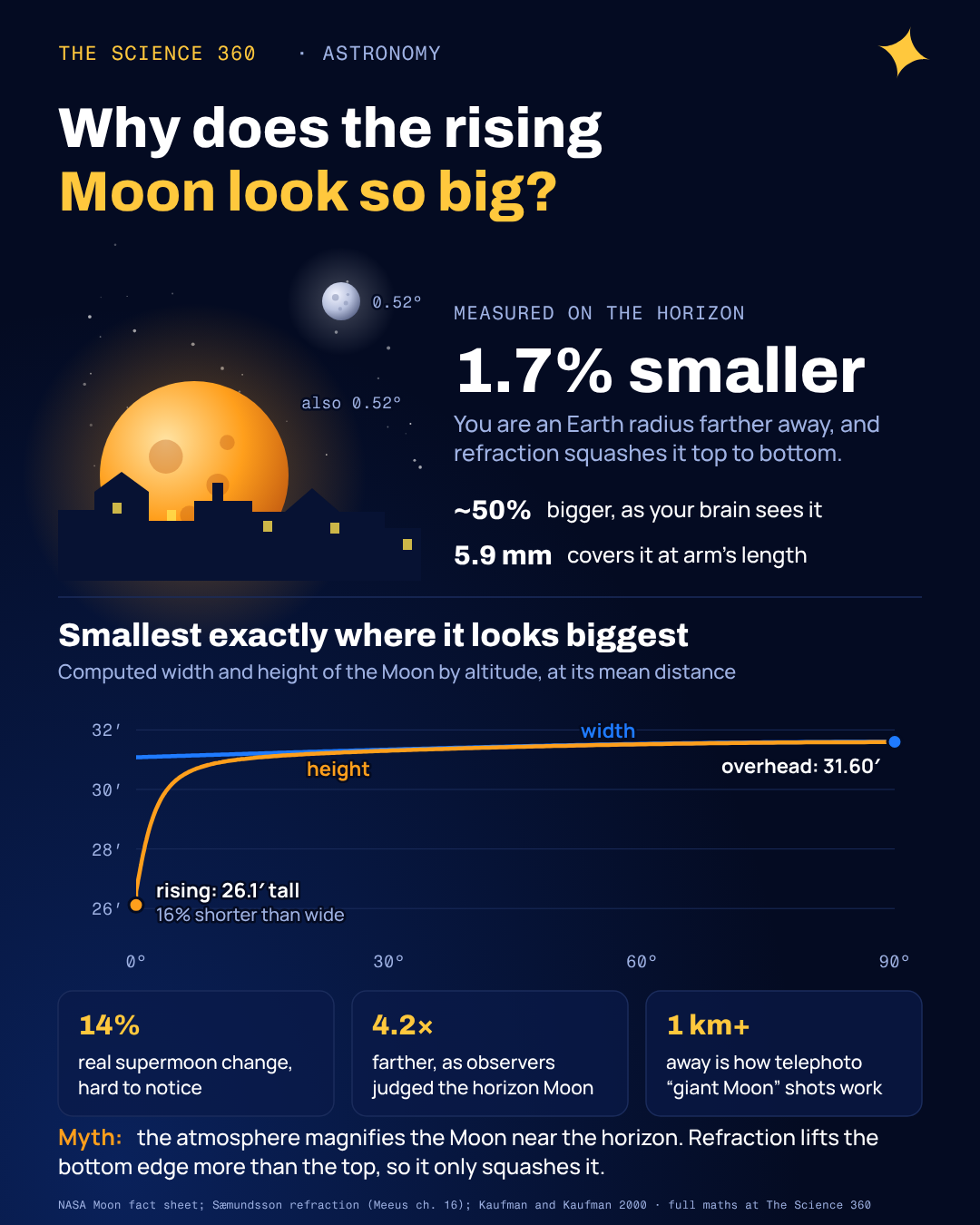
Hold a hole-punch dot at arm's length and it will exactly cover the full Moon. It covers it when the Moon is a huge orange disk sitting on the rooftops, and it covers it three hours later when the Moon is a small white coin high in the sky. Nothing out there changed size. You did.
The Moon illusion is one of the oldest unsolved puzzles in science. Ptolemy tried to explain it twice, around 150 AD, and psychologists are still publishing papers on it. Most explanations online jump straight to "it's the Ponzo illusion" or "the atmosphere magnifies it." The second is simply wrong, and the first is at best part of the story.
Physics can settle half of this question cleanly: what size the Moon actually is at the horizon. I've done that calculation below, and the answer runs the opposite way from what your eyes report. The other half, why the brain inflates it, is psychology, and there I'll give you the competing theories and be honest that the jury is still out.
Is the Moon actually bigger on the horizon?
No, it's slightly smaller. The reason is simple geometry, and once you see it, it's obvious.
When the Moon is straight overhead, you're standing on the part of Earth that faces it, so you're one Earth radius (6,378 km) closer to it than Earth's center is. When the Moon is on your horizon, your line of sight to it is at right angles to the line from Earth's center to you. You're no closer to the Moon than the center of the Earth is, to within a few dozen kilometers.
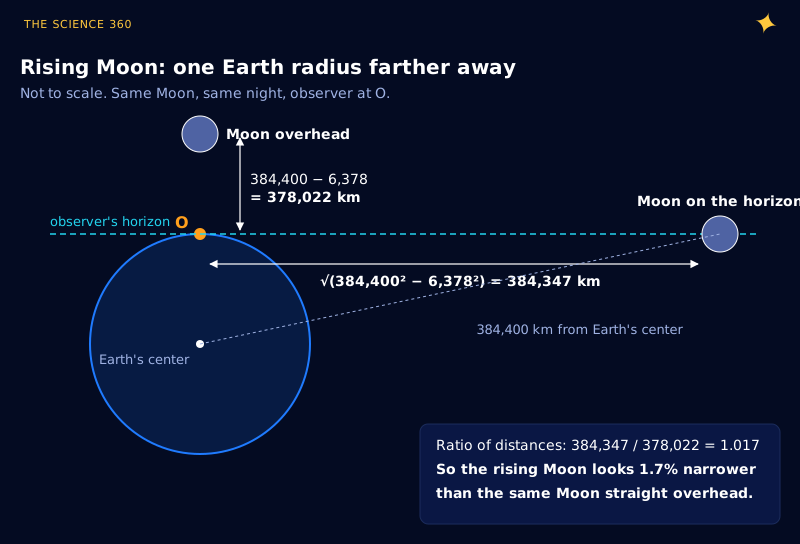
Worked calculation 1: horizon Moon versus overhead Moon
Mean Earth-Moon distance (center to center) ; Earth's equatorial radius ; Moon's radius .
Overhead:
On the horizon:
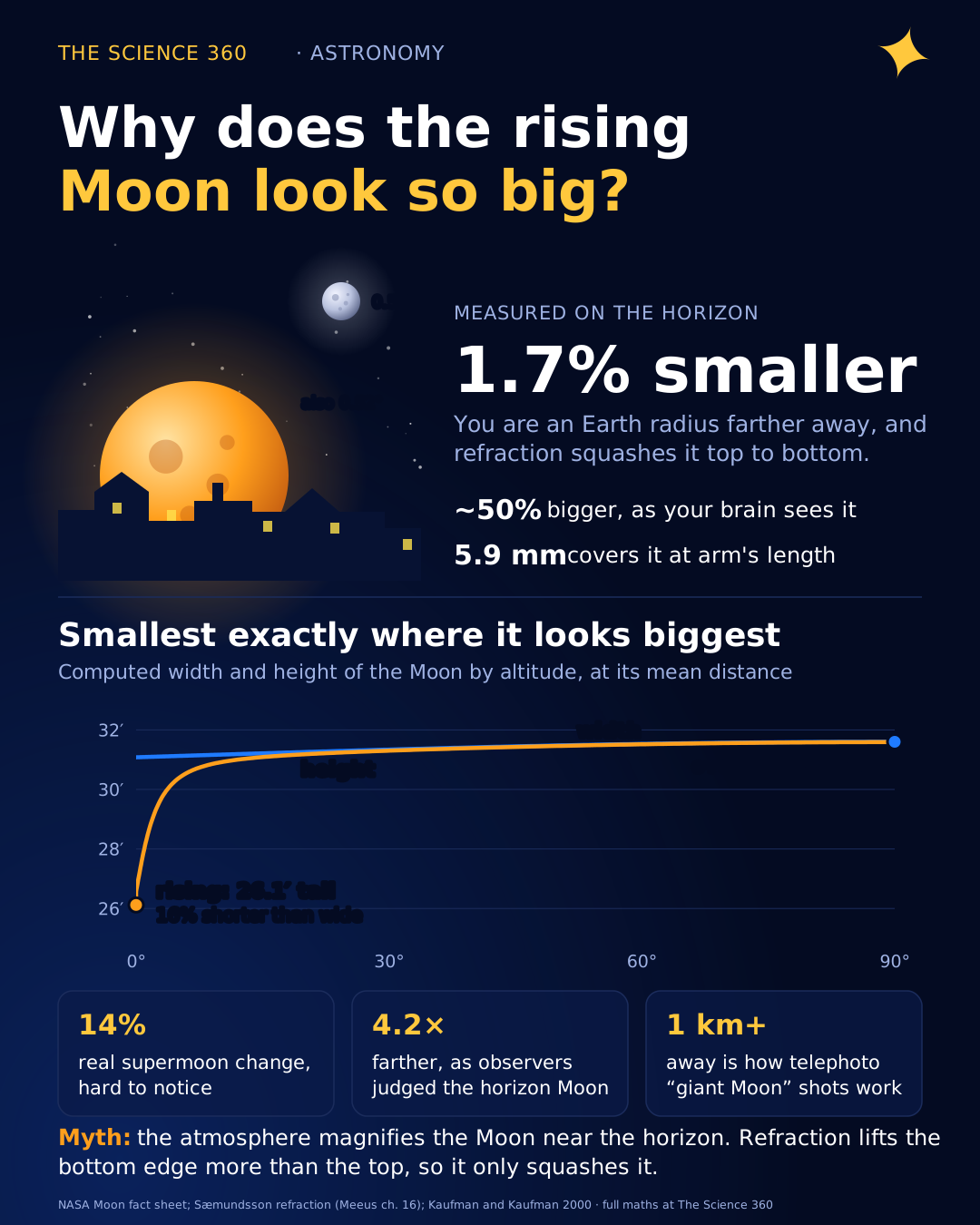
The horizon Moon is 1.7% narrower.
In practice the Moon only passes overhead from the tropics, so most people compare a rising Moon with one at 40° to 60° up. At 60° altitude the difference is still about 1.5%, which is the figure you'll often see quoted. Small, but real, and in the wrong direction for the illusion.
Does the atmosphere magnify the Moon?
This is the most common wrong answer, and it's an old one: Ptolemy offered a version of it in the Almagest. The atmosphere does bend moonlight near the horizon. That bending, called refraction, makes everything near the horizon appear higher than it really is. When you see the Moon's lower edge just touching the horizon, it's geometrically already below it.
But refraction doesn't magnify anything. It gets weaker quickly as you look higher, so the Moon's lower edge is lifted more than its upper edge. The result is a squashed, slightly oval Moon. Its width is untouched; its height shrinks.
Worked calculation 2: how much refraction squashes the rising Moon
Sæmundsson's formula for refraction in arcminutes, with the true altitude in degrees (standard air at 10 °C, 1010 mbar):
Moon just risen: true altitude of center −0.315°, semi-diameter 0.259°.
Lower edge, true altitude −0.574°:
Upper edge, true altitude −0.056°:
True height 31.08′, minus the 4.96′ extra lift of the bottom edge:
So the rising Moon is 16% shorter than it is wide.
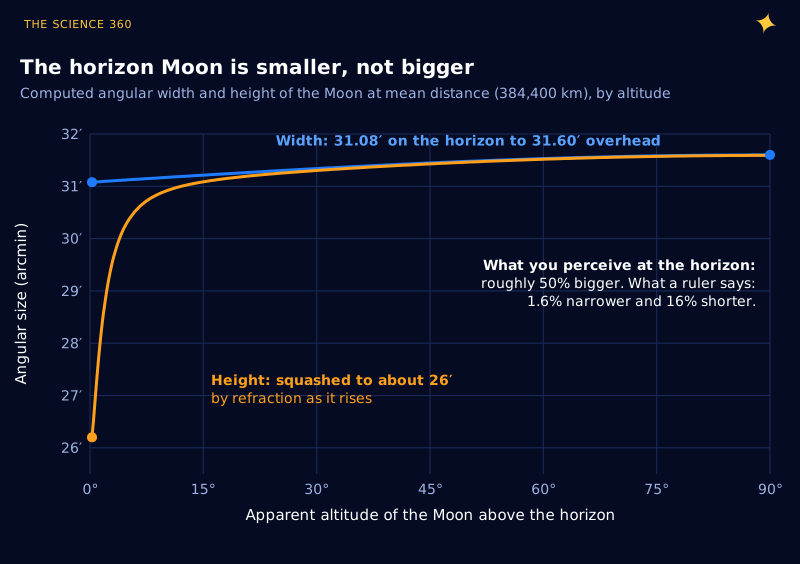
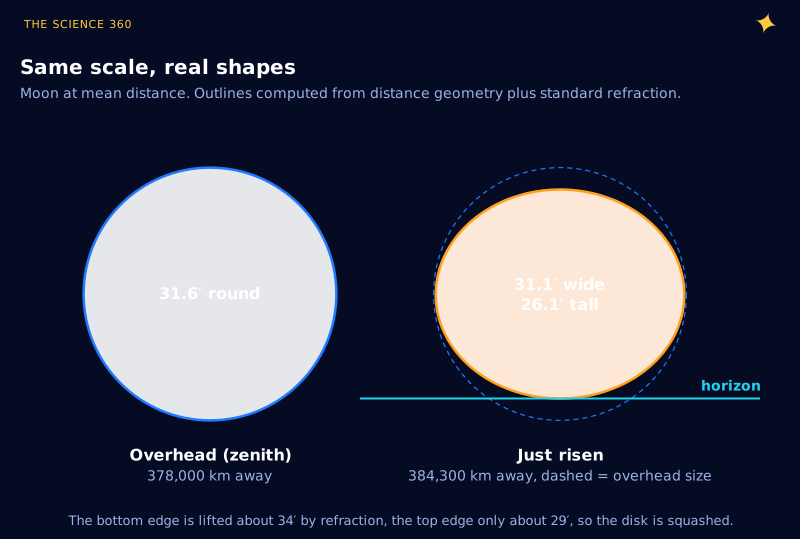
So physics has the clean answer for the measurable part. Every optical effect that touches the Moon near the horizon makes it smaller. Whatever makes it look huge is not out in the sky.
What about telephoto photos of giant moons?
Those viral photos of an enormous Moon behind a lighthouse or a city skyline are real, but they're not showing the illusion. They show telephoto compression. The photographer stands a kilometer or more from the building with a long lens. The building shrinks in the frame because it's far away. The Moon doesn't, because it's always effectively infinitely far.
Worked calculation 3: the Moon in a 600 mm photo
Moon's angular size .
A full-frame sensor is 36 mm wide, so the Moon fills 5.4 / 36 = 15% of the frame width. A 30 m lighthouse shot from 3 km away subtends , about the same 6 mm on the sensor.
The lighthouse and the Moon look the same size because, from there, they are.
The same lens would make the Moon exactly as big at midnight. The giant-Moon shot is a choice of distance, not evidence of a bigger Moon.
Why does the Moon look bigger on the horizon, then?
It's your brain. That's settled. What's not settled is exactly which part of the brain's size calculation goes wrong. In their 2002 book The Mystery of the Moon Illusion, psychologists Helen Ross and Cornelis Plug reviewed the whole history and concluded that "no single theory has emerged victorious." They estimate the typical illusion as an apparent increase in diameter of about 50%, and it varies a lot between people and nights.
Here are the main contenders, roughly in order of how much support they have.
1. Apparent distance: the flattened sky
Your brain doesn't see the sky as a sphere. It sees a shallow, flattened bowl: clouds overhead might be a few kilometers away, while clouds near the horizon can be a hundred kilometers off, and we learn that the horizon is "far." Robert Smith drew this flattened vault in his Compleat System of Opticks in 1738, and versions of the idea go back to Cleomedes around 200 AD and to Ibn al-Haytham in the eleventh century.
Now apply what's called Emmert's law: for a fixed angular size, perceived size scales with perceived distance. The Moon is 0.52° wide in both places. If your brain places it on a far-off horizon, that angle must belong to a large object. If it places it on a nearby overhead dome, the same angle must be a small object.
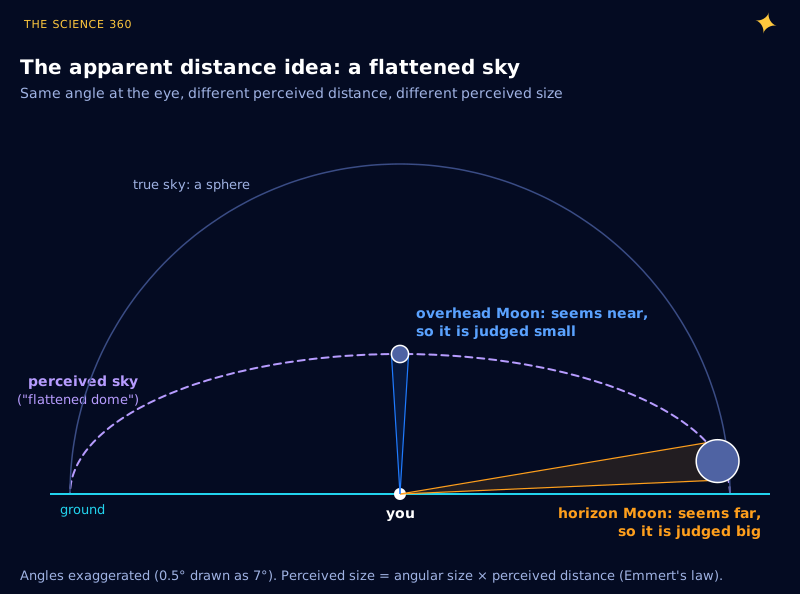
Lloyd Kaufman and Irvin Rock tested this in the late 1950s and early 1960s with artificial moons projected onto the real sky. Moons seen over terrain looked bigger than the same moons seen through empty sky, and hiding the terrain made the horizon moon shrink. In 2000, Lloyd Kaufman and his son James published a stereoscopic follow-up in PNAS. Asked to set a comparison moon so that it bisected the distance to a reference moon, their five observers placed it about 4.2 times farther when the reference sat near the horizon than when it sat at 45°. On average their visual systems really did treat the horizon Moon as farther away.
The size-distance paradox
Here's the catch that keeps the debate alive. Ask people directly which Moon looks closer, and most say the horizon Moon. That's backwards from the theory. If the brain thinks the horizon Moon is farther away, why does it feel nearer?
The Kaufmans' answer is that there are two different distance judgments. One is unconscious and sets perceived size. The other is a conscious, after-the-fact inference: "that looks big, so it must be close." Critics, including those who favor oculomotor explanations (where the eye's focusing and convergence muscles feed size signals), argue the paradox shows the size change comes first. Neither side has knocked the other out.
2. The Ponzo illusion and terrain cues
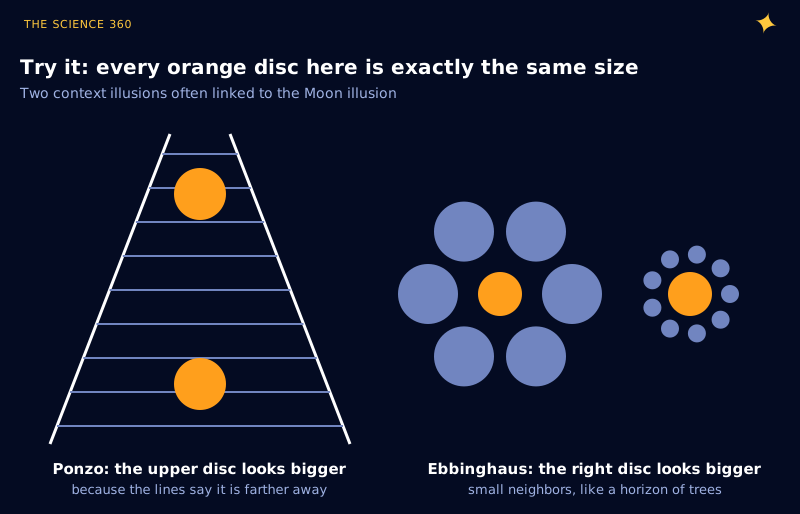
The Ponzo illusion is a close cousin of the apparent distance theory. Two identical objects between converging lines look different in size, because the converging lines read as perspective, and the object "farther down the road" gets scaled up. Real scenery is full of such cues: roads, fields, rows of houses shrinking toward the horizon.
3. Relative size: the Ebbinghaus effect
Frank Restle proposed in 1970 that we judge the Moon against its surroundings. On the horizon it sits next to distant trees and buildings that subtend tiny angles, so it looks large by comparison. Overhead, it's surrounded by a vast empty sky and looks small. That's the Ebbinghaus illusion at the scale of a whole view.
4. Angle of regard
In 1940 Holway and Boring argued that the illusion depends on the angle of your eyes in your head: looking up shrinks things. It's true that tilting your head changes the effect a little, but when the terrain is hidden the illusion largely disappears even with your eyes level, so this theory has lost most of its support.
My own read: terrain-driven distance cues do most of the work, which fits the lab results and the tube test below. But a theory that can't cleanly explain why the big Moon also feels closer isn't finished, and I wouldn't trust any source that tells you the case is closed.
Is the Moon illusion the same as a supermoon?
No, and mixing them up is the other common error. A supermoon is a real, measurable change. The Moon's distance swings between perigee and apogee, so its angular diameter ranges from about 29.4′ to 33.5′, a 14% difference. That's a real effect, but surprisingly hard to notice without a side-by-side photo, because there's no fixed reference in the sky. The Moon illusion is the reverse: no change at all, yet a perceived change of around 50%. Your brain shrugs off a real 14% and invents a fake 50%.
Experiments you can do tonight
You don't have to take my word for any of this. Each of these takes a few minutes and costs nothing.
The hole-punch test. The Moon is about 0.52° wide. At arm's length, roughly 650 mm, that's . A paper hole-punch dot (about 6 mm) or a pencil eraser held at arm's length just covers it, whether it's rising or high. Keep the same arm extension each time.
The phone photo test. Photograph the Moon at moonrise and again three hours later, at the same zoom setting and without moving the zoom. Measure the Moon's width in pixels. The later one should be about 1% wider, and the moonrise shot should be visibly shorter than it is wide.
The tube test. Roll a sheet of paper into a tube, or curl your fist, and look at the rising Moon through it so the trees and buildings are hidden. Most people find the Moon shrinks as soon as the terrain disappears.
The upside-down test. Turn your back to the Moon, bend over and look at it between your legs. The illusion is noticeably weaker for most people, possibly because the inverted scene disrupts the brain's reading of the terrain.
The afterimage test for Emmert's law. Stare at a bright lamp for a few seconds, then look at a nearby wall and then a distant one. The afterimage covers the same patch of your retina every time, yet it looks bigger on the distant wall. That's the same scaling rule the apparent distance theory says your brain applies to the Moon.
FAQ
Why does the Moon look bigger on the horizon?
It's an illusion created by the brain. The leading explanation is that the brain judges the horizon sky to be farther away and scales up an object of the same angular size, helped by terrain cues. No theory is fully settled.
Is the Moon actually bigger when it rises?
No. You're about 6,300 km farther from it than when it's overhead, so it's about 1.7% narrower, and refraction makes it about 16% shorter.
Does the atmosphere magnify the Moon near the horizon?
No. Refraction lifts the bottom edge more than the top, which squashes the Moon into an oval. It never makes it wider.
Is the Moon illusion the same as a supermoon?
No. A supermoon is a real 14% increase in diameter at perigee. The Moon illusion is a perceived increase of around 50% with no real change.
How can I prove the Moon illusion is an illusion?
Cover the Moon with a 6 mm object at arm's length when it rises and again when it's high, or compare two photos taken at the same zoom.
Related on The Science 360
Sources
- Kaufman, L. and Kaufman, J. H. (2000), Explaining the moon illusion, PNAS 97(1), 500 to 505: pmc.ncbi.nlm.nih.gov/articles/PMC26692
- Ross, H. and Plug, C. (2002), The Mystery of the Moon Illusion: Exploring Size Perception, Oxford University Press: academic.oup.com/book/11843
- Wikipedia, Moon illusion (history of explanations, Restle 1970, angle of regard, 1.5% distance, inverted-viewing test, 29.43′ to 33.5′ range): en.wikipedia.org/wiki/Moon_illusion
- Scientific American, Why does the Moon look bigger near the horizon?: scientificamerican.com/article/why-does-the-moon-look-bigger-near-the-horizon/
- Meeus, J., Astronomical Algorithms, 2nd ed. (1998), chapter 16, Sæmundsson's refraction formula, used for Worked calculation 2 and Figures 2 and 3. Background on the formula: en.wikipedia.org/wiki/Atmospheric_refraction
- NASA Moon Fact Sheet (mean distance 384,400 km, radius 1,737.4 km): nssdc.gsfc.nasa.gov (Moon fact sheet)
Header image: NASA/Bill Ingalls (image NHQ201907160022), regraded for this article.