How Far Is the Horizon? Formula, Refraction, Examples
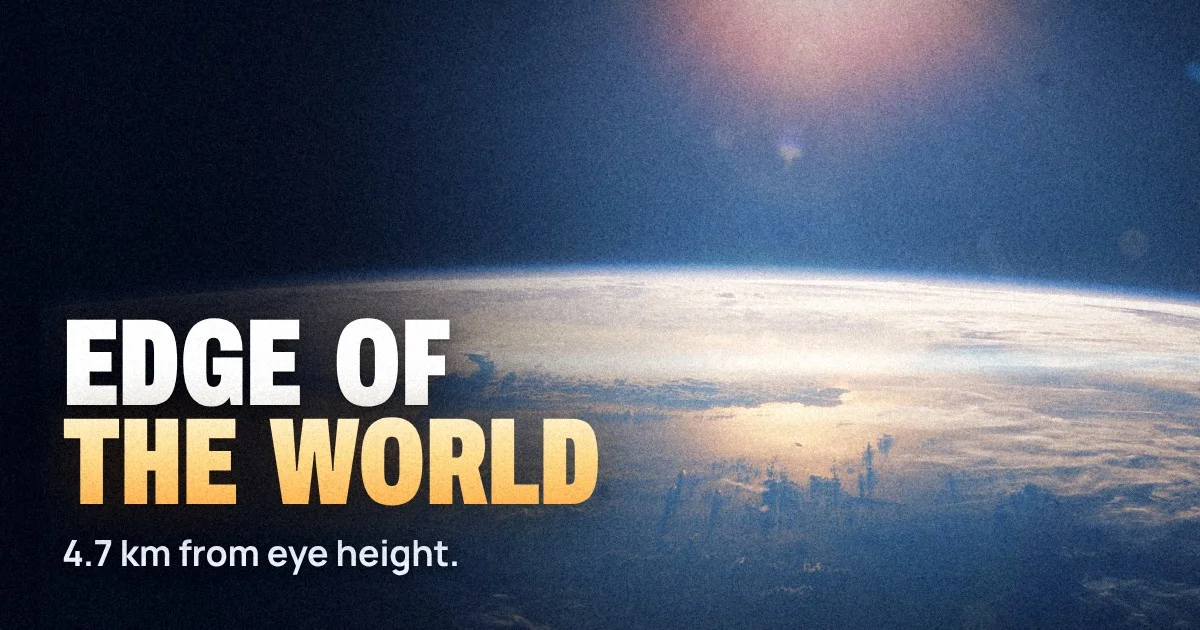
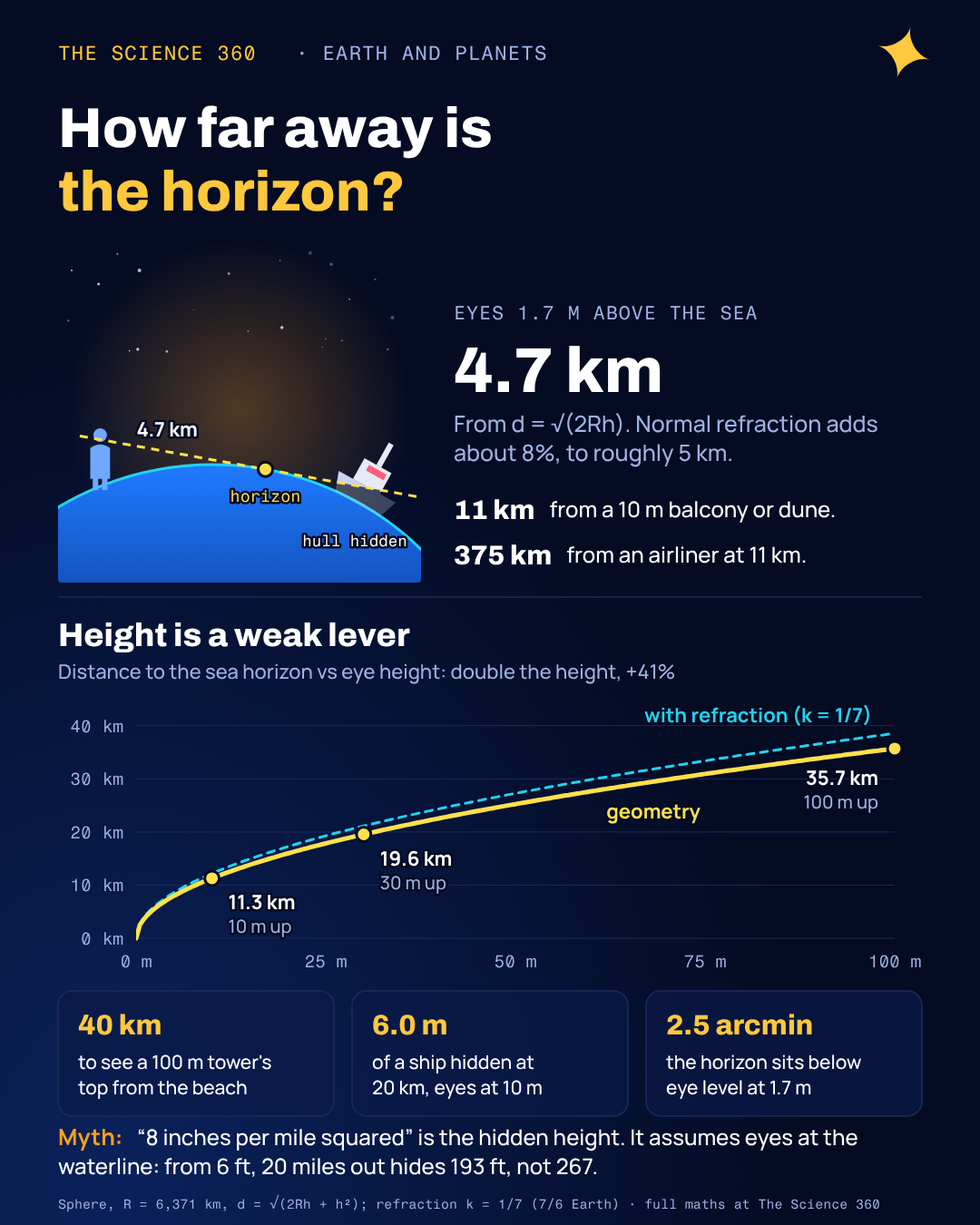
Stand at the water's edge and look out to sea. With your eyes about 1.7 m above the water, the line where sea meets sky is 4.7 km away: a little under three miles, a brisk 50-minute walk if you could walk on water. Every ship you see beyond that line is partly sunk below it, and climbing to a viewpoint just 10 m up, a tall dune or a third-floor balcony, moves the horizon out to 11 km.
The top results for "how far is the horizon" give the rule and a few examples, and that is a good start. What they mostly skip is everything that makes the number messy in real life: refraction pushes the horizon out by about 7 to 10% and can, on odd days, push it out a lot more; seeing a distant tall object depends on two horizons, not one; and the popular "8 inches per mile squared" curvature rule answers a different question from the one people use it for. Here are the numbers for all of it.
The horizon distance formula, derived in three lines
Draw a line from your eye that just grazes the sea: that grazing point is the horizon. The line meets the radius of the Earth at a right angle, so you, the horizon and the centre of the Earth form a right triangle. Its sides are R (centre to horizon), d (you to horizon) and R + h (centre to you).
Pythagoras on a sphere
Since is tiny compared with :
Numbers for a standing adult, h = 1.7 m
The handy versions
So (km, in metres). In miles and feet: . In nautical miles and feet: , usually rounded to .
Because distance grows with the square root of height, height is a weak lever. Double your height and the horizon moves out only 41%. To see three times further you have to climb about ten times higher. Figure 1 shows the whole range, from a beach to the top of Everest.
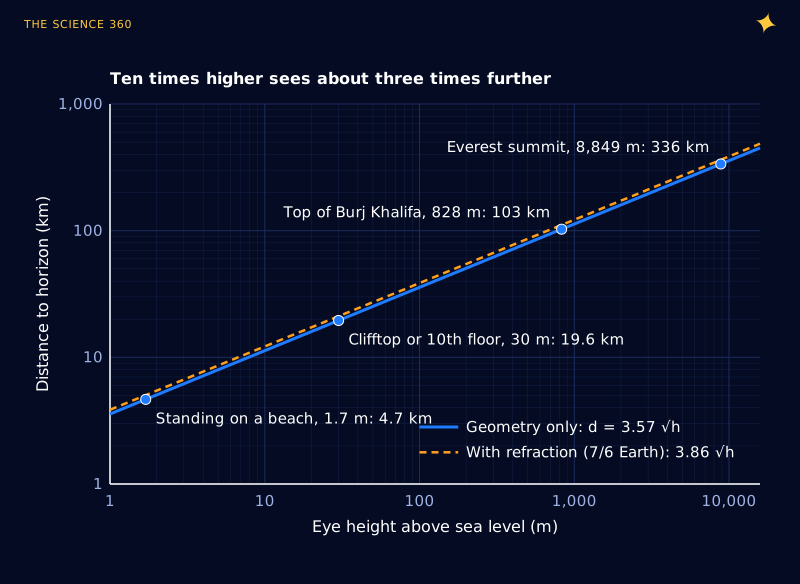
A few useful values, all geometric (refraction comes next): 2 m sees 5.0 km, 10 m sees 11.3 km, 30 m sees 19.6 km, 100 m sees 35.7 km, and an airliner at 11 km sees 375 km. The term we dropped only matters when the height is a decent fraction of Earth's radius: from the International Space Station at about 400 km, the exact formula gives a horizon 2,290 km away.
Does refraction make the horizon farther?
Yes. Air gets thinner with height, so its refractive index falls, and a nearly horizontal light ray bends slightly downward, following the curve of the Earth a little. You see over the edge. Surveyors capture this with the refraction coefficient k, the ratio of Earth's radius to the radius of curvature of the light ray. The effect is the same as living on a bigger planet with radius R / (1 − k).
Horizon with refraction
0.13 is a common surveying value; is the "7/6 Earth" rule, ; 0.17 is the US Standard Atmosphere (see below). At , 4.65 km becomes 4.99 to 5.11 km.
You will see " gives the 7/6 rule" in places, and it is a near miss: 7/6 corresponds to , which is also the value behind the standard leveller's correction of metres ( in km) for curvature and refraction combined. The difference between 3.83 and 3.86 is under 1%, much less than the day-to-day variation, so pick either.
Where does come from? It depends almost entirely on how fast temperature changes with height in the lowest layer of air. A standard formula, quoted in Wikipedia's article on atmospheric refraction, is , with in millibars, in kelvins and in kelvins per metre.
k for different weather near the ground (P = 1013 mbar, T = 288 K)
Standard atmosphere, :
Our own ray trace through the US Standard Atmosphere gives the same: . Air cooling at 3.43 °C per 100 m gives , no bending at all. For (light follows the Earth's curve exactly):
That is a 13 °C rise per 100 m.

Those strong inversions are not exotic. Warm air flowing over cold water, on a spring afternoon over a lake or the sea, can give k near or above 1. Then distant coastlines and ships "loom" into view that are normally hidden, and mirages like the Fata Morgana appear. The opposite case, a hot road or desert, gives a negative k near the surface: rays bend upward, the horizon comes closer, and you see the inferior mirage that looks like water. The same near-surface layers are what turn the textbook green rim on the setting Sun into a visible flash, which we worked through in what causes the green flash.
How far can you see a tall building, ship or mountain?
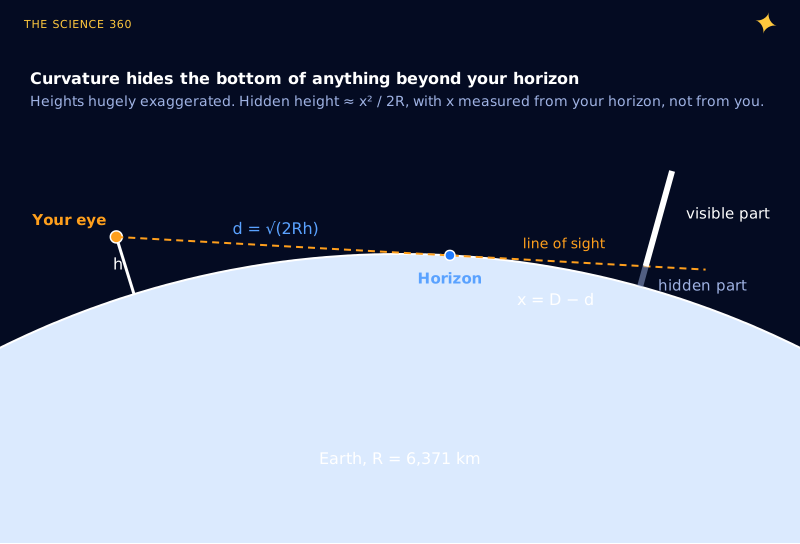
This is the question people usually mean. A distant object has its own horizon: the point from which its top would just be visible. If you stand at your horizon and it stands at its horizon, and the two points coincide, the line of sight just grazes the sea. So the maximum distance is the sum of the two horizon distances.
Seeing the top of a 100 m tower from the beach
A 3,000 m mountain from the same beach
That is about 216 km with typical refraction.
Notice how little your own height matters in that sum. The tall object does most of the work, which is why sailors spot a lighthouse or a mountain peak long before the coastline itself. It also means a tiny bit of refraction makes a big difference at long range: 8% of 200 km is 16 km.
If the object is closer than that limit, its top shows and its bottom is hidden. Figure 3 shows the geometry. The hidden part depends on how far the object is beyond your horizon, not on its distance from you.
Hidden height of a ship 20 km away, observer 10 m above the sea
With (use ): about 4.1 m.
The misconception: “8 inches per mile squared” is not the hidden height
The rule appears in countless arguments about whether the Earth is curved. It says the surface drops 8 inches times the distance in miles squared. The rule is real, and it comes straight from the same geometry.
Where 8 inches per mile squared comes from
Drop below a level line after distance is (for ), with miles:
The catch is the starting point. That level line starts at the surface: it is the drop seen by an eye lying on the ground. Raise your eyes even a couple of metres and you can see 3 miles further before the drop even starts. Use the rule as if it were the hidden height and you overstate it, often badly. People on both sides of the flat-Earth argument make this mistake, which is one reason those arguments go nowhere.
A target 20 miles away across a lake, observer's eyes 6 ft above the water
The "8 inches × miles²" rule says this much "should be hidden":
Your horizon: miles, so the target is 17.0 miles beyond it. True hidden height:
With standard refraction (): about 161 ft. The naive rule is off by 66% compared with what you would actually observe.
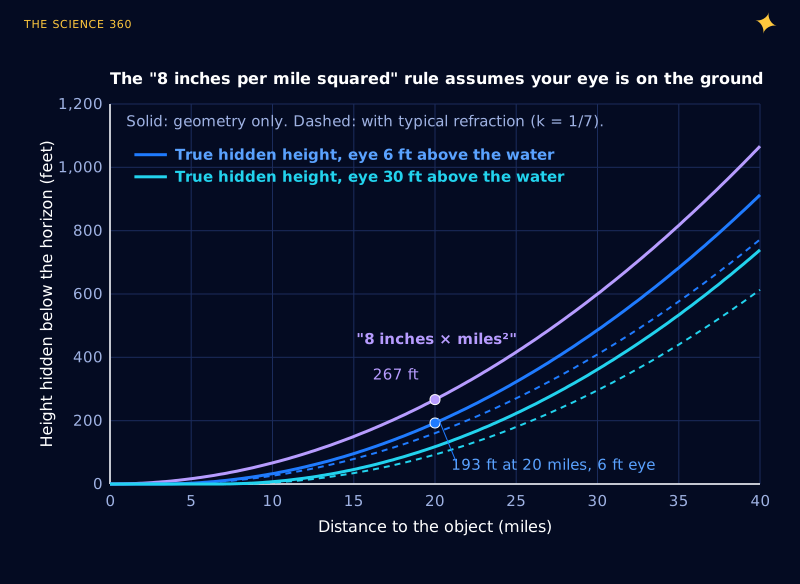
Two smaller caveats. The 8-inch rule is a parabola approximating a circle, so it slowly under-reads at very long range: at 1,000 miles it gives 126 miles of drop below the tangent line, against 130 miles for the exact geometry. And it measures drop vertically from a level line, which is not the same as the drop along your line of sight to the target. For anything you can see from a beach, these differences are negligible next to refraction.
Is the horizon at eye level?
Not quite. Because the line to the horizon slopes down to graze the curve, the horizon sits slightly below eye level, by an angle called the dip. For small heights the dip is radians.
Dip of the horizon
100 m: 19 arcminutes, about two thirds of the Moon's width. 1,000 m: 61 arcminutes, about 1°. 11,000 m (airliner): 3.4°.
At the beach, 2.5 arcminutes is a twelfth of the Sun's diameter, far too small to notice without an instrument. Navigators correct sextant sightings for it. From an aircraft window, 3.4° is enough that the horizon visibly sits below the wingtips.
What actually limits how far you can see?
Over open sea in clean air, geometry and refraction set the limit, as above. Over land, the horizon is usually terrain: hills, trees and buildings much closer than the geometric horizon. And on most days, haze limits what you can make out long before geometry does. Air molecules alone scatter enough light to wash out distant mountains into the sky colour, the same scattering that makes the sky blue, which we computed in why the sky is blue and not violet. Distant hills look bluer and paler for the same reason.
How far is the horizon on the Moon or Mars?
The formula works anywhere: just change R. Smaller worlds curve away faster.
Horizon at 1.7 m eye height
Earth (): 4.7 km
On the Moon there is no air, so no refraction and no haze, and the horizon is a perfectly sharp edge only 2.4 km away. The same roundness that makes the horizon possible is the subject of why planets are round.
FAQ
How far is the horizon at sea level?
For an adult standing at the water's edge with eyes about 1.7 m above the sea, the geometric horizon is 4.7 km (2.9 miles) away. Normal atmospheric refraction bends light slightly around the curve and pushes it out to about 5.0 km (3.1 miles).
What is the formula for distance to the horizon?
Distance , where is Earth's radius (6,371 km) and your eye height. In practice with in kilometres and in metres, or with in miles and in feet. Including typical refraction, use km or miles.
How far can you see from an airplane?
From a cruising height of 11 km (36,000 ft), the geometric horizon is about 375 km (233 miles) away, and roughly 400 km with refraction. Haze and cloud usually limit what you can actually make out to much less.
How far away can you see a tall building or mountain?
Add the two horizon distances. A 1.7 m observer's horizon is 4.7 km and a 100 m tower's is 35.7 km, so the tower top can just be seen from 40.4 km, or about 43.6 km with normal refraction. For a 3,000 m peak seen from a beach it is about 200 km before refraction.
Is the 8 inches per mile squared rule correct?
It correctly gives how far Earth's surface drops below a level line drawn from a point on the ground. It does not give how much of a distant object is hidden, because your eyes are above the ground. For a 6 ft observer, 20 miles away, the rule says 267 ft but the true hidden height is 193 ft, or about 160 ft with normal refraction.
Related on The Science 360
Sources
- Wikipedia, "Horizon" (geometric formula, 3.57 and 1.22 constants, 7/6 and 4/3 Earth models, examples, combined distances): en.wikipedia.org/wiki/Horizon
- Wikipedia, "Atmospheric refraction" (terrestrial refraction formula k = 503 P/T² (0.0343 + dT/dh)): en.wikipedia.org/wiki/Atmospheric_refraction
- NPTEL (Indian Institutes of Technology), surveying course, "Error due to Earth's curvature and refraction" (combined correction 0.0675 D² m): archive.nptel.ac.in
- Live Science, "How far away is the horizon?" (an example of the standard explanation): livescience.com
- US Standard Atmosphere 1976 temperature profile and the Ciddor (1996) refractive index of air, used for our own ray trace of k: refractiveindex.info
Method note: distances use a spherical Earth of mean radius 6,371 km. Refraction is modelled as a constant coefficient k (an effective Earth radius R / (1 − k)), which is good for typical conditions and poor for strong inversions, where rays curve unevenly and mirages form. Hidden heights use the exact tangent-line geometry, not the parabolic approximation.
Header image: NASA (image iss007e10807), regraded for this article.