Is There Gravity on the ISS? Yes: 89% of Earth's
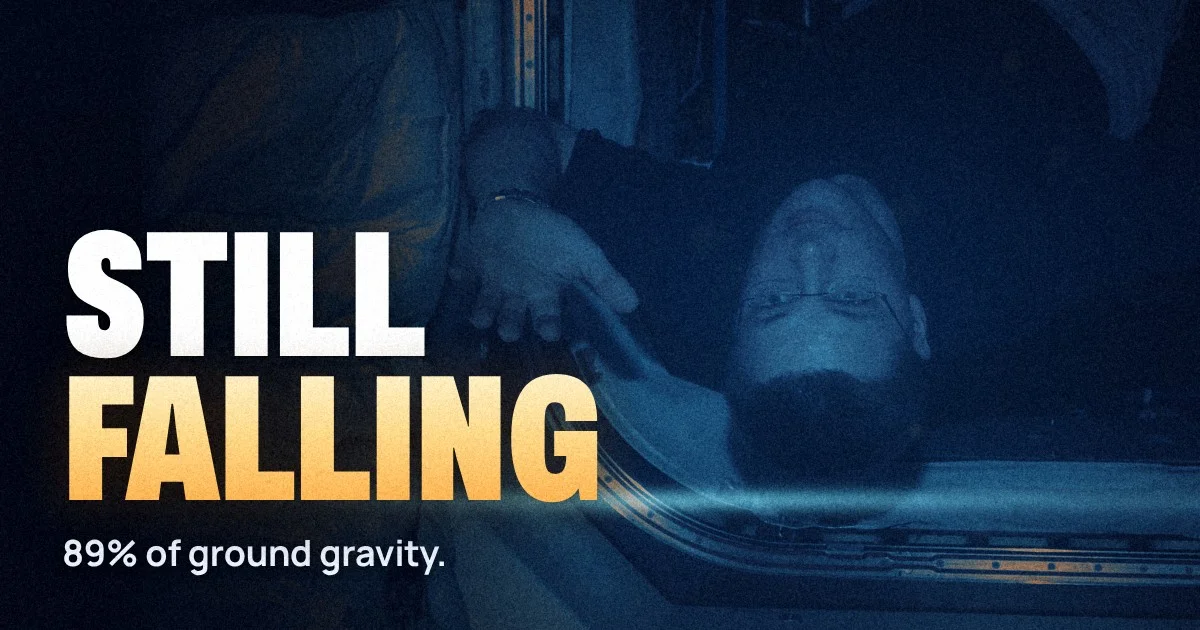
If you could build a tower 400 km tall and stand on top of it, next to the International Space Station's orbit, a bathroom scale would read about 89% of your weight at sea level. A 70 kg person would weigh as much as a 62 kg person does at home. You would not float, and if you stepped off, you would fall.
The astronauts gliding past you on the station are falling too. That is the whole trick, and it is why "zero gravity" is one of the most durable misnomers in science. Gravity at the ISS is strong. What is missing is anything to push back against it.
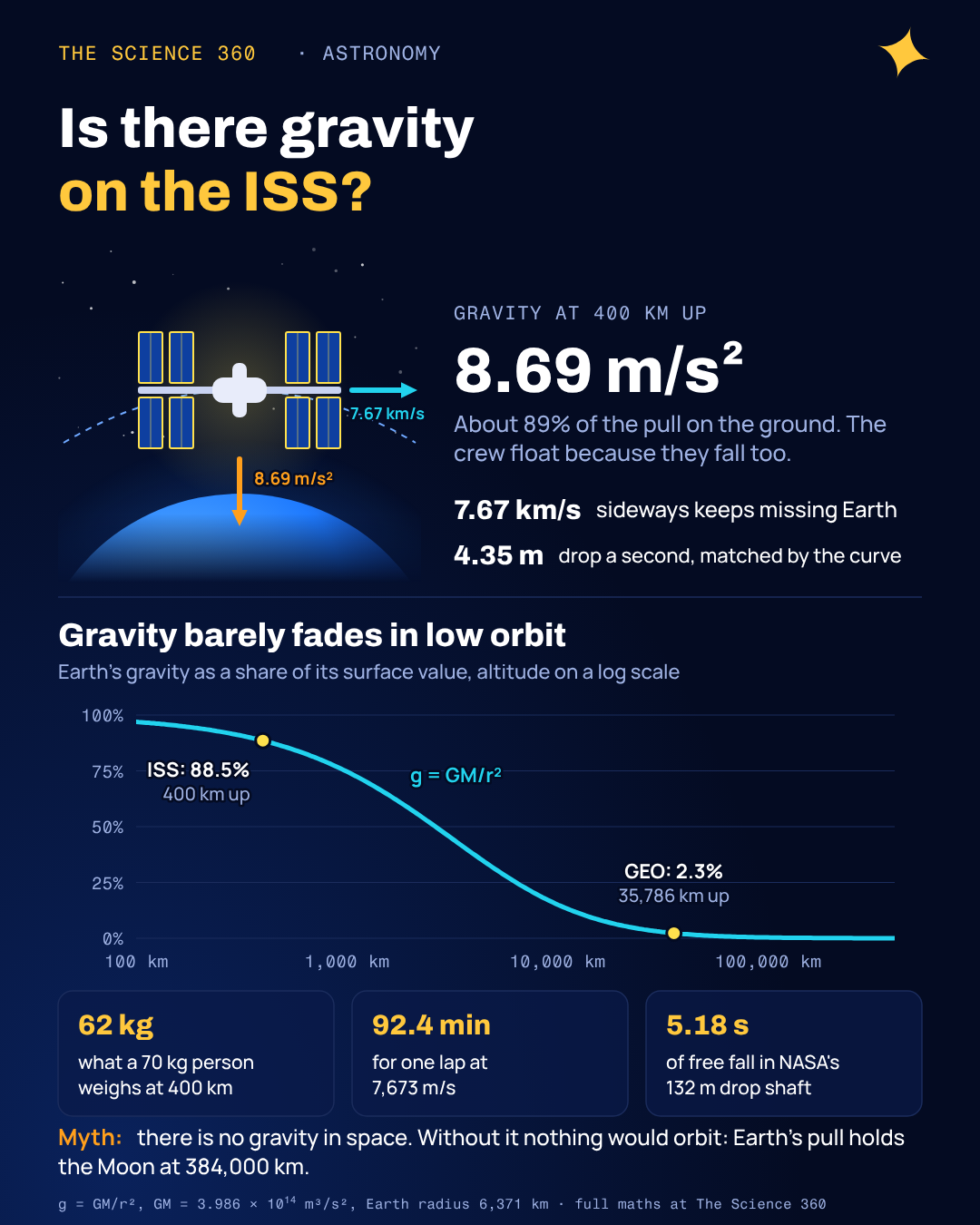
How strong is gravity at the space station’s altitude?
Newton's law of gravity says the pull falls off with the square of your distance from Earth's centre, not from its surface. That detail is what most people miss. The ISS is not far from Earth in the way that matters: Earth's mean radius is 6,371 km, and the station adds only about 400 km on top.
Worked example: gravity at 400 km
At the surface, :
before Earth's spin trims it to the familiar 9.81. At the ISS, :
Ratio:
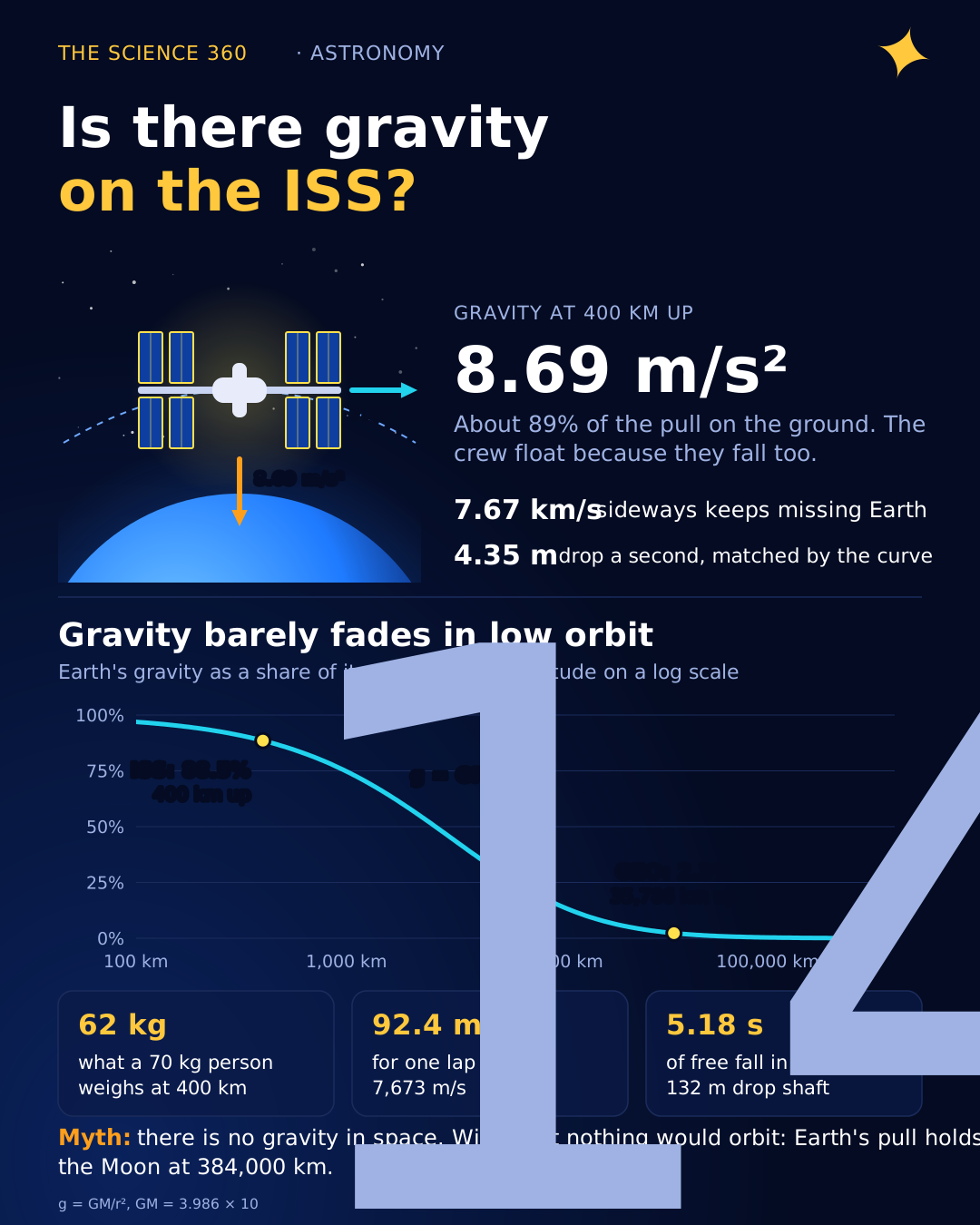
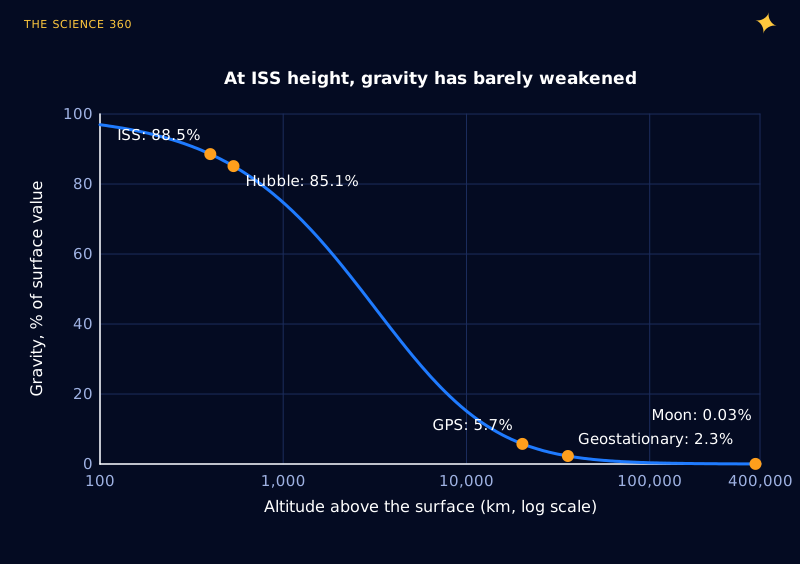
The station's altitude drifts between about 400 and 420 km as air drag lowers it and engine burns raise it again, which moves the answer between 88% and 89%. Either way it is nowhere near zero. Figure 1 shows how far out you have to go before Earth's gravity really fades. Even at geostationary orbit, 35,786 km up, it is still 2.3% of surface gravity, and that is enough to hold a satellite in a 24-hour orbit.
Why do astronauts float if gravity is still 89%?
Weight, the thing you feel, is not gravity itself. It is the push of the floor (or a chair, or a scale) holding you up against gravity. Standing on Earth, your feet press on the ground and the ground presses back, and your inner ear and every load-bearing joint report that force to your brain.
Now picture the elevator thought experiment. If the cable snapped, you and the elevator car would fall at the same rate. The floor would no longer push on you, a dropped pen would hover next to your hand, and a scale under your feet would read zero. Gravity would be acting on you as strongly as ever. You would simply have nothing resisting it. That is weightlessness, and you can experience it on Earth for a few seconds at a time. NASA's Zero Gravity Research Facility in Ohio drops experiments 132 m down an evacuated shaft for 5.18 seconds of free fall, and parabolic aircraft flights give about 20 to 25 seconds per arc.
The ISS is that elevator, except it never hits the bottom.
The misconception: “there is no gravity in space”
The language does the damage. "Zero-g", "zero gravity" and "weightless in space" all suggest that once you leave the atmosphere, gravity stops. If that were true, nothing would orbit anything. The Moon is held in its path by Earth's gravity at 384,000 km, where it is about 0.03% of surface strength. The Earth is held around the Sun by gravity across 150 million km.
A related myth says the station floats because it is "above the pull of gravity", or because air pressure or the vacuum holds it up. If you somehow stopped the ISS dead in its orbit, it would fall straight down, accelerating at nearly 9 m/s² at first, and hit the dense atmosphere within a few minutes. What keeps it up is its sideways speed.
How fast does the ISS have to go to keep missing the ground?
Isaac Newton imagined a cannon on a very tall mountain. Fire a ball slowly and it falls to the ground nearby. Fire it faster and it lands farther away, because the ground curves downward under its path. At one particular speed, the ground curves away exactly as fast as the ball falls, and the ball goes all the way around. That is an orbit. Figure 2 draws it to scale from the ISS's altitude.
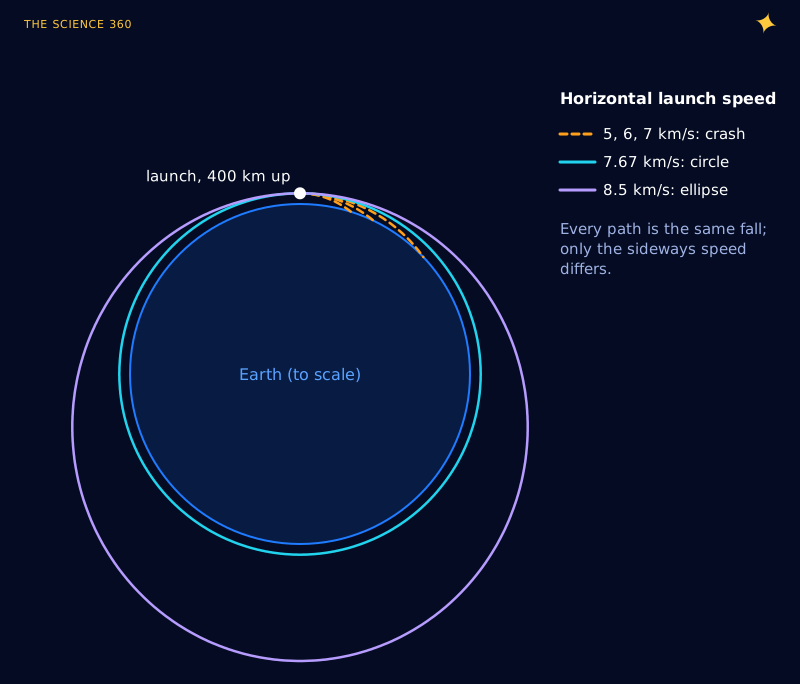
Here is that speed worked out two ways. They had better agree.
Method 1: gravity supplies the centripetal acceleration
That is 27,600 km/h.
Method 2: the one-second picture
Drop from rest for 1 s at 8.69 m/s²:
In that second the station travels 7,673 m sideways. How far does a straight line 7,673 m long rise above a circle of radius 6,771 km?
Every second, the station falls 4.35 m toward Earth, and every second the curved surface drops 4.35 m away beneath its path. It has been doing that since 1998. The real station usually flies a little higher than our round 400 km, so it moves slightly slower, about 7.66 km/s, with a period of about 92 to 93 minutes.
A subtle point hides in Method 1: the mass of the astronaut never appears. Gravity pulls harder on a heavier object, but a heavier object needs proportionally more force to accelerate, so everything falls at the same rate. That equality of gravitational and inertial mass is why the station, its crew and a loose pen all follow the same orbit and drift together instead of separating. Einstein took it further: in general relativity a freely falling observer feels no force at all, because gravity is the curvature of spacetime, not a pull. In that picture the astronauts are moving in the straightest possible line through curved spacetime, and it is you, standing on the ground, who is being accelerated by the floor.
What is microgravity, then?
NASA prefers "microgravity" to "zero gravity", and the word is more precise than it sounds. It refers to the small accelerations that remain inside the station relative to perfect free fall. NASA's guide to the ISS acceleration environment says the slow, steady part of these, the quasi-steady regime, is typically below one micro-g, a millionth of surface gravity. Figure 3 puts those leftovers on the same scale as gravity itself.
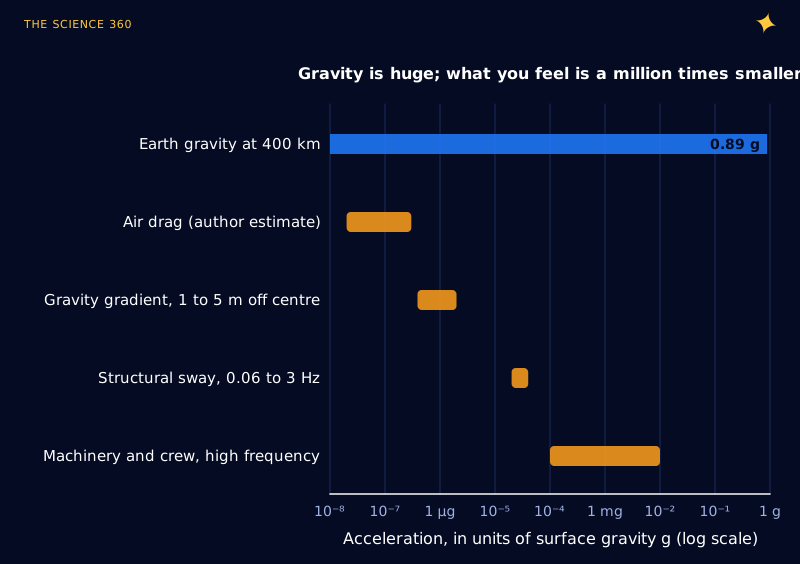
There are three main sources of these residual accelerations.
Air drag. At 400 km there is still a trace of atmosphere, and the station ploughs through it at 7.7 km/s. The station feels the drag, but a floating astronaut, shielded inside the hull, does not, so relative to the walls the astronaut drifts very slowly forward.
Worked example: how big is drag on the ISS?
Air density at 400 km: (it varies about tenfold with solar activity). Drag coefficient ; effective frontal area (depends on how the solar arrays are angled). Mass .
Orbit loss: about , or roughly 100 m per day.
The force is about the weight of a 30 g letter on Earth, yet over weeks it drops the station by kilometres, which is why it needs regular reboosts from visiting cargo craft. These input values are my assumptions, so treat the result as an order of magnitude.
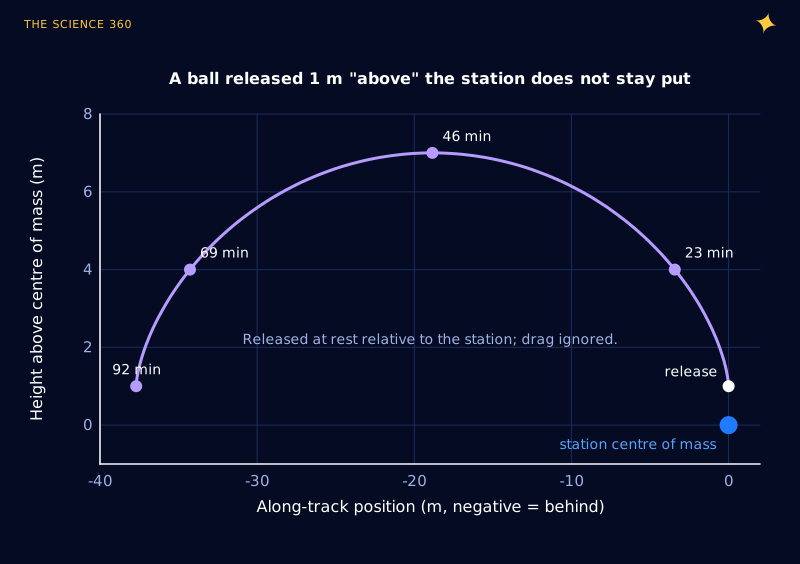
Gravity gradient. Only the station's centre of mass is in a perfect orbit. A point 1 m farther from Earth feels slightly weaker gravity but is carried around at the same angular speed, so it is not quite in free fall. The net effect, including the station's once-per-orbit rotation, is a radial acceleration of 3ω² per metre of offset, where ω is the orbital angular speed.
That sounds negligible, but give it time. Figure 4 solves the Clohessy-Wiltshire equations, the standard equations for motion near an orbiting spacecraft, for a ball released at rest 1 m above the station's centre of mass. In one orbit it rises to 7 m above and ends up nearly 38 m behind, outside the station's pressurized modules if nothing stopped it. Inside, of course, it just drifts into a wall after a few minutes, which is one reason loose items migrate to the air vents and corners.
Vibration. Pumps, fans, exercise machines and the crew pushing off walls shake the structure. NASA measures structural vibration in the 0.06 to 3 Hz band at about 20 to 40 micro-g RMS in the laboratory modules, and at higher frequencies the unisolated environment can exceed 10 milli-g. Sensitive experiments sit on isolation racks that cut this by up to a factor of 100.
Does the body notice the difference between 89% gravity and free fall?
Very much so, because the body responds to load, not to gravity. Without a floor pushing back, fluids shift toward the head (the "puffy face, bird legs" look), the spine lengthens by a few centimetres, and the skeleton stops being stressed in the way that maintains it. Studies of long-duration ISS crews have measured hip bone density losses of roughly 1.5 to 2.7% per month depending on the bone region, which is why astronauts exercise about two hours a day on a treadmill, a bike and a resistance machine.
Even weighing yourself requires a workaround. A scale measures the floor's push, which is zero. So the station uses a spring-loaded device that shakes the astronaut back and forth and infers mass from Newton's second law, . Mass, unlike weight, does not care whether you are falling.
FAQ
How strong is gravity on the ISS?
At the station's altitude of about 400 km, Earth's gravity is about 8.7 m/s², roughly 88 to 89% of its strength at the surface. Gravity weakens with the square of distance from Earth's centre, and 400 km only adds about 6% to that distance.
Why do astronauts float if there is gravity?
Because the astronauts and the station are falling together. They are moving sideways at about 7.67 km/s, so while they fall toward Earth the curved surface drops away beneath them at the same rate. Nothing pushes up on them, so they feel weightless, like a passenger in a falling elevator.
What is microgravity?
Microgravity is NASA's term for the tiny accelerations that remain inside a freely falling spacecraft, typically around a millionth of Earth's surface gravity or less at low frequencies. They come from air drag, the station's rotation and the slight difference in gravity across its length, not from gravity being switched off.
What would happen if the ISS stopped moving?
It would fall straight down. With about 89% of surface gravity acting on it and no sideways speed to carry it around the curve of the Earth, it would drop into the atmosphere within minutes, picking up speed until air resistance and heating tore it apart.
How fast does the ISS travel?
About 7.66 to 7.67 km/s, or roughly 27,600 km/h, completing one orbit in about 92 to 93 minutes. That speed is set by the altitude: it is the speed at which falling and the curvature of the Earth exactly match.
Related on The Science 360
Sources
- NASA, "The Acceleration Environment of the International Space Station" (mini-book: quasi-steady regime below one micro-g; structural modes 20 to 40 micro-g RMS; unisolated environment above 10 milli-g; isolation up to a factor of 100): nasa.gov/.../acceleration-environment-iss-mini-book_detail-508c.pdf
- NASA Glenn Research Center, Zero Gravity Research Facility (132 m drop, 5.18 s of free fall): nasa.gov/glenn/.../reduced-gravity-drop-towers-and-test-rigs
- NASA, International Space Station facts and figures (mass 419,725 kg, about 16 orbits a day at about five miles per second): nasa.gov/international-space-station/space-station-facts-and-figures
- Standard gravitational parameter of Earth, GM = 3.986004418 × 10¹⁴ m³/s² (IERS conventions; summary): en.wikipedia.org/wiki/Standard_gravitational_parameter
- Clohessy-Wiltshire (Hill) equations for relative orbital motion: en.wikipedia.org/wiki/Clohessy-Wiltshire_equations
- Space.com, "Space Station Astronauts Lose Bone Strength Fast" (Lang and Keyak CT study: hip losses 1.6 to 2.7% per month): space.com/6354-space-station-astronauts-lose-bone-strength-fast.html
Method note: gravity values use a spherical Earth of mean radius 6,371 km. Drag, orbit decay and gravity-gradient figures are the author's calculations from the stated assumptions; real values vary with solar activity, station attitude and location inside the station.
Header image: NASA (image iss025e007217), regraded for this article.