500 Rule vs NPF Rule: Which Is Right for Sharp Stars?
Put a camera on a tripod, aim it at the Milky Way and open the shutter. Earth turns under the sky at 15 arcseconds per second, so every star slowly slides across the sensor. Leave the shutter open too long and the stars become short dashes. The question every night sky photographer asks is how long is too long, and the two best-known answers, the 500 rule and the NPF rule, can disagree by a factor of two or three.
This post explains where each rule comes from, why the 500 rule gives trailed stars on modern cameras, and when the two agree. You can try every example in the astrophotography exposure calculator, which draws one star pixel by pixel at each rule's shutter speed.
What is the 500 rule?
The 500 rule says the longest exposure in seconds is 500 divided by the focal length, times the crop factor for smaller sensors. AstroBackyard's guide gives the usual examples: a 24 mm lens on full frame allows 500 ÷ 24 = 20.8 seconds, and a 50 mm lens on a Canon APS-C body with a 1.6× crop allows 500 ÷ (1.6 × 50) = 6.25 seconds. The same guide notes that the rule was designed for 35 mm film and that the number 500 has no particular meaning.
Frédéric Michaud's article for the Société Astronomique du Havre shows where the number really comes from. The image of a star on the sensor moves at the focal length times cos δ divided by 13,713 per second, where δ is the star's declination and 13,713 is the number of seconds in a sidereal day divided by 2π. If you accept a blur equal to the film-era circle of confusion, 0.029 mm, the time is:
That is 398 ÷ f on the celestial equator and 562 ÷ f at 45° declination. Round the range to 500 and you have the rule. The key number is the 0.029 mm, 29 micrometres, of blur it allows. Film grain and small prints hid that. A modern sensor has pixels of 4 to 6 micrometres, so the same blur covers five to seven pixels.
What is the NPF rule?
Michaud's NPF rule, published in 2010 and explained in the 2013 SAH article, asks a sharper question: how big is a star's image on this sensor, and how long before it moves by about its own width? It is named after the three things it uses: N, the aperture as an f-number; P, the pixel pitch; and F, the focal length.
The star's image has three parts. Diffraction in the lens gives a blur of 4.47 × λ × N, with λ = 0.55 µm for green light. Turbulence in the air spreads it by about 3 arcseconds. And the colour filter pattern on the sensor means a star needs about two pixels to be recorded properly. Add those, divide by how fast the image moves, and allow a trail of k star radii:
Here p is the pixel pitch in micrometres and f the focal length in millimetres. The article gives k = 1 for no visible trail, k = 2 for a slight trail of about one star width, and k = 3 for a visible one. With k = 2 and δ = 0, the celestial equator where stars move fastest, it simplifies to the version most people quote:
The simple version rounds its constants up a little, so it gives about 5% more time than the full version at the equator. It ignores the 0.1 f seeing term, which matters only for long lenses.
Example 1: a 45 MP camera with a 24 mm f/1.4 lens
Example 1: the longest exposure for the Milky Way core
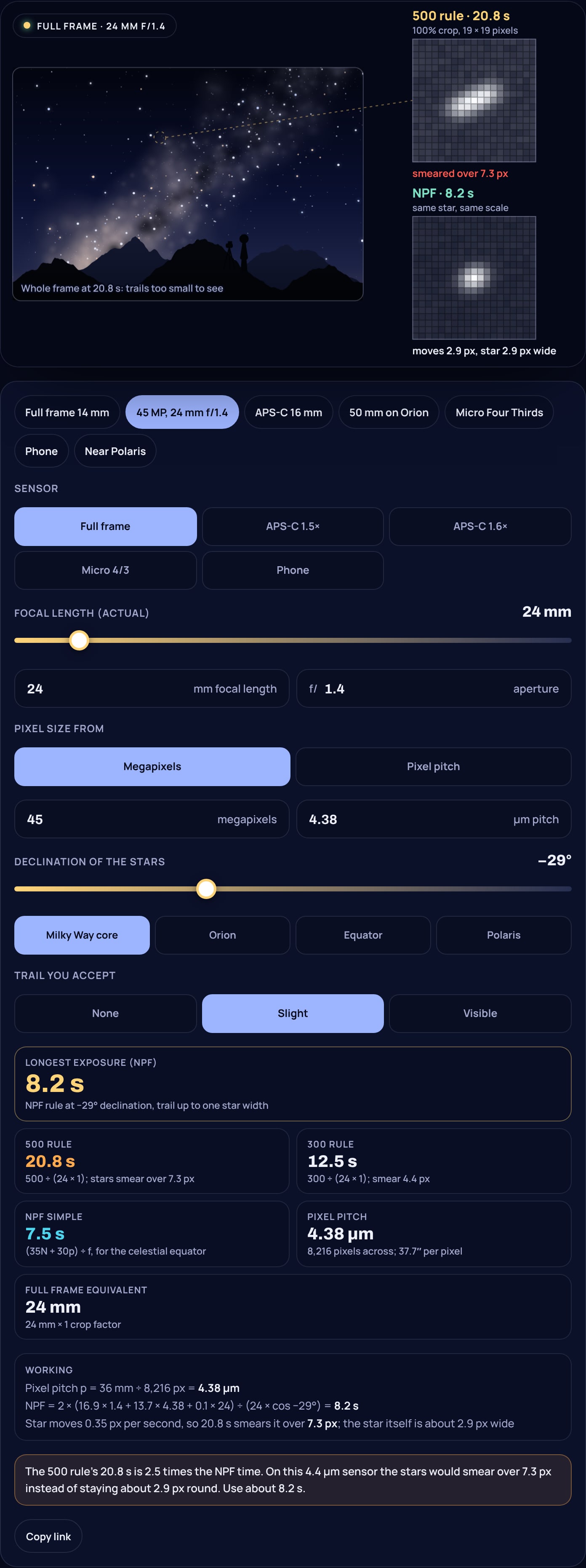
A full frame sensor 36 mm wide with 45 megapixels in a 3:2 shape has 8,216 pixels across. The lens is 24 mm at f/1.4, and the centre of the Milky Way is at declination −29°.
The 500 rule allows two and a half times as long as the NPF rule.
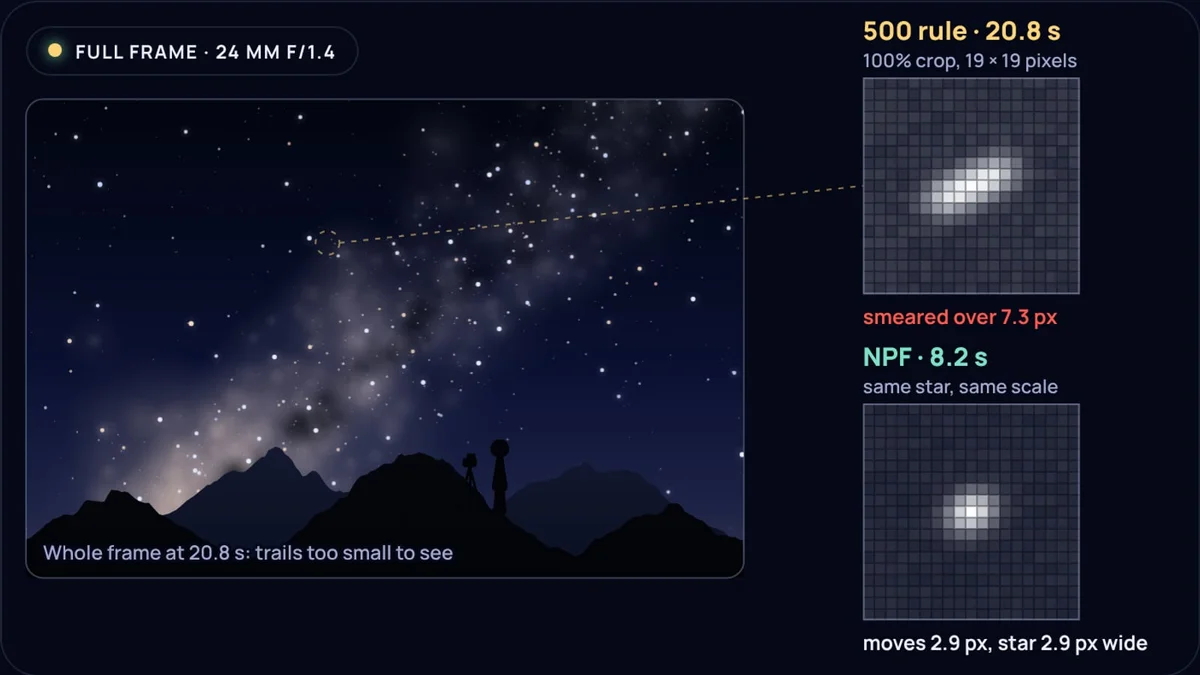
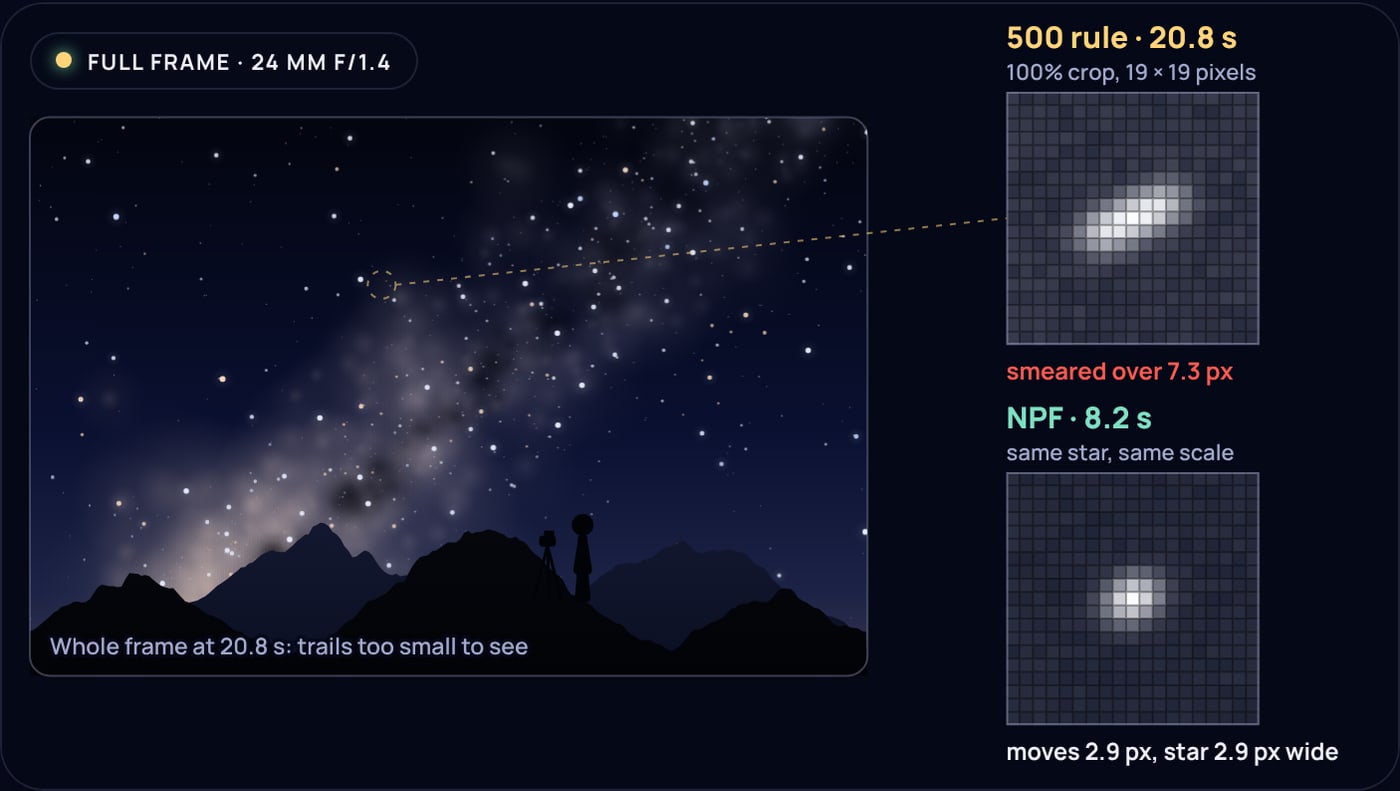
Figure 1 shows what that means for one star. The two crops are 100% views, each square a single sensor pixel. At 20.8 seconds the star is a streak; at 8.2 seconds it is almost round.
Example 2: how far does the star move?
Example 2: trail length in pixels
One pixel of 4.38 µm behind a 24 mm lens covers 206.265 × p ÷ f arcseconds of sky. Stars move at 15.04″ per second times cos δ.
The star's own image, from the NPF parts (3.4 µm of diffraction, 0.35 µm of seeing and 8.8 µm for the colour filter), is 12.6 µm, or 2.9 pixels. A 7.3 pixel trail on a 2.9 pixel star is clearly stretched.
On the whole frame you would not see it: 7.3 pixels out of 8,216 is less than one screen pixel on a phone. It shows when you zoom to 100%, crop, or print large, which is exactly what high resolution cameras are bought for.
When do the two rules agree?
The gap between the rules depends on the pixels and the lens. Here is a 24 MP full frame camera at f/2.8 across a range of focal lengths, for stars at −29°:
| Focal length | 500 rule | 300 rule | NPF simple | NPF at −29° |
|---|---|---|---|---|
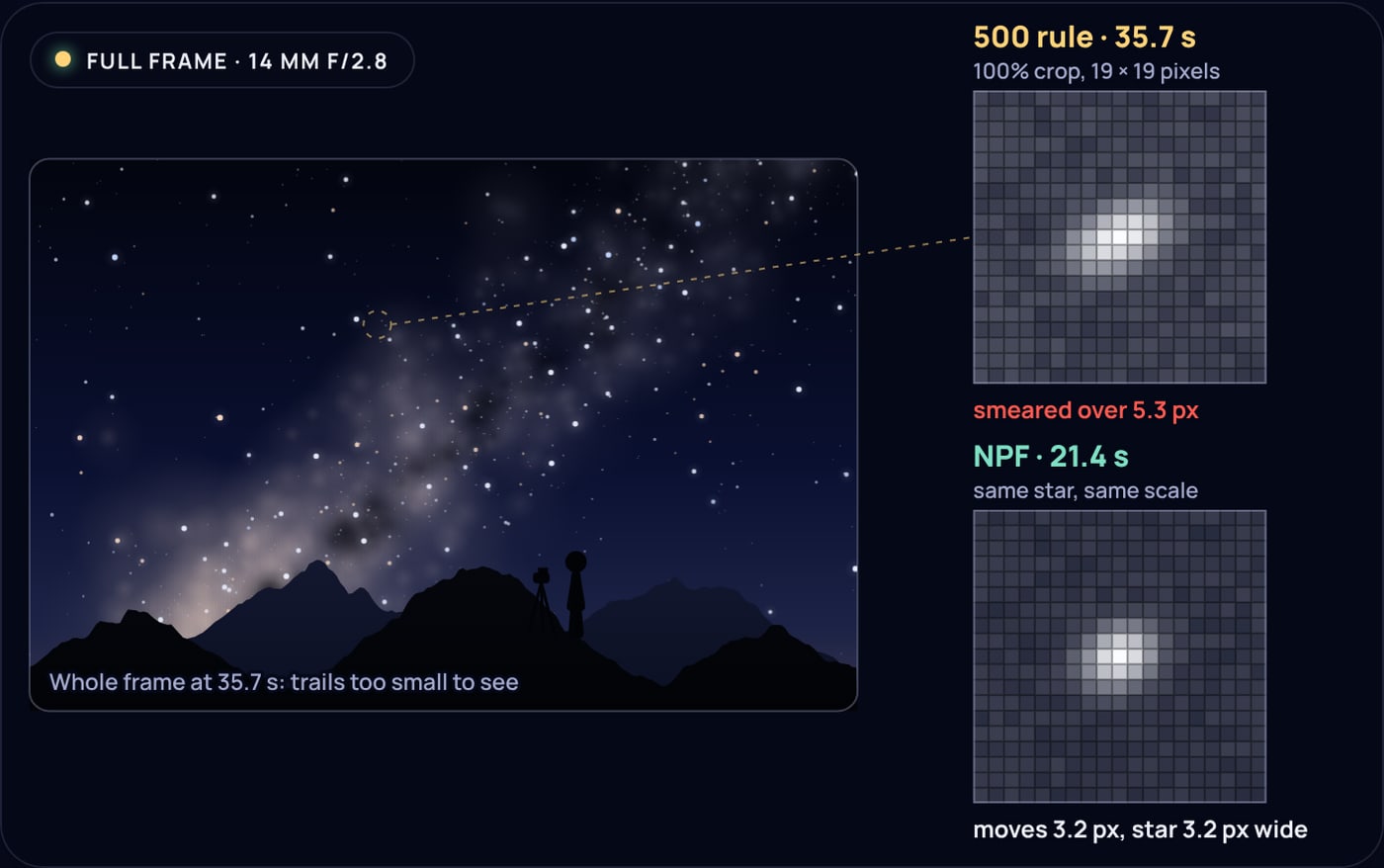
| 14 mm | 35.7 s | 21.4 s | 19.9 s | 21.4 s |
| 20 mm | 25.0 s | 15.0 s | 13.9 s | 15.0 s |
| 24 mm | 20.8 s | 12.5 s | 11.6 s | 12.6 s |
| 35 mm | 14.3 s | 8.6 s | 7.9 s | 8.7 s |
| 50 mm | 10.0 s | 6.0 s | 5.6 s | 6.2 s |
| 135 mm | 3.7 s | 2.2 s | 2.1 s | 2.4 s |
With 6.0 µm pixels at f/2.8, the 500 rule gives about 1.7 times the NPF time at every focal length, and the stricter 300 rule, which some photographers use for crop and high resolution sensors, lands almost exactly on the NPF figure. That is a coincidence of this pixel size and aperture, not a law, but it explains why the 300 rule has a following.
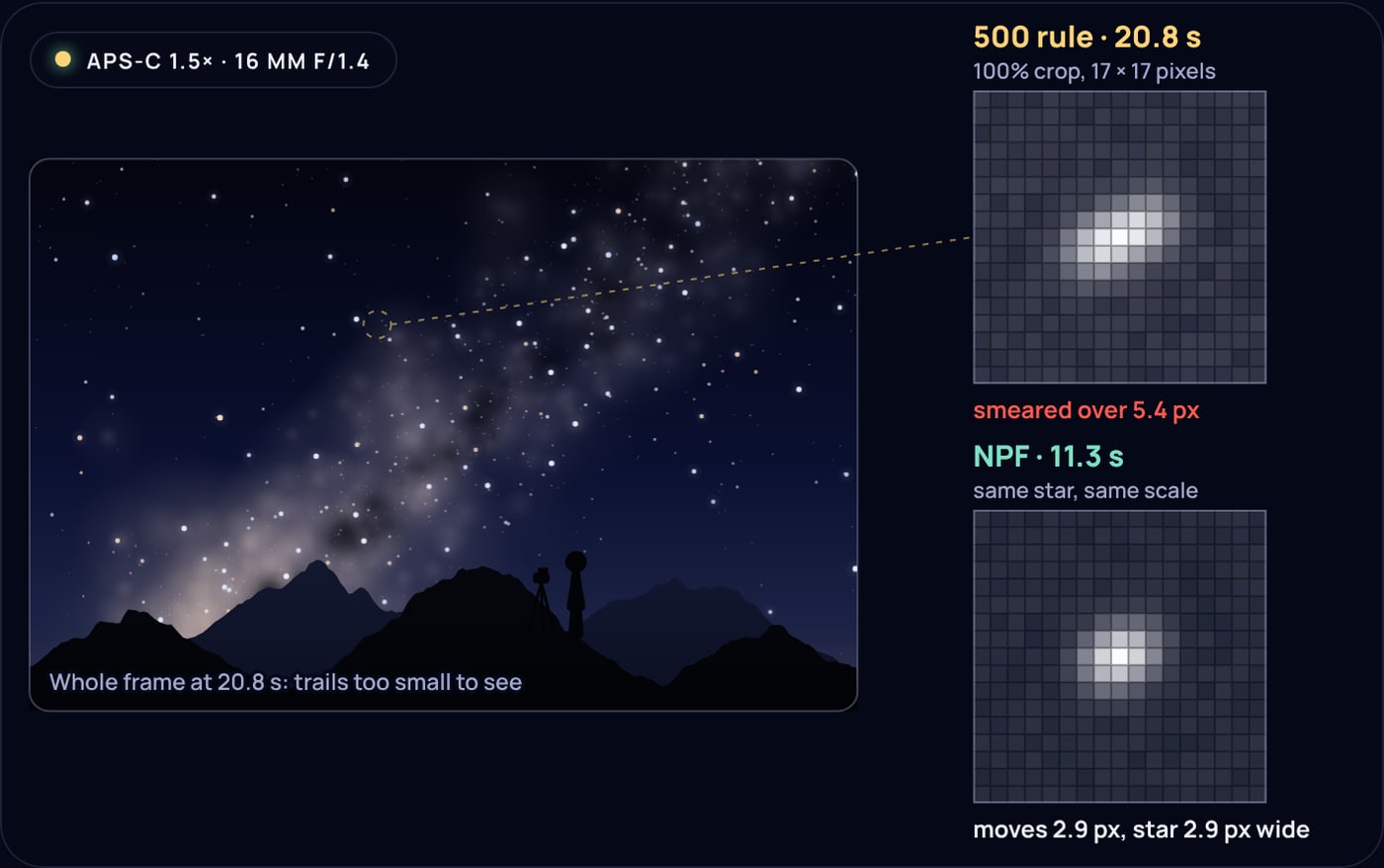
Crop sensors make the gap wider, not narrower. The crop factor already shortens the 500 rule time, but the pixels are smaller too. A 24 MP APS-C camera has 3.9 µm pixels; with a 16 mm f/1.4 lens the 500 rule gives 20.8 s and NPF 11.3 s (Figure 3).
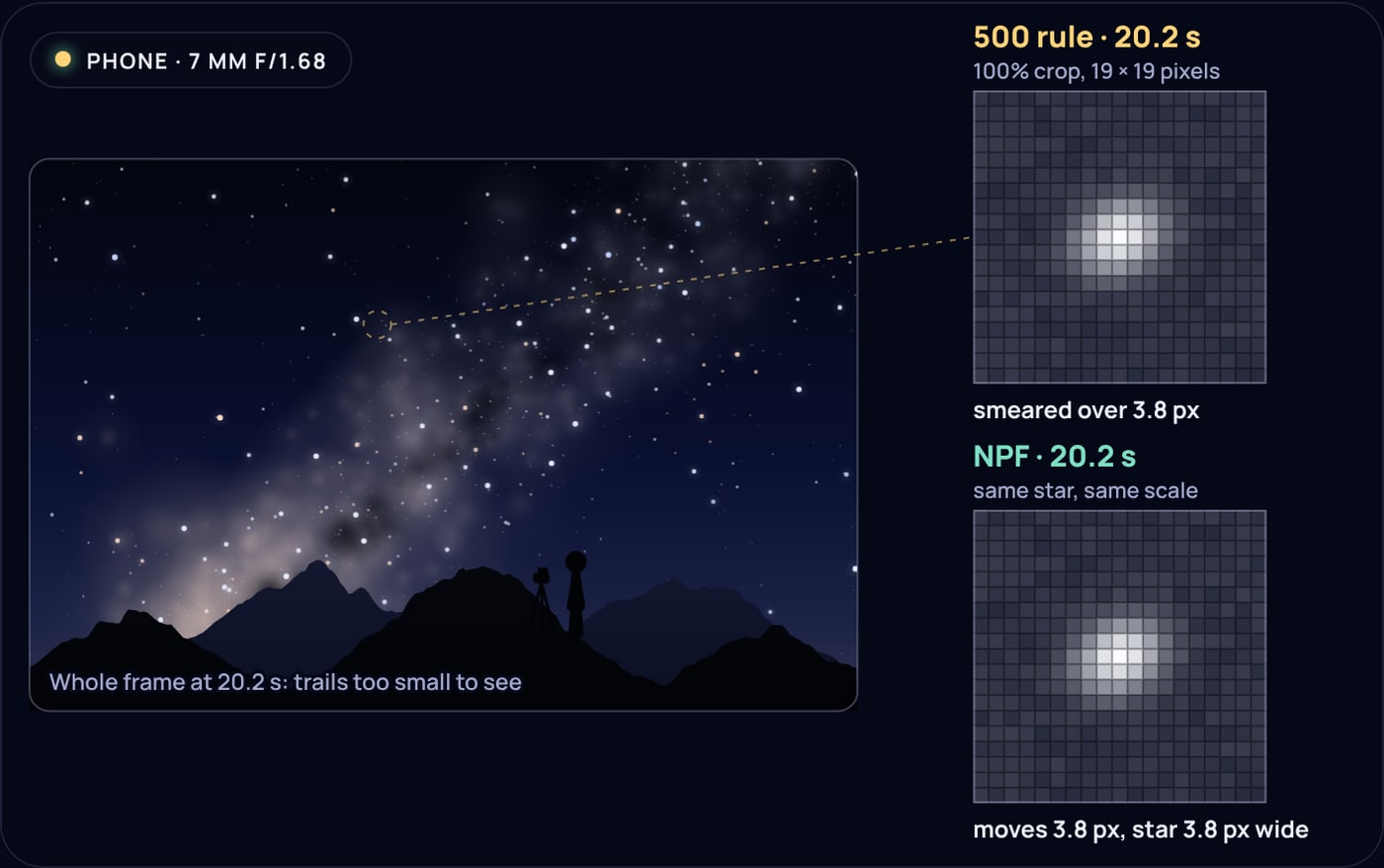
Phones go the other way. A main camera with a 1/1.31 inch sensor of 1.2 µm pixels, as DXOMARK lists for the Pixel 8 Pro, If, as is usual in low light, it combines its pixels in groups of four, they act as 2.4 µm pixels. Its lens is about 7 mm at f/1.68, which frames like 25 mm on full frame. Both rules give about 20 seconds (Figure 4). In practice phone night modes stack many short frames rather than take one long one, so this limit applies to each frame.
Why does declination matter?
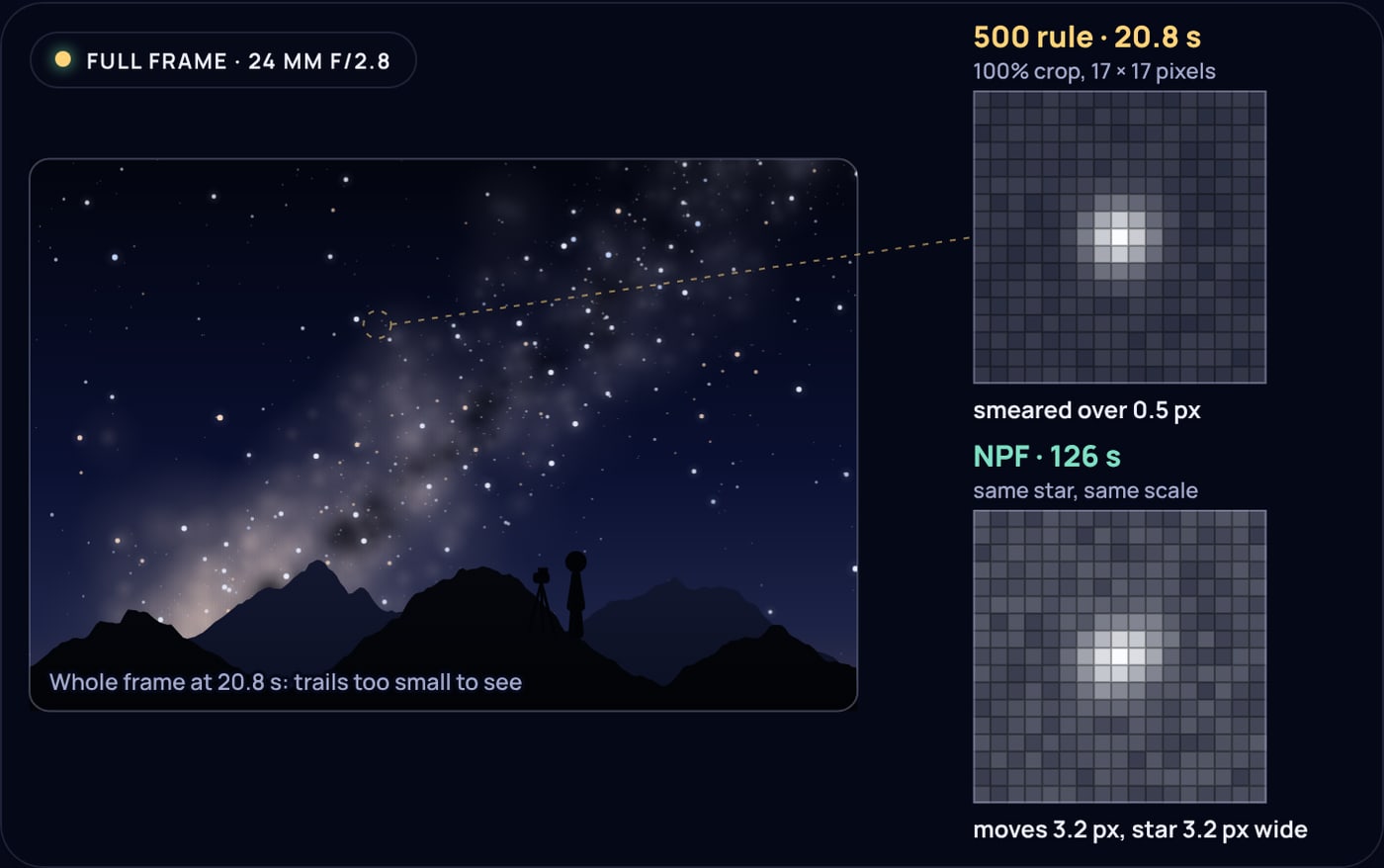
Stars near the celestial equator travel the biggest circles across the sky and move fastest. Towards the celestial poles the circles shrink, and a star's speed falls with the cosine of its declination. The Milky Way's centre at −29° moves at cos 29° = 0.87 of the equator's speed, so you get about 14% more time. Near Polaris, at +85°, stars move at less than a tenth of that speed, and NPF allows 126 seconds where it allows 11.0 at the equator (Figure 5).
There is a catch. A wide lens pointed at the pole still has stars nearer the equator at the edges of its frame, and they move faster. The SAH article recommends using 0° for wide fields, the worst case, so that every star in the frame stays sharp. The 500 rule ignores declination altogether.
So which rule is right?
For a digital camera viewed at full resolution, the NPF rule. It is built from the things that really set star sharpness: the size of the star's image, set by the lens and the pixels, and how fast it moves, set by the focal length and the declination. The 500 rule fixes the allowed blur at a film-era 29 µm whatever the sensor, which is several pixels on any modern camera.
A few practical points:
- Treat both as starting points. Take a test frame, zoom to 100% on a star near the middle and another near the edge, and adjust.
- Decide what trail you accept. NPF with k = 2 allows about one star width. For 45 MP at 24 mm f/1.4 that is 8.2 s; k = 1 gives 4.1 s and k = 3 gives 12.3 s.
- Do not stop down to gain time. A smaller aperture makes the star image bigger, so NPF allows slightly longer, but you collect far less light.
- Short exposures are noisy. If the limit is a few seconds, take many frames and stack them, or use a tracking mount.
The last point leads to the next question: is it better to take one long exposure or many short ones? Read noise decides that, and our guide to splitting exposures to beat read noise works it through. Figure 6 shows the whole calculator for the 45 MP example, with the working.
To find the numbers for your own camera, open the astrophotography exposure calculator, choose your sensor, and type your lens and megapixels.
Sources
- Société Astronomique du Havre: Les coulisses de la règle NPF (Frédéric Michaud, 2013: full and simplified NPF formulas, the star size model, 13,713, k values, and the origin of the 500 rule from a 0.029 mm circle of confusion)
- AstroBackyard: The 500 Rule (Trevor Jones: formula, crop factors and worked examples)
- Galactic Hunter: 500 Rule vs NPF Rule (worked examples: 135 mm and 24 mm f/2 with 4.3 µm pixels)
- Light Stalking: What Is the NPF Rule (pixel pitch from sensor width; Nikon D750 example, about 11.5 s)
- ScanTips: Improved 500 Rule star trail calculator (sidereal rate 15.04107″ per second, variants of the numerator)
- DXOMARK: Google Pixel 8 Pro camera test (primary camera 50 MP, 1/1.31 inch, 1.2 µm, f/1.68)
Frequently asked questions
Is the 500 rule still accurate?
Not for modern digital cameras viewed at full size. It was set for 35 mm film and allows a blur of about 29 µm on the sensor, several pixels wide. On a 45 MP full frame camera at 24 mm it allows 20.8 s, which smears stars over about 7 pixels.
What is the NPF rule formula?
In its simple form, exposure in seconds = (35 × f-number + 30 × pixel pitch in µm) ÷ focal length in mm. The full version, by Frédéric Michaud of the Société Astronomique du Havre, is k × (16.9N + 13.7p + 0.1f) ÷ (f × cos δ), which adds the declination and the trail you accept.
Is the NPF rule always shorter than the 500 rule?
Usually, for current cameras. With large pixels and slower lenses the two can agree: a phone camera with 2.4 µm binned pixels at f/1.68 gets about 20 s from both.
What exposure should I use for the Milky Way with a 14 mm lens?
On a 24 MP full frame camera at f/2.8, the NPF rule gives about 21 s for the Milky Way core at −29° declination. The 500 rule’s 36 s smears stars over about 5 pixels.
What is the 300 rule?
The 500 rule with 300 in place of 500, a stricter version some photographers use for crop sensors and high resolution cameras. For a 24 MP full frame camera at f/2.8 it happens to come close to the NPF result.