How Bright Will Betelgeuse's Supernova Be? The Math
Between October 2019 and February 2020, the right shoulder of Orion lost two thirds of its light. Betelgeuse, normally one of the ten brightest stars in the sky, sank to magnitude +1.6, and the internet decided it was about to explode. It did not. But the episode left a question that every article since has answered differently: when Betelgeuse does go supernova, how bright will it actually get? You will see "as bright as the half Moon", "magnitude −12.5", "brighter than the full Moon" and "a bit brighter than Venus". They cannot all be right. The answer comes from two numbers and one formula, so let's work it out properly.
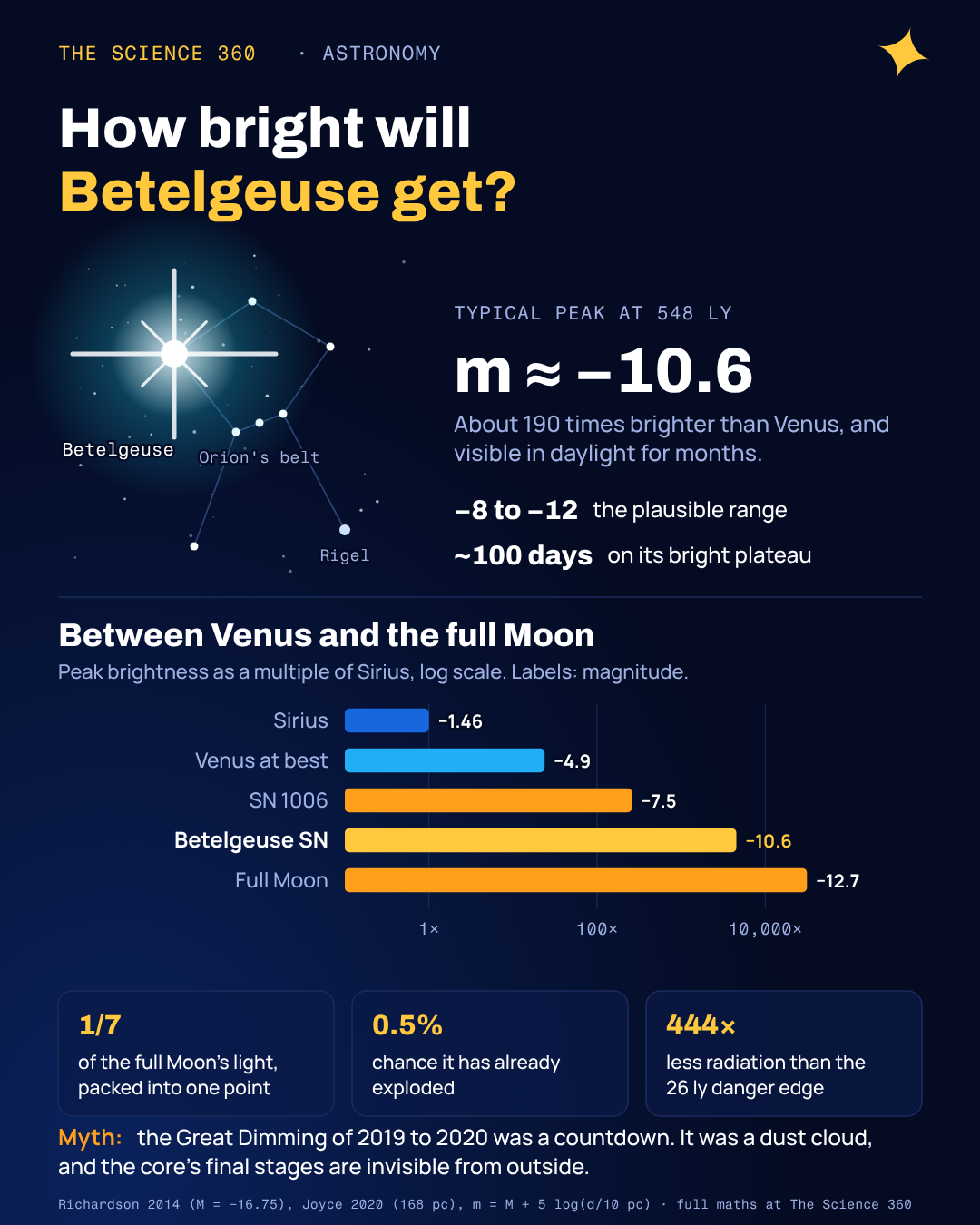
How do astronomers predict the brightness of a supernova?
Astronomers measure brightness in magnitudes, a backwards logarithmic scale inherited from the ancient Greeks: smaller numbers are brighter, and every 5 magnitudes is exactly a factor of 100 in brightness, so 1 magnitude is a factor of 1001/5 ≈ 2.512. Two kinds matter here.
- Apparent magnitude (m) is how bright something looks from Earth. Sirius is −1.46, the full Moon about −12.7.
- Absolute magnitude (M) is how bright it would look from a standard distance of 10 parsecs (32.6 light years). It measures true power output.
The two are connected by the inverse square law, written in magnitude form as the distance modulus:
where is the distance in parsecs and is the dimming by dust along the way (extinction)
So we need three things: how powerful the explosion is (M), how far away Betelgeuse is (d), and how much dust is in the way (A). None of them is known perfectly, which is exactly why published answers disagree.
What kind of supernova will Betelgeuse be?
Betelgeuse is a red supergiant of roughly 16 to 19 solar masses, with a hydrogen envelope hundreds of times wider than the Sun. When stars like this collapse, they almost always produce a Type II-P supernova: the "P" stands for plateau, because the expanding hydrogen envelope keeps the light almost steady for about 100 days before it drops. Red supergiants are the confirmed progenitors of this class.
Type II-P supernovae are also the dimmest of the common core-collapse types. A large survey by Richardson and colleagues (2014) found a mean peak of in the blue band, with a spread (standard deviation) of about 1 magnitude. So a "typical" case is −16.75, a bright one about −18, and a dim one about −15.5. Some of the "−12.5" headlines you will find quietly assume a peak of −18.5 or so, a value more typical of rarer, brighter supernova types.
How far away is Betelgeuse?
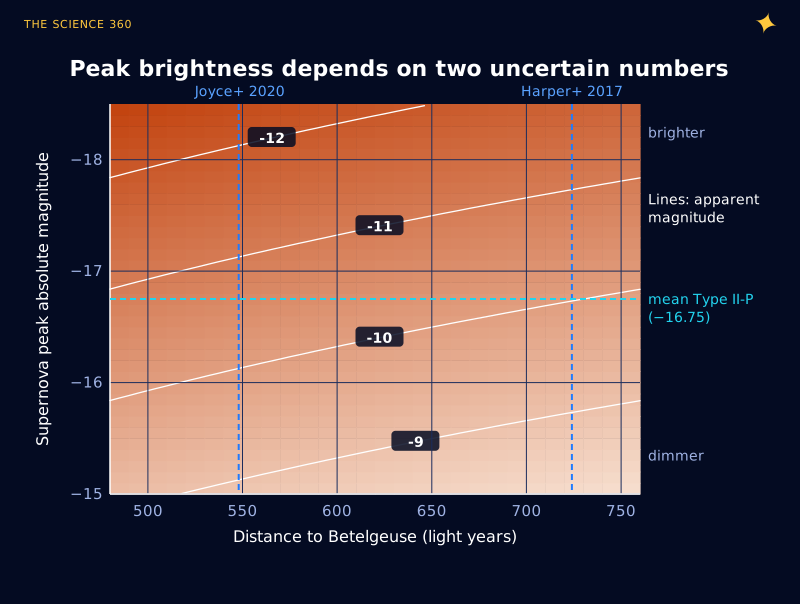
Surprisingly hard to pin down. Betelgeuse is so large and bright that its disk is bigger than its own parallax wobble, and its blotchy, shifting surface confuses position measurements. The main estimates:
| Study | Method | Distance |
|---|---|---|
| Harper et al. 2017 | Radio plus Hipparcos astrometry | 222 (+48, −34) pc ≈ 724 ly |
| Joyce et al. 2020 | Stellar models fitted to pulsations | 168 (+27, −15) pc ≈ 548 ly |
That is a spread of roughly 500 to 750 light years, which translates into about 0.8 magnitudes of uncertainty in the prediction. Not huge, but not nothing either.
Dust is the third term. Spectral fits by Levesque and Massey (2020) give an extinction of magnitudes toward Betelgeuse. Part of that is dust the star itself has puffed out, which a supernova would likely destroy or push aside, so the real number at explosion time sits somewhere between about 0 and 0.6.
The worked calculation
Step 1. Distance modulus for the Joyce et al. distance,
Step 2. Typical Type II-P peak, , no extinction
Step 3. Same, with full
Step 4. Bright case (, 168 pc, no dust)
Step 5. Dim case (, Harper distance 222 pc, , with dust)
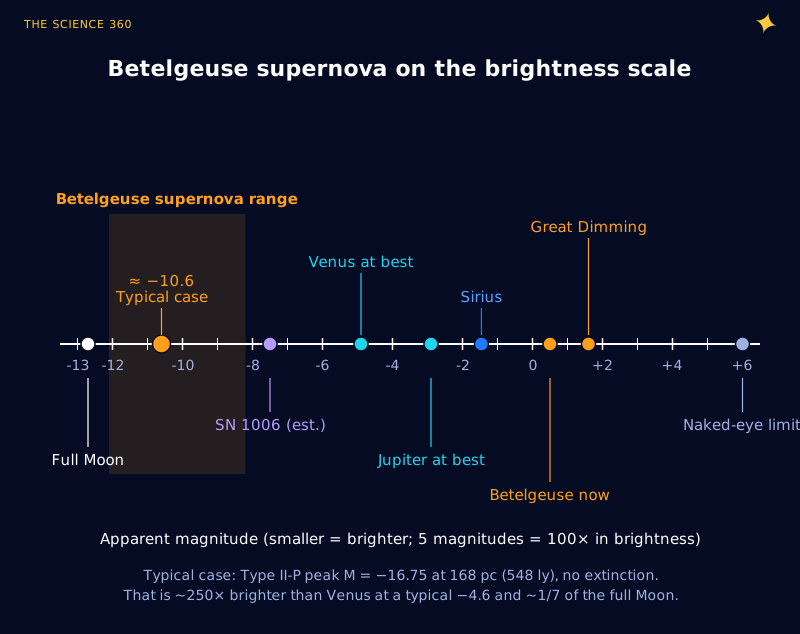
Step 6. Compare the typical case with Venus at its best (−4.9) and the full Moon (−12.7)
Against Venus:
That is about 250 times brighter than Venus at a typical −4.6. Against the full Moon:
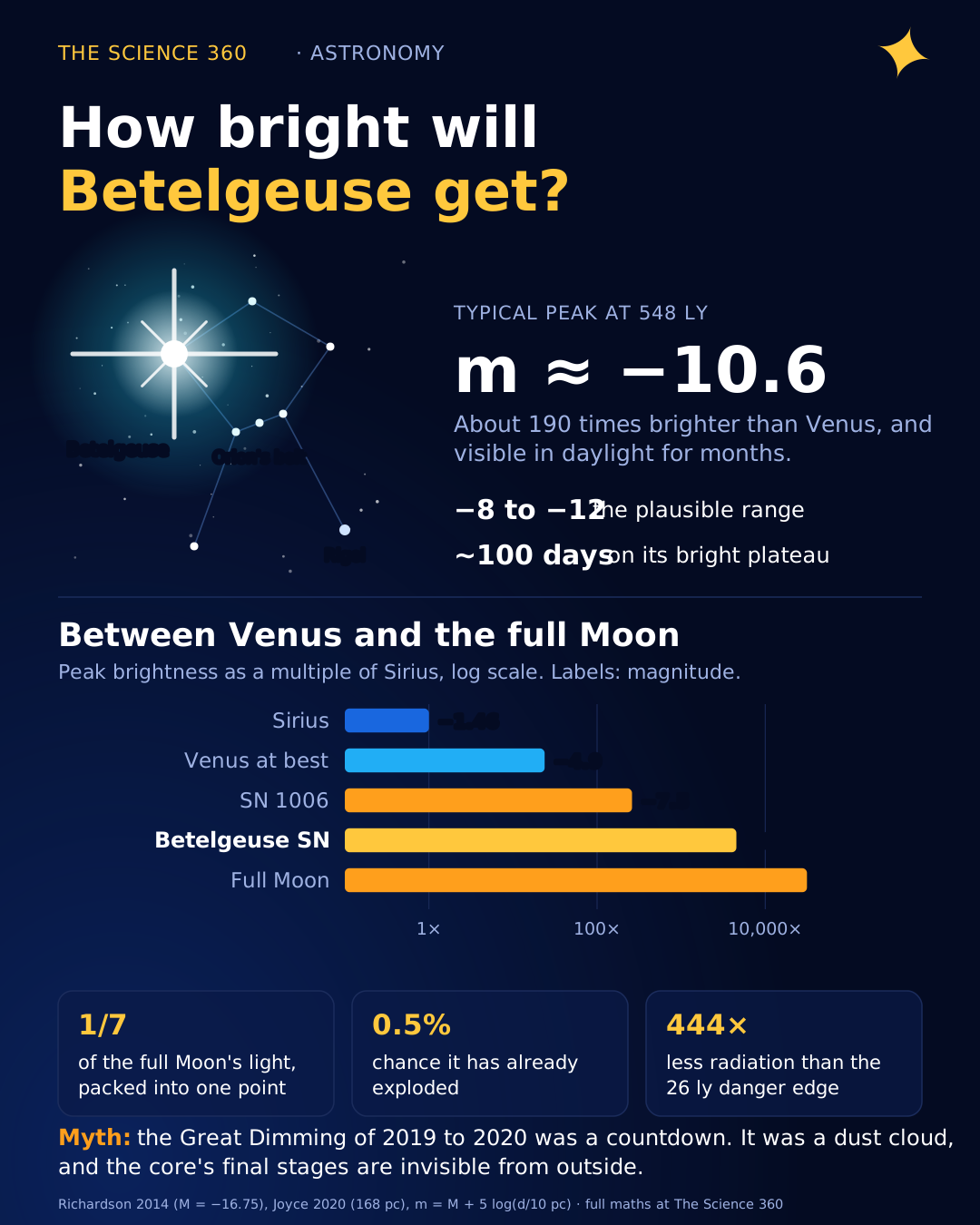
So the honest answer is a range: most likely −10 to −11, with plausible extremes of about −8 and −12. Even the bright extreme falls short of the full Moon. "Brighter than the full Moon" needs a peak around −19.5 or a distance under 400 light years, neither of which fits the evidence.
What would it look like from Earth?
Brightness totals hide the most striking part. The full Moon spreads its light over half a degree of sky; Betelgeuse's supernova would put a seventh of that light into a single point. It would be by far the most intense point of light in the night sky, casting sharp shadows on a dark night. In daylight it would be easy to see: Venus at magnitude −4 to −5 can be spotted in a blue sky if you know where to look, and this would be a few hundred times brighter. For comparison, Chinese astronomers recorded the supernova of 1054 (the one that made the Crab Nebula), at an estimated −6, as visible in daylight for 23 days.
Its color would also change. Betelgeuse is now distinctly orange-red. A supernova in its first days is hot and bluish-white, then cools and reddens over the plateau. Orion's familiar shape would be broken for a year or more by a dazzling point in its shoulder.
How long would it last? Using a simple template of a Type II-P light curve, you can sketch the timeline: a rise over roughly ten days, a slow fade across a 100-day plateau, a drop of about two magnitudes as the hydrogen envelope becomes transparent, then a long tail powered by radioactive cobalt-56, which fades at a textbook rate of 0.98 magnitudes per 100 days (set by cobalt-56's 77-day half-life).
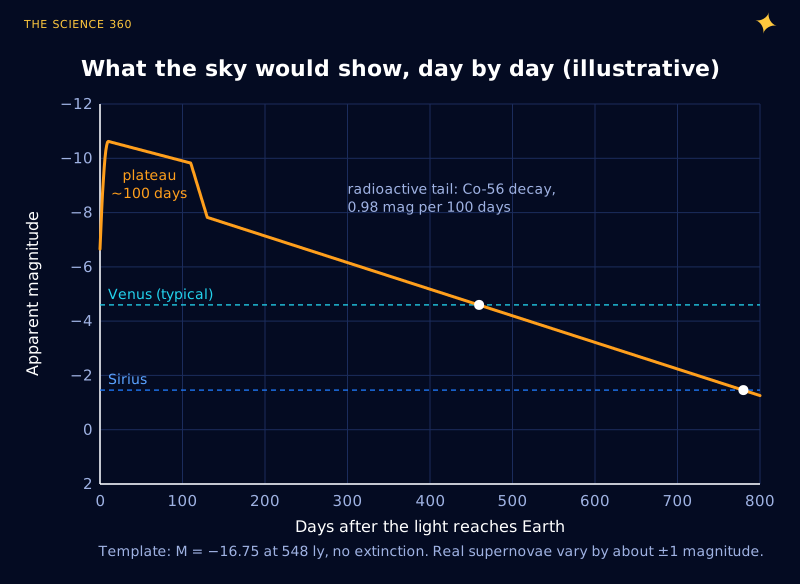
The very first sign would not be light at all. Collapsing cores release most of their energy as neutrinos, which escape immediately, while the shock takes hours to a day to reach the surface of a bloated red supergiant. Neutrino detectors around the world would register the collapse first, and the Supernova Early Warning System is designed to alert astronomers before the star visibly brightens.
Is Betelgeuse about to explode? The Great Dimming explained
The 2019 to 2020 dimming was not a pre-supernova sign. Images from ESO's Very Large Telescope, published by Miguel Montargès and colleagues in Nature in 2021, showed the star's southern half had darkened dramatically. Their modeling supports a scenario in which Betelgeuse burped out a large bubble of gas, a patch of its surface then cooled, and the cooler temperature let that gas condense into dust that blocked part of the starlight. Hubble observations analyzed by Andrea Dupree's team pointed to a huge surface mass ejection. By April 2020 the star was back to normal.
This is the misconception worth correcting: dimming is not a countdown. Red supergiants vary all the time, through pulsation (Betelgeuse has a roughly 400-day cycle) and through dust. The final stages before core collapse, silicon burning in particular, last only days and happen deep inside the core, invisible from the surface. The outside of the star has no way of "knowing" the core is about to go until the shock arrives.
How long is left? Joyce and colleagues (2020) found that Betelgeuse is still burning helium in its core, with about 100,000 years to go. A 2023 study by Saio and colleagues argued instead that the star is in the late carbon-burning stage, which would make it the leading candidate for the next galactic supernova, possibly within our lifetimes. That argument rested on reinterpreting Betelgeuse's roughly six-year (about 2,200-day) brightness cycle as a basic pulsation mode. The companion star discovered in 2025 offers a different explanation for that same cycle, which weakens the case for an imminent explosion. The 100,000-year estimate remains the mainstream view, though nobody would put a precise date on it.
Has it already exploded?
Light travel time is about 548 years. If the explosion is equally likely at any moment over the next ~100,000 years:
Betelgeuse’s companion: Siwarha
For years astronomers suspected that Betelgeuse's six-year cycle came from an orbiting companion, but searches with Hubble and Chandra found nothing. In July 2025 a team led by Steve Howell at NASA Ames reported a faint companion in speckle images from the 'Alopeke instrument on the 8.1 m Gemini North telescope. The images freeze the atmospheric blurring with very short exposures, the same twinkling problem that limits all ground-based astronomy. The companion is about six magnitudes fainter than Betelgeuse, and the discovery team estimated it at about 1.5 solar masses, probably a young A or B type star still contracting toward the main sequence.
The press nicknamed it "Betelbuddy". The discovery team proposed the name Siwarha, Arabic for "her bracelet", a nod to Betelgeuse's own name, which derives from "the hand of al-Jawzā". The IAU Working Group on Star Names approved Siwarha in September 2025. In January 2026, Andrea Dupree's team reported at the American Astronomical Society meeting a wake of denser gas in Betelgeuse's outer atmosphere, recurring every six years as the companion passes through, which is strong independent evidence the companion is real. Independent mass estimates still differ, and you will see figures from about 1.5 to 3 solar masses.
Does the companion change the supernova? Not the peak brightness much. A star a few times the Sun's mass is a minnow next to a 16 to 19 solar mass supergiant. It may get stripped or knocked into a new orbit by the explosion.
Will the Betelgeuse supernova be dangerous?
No. The worry with nearby supernovae is that X-rays, gamma rays and cosmic rays could strip Earth's ozone layer. A 2003 study led by Neil Gehrels at NASA Goddard found a supernova would need to be within about 26 light years to cause serious ozone damage; a 2017 study by Adrian Melott's group pushed the danger radius out to roughly 50 light years once cosmic rays are included.
Radiation falls as :
times less than at the 26 ly threshold, and
times less than at the 50 ly threshold.
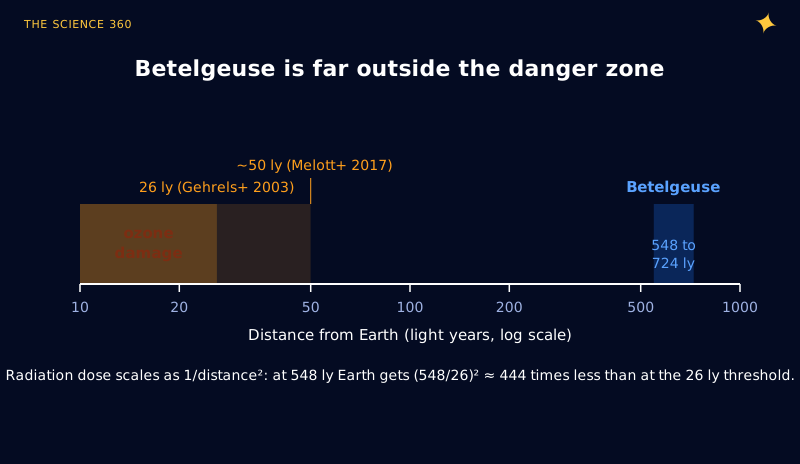
Gamma-ray bursts, the beamed explosions that could do harm from much farther away, come from a different and rarer kind of stellar death than a red supergiant's Type II-P supernova. The realistic risks are to sleep schedules and to telescopes pointed at it. The same inverse square law that makes this a spectacle rather than a catastrophe is also the core of why the sky is dark at night. And if you have ever wondered why Betelgeuse twinkles while Jupiter does not, despite Betelgeuse being one of the largest stars in angular size, see why stars twinkle but planets don't.
FAQ
Will the Betelgeuse supernova be brighter than the Moon?
Almost certainly not brighter than the full Moon. A typical Type II-P supernova at Betelgeuse's distance peaks around magnitude −10 to −11, roughly a seventh to a fifth of the full Moon's total light. Because all of that light comes from a single point, it would look far more intense than the Moon and would cast sharp shadows at night.
Will Betelgeuse be visible during the day when it explodes?
Yes. At magnitude −10 it would be about 250 times brighter than Venus, which can already be seen in daylight if you know where to look. Expect an easy daytime object for a few months, fading over the following year or two.
Is Betelgeuse going to explode soon?
Probably not in our lifetimes. Most models say Betelgeuse is still burning helium in its core and has around 100,000 years left. A 2023 study argued it could be in the carbon-burning stage, but that relied on a six-year brightness cycle that the companion star discovered in 2025 may explain instead.
Will the Betelgeuse supernova harm Earth?
No. A supernova would need to be within roughly 25 to 50 light years to damage Earth's ozone layer. Betelgeuse is about 550 to 720 light years away, so Earth would receive hundreds of times less radiation than even the edge of the danger zone.
Has Betelgeuse already exploded?
It is possible but unlikely. Its light takes about 550 years to reach us. If the explosion is equally likely at any time in the next 100,000 years, the chance it has already happened and the light is still on its way is about 0.5%.
Sources
- Richardson, D. et al. (2014), "Absolute-Magnitude Distributions of Supernovae", Astronomical Journal (Type II-P mean −16.75, σ ≈ 1 mag): arxiv.org/abs/1403.5755
- Joyce, M. et al. (2020), "Standing on the Shoulders of Giants", Astrophysical Journal (168 pc, core helium burning, ~100,000 yr): ANU summary
- Harper, G. M. et al. (2017), "An Updated 2017 Astrometric Solution for Betelgeuse", Astronomical Journal (222 +48/−34 pc): arxiv.org/abs/1706.06020
- Levesque, E. M. and Massey, P. (2020), "Betelgeuse Just Isn't That Cool", Astrophysical Journal Letters (AV = 0.62): arxiv.org/abs/2002.10463
- Montargès, M. et al. (2021), "A dusty veil shading Betelgeuse during its Great Dimming", Nature 594, 365; ESO press release: eso.org/public/news/eso2109
- Saio, H. et al. (2023), "The evolutionary stage of Betelgeuse inferred from its pulsation periods": arxiv.org/abs/2306.00287
- Gemini North / NOIRLab, discovery of Betelgeuse's companion (Howell et al. 2025): newswise.com; Smithsonian coverage: smithsonianmag.com
- Astronomy magazine (Jan 2026), Dupree et al. wake detection and IAU approval of the name Siwarha: astronomy.com
- NASA (2003), Gehrels et al., supernova ozone threat within ~26 light years: NASA Earth Observatory (archived)
- SN 1054 daylight visibility and SN 1006 peak magnitude: en.wikipedia.org/wiki/SN_1054, en.wikipedia.org/wiki/SN_1006
- NASA NSSDC Jupiter fact sheet (maximum magnitude −2.94): nssdc.gsfc.nasa.gov
Header image: ESA/Herschel/PACS/L. Decin et al. (image PIA16680), regraded for this article.