Why Is the Sky Dark at Night? Olbers' Paradox Solved
Pick any direction in the night sky and draw a straight line out into space. If the universe went on forever, filled with stars forever, that line would eventually run into the surface of a star. Every line, in every direction. The night sky would be one continuous sheet of star surface, as bright as the face of the Sun, and Earth would be cooked to about 5800 K. The fact that you can step outside tonight and see black between the stars is one of the strongest pieces of everyday evidence that the universe had a beginning.
This puzzle is known as Olbers' paradox, after the German astronomer Heinrich Olbers who wrote about it in 1823, although Kepler raised it in 1610 and Edmond Halley and Jean-Philippe de Chéseaux worked on it in the 1700s. Most explanations online give you the answer in a sentence. Here we will actually do the numbers, because the numbers are where it gets good: the "obvious" answer (expansion and redshift) turns out to be the minor one.
Why should an infinite universe have a bright sky?
There are two ways to see it. Both lead to the same place.
The shell argument
Imagine the universe split into thin, concentric shells around Earth, like the layers of an onion, each of the same thickness. Now compare a shell at distance r with one at distance 2r.
- The outer shell has four times the area (area grows as r2), so if stars are spread evenly it holds four times as many stars.
- Each of those stars is twice as far away, so it looks one quarter as bright (light spreads out as 1/r2).
Four times as many stars, each a quarter as bright: the two shells deliver exactly the same amount of light. So does every other shell, out to infinity. Add up infinitely many equal contributions and you get an infinitely bright sky.
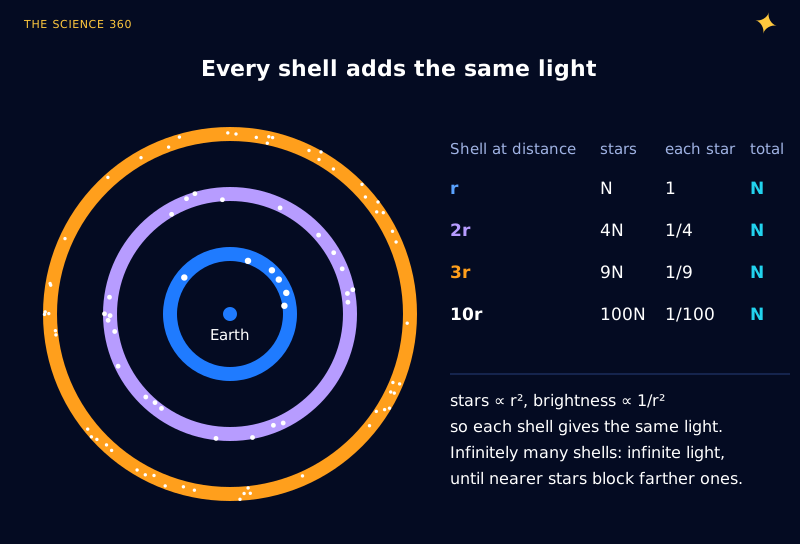
In reality the sum stops being infinite because near stars block the ones behind them. That leads to the second, cleaner version.
The line of sight argument
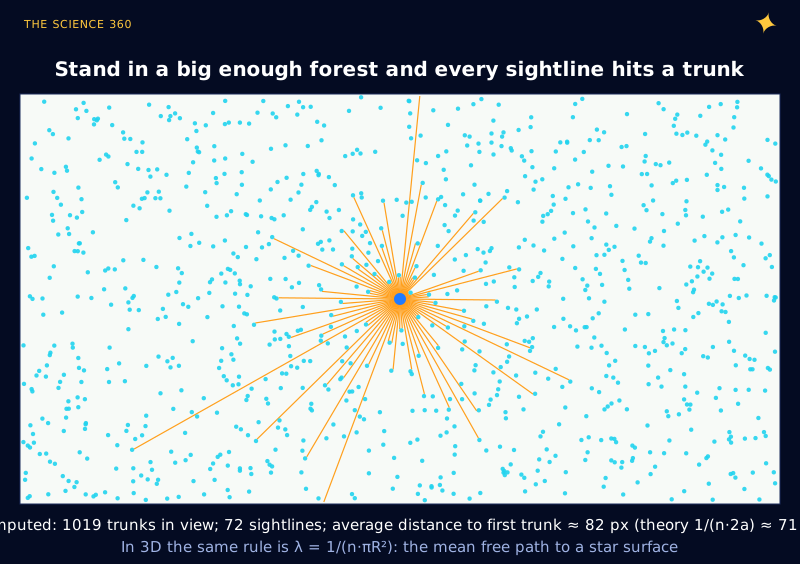
Forget the total and just follow a single line of sight. In an infinite, uniform universe it must hit a star eventually, in the same way that if you stand in a big enough forest every direction you look ends on a tree trunk. Once every line of sight ends on a star surface, the sky has the same surface brightness as an average star, everywhere.
How bright would the sky actually be?
This is easy to work out, because the answer only depends on what the surface of a star looks like, not how far away it is. (A star twice as far looks a quarter as bright but also covers a quarter as much sky, so its surface brightness is the same. That is why a distant wall of stars would look exactly like the Sun's face.)
The Sun's disk covers a solid angle of
The whole sky is , so a sky made of star surface has
times as much glowing area as the Sun's disk. Sunlight at Earth is 1361 W/m². Radiance of the Sun's face:
Irradiance on flat ground from a whole hemisphere at that radiance:
That is about 46,000 times normal sunlight.
Day and night would be indistinguishable and the ground would heat until it glowed at the same temperature as the star surfaces around it. Nothing living, nothing solid. The paradox is not a subtle effect; it is the difference between our universe and a furnace.
How far would you have to look to hit a star?
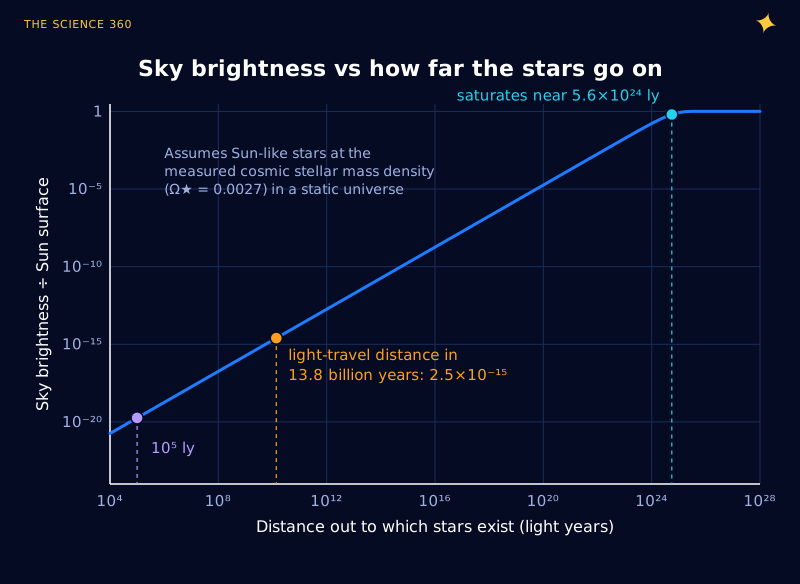
Here is the number that resolves the whole thing. In 3D, the mean distance a line of sight travels before hitting a star is the mean free path, , where is the number of stars per unit volume and is the cross section of one star. To get n for the universe as a whole, use the measured cosmic density of stars. Fukugita and Peebles's "Cosmic Energy Inventory" puts the mass in stars and stellar remnants at of the critical density.
Critical density, with :
Mass density in stars:
Treat every star as Sun-like (, ):
That is about 370 million stars per cubic megaparsec, or one star per 9×10¹⁰ cubic light years.
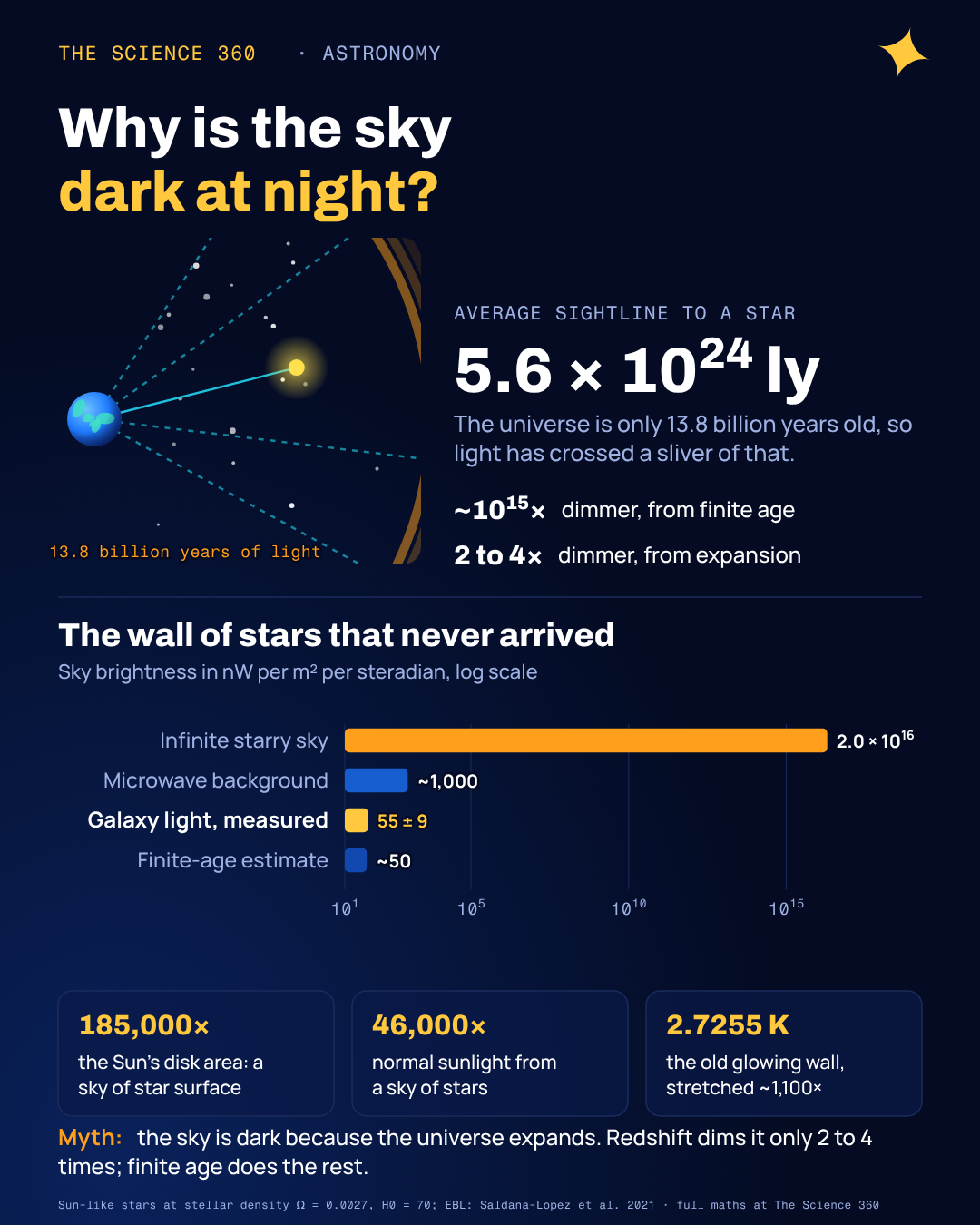
Different assumptions about the mix of stars (small red dwarfs have less cross section per kilogram than the Sun, giants have more) shift this by a factor of a few either way, and older textbook estimates land around 1023 light years. Whichever you take, the conclusion is the same, because the observable universe is about 1010 light years in light-travel terms. You fall short of the mean free path by a factor of about 1014.
Inside our own galaxy the stars are packed much tighter, about 0.1 per cubic parsec near the Sun, which shortens the mean free path to about 2×10¹⁶ light years. But the Milky Way is only about 105 light years across, so it too covers only a few parts in 1012 of the sky with star surface. The bright band of the Milky Way is many faint stars blurred together, not a solid wall.
A worked check: does this predict the sky we actually measure?
Here is a pleasing test. If the sky is covered by star surface over a fraction f of its area, it should glow with f times the Sun's radiance.
Predicted background radiance:
Measured extragalactic background light (all galaxies, ultraviolet to far-infrared): 55 ± 9 nW m−2 sr−1 (Saldana-Lopez et al. 2021).
That agreement is better than this crude model deserves. It ignores expansion (which dims the light), the fact that stars were more active in the past (which brightens it), dust that absorbs starlight and re-emits it in the infrared, and the real mix of stellar types. Several of those errors happen to cancel. But it shows the logic is sound to within an order of magnitude: the sky is dark because the "wall of stars" is covered only to one part in 1015 or so.
Is the answer finite age or the expanding universe?
This is where the common explanation goes wrong. Many popular sources say the sky is dark "because the universe is expanding and light from distant stars is redshifted". Expansion does dim distant light: each photon loses energy as it is stretched, and photons arrive less often. But the cosmologist Edward Harrison, who wrote the definitive book on the subject (Darkness at Night, 1987), showed that this is the smaller effect. Detailed calculations by Paul Wesson and colleagues found that expansion reduces the background intensity by a factor of only about 2 to 4, depending on the cosmological model. The finite age, as we just computed, accounts for a factor of around 1014 to 1015.
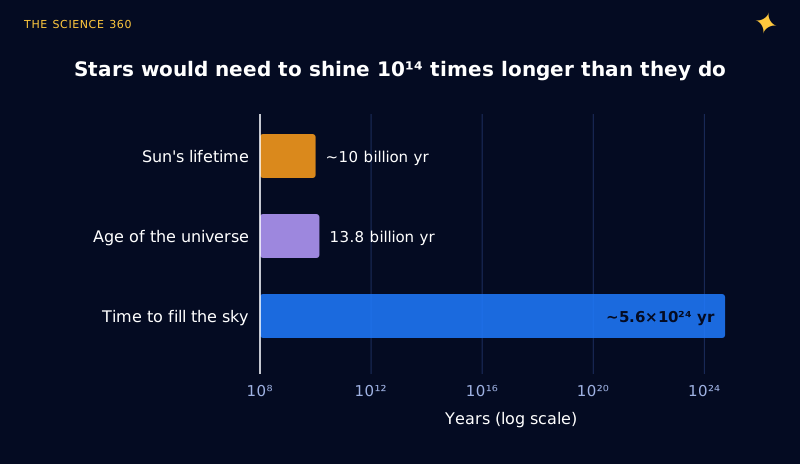
There is a second, equivalent way to say it, which Harrison emphasized. To fill the sky, starlight would have to travel 1024 light years, which means stars would have to shine for about 1024 years. The Sun will shine for about 10 billion. Even if the universe were infinitely old, there is not enough energy in stars to light up the sky: Lord Kelvin made this point quantitatively in 1901, decades before anyone knew the universe was expanding.
Two other popular explanations do not work at all:
- "Dust blocks the light." In an eternal universe the dust would absorb starlight until it heated up to the same temperature as the stars, then glow just as brightly. Absorbing light moves energy around; it does not delete it. The astronomer John Herschel raised this objection in the nineteenth century, against Olbers's own suggested answer.
- "Stars are clumped into galaxies, leaving gaps." Clumping changes how fast the sky fills up but not whether it fills. With infinitely many galaxies, every sightline still eventually ends on a star.
Did Edgar Allan Poe solve Olbers’ paradox?
Surprisingly, the first person to state the modern answer in print was not an astronomer. In his 1848 prose poem Eureka, Edgar Allan Poe wrote: "Were the succession of stars endless, then the background of the sky would present us an uniform luminosity, like that displayed by the Galaxy", since there could be "absolutely no point, in all that background, at which would not exist a star." His way out: "The only mode, therefore, in which, under such a state of affairs, we could comprehend the voids which our telescopes find in innumerable directions, would be by supposing the distance of the invisible background so immense that no ray from it has yet been able to reach us at all."
That is the light-travel-time answer, 80 years before Hubble and Lemaître. Poe had no numbers and much of Eureka is speculative to the point of mysticism, so it is fair to call it an inspired guess rather than a solution. Kelvin's 1901 paper was the first quantitative one. But the guess was right.
The sky does glow, just not where your eyes can see
Here is the twist that makes Olbers' paradox satisfying rather than merely solved. The universe does have a glowing "wall" behind everything. About 380,000 years after the Big Bang, the whole universe was a hot gas at about 3000 K, glowing orange-white, and opaque. Every line of sight that goes back far enough ends on that glowing gas, exactly as Olbers' argument says it should.
The difference is that this wall is so far back in time that the expansion has stretched its light by a factor of about 1100. The glow that left at 2973 K arrives today as the cosmic microwave background (CMB) at 2.7255 K, peaking at around 160 GHz in microwaves. So in the one place where the sightlines really do all end on a glowing surface, it is redshift that turns the surface dark. Harrison's ranking holds for starlight; for the CMB, expansion does the heavy lifting.
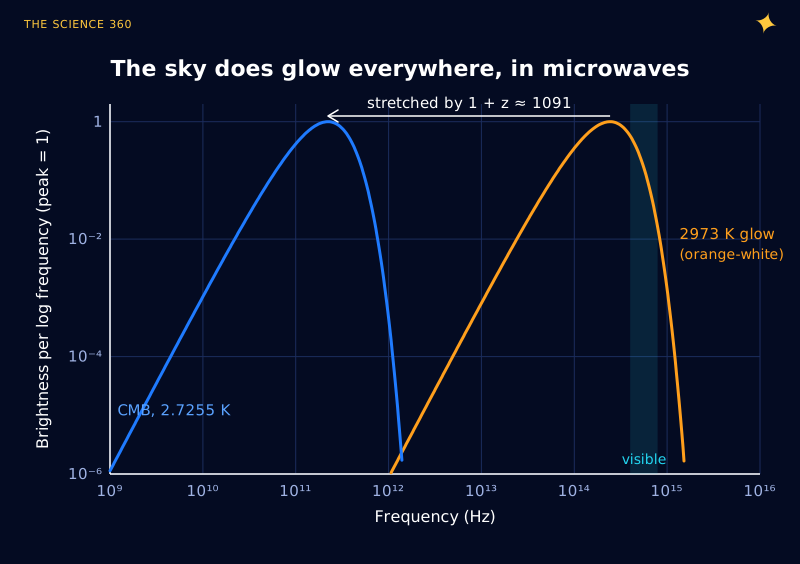
In energy terms the CMB is the brightest thing in the night sky by far. Its radiance is , about 18 times the combined light of every galaxy that ever existed. Old analog TVs tuned between channels picked up a small fraction of it as snow. Olbers was right that the sky glows everywhere; he just was not looking in microwaves.
The same inverse square law that sets up the shell argument also decides how bright a nearby supernova would be: see how bright the Betelgeuse supernova will be. And for the color of our own star, the one patch of star surface we do get to see up close, read what color the Sun really is.
FAQ
What is Olbers’ paradox in simple terms?
If the universe were infinite, unchanging and evenly filled with stars forever, every line of sight would eventually end on the surface of a star, so the whole night sky would be as bright as the surface of the Sun. It is dark, so at least one of those assumptions must be wrong.
Why is space black if there are so many stars?
Stars are extremely sparse compared with their size. An average line of sight would have to run about 1024 light years before hitting a star surface, but the universe is only 13.8 billion years old, so light has only reached us from a tiny fraction of that distance. Only about one part in 1015 of the sky is covered.
Does the expansion of the universe explain the dark sky?
Only partly. Redshift dims the background light by a factor of about 2 to 4 in detailed models. The finite age of the universe and the short lives of stars reduce it by a factor of roughly 1014 to 1015, so finite age is the main answer.
Can interstellar dust explain why the sky is dark?
No. In an eternal universe, dust absorbing starlight would heat up until it glowed as brightly as the stars themselves. Absorption only moves the energy around.
Is the night sky completely dark?
No. Away from stars there is a faint extragalactic background light from all galaxies, about 55 nW m−2 sr−1, and a much brighter cosmic microwave background, about 1000 nW m−2 sr−1, which fills the whole sky but is invisible to our eyes.
Related on The Science 360
Sources
- Harrison, E. R. (1974), "Why the sky is dark at night", Physics Today 27(2), 30: physicstoday.aip.org; and Harrison, E. (1987), Darkness at Night: A Riddle of the Universe, Harvard University Press
- Olbers' paradox, history (Kepler 1610, Halley, de Chéseaux 1744, Olbers 1823, Kelvin 1901): en.wikipedia.org/wiki/Olbers'_paradox
- Fukugita, M. and Peebles, P. J. E. (2004), "The Cosmic Energy Inventory", ApJ 616, 643 (Ωstars = 0.0027 ± 0.0005): arxiv.org/abs/astro-ph/0406095
- Wesson, P. S. (1991), "Olbers's Paradox and the Spectral Intensity of the Extragalactic Background Light", ApJ 367, 399 (expansion reduces intensity by a factor of about 3 to 4): ui.adsabs.harvard.edu
- Knutsen, H. (1997), "Darkness at night", European Journal of Physics 18, 295: if.ufrj.br (PDF)
- Saldana-Lopez, A. et al. (2021), extragalactic background light from HST/CANDELS, integrated EBL 55.1 ± 8.6 nW m−2 sr−1: arxiv.org/abs/2012.03035
- Poe, E. A. (1848), Eureka: A Prose Poem, Project Gutenberg: gutenberg.org/ebooks/32037
- Fixsen, D. J. (2009), "The Temperature of the Cosmic Microwave Background", ApJ 707, 916 (2.72548 K): arxiv.org/abs/0911.1955
- NASA WMAP, "Tests of Big Bang: The CMB" (380,000 years, ~3000 K): map.gsfc.nasa.gov
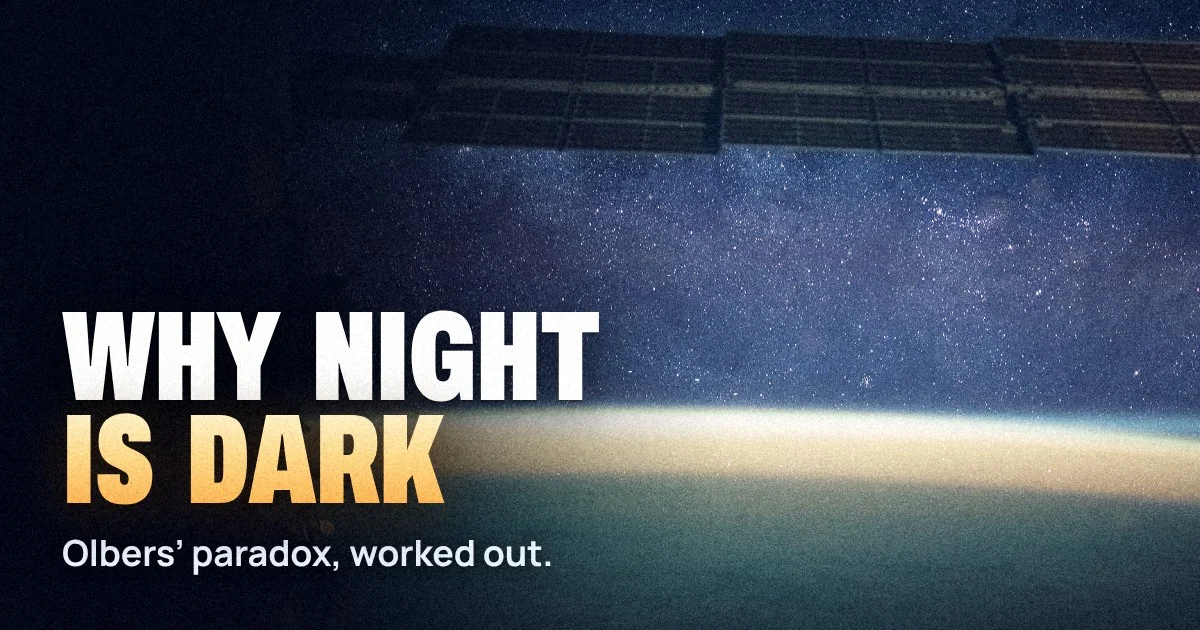
Header image: NASA (image iss073e0982261), regraded for this article.