Why Stars Twinkle but Planets Don't (With the Math)
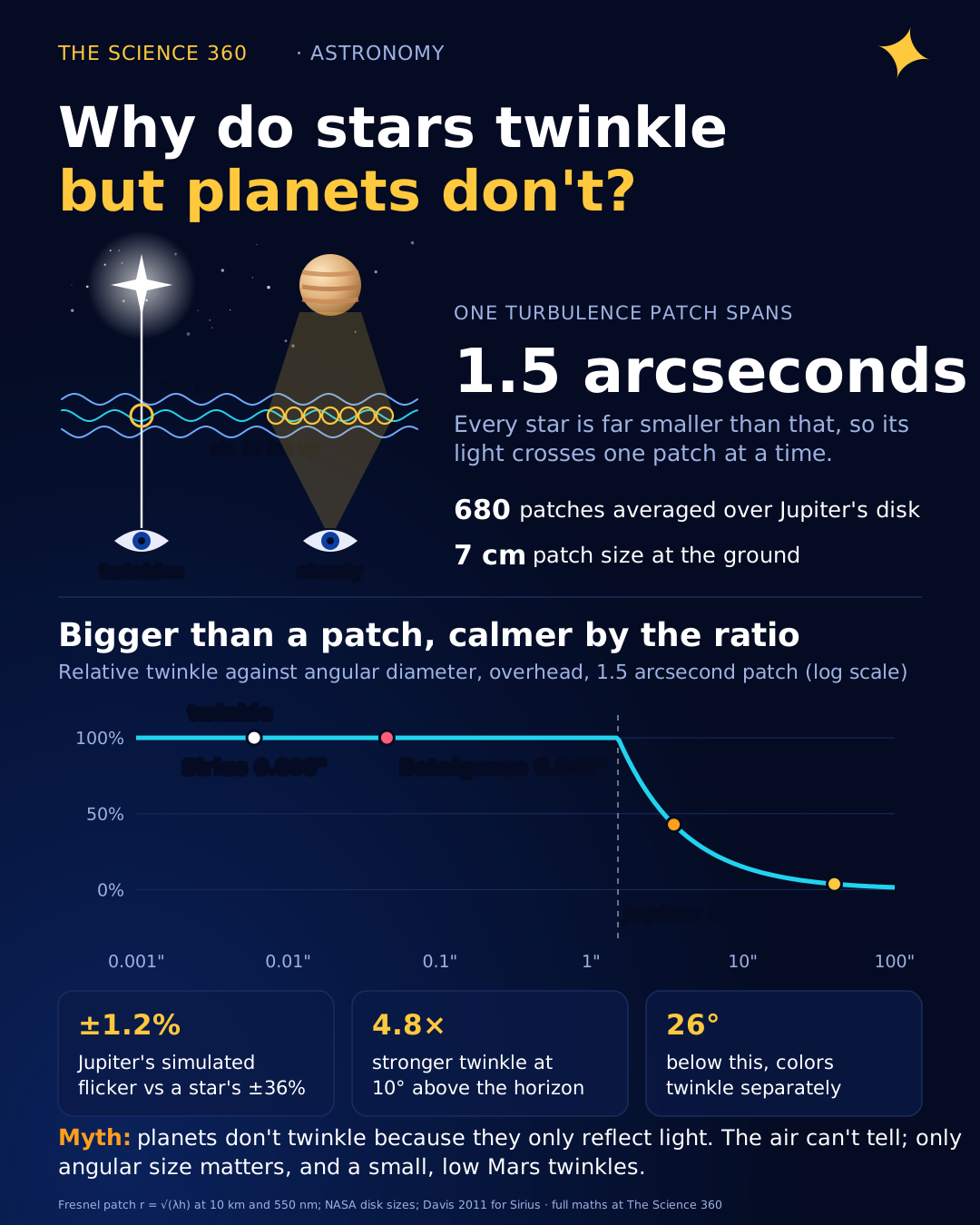
Sirius, the brightest star in the night sky, is about 0.006 arcseconds across as seen from Earth. Jupiter, which often hangs near it in winter skies, is around 40 arcseconds across. That is a ratio of nearly seven thousand. Both look like dots to your eye, yet one sparkles like a cut diamond and the other sits there as calm as a streetlight. The whole difference between twinkling and not twinkling lives inside that ratio, and you can work it out on the back of an envelope.
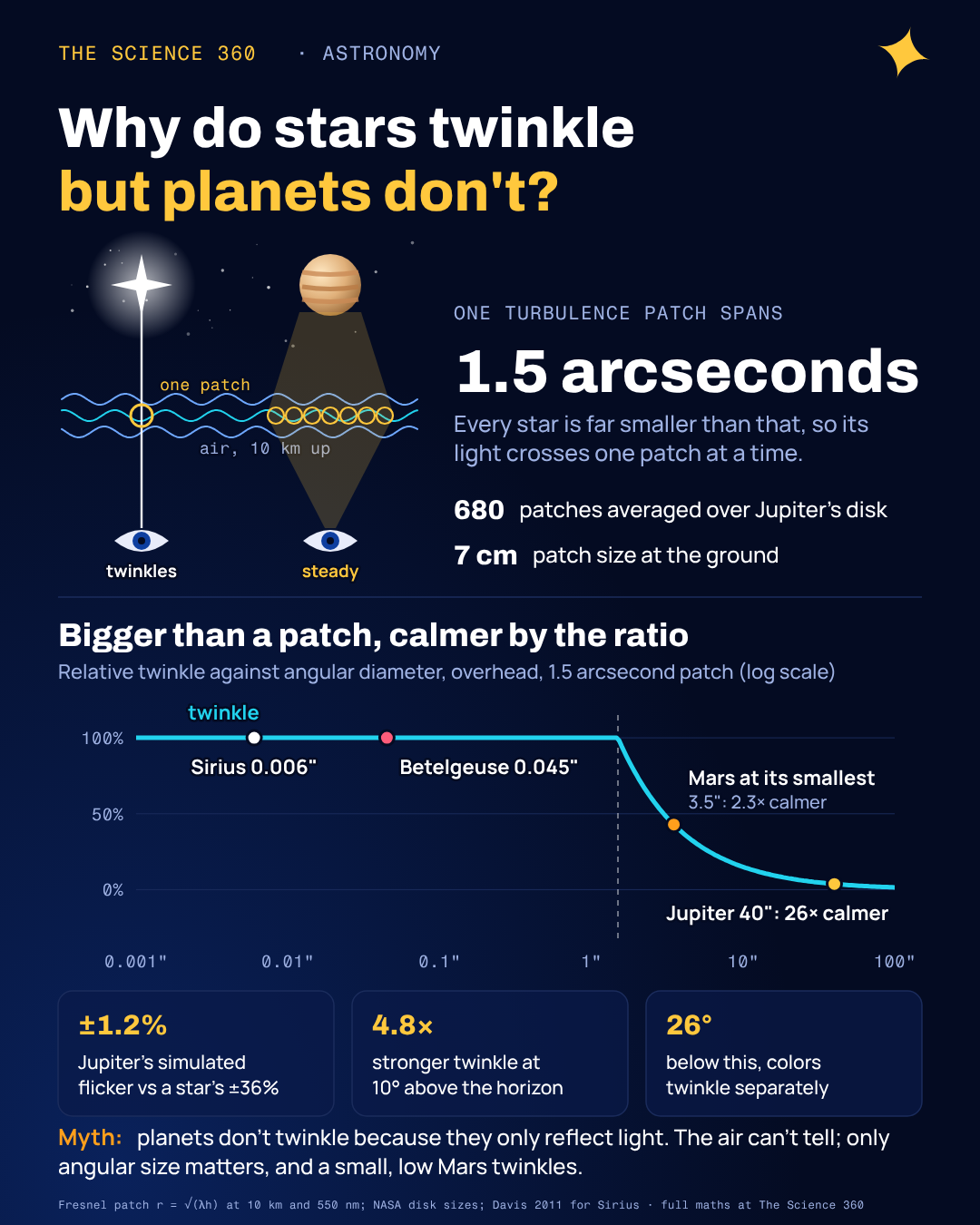
Most explanations stop at "planets are disks, stars are points". That is correct, but it hides the useful part: how big a disk has to be, compared with what. Once you have the number, you can also predict when a planet will twinkle (and it does), and why Sirius flashes colors when it is low.
What actually makes a star twinkle?
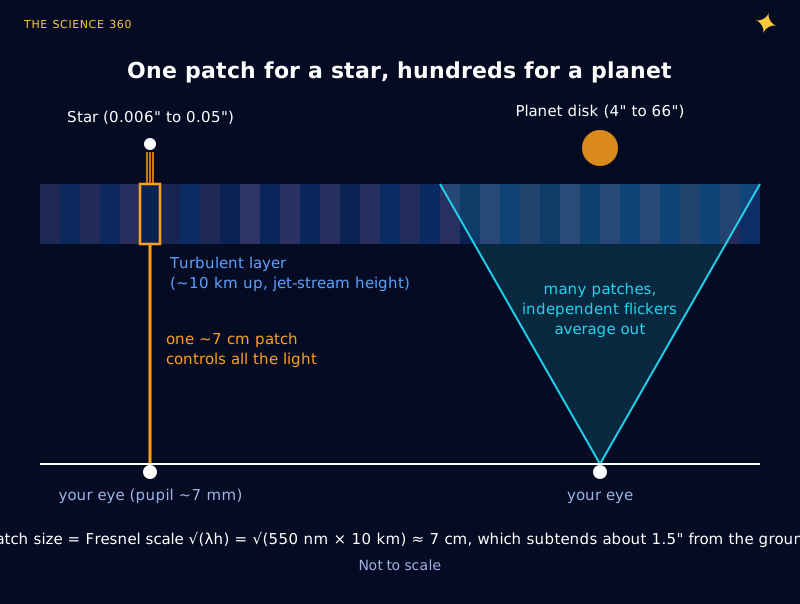
Air bends light a tiny amount, and how much depends on its density, which depends on its temperature. The atmosphere is full of turbulent blobs that differ by a fraction of a degree. Each blob acts like a very weak lens. A single weak lens does almost nothing to the overall direction of starlight, but by the time the light has travelled a few kilometers past the turbulent layer, those slight bends have rearranged the light on the ground into a mottled pattern of brighter and darker patches. If you could see it on the ground, it would look like the wavy light on the bottom of a swimming pool. Astronomers call the effect scintillation.
The wind carries this pattern past you. Your pupil, at most about 7 mm wide at night, is much smaller than the patches, so your eye samples one patch at a time. When a bright patch slides across your pupil the star looks brighter, and when a dark one does it dims. That is twinkling: you are watching an interference-and-focusing pattern sweep across your eye at wind speed.
How big are the patches? Optics gives a clean answer. The characteristic size of the scintillation pattern is the radius of the first Fresnel zone, , where is the wavelength and is the distance from the turbulent layer to you. Durham University researchers put it plainly in a 2015 paper on scintillation noise: a turbulent layer at 10 km observed at 500 nm makes patches about 0.07 m across, whatever the strength of the turbulence. Strength sets how deep the flicker is; distance sets the patch size.
The worked calculation: how many patches does a planet average over?
Here is the key step most explanations skip. We need the angle a single patch covers as seen from the ground, then we compare it with the planet's angular size.
Step 1. Patch size at the ground
For a layer up and (green light):
Step 2. Angle that patch subtends from the ground
Step 3. Jupiter's disk, about 40″ (NASA range: 30.5″ to 50.1″)
Circle compared with circle, so the area ratio is just the diameter ratio squared.
Step 4. Independent flickers average down as
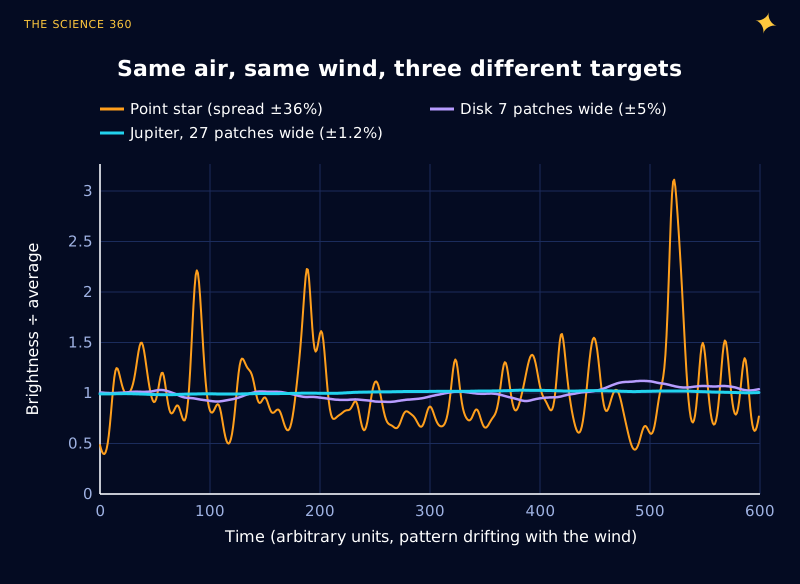
A star flickering by ±36% would become a Jupiter flickering by about ±1.4%.
Step 5. Betelgeuse, one of the largest stars in angular size, about 0.045″
It is a point as far as the air is concerned.
So "smaller than the turbulence" understates it for a star: even the fattest star in the sky is about 30 times smaller than one patch, and Sirius is about 250 times smaller. Jupiter is 26 times bigger. Those two ratios point in opposite directions, and that is why one twinkles and the other does not.
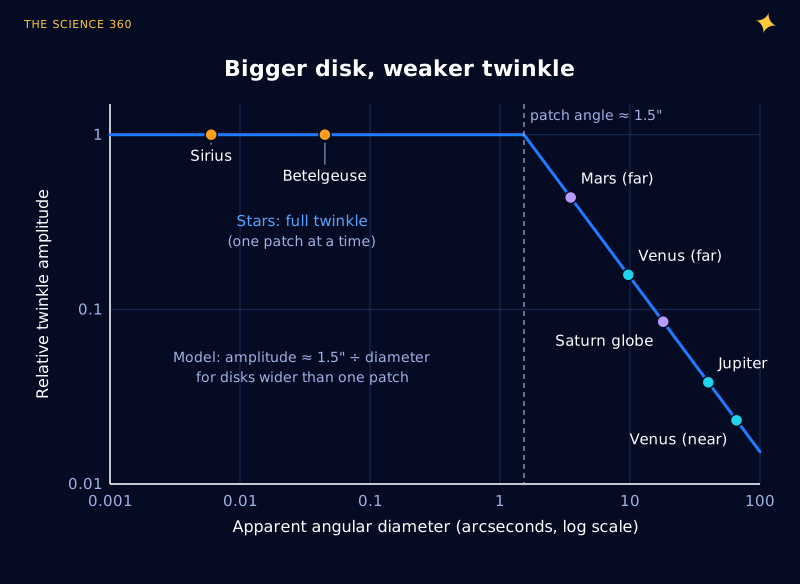
A tidy way to state the rule: for a disk wider than one patch, the twinkle amplitude falls roughly as . Radio astronomers use exactly the same relation for quasars twinkling in the solar wind (a source wider than the "Fresnel angle" scintillates less, in proportion to its size), which is a nice sign the physics is general.
To check that the averaging argument holds up beyond hand waving, I simulated it. The code builds a random, smoothly varying brightness pattern with a known patch size, slides it past three "eyes" and records what each sees: a point, a disk 7 patches wide, and a disk 27 patches wide (Jupiter). Over the whole simulated field the point varies by ±36%, the 7-patch disk by ±4.7% and the Jupiter disk by ±1.2%. The ratios come out at about 7.6 and 29, close to the 7 and 27 the square-root rule predicts.
The common misconception: planets don’t twinkle because they reflect light
You will still find this on quiz sites and in some school worksheets: stars twinkle because they make their own light, planets do not because they only reflect sunlight. It is wrong, and easy to disprove. The Moon reflects sunlight and a bright star emits its own; put a tiny reflecting asteroid next to that star and both would twinkle exactly the same, because the atmosphere has no idea where the light came from. What matters is angular size. Mars proves the point from the other side: it reflects sunlight like every planet, yet when it is far from Earth and its disk shrinks to 3.5 arcseconds it twinkles noticeably, as the calculation below predicts.
A second, subtler mix-up is treating twinkling and "seeing" as the same thing. They come from the same air but measure different things.
- Seeing is blur and image jitter: the light arrives at slightly different angles. It is described by the Fried parameter r0, about 10 cm at a typical site in visible light, which gives a seeing disk of roughly λ/r0 ≈ 1 arcsecond. Seeing is dominated by turbulence near the ground and in the lowest kilometer.
- Twinkling (scintillation) is the brightness change. It needs distance to develop, so it is dominated by high layers. In the standard small-aperture formula the turbulence at height h is weighted by h5/6, so a layer at 10 km counts about 46 times more, per unit of turbulence, than one at 100 m.
That is why a night with a ripping jet stream overhead makes stars dance even when the air near the ground is still, and why astronomers can have bad seeing with quiet twinkling, or the reverse.
Why do stars twinkle less through a telescope?
Same reason planets twinkle less. A 20 cm telescope collects light over about 800 times the area of your dark-adapted pupil, enough to span several 7 cm patches at once. The telescope's lens is doing to a star what Jupiter's disk does for Jupiter: averaging many independent patches. This "aperture averaging" is why photometry with large telescopes reaches precisions that would be impossible with a small lens, and why a star that seemed to sparkle by eye looks steadier, if wobblier, in the eyepiece.
When do planets twinkle?
Here is where the numbers earn their keep. "Planets don't twinkle" is a rule of thumb, and you can calculate when it breaks.
Look at a planet 10° above the horizon. Your line of sight now crosses the 10 km layer about 57 km away instead of 10 km, and passes through about 5.6 times as much air (the airmass). Two things change:
Airmass at 10° altitude:
With Earth's curvature included it is 5.6.
1. Patch angle shrinks as
2. Point-source twinkle grows
Scintillation variance scales as (weak-turbulence theory, Dravins et al.), so amplitude scales as :
So a star at 10° twinkles about 4.8 times as strongly as one overhead.
Each number is the planet's twinkle at 10° altitude as a fraction of an overhead star's.
So a small Mars low in the sky should twinkle almost as hard as a star overhead, and observers report exactly that. Mercury, which is 4.5 to 13 arcseconds across and is only ever seen low in twilight, is the planet most often caught twinkling. Venus low in a turbulent sky can shimmer noticeably. Jupiter rarely does.
One honest caveat. Close to the horizon the weak-turbulence formula overestimates the growth, because scintillation "saturates" once the light has been scrambled by several layers, and the amplitude stops climbing as fast. So read those numbers as an upper bound on the trend, not as precise predictions. The direction of the effect is solid; the exponent near the horizon is not.
Why does Sirius flash different colors?
Watch Sirius rising on a cold winter evening and it flickers red, green and blue, sometimes fast enough to look like a disco ball. The star is not changing. The atmosphere near the horizon acts like a weak prism: blue light is refracted slightly more than red, so the two colors reach your eye along slightly different paths.
Using the standard refractive index of air ( at 450 nm and at 650 nm), the blue and red images of a star at 10° altitude are separated by about 5 arcseconds. Traced back up to the 10 km turbulent layer, the blue and red beams are something like 80 cm apart, while the patches there are only about 18 cm across. So the blue light and the red light are being twinkled by different pieces of air. When the blue happens to hit a bright patch and the red a dark one, the star flashes blue for a split second.
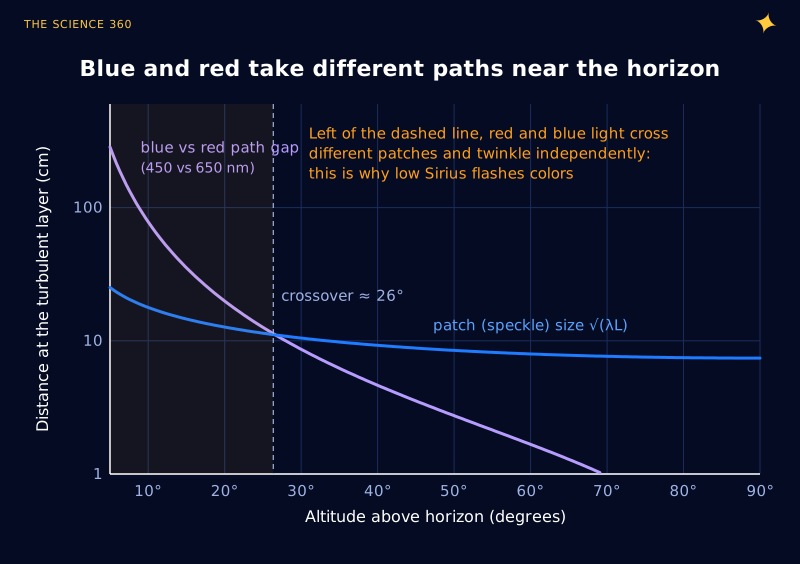
Sirius sits at a declination of about −17°, so from 40° north it never climbs higher than about 33°, and from Britain or Germany it peaks around 20° to 25°. For most northern observers it spends its whole night in or near the color-flashing zone of Figure 4, and it is bright enough for your color vision to work. That combination, not anything special about the star, is why it has a reputation. Fainter low stars flash colors too; you just cannot see the color.
Do stars twinkle in space?
No. Every bit of twinkling comes from the last 20 kilometers or so of the light's trip, after it has crossed trillions of kilometers of empty space without a flicker. Astronauts describe stars from orbit as steady points, and space telescopes measure stellar brightness to parts per million precisely because there is no air in the way. On the ground, astronomers fight scintillation with large apertures, longer exposures and, on the biggest telescopes, adaptive optics, which corrects the image blur (although not the light lost to brightness fluctuations).
How to use this tonight
- A bright point that is high and steady is almost certainly a planet. A bright point that is high and sparkling is a star.
- Near the horizon, the test gets unreliable. Wait an hour for the object to climb, or compare it with a known star at the same height.
- If the stars overhead are barely twinkling, the upper air is calm, and it is a good night to look at planets through a telescope; if they are dancing, the jet stream is probably right above you.
Twinkling is an optics problem with a size threshold of about one and a half arcseconds. Everything on the star side of that line sparkles; everything on the planet side averages itself into calm. The atmosphere that makes this happen also decides what color the Sun looks, which is a story for what color the Sun really is.
FAQ
Do planets ever twinkle?
Yes. A planet low on the horizon, or a small one such as Mars near its farthest from Earth or Mercury, can twinkle visibly. Near the horizon the light crosses about five times more air and the turbulence patches shrink in angle, so even a small disk no longer averages the flicker away.
Why do stars twinkle different colors?
Low in the sky, the atmosphere acts like a weak prism. Blue and red light from the same star take paths that are tens of centimeters apart when they cross the turbulent layer, so each color brightens or dims independently. Below roughly 25° altitude this makes bright stars like Sirius flash red, green and blue.
Do stars twinkle in space?
No. Twinkling is made entirely by Earth's atmosphere. Astronauts on the International Space Station and telescopes like Hubble and JWST see stars as steady points.
Is twinkling a reliable way to tell a planet from a star?
It is a good rule of thumb for objects well above the horizon: a bright, steady point is probably Venus, Jupiter, Saturn or Mars. It fails near the horizon, where planets can flicker, and on very calm nights, when even stars barely twinkle.
Why do stars twinkle more on some nights than others?
Twinkling depends mostly on turbulence high up, around jet-stream altitude. A strong jet stream overhead means strong twinkling. On nights when the upper air is calm, stars shine more steadily even if the air near the ground is moving.
Related on The Science 360
Sources
- Osborn, J. et al. (2015), "Atmospheric Scintillation in Astronomical Photometry", MNRAS (Fresnel-zone patch size, ~0.07 m for a 10 km layer at 500 nm; small-aperture formula with (cos γ)−11/6): arxiv.org/abs/1506.06921
- Astronomical seeing (Fried parameter, r0 ≈ 10 cm and ~1" seeing): en.wikipedia.org/wiki/Astronomical_seeing
- Isaac Newton Group, DIMM seeing monitor (median r0 ≈ 15 cm at La Palma): ing.iac.es
- NASA NSSDC, Jupiter Fact Sheet (apparent diameter 30.5" to 50.1"): nssdc.gsfc.nasa.gov/planetary/factsheet/jupiterfact.html
- NASA NSSDC, Planetary Fact Sheets (Venus 9.7" to 66", Mars 3.5" to 25.1"): nssdc.gsfc.nasa.gov/planetary/factsheet/
- Davis, J. et al. (2011), "The Angular Diameter and Fundamental Parameters of Sirius A", PASA (6.04 mas): arxiv.org/abs/1010.3790
- Betelgeuse angular diameter measurements (~0.042" to 0.056" depending on epoch and wavelength): en.wikipedia.org/wiki/Betelgeuse
- Interplanetary scintillation of compact radio sources, source size versus Fresnel angle: arxiv.org/abs/1711.00393
- EarthSky, "Why don't planets twinkle as stars do?": earthsky.org
- BBC Sky at Night, Sirius flashing colors near the horizon: skyatnightmagazine.com
Header image: NASA (image iss073e0982823), regraded for this article.