What Causes the Green Flash at Sunset? The Numbers
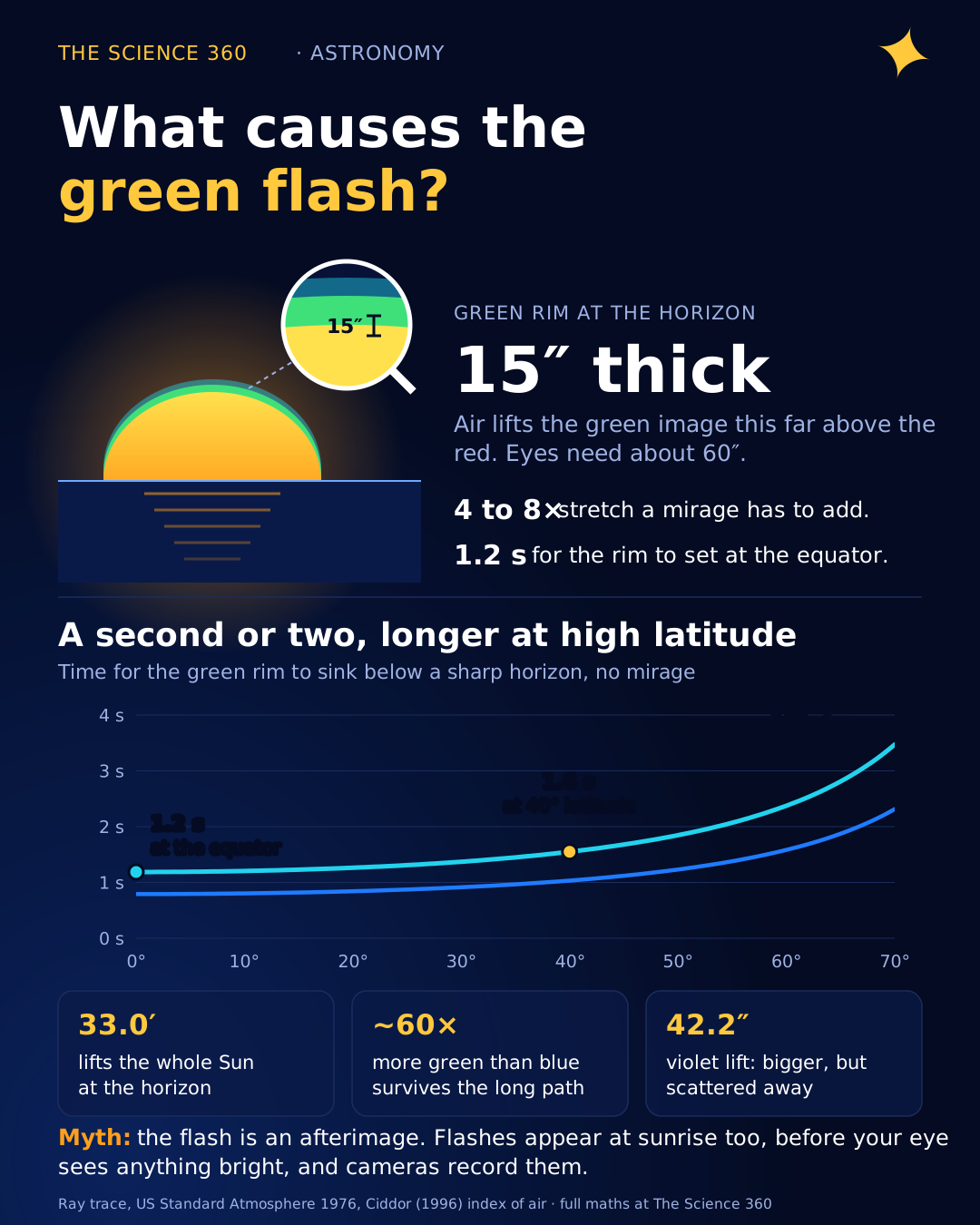
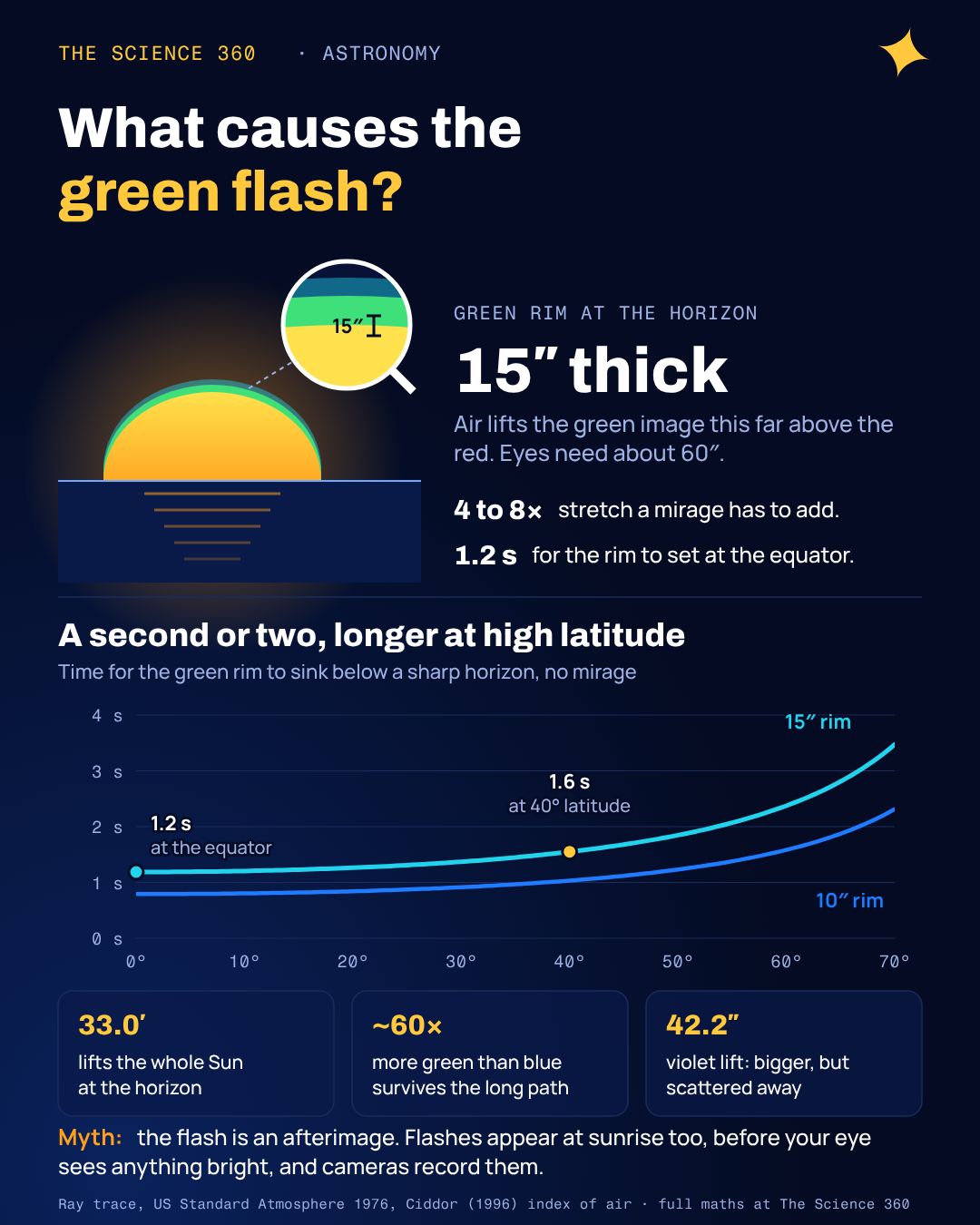
Every clear sunset you have ever watched had a green edge on top of the Sun. It was there, in real light, and a pair of binoculars would have shown it. You did not see it because it was about 15 arcseconds thick, about the width of a 0.1 mm hair held 1.4 metres from your eye. The naked eye needs about 60. The green flash that people actually see, and photograph, happens on the evenings when the air near the horizon acts as a magnifying lens for that rim.
Most pages on the green flash get the first half of this right: refraction bends green light more than red, and blue gets scattered away. Few of them put numbers on it, and almost none explain why that textbook mechanism is far too small to see on its own. A minority still describe the flash as an afterimage, which it is not. Below we trace sunlight through a standard atmosphere and work out how thick the green rim is, how long it lasts and why a mirage is usually needed.
How much does the atmosphere bend the setting Sun?
Light from the Sun enters the atmosphere at a shallow angle and passes into denser and denser air, which bends it downward along a curved path. You see the Sun along the direction the light arrives from, so it appears higher than it really is. At the zenith this effect is zero. At the horizon it is huge.
We traced rays through the US Standard Atmosphere (15 °C at sea level, temperature falling 6.5 °C per kilometre), using the Ciddor (1996) formula for the refractive index of air and integrating the bending layer by layer over a curved Earth.
Refraction at the horizon, 550 nm light
Refractive index of standard air: .
Ray trace, US Standard Atmosphere, Sun's apparent centre on the horizon: 33.0′.
Bennett's (1982) formula, standardised to 10 °C and 101.0 kPa:
The Sun's angular diameter is about 32′, so when the bottom of the Sun appears to touch a sea horizon, the whole Sun is geometrically below it.
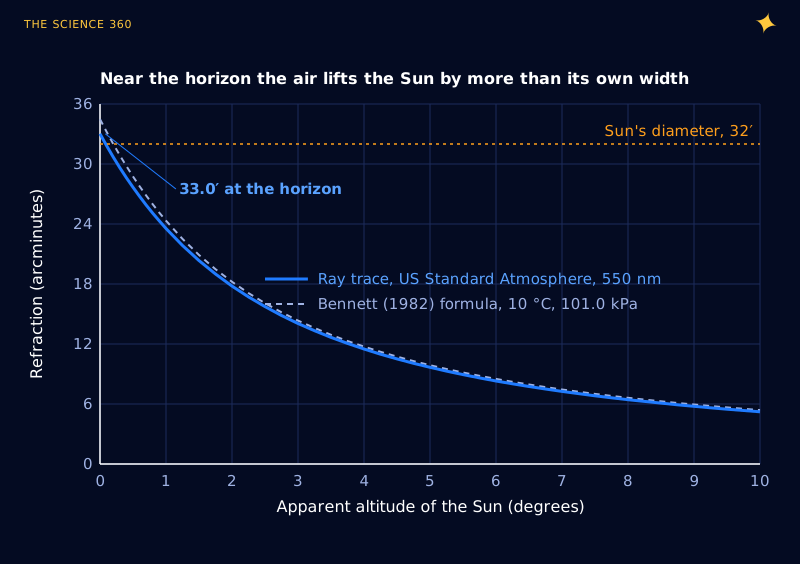
Refraction also falls steeply with altitude near the horizon, by about 11′ per degree. The bottom of the setting Sun is lifted more than the top, which squashes the disk into the familiar flattened oval. It also slows the apparent sunset, which matters for timing the flash.
Why does green light get bent more than red?
Air, like glass, has a refractive index that rises toward short wavelengths. The effect is tiny, but at the horizon it multiplies a 33′ total.
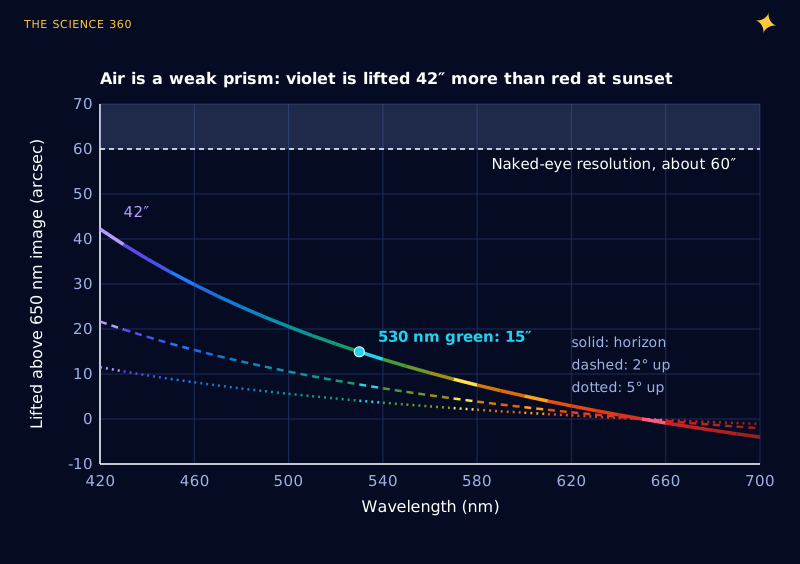
Dispersion of air (Ciddor 1996, standard air)
Refraction scales almost exactly with , so green is lifted more than red by
Full ray trace: 14.9″ for 530 nm, 32.6″ for 450 nm, 42.2″ for 420 nm.
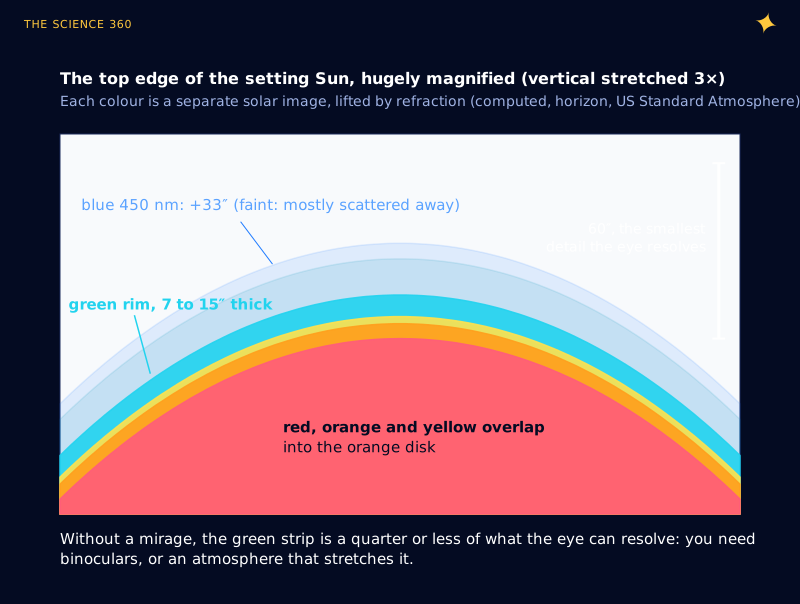
So the setting Sun is really a stack of slightly offset images, one per colour, with the violet image highest. Through the body of the disk they overlap and add up to orange. Only at the top edge does the short-wavelength image stick out on its own, and at the bottom edge the red one does. That is the green upper rim and the red lower rim, and astronomers have recorded them since Pierre Bouguer described the blue upper limb in 1748.
Why is the flash green and not blue or violet?
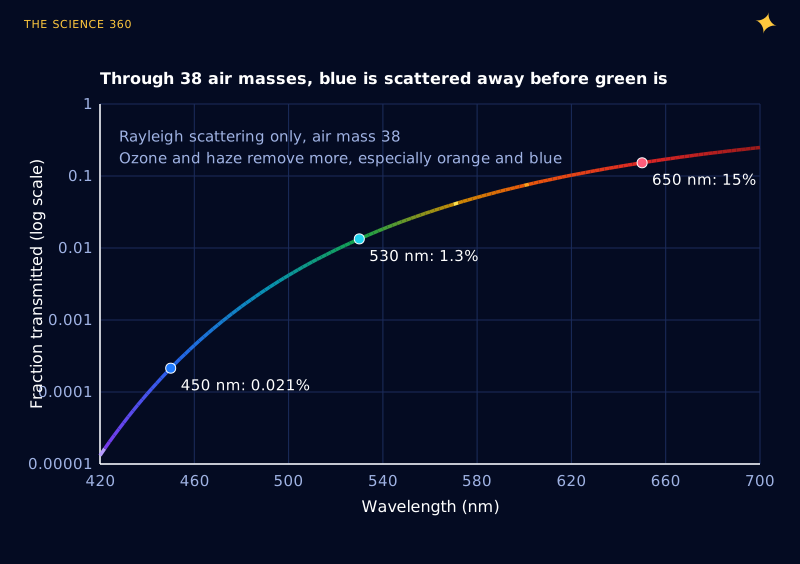
If dispersion were the whole story, the last light to vanish would be violet. It is not, because the sunlight skimming the horizon has crossed a huge amount of air. Our ray trace gives an air mass of 38.2 at the horizon (that is, 38 times the air you look through straight up), and Rayleigh scattering removes short wavelengths fast over that path. This is the same scattering that makes the daytime sky blue, which we worked through in why the sky is blue and not violet.
Rayleigh transmission through 38.2 air masses (Bodhaine et al. optical depths)
Green arrives about 60 times stronger than blue, relative to the light each started with.
Two more filters act on the colour. Ozone absorbs in a weak band centred on orange, which Andrew Young (San Diego State University), who has studied green flashes for decades, credits with most of the orange removal. And haze or pollution can remove the green too, leaving a yellow flash. In exceptionally clean air enough blue survives for a rare blue flash.
Combine dispersion and scattering and you get the colour order on the top of the Sun: red, orange and yellow merged into the disk, then a green strip, then a faint cyan and blue fringe that has mostly been scattered away.
The misconception: the textbook green flash is too small to see
Here is where page 1 goes quiet. The usual explanation stops at "refraction separates the colours, the green is the last to set". That mechanism is real, but on its own it makes a rim 7 to 15″ thick, against a naked-eye resolution of about 60″ (the definition of 20/20 vision is resolving detail 1 arcminute across). That is 4 to 8 times too thin. Young's history of the subject credits Gerhard Dietze with showing in 1955 that the standard-atmosphere flash is "ten times smaller than the naked eye can see"; Dietze's factor includes contrast and brightness, not just geometry, but the conclusion is the same. Dietze published in an East German journal and the result was overlooked for about 40 years.
Young's own simulations of the standard-atmosphere sunset describe that textbook flash as "so puny it can only be seen through binoculars". In binoculars or a telephoto viewfinder, you can see the green rim on most clear evenings, and his advice is to look 5 to 10 minutes before sunset when the Sun is 3 or 4 diameters up. Do that with care: never point binoculars at the Sun while it is still bright and high.
So how does anyone see one?
Most naked-eye flashes need a mirage. The air just above the sea is rarely at the temperature the standard atmosphere assumes. When the water is warmer than the air, the bottom few metres of air are warmer and less dense, and rays are bent upward near the surface: an inferior mirage, the same effect as a "wet" road on a hot day. The setting Sun then shows an inverted image below its erect image, and the two join in an Ω shape.
Young's description of his inferior-mirage simulation, computed for an observer 4 m above sea level, is that the flash "appears where the erect and inverted images join", in "a narrow zone of sky parallel to the horizon that has very great vertical magnification". When the green rim reaches that zone it is stretched enough to be seen. From our numbers, the stretch has to be at least 4 to 8 times for a 7 to 15″ rim to reach 60″, which is our own estimate of the threshold.
When the water is colder than the air above it, you get the opposite: a temperature inversion. Rays bending around the inversion make a mock mirage, which slices thin strips off the top of the Sun and can tint a detached strip green. Under a strong inversion, a duct can trap light and produce the rarer sub-duct flash, which Wikipedia's summary of the literature puts at up to 15 seconds. All of these are refraction by layers below your eye level, not in the upper atmosphere.
Mirages and refraction this close to the horizon are also why the distance to the sea horizon is not quite what simple geometry predicts, which we calculate in how far is the horizon. And the same thin, layered air near the ground is what makes stars twinkle while planets don't.
Is the green flash an afterimage?
No, but there is a grain of truth in the idea. The afterimage claim falls apart at sunrise: flashes appear as the first sliver of the Sun breaks the horizon, before your eyes have been exposed to anything bright, and observers have reported sunrise flashes since the earliest records. Flashes are also photographed routinely, and a camera has no afterimage. Young points out that a real solar afterimage is much dimmer and bluer, and so inconspicuous that he knew of only two or three published observations of it.
The grain of truth is bleaching. If you stare at the low orange-red Sun for a few seconds, the red-sensitive pigment in your retina is partly used up. Young notes that this is enough to make most flashes look green at a stage where they photograph as yellow. So at sunset the colour you perceive is part physics, part physiology. At sunrise it is almost pure physics. The light is real either way.
How long does a green flash last?
The Sun moves across the sky at 15.04″ per second of time (360° in one sidereal day). Near the equator it sets almost vertically. At latitude φ, with the Sun on the celestial equator, its altitude falls at 15.04″ × cos φ per second. Refraction slows the apparent motion further: because refraction drops by about 0.19′ for every 1′ of altitude near the horizon, the apparent Sun sinks about 19% slower than the true one (a factor 1 / 1.19 = 0.84).
Time for a 15″ green rim to sink below a sharp horizon
The Sun moves 15.04″ per second; at latitude it sinks at that rate times at the equinox.
Latitude 40° covers the Mediterranean and mid-USA; 60° is Oslo or Anchorage. Away from the equinoxes the Sun sets at an even shallower angle, so these are lower limits at a given latitude.
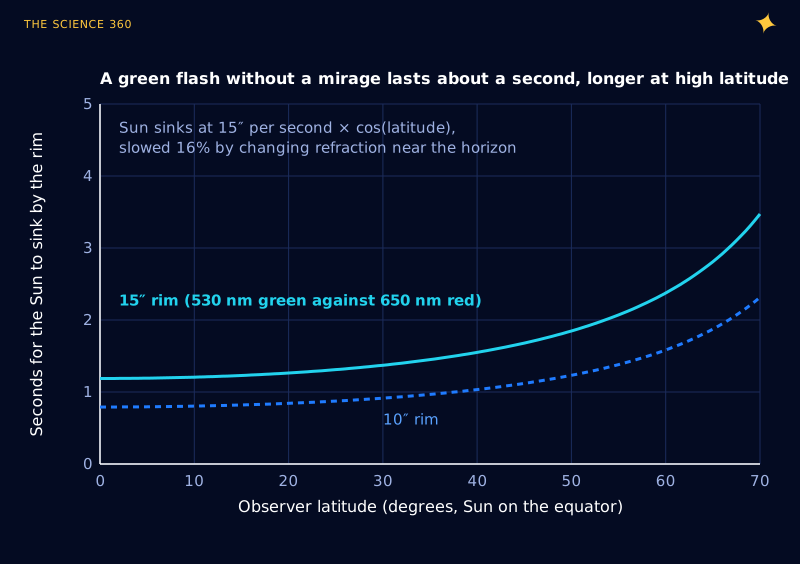
That matches the observing record: Young puts the green colour at "a second or two at moderate latitudes", and Wikipedia's summary notes that at the equator a flash rarely lasts longer than a second. At high latitudes in summer, where the Sun slides along the horizon, it can come and go repeatedly. The best-known case is the Byrd Antarctic expedition, which reported green seen on and off for 35 minutes as the Sun skimmed an uneven ice horizon. Young's account, drawing on the expedition meteorologist W. C. Haines, is that the individual flashes lasted from a fraction of a second to several seconds, spread over more than half an hour, not one continuous 35-minute flash.
Where did the idea of a green ray come from?
Jules Verne's 1882 novel Le Rayon vert (The Green Ray) popularised the phenomenon. The genuine "green ray", a green beam extending a few degrees up from the horizon after sunset, does exist, but it is much rarer than the "green dot" or flattened green segment most people see, and it needs hazy air to light up the beam.
FAQ
What causes the green flash at sunset?
The atmosphere refracts green light slightly more than red, so the green image of the Sun sits about 15 arcseconds higher than the red one at the horizon. Blue and violet are lifted even more but are scattered away along the long horizon path. A mirage near the horizon usually stretches that thin green rim enough for the naked eye to see it for a second or two.
Is the green flash an afterimage?
No. Green flashes are seen at sunrise, before the eye has been exposed to the Sun, and they are routinely photographed. Staring at the red setting Sun does bleach the red-sensitive pigment in your eye, which can make a yellowish flash look greener, but the flash itself is real light.
How long does a green flash last?
Usually a second or two. Without a mirage the green rim takes about 1.2 seconds to sink at the equator and about 2 seconds at 55 degrees latitude, because the Sun sets at a shallower angle further from the equator. Rare duct displays last longer, up to about 15 seconds.
Do you need an ocean horizon to see a green flash?
No. Flashes are seen over land and from mountains too. A sea or large lake horizon helps because water's temperature differs from the air above it, which creates the mirages that magnify the green rim, and because the horizon is sharp and distant.
Why is the flash green and not blue?
Blue and violet are refracted even more than green, but at the horizon sunlight passes through about 38 times more air than overhead. Rayleigh scattering alone then lets through about 1.3% of 530 nm green but only about 0.02% of 450 nm blue. In exceptionally clear air a blue flash is occasionally seen.
Related on The Science 360
Sources
- A. T. Young, San Diego State University, "An Introduction to Green Flashes": aty.sdsu.edu
- A. T. Young, "Simulation of the Textbook Green Flash" (binocular visibility, timing advice, Bouguer 1748): aty.sdsu.edu
- A. T. Young, "Simulation of the Inferior-Mirage Green Flash at Sunset" (4 m observer, magnification zone): aty.sdsu.edu
- A. T. Young, "Green-flash Fallacies and Misconceptions" (afterimages, bleaching, Dietze 1955, Byrd expedition, ozone): aty.sdsu.edu
- P. E. Ciddor, "Refractive index of air: new equations for the visible and near infrared", Applied Optics 35, 1566 (1996), via refractiveindex.info: refractiveindex.info
- B. A. Bodhaine et al., "On Rayleigh optical depth calculations", J. Atmos. Oceanic Technol. 16, 1854 (1999): PDF via Colorado State University
- Wikipedia, "Atmospheric refraction" (Bennett and Sæmundsson formulas): en.wikipedia.org/wiki/Atmospheric_refraction
- Wikipedia, "Green flash" (types, durations, Verne 1882): en.wikipedia.org/wiki/Green_flash
Method note: refraction, dispersion and air mass are computed by integrating rays through a spherically layered US Standard Atmosphere 1976 (sea-level observer, dry air) with the Ciddor refractive index. Transmission includes Rayleigh scattering only. Real sunsets have non-standard temperature profiles near the surface, which change horizon refraction by several arcminutes and create the mirages discussed above; those are not modelled here.
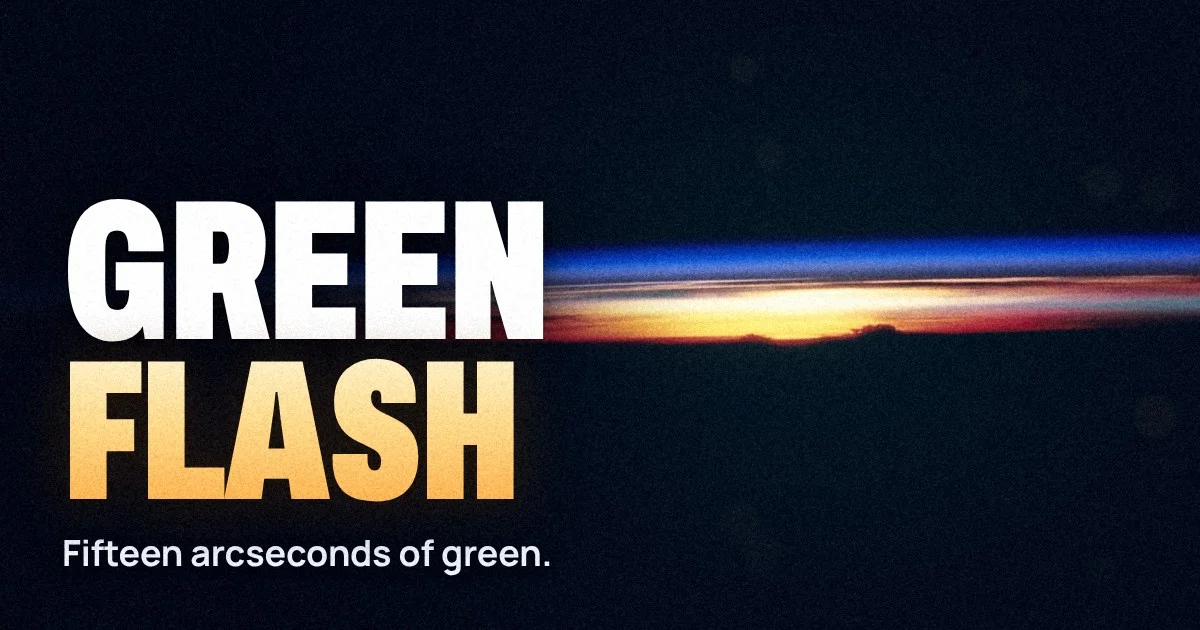
Header image: NASA (image STS067-709-007), regraded for this article.