Why Is the Sky Blue and Not Violet? The Full Answer
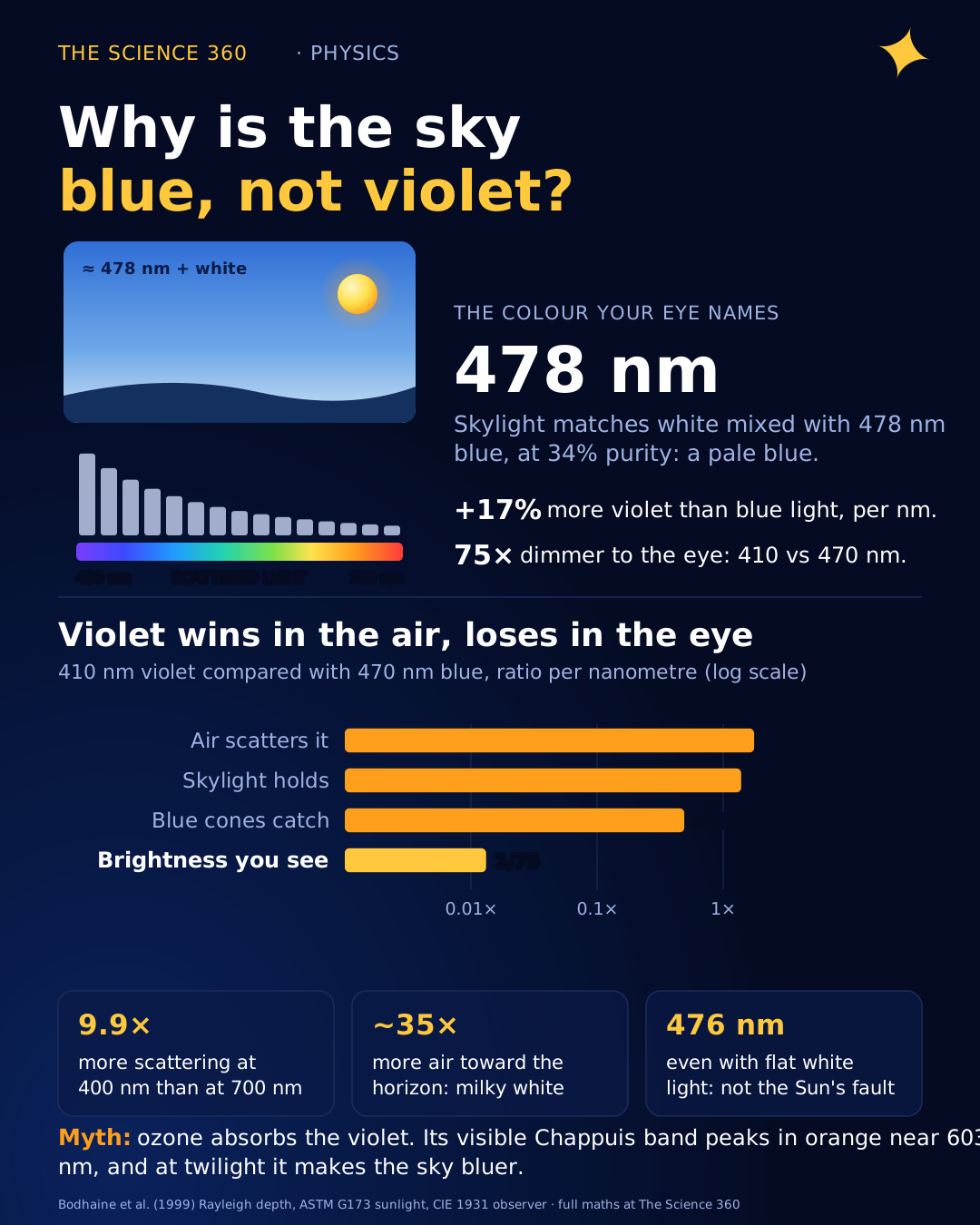
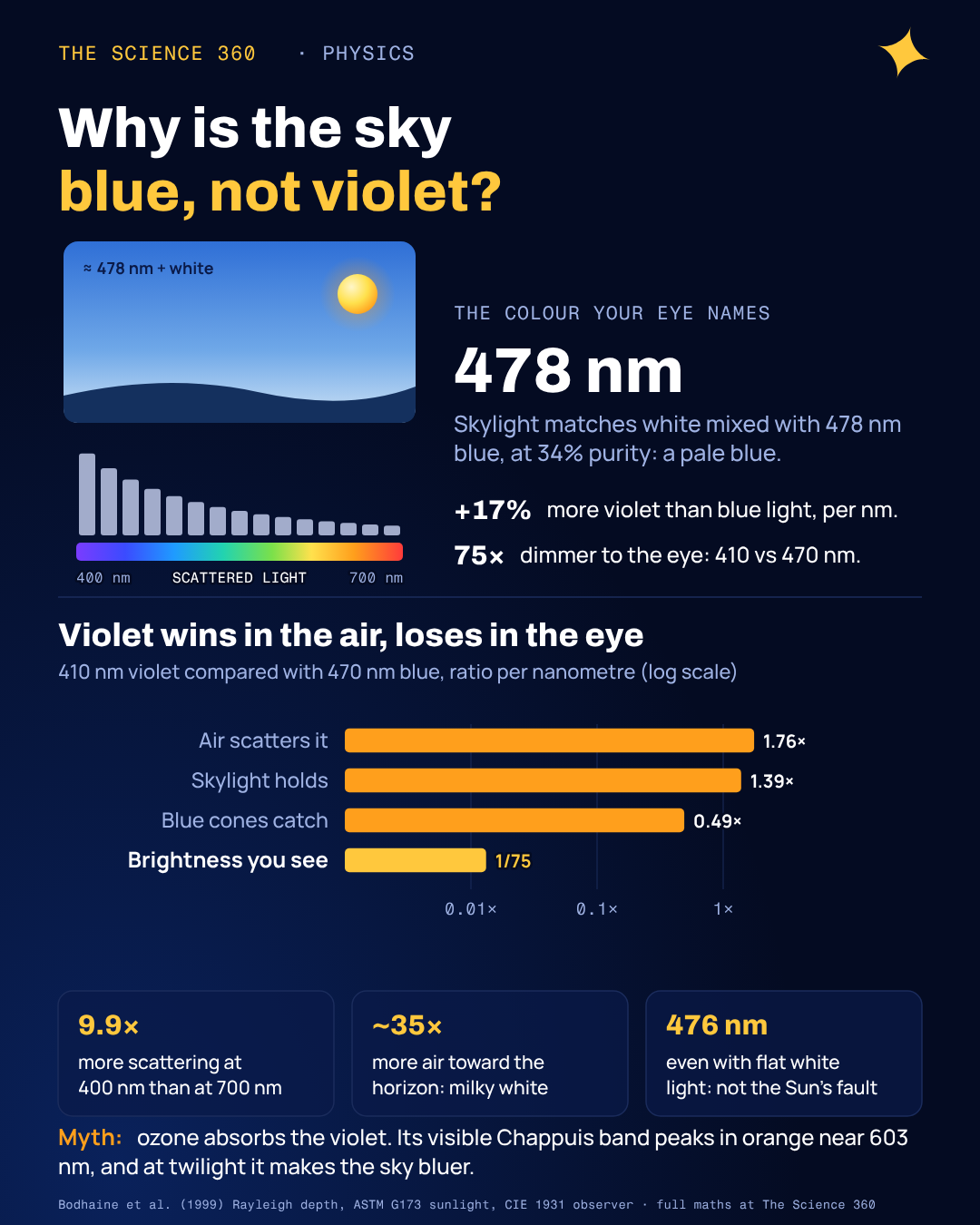
Point a spectrometer at the clear sky overhead and the trace climbs all the way to the left edge. In our model of the zenith sky with the Sun 30° up, there is 17% more light per nanometre between 400 and 450 nm (violet) than between 450 and 500 nm (blue). The sky is, by energy, a violet-leaning light source. And yet nobody has ever called it violet.
The top results for this question give three reasons and treat them as equal: the Sun emits less violet, the upper atmosphere absorbs violet, and our eyes are less sensitive to violet. The first is true but makes almost no difference. The second is wrong. The third is closest, but the way it is usually phrased ("we see blue because our eyes like blue") misses what actually happens. Your eye does not find the peak of a spectrum and name its colour. It collapses the whole spectrum into three numbers, and the three numbers from skylight look like white with some blue mixed in. Here is the full calculation.
How much more does air scatter violet than blue?
Molecules of nitrogen and oxygen are a thousand times smaller than a wavelength of light, so they scatter it in the Rayleigh regime: the scattered power goes roughly as . The exact law for real air is a little steeper because air's refractive index itself rises toward the blue. Bodhaine and colleagues (1999) give a fitted formula for the Rayleigh optical depth of the whole atmosphere at sea level, which is what we use throughout.
Rayleigh scattering, 410 nm violet versus 470 nm blue
Pure :
Bodhaine et al. optical depth:
Across the visible:
Pure gives 9.4, so the effective exponent is 4.1.
So air sends you about 75% more violet than blue, before anything else happens. Optical depth also tells you how much the direct sunbeam loses: with the Sun overhead, of 410 nm light gets through to the ground, against 96% at 700 nm. That is the start of every red sunset.
Does the Sun emit too little violet?
A little less, yes. Sunlight above the atmosphere (the ASTM extraterrestrial reference spectrum) is ragged in the violet because of deep absorption lines from calcium and hydrogen in the Sun's atmosphere, and it falls off below about 450 nm. Averaged over 50 nm bands, sunlight delivers 13% less power per nanometre in 400 to 450 nm than in 450 to 500 nm. At the single wavelengths we picked, 410 nm gets 0.79 times as much as 470 nm.
Sunlight times scattering, 410 nm versus 470 nm
Each line is the 410 nm value divided by the 470 nm value:
So the sky is 39% brighter at 410 nm than at 470 nm.
The Sun's shortfall trims the violet excess but nowhere near cancels it. Figure 1 shows the product over the whole visible range. The scattered spectrum peaks right around 400 nm, in the violet.
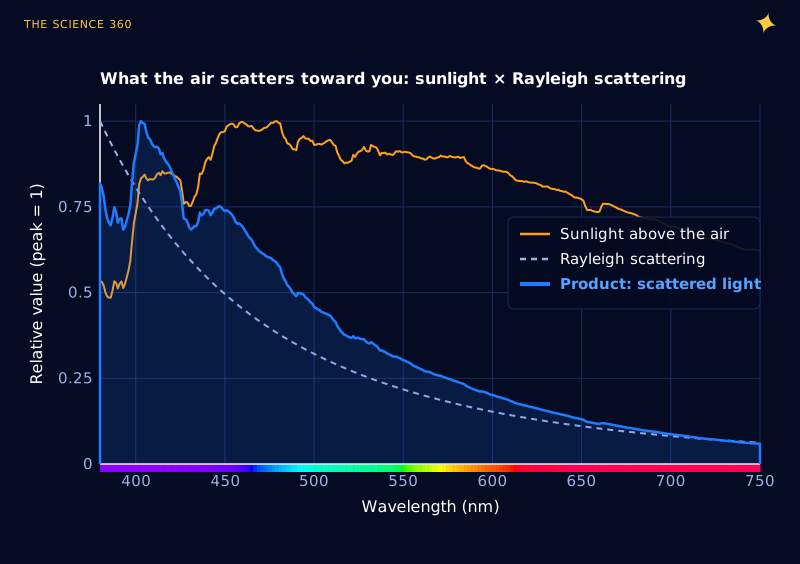
If you want to know why the Sun's light is the colour it is in the first place, we worked through it in what color is the Sun, really? For this post the point is simpler: the Sun is not the reason the sky isn't violet. We can prove it by throwing the Sun away, which we do further down.
Does the atmosphere absorb the violet?
This one shows up on page 1 more than it should. Ozone is the only major absorber in the clear atmosphere at these wavelengths, and its absorption is in the wrong place. Its strong bands, called the Hartley and Huggins bands, are in the ultraviolet. Its weak visible band, the Chappuis band, runs from 400 to 650 nm with its maxima at 575 and 603 nm: yellow and orange, not violet.
If anything, ozone makes the sky bluer. In 1952 E. O. Hulburt measured the twilight sky from Sacramento Peak and found it two to four times dimmer than scattering alone predicted. Including Chappuis absorption fixed the discrepancy. After sunset, light reaching the overhead sky has travelled a long slanting path through the ozone layer, the orange is removed, and the zenith stays a deep blue that scattering alone would turn grey. In daylight the effect on colour is small.
What the atmosphere does remove is violet from the direct sunbeam, by scattering it sideways. That light does not vanish. It becomes the sky. In our zenith-sky model this depletion is already included, and the skylight is still violet-heavy: 17% more power per nanometre in 400 to 450 nm than in 450 to 500 nm.
What your cones actually measure
Your retina has three types of cone, conventionally called L, M and S for long, medium and short wavelength. Each one adds up all the light that hits it, weighted by its own sensitivity curve, and reports a single number. Two lights with completely different spectra look identical if they produce the same three numbers. That is not a quirk; it is how colour works, and it is why a screen with three pixel colours can show you a photograph of the sky.
The S cone, the one that responds to blue, peaks at about 442 nm in the Stockman and Sharpe cone data. Its sensitivity drops fast below that: at 410 nm it is only 23% of its peak, at 470 nm it is 65%.
S-cone signal per nanometre of skylight
Relative skylight times S-cone sensitivity:
So each nanometre of 470 nm skylight drives the S cone about twice as hard as each nanometre at 410 nm.
Brightness, using the CIE luminosity curve
Watt for watt, 410 nm light looks 75 times dimmer than 470 nm and 800 times dimmer than green.
This is the part of the usual answer that is right: your eye throws away most of the violet the sky sends. But look at Figure 2, because it shows the part that is usually left out. The sky does not only send violet and blue. It sends plenty of green, yellow and red too, about half as much per nanometre at 550 nm as at the violet peak. The M and L cones collect that light.
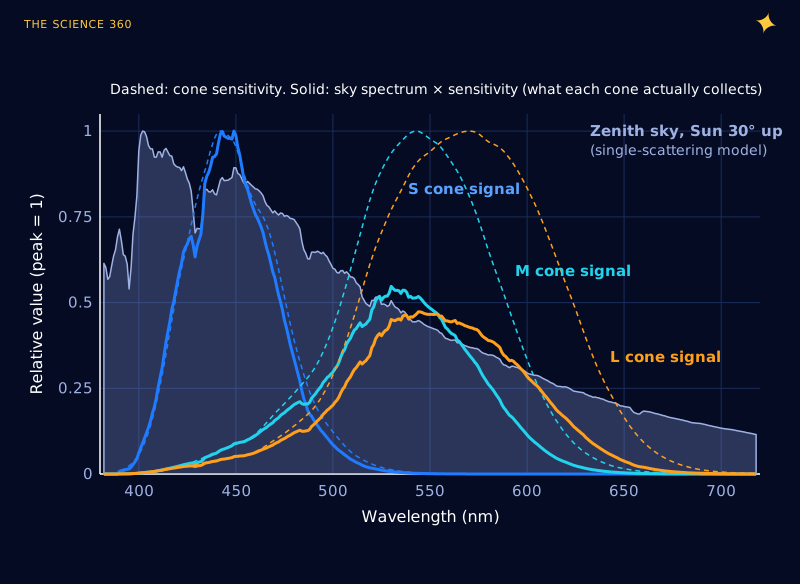
Integrate each curve and compare with the same integrals for plain sunlight. The overhead sky gives the L, M and S cones relative signals of 1 : 1.14 : 1.98. Sunlight, which you see as white, gives 1 : 1 : 1 by definition. So the sky is roughly "white, plus about as much again in the S channel, plus a dash of M". That is the recipe for a pale blue.
The misconception: the sky’s colour is not its peak wavelength
Every one of the page-1 explanations assumes that the sky's colour is set by where its spectrum peaks, and then needs an excuse for why the peak (violet) is not what we see. That assumption is the mistake. A broad, smoothly sloping spectrum like does not have the colour of its brightest wavelength, any more than daylight, which peaks around 450 to 500 nm, looks blue-green.
The clean way to name the colour of any spectrum is to compute its CIE chromaticity, a point on the familiar horseshoe diagram, then draw a line from the white point through it to the edge. Where the line hits the curved edge is the dominant wavelength: the pure spectral colour that, mixed with white, matches what you see. How far along the line the point sits is the purity.
Chromaticity of the zenith sky, Sun 30° up
Integrate the sky spectrum against the CIE 1931 colour-matching functions from 360 to 830 nm, then normalise:
White point (sunlight above the atmosphere): . The line from white through the sky meets the spectral locus at 478 nm.
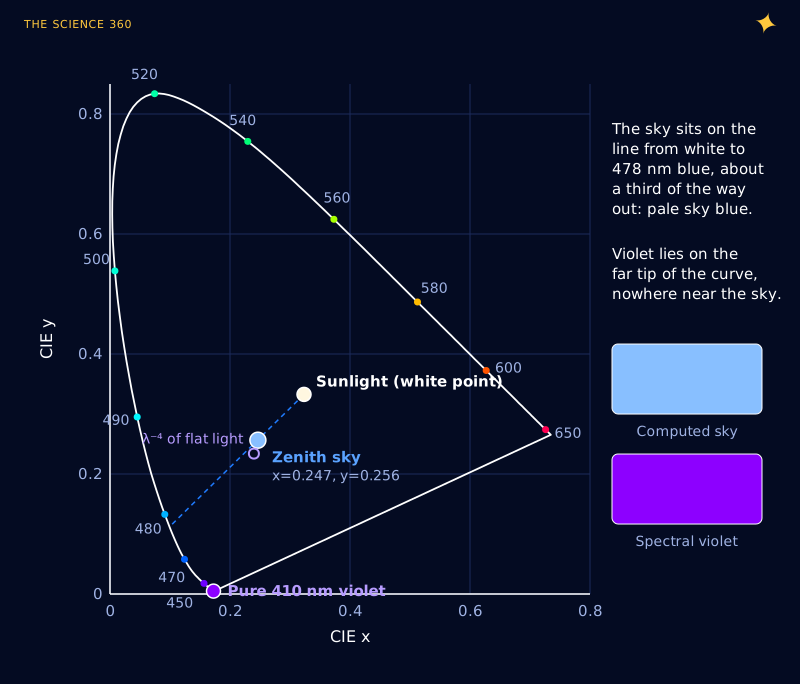
Our 478 nm lines up with Glenn Smith's analysis in the American Journal of Physics (2005), which found the daytime sky matches 474 to 476 nm blue mixed with white. A different solar spectrum, a slightly different white point and a different sky geometry move the answer by a couple of nanometres, which is the honest error bar.
The test: delete the Sun’s violet deficit and see what changes
If "the Sun emits less violet" were a real part of the answer, swapping sunlight for perfectly flat, equal-energy light should push the sky toward violet. We ran that, along with the other variations, through the same colour calculation.
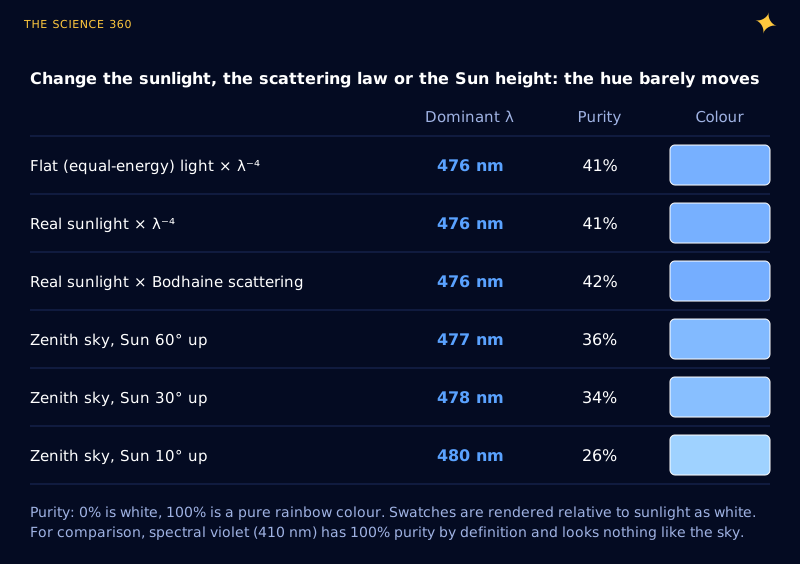
Flat light scattered by gives 476 nm, the same as real sunlight to the nanometre. The Sun's spectrum is simply not a factor in the hue. The real job is done by two things working together. First, the steep shape of leaves a lot of light at all wavelengths, so the M and L cones are strongly driven and the colour is heavily diluted with white. Second, the S cone's sensitivity falls off below 440 nm and the brightness curve falls off even faster, so the extra violet at the far end adds a bit of S signal and almost no brightness.
Could any broad scattering spectrum look violet? To look violet a light has to drive the S cone hard while driving M and L only weakly, and with a slightly higher L than M (that L tail is why spectral violet has a reddish, purple cast). A smooth power law that keeps going into the green and red can never do that. You need a spectrum that is almost nothing but short wavelengths, like a 405 nm laser pointer.
Why is the sky pale near the horizon and deep blue overhead?
Overhead, the whole atmosphere has an optical depth of only 0.097 at 550 nm: most green light goes straight through, and only the short-wavelength end gets scattered much. Near the horizon you look through a far longer path. For a curved atmosphere with an 8 km scale height, the path at the horizon is about times longer than straight up (our estimate; real air with refraction gives a similar figure, around 35 to 40).
Optical depth looking at the horizon
Both well above 1: light at every colour is scattered, rescattered and partly extinguished along the path, so the preference is lost.
Once every wavelength has been scattered at least once along your line of sight, the scattering law stops sorting colours and the horizon sky goes milky white. Fine haze and aerosols, which scatter all wavelengths more evenly, make this worse. The model in Figure 4 shows a gentler version of the same thing: with a low Sun the overhead sky drops from 36% to 26% purity.
What about sunsets and the Moon in eclipse?
The same optical depths that whiten the horizon strip blue from the direct sunbeam at sunset: at the horizon the 410 nm transmission is about , effectively zero, while red still gets through. That leftover red light is what reddens clouds at dusk, and it is also what you see painted on the Moon during totality, which we worked out in why a lunar eclipse is red. Push the same refraction and scattering to the very last instant of sunset and you get the brief green rim described in what causes the green flash. Green, not blue or violet, for exactly the reason in this post: those are scattered out of the beam first.
FAQ
Why is the sky blue and not violet?
Air scatters violet more strongly than blue, and skylight really does contain slightly more violet than blue light per nanometre. But the sky's spectrum is broad, and your eye reduces it to three cone signals. That mixture matches white light plus some 476 to 478 nm blue, so you see a pale blue, not violet.
Is the sky actually violet?
Only in a narrow sense. The scattered spectrum peaks near 400 nm, so a spectrometer sees the most energy per nanometre at the violet end. But colour is not the peak of a spectrum. Computed through the CIE colour-matching functions, the same spectrum has a dominant wavelength of about 476 nm, which is blue.
Does ozone stop the sky being violet?
No. Ozone absorbs strongly in the ultraviolet and weakly in the Chappuis band, which peaks in orange light near 603 nm. It does not remove violet. At twilight the Chappuis band actually helps keep the overhead sky blue by removing orange light.
Why is the sky paler near the horizon?
Looking toward the horizon you look through roughly 35 to 40 times more air than straight up. Over that path even red light gets scattered many times, so every colour is scattered about equally and the blue excess washes out toward white.
Would the sky be violet if the Sun emitted more violet?
No. If you replace sunlight with perfectly flat white light and apply the same Rayleigh scattering law, the computed dominant wavelength is still about 476 nm. The Sun's shortage of violet light barely changes the hue.
Related on The Science 360
Sources
- B. A. Bodhaine, N. B. Wood, E. G. Dutton and J. R. Slusser, "On Rayleigh optical depth calculations", Journal of Atmospheric and Oceanic Technology 16, 1854 (1999), equation 30 for sea level: PDF via Colorado State University
- ASTM G173-03 reference spectra (extraterrestrial column), as distributed with the pvlib-python library: github.com/pvlib/pvlib-python
- Colour & Vision Research Laboratory (UCL), CIE 1931 2° colour-matching functions and Stockman and Sharpe (2000) 2° cone fundamentals: cvrl.ioo.ucl.ac.uk
- Wikipedia, "Diffuse sky radiation" (citing G. S. Smith, "Human color vision and the unsaturated blue color of the daytime sky", Am. J. Phys. 73, 590, 2005): en.wikipedia.org/wiki/Diffuse_sky_radiation
- Wikipedia, "Chappuis absorption" (band 400 to 650 nm, maxima 575 and 603 nm, Hulburt's 1952 twilight measurements): en.wikipedia.org/wiki/Chappuis_absorption
- Hong Kong Observatory, "Why is the sky blue?" (an example of the standard explanation): hko.gov.hk
- C. Baird, West Texas A&M University, "Why is the sky blue?": wtamu.edu
Method note: skylight is modelled as single Rayleigh scattering in a plane-parallel atmosphere (zenith view, Sun at the stated elevation) using the Bodhaine et al. sea-level optical depth and the ASTM G173 extraterrestrial spectrum. Multiple scattering, aerosols and ozone are left out, so real skies are somewhat paler; the dominant wavelength is robust to these choices. Colours are computed with the CIE 1931 2° observer, with sunlight above the atmosphere as the white point, and swatches are approximate sRGB renderings.
Header image: NASA (image iss071e439624), regraded for this article.