How long can I expose before the stars trail?
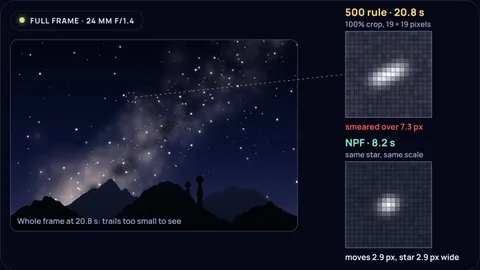
Earth turns, so on a fixed tripod every star slides across the sensor. With a 45 megapixel full frame camera and a 24 mm f/1.4 lens, the 500 rule allows 20.8 s, but the NPF rule, which counts the pixels, gives 8.2 s for the Milky Way core. At the 500 rule's time each star smears over 7.3 px instead of staying about 2.9 px round.
The calculator gives the 500 rule, the stricter 300 rule and both forms of the NPF rule for any camera, and draws one star at 100% for each. The companion post explains which rule to trust; for what to do with the exposure once you have it, see splitting exposures to beat read noise.
Key results from the calculator
- The 500 rule is too long on modern sensors. For a 24 MP full frame camera at 14 mm f/2.8 it gives 35.7 s; NPF gives 21.4 s for the Milky Way core. With 45 MP at 24 mm f/1.4 the gap is 2.5×.
- Pixel size matters, not just focal length. At 24 mm f/1.4, NPF allows 13.6 s on a 12 MP full frame body and 8.2 s on a 45 MP one; the 500 rule gives 20.8 s for both.
- A faster lens shortens the NPF time: a sharper, smaller star image shows movement sooner. The 500 rule ignores aperture altogether.
- Declination changes everything near the pole. Stars at +85° move about a tenth as fast as those on the celestial equator, so NPF allows 126 s there instead of 11.0 s.
Seven cameras, two rules
Each example loads the sensor, lens, megapixels and target declination. NPF here allows a trail of about one star width (k = 2).
Full frame, 24 MP, 14 mm f/2.8
Classic Milky Way lensA 14 mm lens on a 24 MP full frame body is the classic Milky Way setup. The 500 rule says 35.7 s; NPF says 21.4 s for the core at −29°. At 35.7 s the stars smear over 5.3 px, against a star image about 3.2 px wide.
The difference shows when you zoom to 100% or print large, not on a phone screen. Wide lenses at f/2.8 are where the two rules are closest.
45 MP full frame, 24 mm f/1.4
High resolutionSmall 4.38 µm pixels and a sharp f/1.4 lens make tiny star images, so every bit of movement shows. NPF gives 8.2 s; the 500 rule's 20.8 s is 2.5× longer and smears stars over 7.3 px.
This is the case the NPF rule was made for: high resolution sensors that record far more detail than 35 mm film.
APS-C 1.5×, 24 MP, 16 mm f/1.4
Crop sensorOn a 1.5× crop body a 16 mm lens frames like 24 mm on full frame. The 500 rule, with the crop factor, gives 20.8 s; NPF gives 11.3 s, because 3.91 µm pixels are smaller than a 24 MP full frame camera's.
The 300 rule, a stricter version some photographers use for crop sensors, gives 12.5 s, close to NPF here.
Canon APS-C 1.6×, 50 mm f/1.8, Orion
Longer lensA 50 mm lens on a 1.6× body is an 80 mm equivalent: AstroBackyard's own example gives 500 ÷ (1.6 × 50) = 6.3 s. NPF gives 3.5 s for Orion at −5°.
At these focal lengths a tracking mount, or many short frames stacked, is the usual answer.
Micro Four Thirds, 20 MP, 12 mm f/2
Small sensorA 2× crop factor makes 12 mm frame like 24 mm. The 500 rule gives 20.8 s and NPF 15.4 s: closer than on full frame, because the slower f/2 lens makes slightly bigger star images.
Smaller sensors also collect less light in the same time, so the exposure limit hurts more.
Phone main camera, 7 mm f/1.68
PhoneA phone main camera with a 1/1.31 inch sensor of 1.2 µm pixels, saving 12.5 MP pictures by combining pixels in fours (2.4 µm), has a crop factor of about 3.53. Its 7 mm lens frames like 25 mm. The 500 rule and NPF both give about 20.2 s.
Phone night modes do not take one long exposure: they stack many short frames and align them, so these limits apply to each frame, not the result.
Pointing near Polaris, +85°
DeclinationStars close to the celestial pole trace small circles, so they hardly move. At +85° NPF allows 126 s, against 11.0 s on the celestial equator.
The SAH article recommends using 0° for wide fields, because a wide lens pointed at the pole still has faster-moving stars near the edges of the frame.
Longest exposure by lens, 24 MP full frame, f/2.8
| Focal length | 500 rule | 300 rule | NPF simple | NPF at −29° |
|---|---|---|---|---|
| 14 mm | 35.7 s | 21.4 s | 19.9 s | 21.4 s |
| 20 mm | 25.0 s | 15.0 s | 13.9 s | 15.0 s |
| 24 mm | 20.8 s | 12.5 s | 11.6 s | 12.6 s |
| 35 mm | 14.3 s | 8.6 s | 7.9 s | 8.7 s |
| 50 mm | 10.0 s | 6.0 s | 5.6 s | 6.2 s |
| 85 mm | 5.9 s | 3.5 s | 3.3 s | 3.7 s |
| 135 mm | 3.7 s | 2.2 s | 2.1 s | 2.4 s |
Pixel pitch 6.00 µm. NPF simple is for the celestial equator (the fastest stars); −29° is the declination of the Milky Way's centre. On APS-C, multiply the focal length by the crop factor for the 500 and 300 rules.
How the calculator works
The 500 rule is 500 ÷ (focal length × crop factor) seconds, as AstroBackyard gives it. It dates from 35 mm film; the number 500 has no deeper meaning. The 300 rule is the same with 300, a stricter version some photographers use with crop and high resolution sensors.
The NPF rule was published by Frédéric Michaud for the Société Astronomique du Havre. It works out how big a star's image is on the sensor (the lens's diffraction blur, 4.47 × 0.55 µm × N; atmospheric blur of about 3 arcseconds; and two pixels for the colour filter pattern) and how fast it moves (focal length × cos δ ÷ 13,713 per second), then allows a trail of k star radii.
That gives t = k (16.9 N + 13.7 p + 0.1 f) ÷ (f cos δ), with N the f-number, p the pixel pitch in µm and f the focal length in mm. With k = 2 and δ = 0 it simplifies to the well-known (35 N + 30 p) ÷ f.
Pixel pitch is the sensor width divided by the number of pixels across it, worked out from the megapixels and the sensor's shape. You can type the pitch instead if you know it.
The crops draw one star as a soft spot of the NPF star diameter, swept along by the trail length for each exposure, with the sky background rising with time.
What the model leaves out
- Lens aberrations: coma and astigmatism in the corners can make stars look stretched even in short exposures.
- Field rotation across a wide frame: the declination you set applies to the stars you care about; others in the frame move at their own rate.
- Exact sensor sizes: sensor dimensions are typical values for each format; models differ by a few tenths of a millimetre.
- Noise and brightness: the rules only limit trailing. How bright and clean the picture is depends on ISO, aperture and stacking.
Common misconceptions
"The 500 rule gives pin-sharp stars." It was set for film and small prints. On a 45 MP sensor viewed at 100% its stars are visibly stretched.
"A crop sensor lets you expose longer." The opposite: the crop factor shortens the 500 rule time, and the smaller pixels shorten the NPF time.
"Stopping down makes stars trail less." It makes the star image bigger, which hides a little movement, so NPF allows slightly longer, but you collect far less light.
Frequently asked questions
What is the 500 rule in astrophotography?
The longest exposure in seconds before stars trail is about 500 divided by the focal length times the crop factor. A 24 mm lens on full frame gives about 21 seconds; on a 1.6× APS-C body about 13 seconds.
What is the NPF rule?
A more accurate rule by Frédéric Michaud of the Société Astronomique du Havre. In its simple form the exposure is (35 × f-number + 30 × pixel pitch in µm) ÷ focal length. It counts the pixel size and aperture, which the 500 rule ignores.
Is the 500 rule or the NPF rule better?
NPF, for modern digital cameras viewed at full size. The 500 rule allows 20.8 s for a 45 MP camera at 24 mm f/1.4, which smears stars over 7.3 px; NPF allows 8.2 s.
How do I find my camera's pixel pitch?
Divide the sensor width in millimetres by the number of pixels across it, then multiply by 1000. A 24 MP full frame sensor 36 mm wide with 6000 pixels across has 6.0 µm pixels.
Does declination change the exposure?
Yes. Stars move fastest on the celestial equator and slow down towards the poles by the cosine of the declination. The Milky Way core at −29° allows about 14% longer than the equator, and stars near Polaris many times longer.
Keep learning
500 Rule vs NPF Rule: Which Is Right for Sharp Stars?
Why the 500 rule gives trailed stars on modern cameras, how the NPF rule works out the longest exposure from pixel size and aperture, and worked examples for full frame, APS-C and phones.

One hour of astrophotography: why 240 short exposures can differ from six long ones
A reproducible Python noise budget compares equal total exposure times in two illustrative regimes—and shows why longer is not automatically better in the field.
How Much Magnification Do You Need to See Saturn's Rings?
The magnification that shows Saturn's rings, why 25× is the floor and 50× to 150× the sweet spot, how to work out your own telescope's power, and why 500× does not help.