How many hours of daylight are there today?
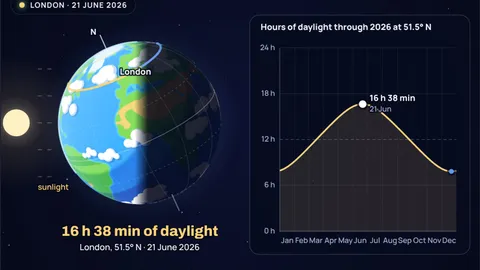
Choose a latitude and a date and the calculator gives the time from sunrise to sunset. London gets 16 h 38 min of daylight on the June solstice and 7 h 50 min in late December. Delhi swings only between 10 h 19 min and 13 h 58 min, and Singapore, almost on the equator, stays within a few minutes of 12 hours all year. Above the Arctic Circle, Tromsø gets 69 days of midnight sun and 48 days without a sunrise in 2026.
The numbers use the NOAA solar calculator equations, with sunrise and sunset at the moment the Sun's upper edge touches the horizon, and match US Naval Observatory tables to within a minute. Why the day length changes at all is the tilt of Earth's axis; the seasons simulation shows it from space, and the companion post explains the curve.
Key results from the calculator
- Longest and shortest days (2026): London 16 h 38 min and 7 h 50 min, New York 15 h 6 min and 9 h 15 min, Delhi 13 h 58 min and 10 h 19 min, Reykjavik 21 h 9 min and 4 h 7 min.
- Equinox days are a little over 12 hours: 12 h 10 min in London on 20 March, and 12 h 7 min on the equator, because refraction and the Sun's width add a few minutes at each end.
- The day length changes fastest at the equinoxes: London gains +3 min 59 s a day around 20 March and only +2 s at the June solstice.
- The southern hemisphere is reversed: Sydney's longest day is in December (14 h 25 min) and its shortest in June (9 h 54 min).
Six places, six very different years
Each city loads its latitude and longitude; the date stays as you set it. Numbers below are for 2026.
London, 51.5° N
Mid latitudeLondon's daylight runs from 7 h 50 min on 21 December to 16 h 38 min at midsummer, a difference of almost nine hours. Around the March equinox it gains about +3 min 59 s of daylight every day, which is why spring evenings seem to stretch so quickly.
On 13 November it has 8 h 59 min and is still losing about +3 min 11 s a day.
New York, 40.7° N
Mid latitudeNew York is about 11° closer to the equator than London, so its seasons are milder in daylight terms: 15 h 6 min at midsummer and 9 h 15 min at midwinter.
That is the same latitude as Madrid, Beijing and Ankara, which share almost exactly the same daylight curve. Day length depends only on latitude and date; longitude only moves the clock times.
Delhi, 28.6° N
SubtropicalDelhi's longest day is 13 h 58 min and its shortest 10 h 19 min, a range of 3 h 39 min. Further south the range shrinks: Mumbai and Chennai have under two and a half hours between their longest and shortest days.
Winter mornings in North India feel dark mostly because the whole country runs on one clock set for 82.5° E. Day length is unaffected, but in the east the Sun rises much earlier by the clock than in the west.
Sydney, 33.9° S
Southern hemisphereIn the southern hemisphere the curve is flipped. Sydney's longest day falls in December at 14 h 25 min, and its shortest in June at 9 h 54 min.
On the globe, the latitude circle sits below the equator: in December the south pole leans towards the Sun, so most of Sydney's circle is in daylight.
Reykjavik, 64.1° N
Near the Arctic CircleReykjavik sits just 2.4° south of the Arctic Circle, so the Sun does set at midsummer, but only for a short while: the day is 21 h 9 min long. In December it is 4 h 7 min.
Even when the Sun is down at midsummer it stays only a few degrees below the horizon, so the sky never gets fully dark. That twilight is not counted here; the calculator counts sunrise to sunset only.
Tromsø, 69.6° N: midnight sun and polar night
ArcticInside the Arctic Circle the formula breaks in a useful way: for part of the year the Sun never reaches −0.833°, so it never sets. Tromsø has 69 days of midnight sun in 2026, and 48 days on which the Sun never rises.
On 13 November there are only 4 h 29 min of daylight left. NOAA notes that its equations are less accurate beyond about 72° latitude, where the Sun skims the horizon and small changes in refraction move sunrise by many minutes.
Longest and shortest day by city (2026)
| City | Latitude | Longest day | Shortest day | 20 March |
|---|---|---|---|---|
| Singapore | 1.4° N | 12 h 12 min | 12 h 3 min | 12 h 6 min |
| Delhi | 28.6° N | 13 h 58 min | 10 h 19 min | 12 h 7 min |
| Sydney | 33.9° S | 14 h 25 min | 9 h 54 min | 12 h 9 min |
| New York | 40.7° N | 15 h 6 min | 9 h 15 min | 12 h 9 min |
| London | 51.5° N | 16 h 38 min | 7 h 50 min | 12 h 10 min |
| Reykjavik | 64.1° N | 21 h 9 min | 4 h 7 min | 12 h 15 min |
| Tromsø | 69.6° N | 24 h (69 days) | 0 h (48 days) | 12 h 18 min |
Sunrise to sunset with the Sun's upper edge on a flat, sea level horizon, standard refraction. Civil twilight adds roughly 30 to 40 minutes at each end in mid latitudes and more near the poles.
How the calculator works
First it finds the Sun's declination for the date: how far north or south of the equator the Sun is overhead. It uses the equations in NOAA's solar calculator, which follow Jean Meeus's Astronomical Algorithms. The declination runs from about +23.44° in June to −23.44° in December.
Sunrise and sunset are when the centre of the Sun is 0.833° below a level horizon: about 0.57° of that is atmospheric refraction, which lifts the Sun into view early, and 0.27° is the Sun's radius, because sunrise counts from the first glint of its upper edge. The hour angle H of that moment comes from cos H = (sin(−0.833°) − sin φ sin δ) ÷ (cos φ cos δ), where φ is your latitude.
Earth turns 15° an hour, so the day is about 2H ÷ 15 hours. The calculator then recomputes the Sun's position at the moment of sunrise and of sunset and repeats, because the declination drifts by up to 0.4° a day around the equinoxes. The results agree with US Naval Observatory times to within a minute.
Longitude only shifts the clock time of sunrise and sunset, not the length of the day, apart from a few seconds. It is included so city results match published tables exactly.
What the model leaves out
- Hills, buildings and altitude: the horizon is taken as flat and at sea level. From a mountain top you see the Sun earlier and later; in a valley, later and earlier.
- Unusual refraction: 0.833° is an average. Cold air over the sea or ice can bend light more and change sunrise by a minute or two, more near the poles.
- Twilight: the calculator stops at sunset. It stays light enough to read outdoors for roughly half an hour after sunset in mid latitudes (civil twilight).
- Beyond about 72° latitude NOAA warns its sunrise times can be off by up to about 10 minutes.
Common misconceptions
"Days are longer in summer because Earth is closer to the Sun." Earth is closest to the Sun in early January, during northern winter. Day length comes from the 23.44° tilt of the axis.
"Day and night are exactly 12 hours at the equinox." Refraction and the Sun's width make the equinox day about 7 to 13 minutes longer than 12 hours between the equator and 60° latitude. The date of equal day and night is a few days before the March equinox in the north.
"The shortest day has the latest sunrise." In London the latest sunrise is around 30 December and the earliest sunset around 12 December. The equation of time shifts the clock times either side of the solstice.
Frequently asked questions
How many hours of daylight are there on the shortest day?
It depends on latitude: about 7 h 50 min in London, 9 h 15 min in New York, 10 h 19 min in Delhi and 4 h 7 min in Reykjavik on the December solstice. North of the Arctic Circle the Sun does not rise at all.
How much does the day length change each day?
Most around the equinoxes and least at the solstices. In London the day grows by about 3 min 59 s a day in late March and by only a few seconds around 21 June.
Why is the equinox day longer than 12 hours?
Sunrise is counted from the moment the Sun's upper edge appears, and the atmosphere bends its light so it appears while still below the horizon. Together these add several minutes, so equinox days are about 12 hours 7 to 13 minutes long up to 60° latitude.
Does longitude change the length of the day?
No, only the clock times. Places on the same latitude get the same day length on the same date to within a few seconds, whatever their longitude or time zone.
Where on Earth is daylight 12 hours all year?
On the equator it stays within a few minutes of 12 hours: 12 h 3 min to 12 h 12 min in Singapore, at 1.4° N.
Keep learning
Why Are Days Longer in Summer? Daylight Hours Explained
Why summer days are long and winter days short, how many hours of daylight you get on the shortest day, and the two-line formula behind it.
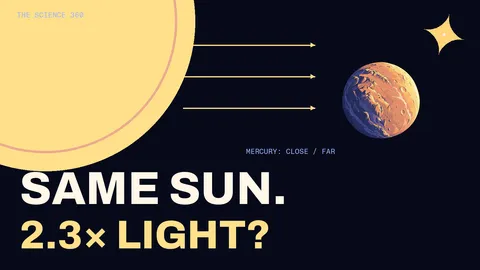
How much does sunlight change around a planetary orbit? A Python comparison
The same inverse-square calculation gives Earth about a 7% close-to-far sunlight increase and Mercury about 130%. Reproduce all eight comparisons.
How Fast Is Earth Moving Through Space? Every Frame
Earth spins at up to 465 m/s, orbits at 29.8 km/s and moves at 370 km/s relative to the CMB. How each speed is measured, and why they don't add.
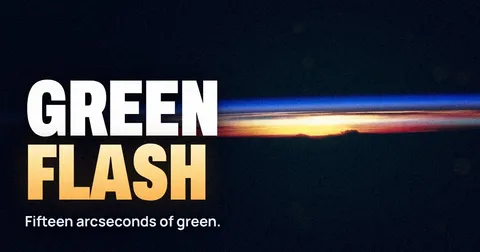
What Causes the Green Flash at Sunset? The Numbers
Every sunset has a green rim, but it is 4 to 8 times too thin to see. We compute the refraction and dispersion, and show why mirages make the flash visible.