How Fast Is Earth Moving Through Space? Every Frame
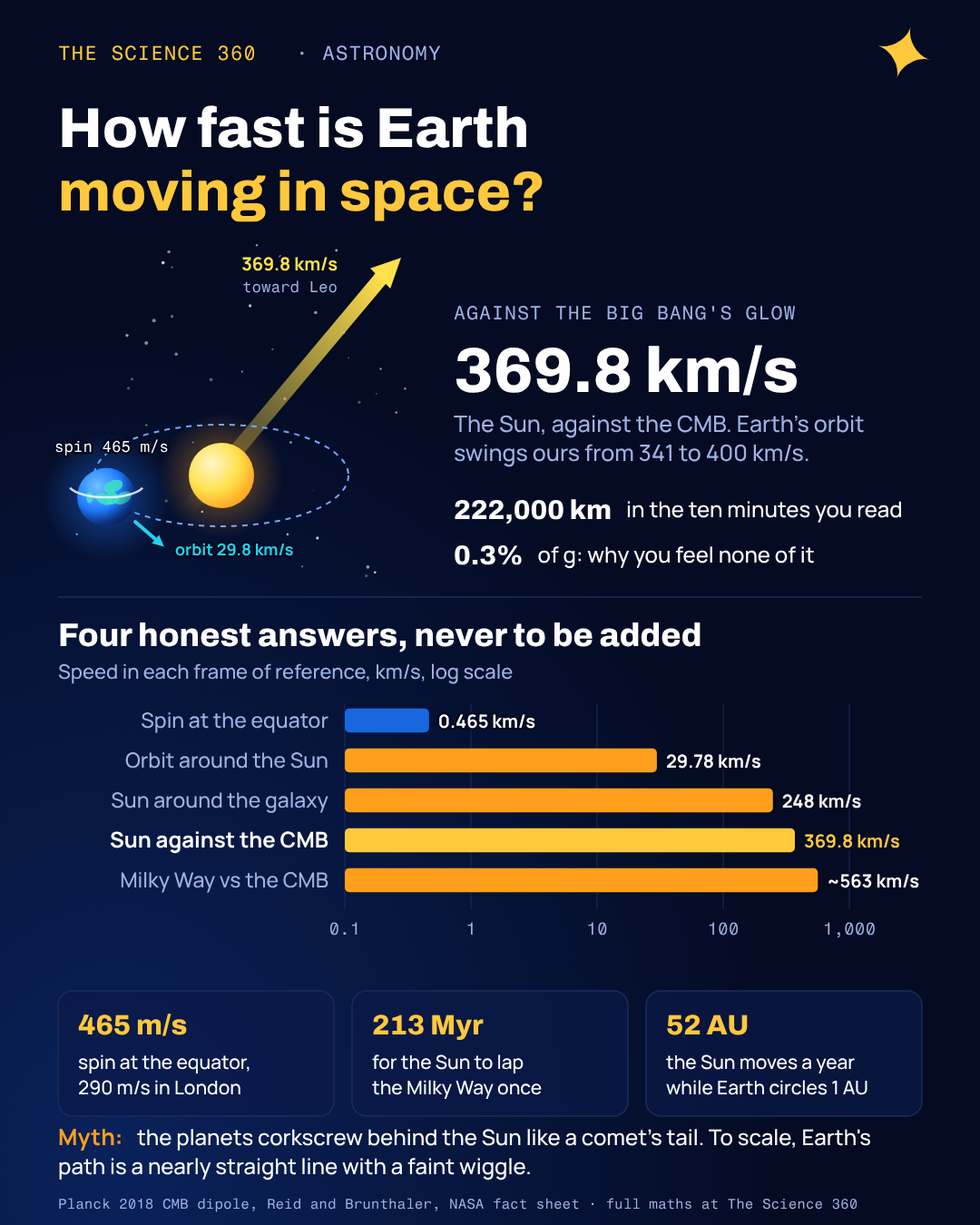
In the ten minutes it takes to read this, you will travel about 222,000 km relative to the oldest light in the universe, more than half the distance to the Moon. If you read it in December, make that about 240,000 km. If you read it in June, a little under 205,000 km. You will not feel any of it.
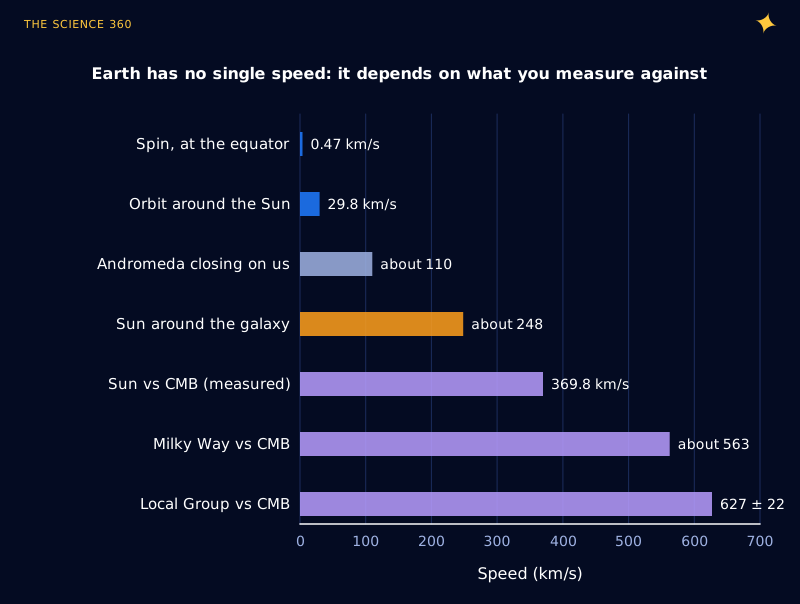
Those numbers come from the Doppler shift of the cosmic microwave background, and they are only one of several honest answers to "how fast is Earth moving". Most pages list four speeds and add them up. That is the one thing you cannot do with them. Each speed is measured against something different, and they point in different directions.
How fast does Earth spin?
Earth turns once on its axis every 23 hours 56 minutes 4 seconds relative to the stars, the sidereal day. The 24-hour solar day is about 4 minutes longer because Earth also moves along its orbit during the day, so it has to turn a little extra to bring the Sun back to the same place.
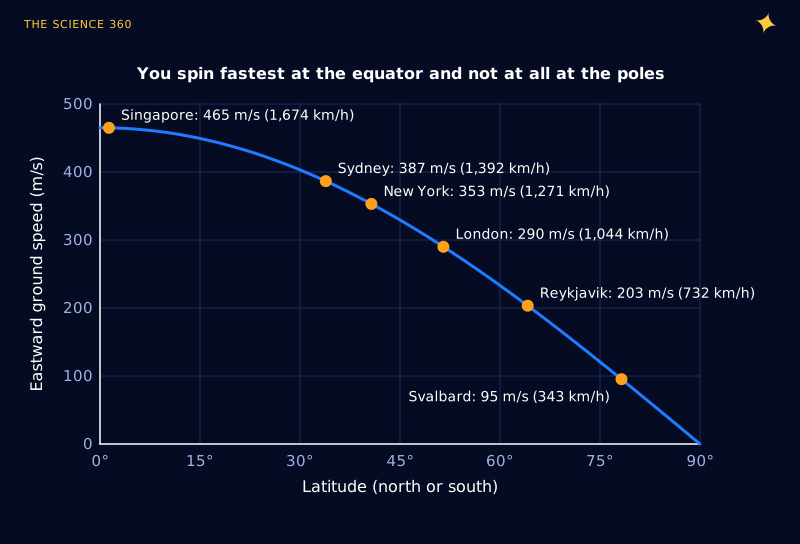
Worked example: rotation speed at the equator and in London
Equatorial radius 6,378.137 km; sidereal day 86,164.1 s.
At latitude the distance to the axis shrinks by . London, 51.5° N:
Using the exact ellipsoid shape changes this by less than 1 m/s.
Figure 3 shows how the speed falls with latitude. Someone standing at the North Pole is simply rotating on the spot once a day.
How fast does Earth orbit the Sun?
The simple calculation gets you close: Earth covers a circle of radius 1 AU, 149.6 million km, once a year.
Worked example: average orbital speed
Circumference of the orbit and length of one year:
That is 107,200 km/h, or 66,600 mph.
That matches NASA's Earth fact sheet value of 29.78 km/s exactly. The orbit is slightly elliptical (eccentricity 0.0167), so the speed varies: 30.29 km/s at perihelion in early January, 29.29 km/s at aphelion in early July. Northern hemisphere winter is when we are closest to the Sun and moving fastest, which is also why northern winter is a few days shorter than northern summer.
How fast is the Sun moving around the galaxy?
This one is harder, because we cannot see the Milky Way from outside. The cleanest modern method uses Sagittarius A*, the radio source at the galaxy's centre, which is almost certainly a supermassive black hole sitting nearly still. Over 18 years, very long baseline radio interferometry tracked its apparent drift across the sky at 6.411 milliarcseconds per year along the galactic plane. That drift is almost entirely our own motion, reflected.
Worked example: the Sun's galactic speed
Angular rate of the Sun around the centre (Reid and Brunthaler):
Distance to the galactic centre: (GRAVITY Collaboration, from stellar orbits around Sgr A*).
Part of that, about 12 km/s, is the Sun's own drift relative to its neighbours, so the circular orbital speed at our radius is about 236 km/s. One lap:
Published values for the "galactic year" range from about 210 to 250 million years depending on the adopted distance and speed, so treat mine as one reasonable estimate. The Sun also bobs up and down through the galactic disk at about 7 km/s, completing an oscillation every few tens of millions of years.
The misconception: the “helical vortex” of planets
A widely shared animation shows the Sun ploughing through space like a comet, with the planets spiralling behind it in a tight corkscrew. It looks great. It gets two things wrong.
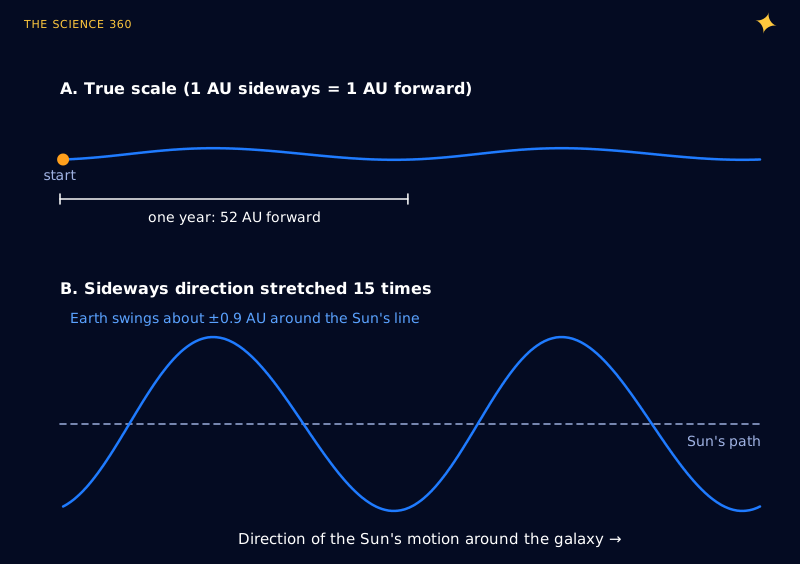
First, the angles. The plane of Earth's orbit is not lined up with the direction of the Sun's galactic motion. By my calculation from the standard coordinate transformations, the Sun's velocity around the galaxy points about 29° away from the ecliptic pole. The planets' orbits are tipped steeply to the direction of travel, closer to a frisbee thrown slightly edge-on than a corkscrew trailing behind.
Second, the proportions. In one year the Sun moves about 52 AU around the galaxy while Earth circles it at a distance of 1 AU. Drawn to scale, as in panel A of Figure 4, Earth's path through the galaxy is a nearly straight line with a barely visible wiggle. You have to stretch the sideways direction 15 times (panel B) to see it as a wave. The planets never "trail" the Sun: they orbit it, and the whole system moves together.
How do we measure Earth’s speed relative to the whole universe?
The cosmic microwave background (CMB) fills the sky at a temperature of 2.72548 K. But it is not exactly the same in every direction. One side of the sky is warmer by about 3.36 millikelvin, and the opposite side is cooler by the same amount. This pattern, called the dipole, is a Doppler shift: we are moving toward the warm side, so the radiation ahead of us is blueshifted and the radiation behind is redshifted.
Worked example: speed from the CMB dipole
For speeds much less than light:
Planck 2018 dipole amplitude ; mean CMB temperature .
Direction: galactic longitude 264.0°, latitude 48.3°, which is RA 11 h 12 m, Dec −6.9°, toward the constellations Leo and Crater.
This is the speed of the Sun (strictly, the solar system's barycentre) relative to the frame in which the CMB looks the same in every direction. It is measured to better than 0.1%. Earth adds its own orbital velocity on top, and because the dipole direction lies only 11° south of the ecliptic, the orbit lines up with it almost perfectly twice a year: once adding, once subtracting.
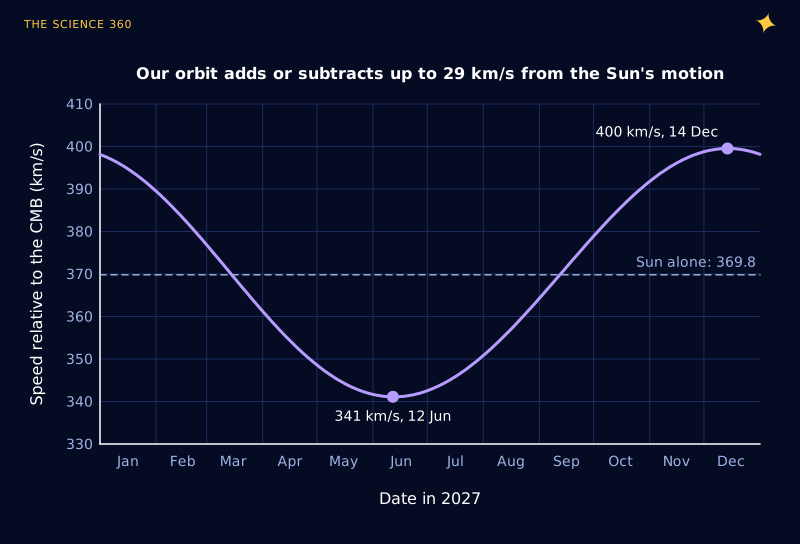
The vector sum is easy to check at the peak. In mid-December Earth's orbital velocity points almost straight toward the dipole direction, off by only the 11° tilt, and Earth is near its fastest (about 30.2 km/s, a few weeks before perihelion), so it contributes 30.2 × cos 11° ≈ 29.7 km/s along the line, giving 369.8 + 29.7 ≈ 399.5 km/s. In June it points the other way and Earth is slower: 369.8 − 29.3 × cos 11° ≈ 341 km/s. Earth's spin adds at most another 0.47 km/s, which is lost in the rounding.
How fast is the Milky Way moving?
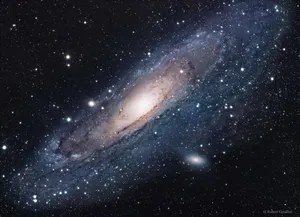
Subtract the Sun's galactic orbit from its motion relative to the CMB and you get the motion of the galaxy as a whole. Doing that as a vector subtraction with the numbers above, I get about 563 km/s toward galactic longitude 266°, latitude 29°. The Local Group, the Milky Way and Andromeda with their satellite galaxies, moves at 627 ± 22 km/s relative to the CMB according to the COBE team's analysis, pulled by the combined gravity of large structures in the direction of the Hydra-Centaurus region and beyond. Within the group, Andromeda is closing in on us at about 110 km/s, and the two galaxies are expected to collide or merge in several billion years.
Is there such a thing as Earth’s “real” speed?
Not in any absolute sense. Special relativity says the laws of physics are the same in every frame moving at constant velocity, so no experiment inside a sealed lab could tell you how fast you are going. The CMB frame is special for a practical reason, not a fundamental one: it is the frame in which the leftover radiation of the Big Bang looks uniform, which makes it a sensible rest frame for the universe's matter on average. Measuring our motion relative to it is no more a violation of relativity than measuring a car's speed relative to the road.
Why can’t we feel any of this?
Because you feel acceleration, not speed. A smooth airliner at 900 km/h feels the same as one parked at the gate. Earth's motions are curved, so they do involve acceleration, but very little:
Accelerations from each motion,
The spin term is the only one you can measure in daily life: it makes you weigh about 0.3% less at the equator than at the poles, before the bulge of the Earth is accounted for. And there is a deeper reason the orbital term does not register at all. You and Earth are both in free fall around the Sun, so the Sun's pull accelerates you and the ground equally. It is the same physics that makes astronauts float in orbit, at a much gentler scale.
FAQ
How fast is Earth moving around the Sun?
On average 29.78 km/s, about 107,000 km/h or 66,600 mph. Because the orbit is slightly elliptical, the speed varies from 30.29 km/s at perihelion in early January to 29.29 km/s at aphelion in early July.
Why can’t we feel Earth moving?
Your body senses acceleration, not speed, and Earth's motions are almost perfectly steady. The largest acceleration, from Earth's spin at the equator, is 0.034 m/s², about 0.3% of gravity. The acceleration from orbiting the Sun is 0.006 m/s², and from circling the galaxy about 0.0000000002 m/s².
How fast is the Sun moving around the Milky Way?
About 240 to 250 km/s. Radio measurements of the apparent motion of Sagittarius A*, the black hole at the galactic centre, give an angular rate of 30.32 km/s per kiloparsec, which with a distance of 8.18 kiloparsecs gives about 248 km/s. One lap takes roughly 210 to 230 million years.
What is Earth’s absolute speed through the universe?
Relativity says there is no absolute speed, but there is a natural reference: the cosmic microwave background. The Sun moves at 369.8 km/s relative to it, measured from the Doppler shift of the background radiation. Adding Earth's orbit, our speed swings between about 341 km/s in June and 400 km/s in December.
Do you add up all of Earth’s speeds?
No. The speeds point in different directions and are measured against different things, so they combine as vectors. Earth's 30 km/s orbit can add to or subtract from the Sun's motion depending on the time of year, which is why the total relative to the microwave background varies by about 59 km/s over a year.
Related on The Science 360
Sources
- NASA NSSDCA, Earth Fact Sheet (orbital velocity 29.78 km/s mean, 30.29 max, 29.29 min; sidereal rotation 23.9345 h; equatorial radius 6,378.137 km): nssdc.gsfc.nasa.gov/planetary/factsheet/earthfact.html
- Planck Collaboration (2020), Planck 2018 results III, HFI dipole: 3,362.08 ± 0.99 µK toward (l, b) = (264.021°, 48.253°): aanda.org/articles/aa/full_html/2020/09/aa33880-18/T2.html
- NASA LAMBDA, CMB solar dipole amplitude and direction: lambda.gsfc.nasa.gov/education/lambda_graphics/cmb_dipole.html
- Fixsen, D. J. (2009), "The Temperature of the Cosmic Microwave Background" (2.72548 K): arxiv.org/abs/0911.1955
- Reid, M. J. and Brunthaler, A. (2020), "The Proper Motion of Sagittarius A*. III" (−6.411 mas/yr along the plane; (Θ0 + V☉)/R0 = 30.32 km/s/kpc): arxiv.org/abs/2001.04386
- GRAVITY Collaboration (2019), "A geometric distance measurement to the Galactic center black hole with 0.3% uncertainty" (R0 = 8,178 pc): arxiv.org/abs/1904.05721
- Schönrich, R., Binney, J. and Dehnen, W. (2010), "Local kinematics and the local standard of rest" (solar motion U, V, W = 11.1, 12.24, 7.25 km/s): arxiv.org/abs/0912.3693
- Kogut, A. et al. (1993), "Dipole anisotropy in the COBE DMR first-year sky maps" (Local Group 627 ± 22 km/s): ui.adsabs.harvard.edu/abs/1993ApJ...419....1K
- van der Marel, R. P. et al. (2012), "The M31 velocity vector. II." (Andromeda approaching at about 110 km/s; merger in several billion years): arxiv.org/abs/1205.6864
Method note: the CMB-frame speeds, the Milky Way's velocity, the 29° angle, the galactic year and both figures 2 and 4 are the author's calculations from the cited inputs, using the standard IAU galactic and J2000 ecliptic coordinate transformations and a low-precision solar ephemeris.
Header image: NASA (image art002e021278), regraded for this article.