How Cold Is Space? 2.7 K, 120 °C and Everything Between
The gas that the International Space Station flies through is hotter than a pizza oven: somewhere between 700 and 2,000 K depending on how active the Sun is. Yet the station's engineers spend most of their effort getting rid of heat, an astronaut on a spacewalk wears a suit laced with cooling water tubes, and the radiators that dump the station's waste heat run cold enough that their working fluid is ammonia. Meanwhile the number every article quotes for "the temperature of space" is 2.7 K, about minus 270 °C.
None of these numbers is wrong. They are answers to three different questions, and most of the confusion about how cold space is comes from mixing them up. Once you separate them, the physics is short and the numbers fall out of one equation you can do on a calculator.
What does “the temperature of space” actually mean?
Temperature is a property of stuff. For a gas, it measures how fast the molecules are moving. For a field of radiation, it is the temperature of the blackbody whose glow has the same spectrum. For a solid object, it is what a thermometer stuck to it would read. In a room all three agree, because air, walls and light keep trading energy until they match. In space they do not trade energy efficiently, so they can be wildly different at the same spot.
Figure 2 below lays out the ladder. The orange bars are gas temperatures, the blue dots are surfaces, and the purple dot is the radiation background. The thermosphere gas around the ISS sits at around 1,000 K, the warm interstellar gas between stars at roughly 8,000 K, and the Sun's corona at over a million kelvin. None of that will warm you, because there is so little of it. At 400 km altitude the air density is around a trillionth of sea level. My estimate for the heat that 1,000 K thermosphere gas could deliver to a stationary surface, using a number density of 1015 atoms per cubic metre, is about 0.008 W per square metre. Sunlight delivers 1,361. The gas is hot. It just cannot hand over its heat fast enough to matter.
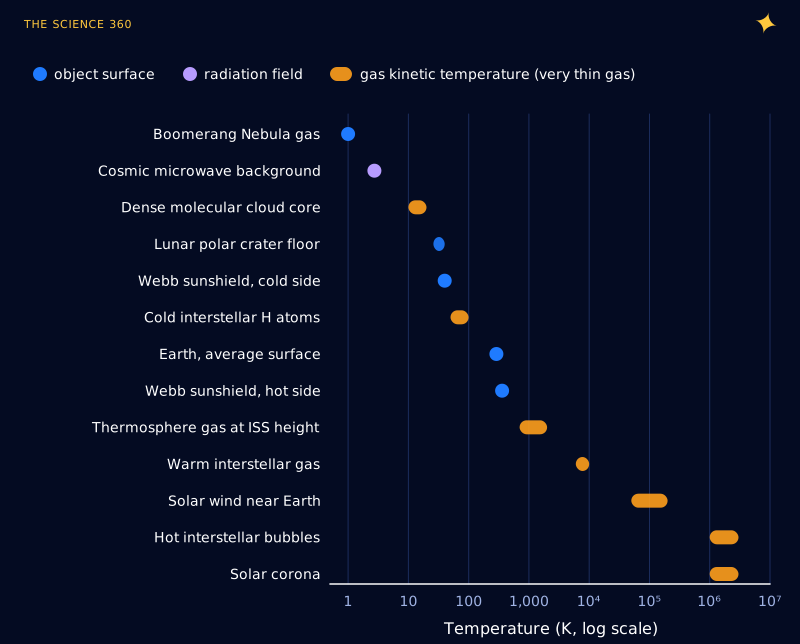
So when people say space is cold, what they really mean is this: an object in space has nothing to exchange heat with except radiation, and the sky, apart from the Sun, radiates almost nothing back. Space is less a freezer than a near-perfect thermos with one bright lamp in it.
Where does the 2.7 K number come from?
Point a radio receiver at any patch of sky away from stars and galaxies and you still pick up a faint glow peaking at a wavelength of about 1 mm. It is the afterglow of the hot early universe, released about 380,000 years after the Big Bang and stretched by cosmic expansion into microwaves. Its spectrum is the most perfect blackbody ever measured. Fixsen's 2009 analysis of the COBE FIRAS data, combined with other measurements, gives 2.72548 ± 0.00057 K.
That is the floor. An object in deep intergalactic space, shaded from every star, would cool until it radiated exactly as much as it absorbed from the microwave background, and it would stop at 2.725 K. Inside the Milky Way the floor is a little higher, because starlight from the whole galaxy adds an energy density comparable to the microwave background's. My rough estimate is that a black ball far from any particular star, but inside our galaxy, would sit near 3 to 4 K. Real interstellar dust grains run hotter, around 15 to 20 K, because tiny grains absorb visible starlight well but radiate poorly at the long wavelengths they would need to emit to cool further.
One natural place beats the floor. The Boomerang Nebula, about 5,000 light-years away, is a dying star blowing gas outward so fast that the gas cools by expansion, the same trick a fridge uses. ALMA observations put it at about 1 K, colder than the background radiation passing through it.
How cold would an object be near Earth?
This is the question most people actually mean, and it has a clean answer. In sunlight, an object heats up until the power it radiates away equals the power it absorbs. Radiated power follows the Stefan-Boltzmann law, per square metre for a perfect black surface. Set absorbed equal to emitted and solve for .
Worked example: equilibrium temperature at 1 AU
Solar irradiance at Earth's distance and the Stefan-Boltzmann constant.
Case A: black sphere, spinning so it is the same temperature all over
It intercepts sunlight on its cross-section and radiates from its whole surface .
Case B: black flat plate facing the Sun, back side insulated
It absorbs and emits from the same one face.
Case C: Earth itself, which reflects 30% of sunlight
The real average is about 288 K; the 33 K difference is the greenhouse effect.
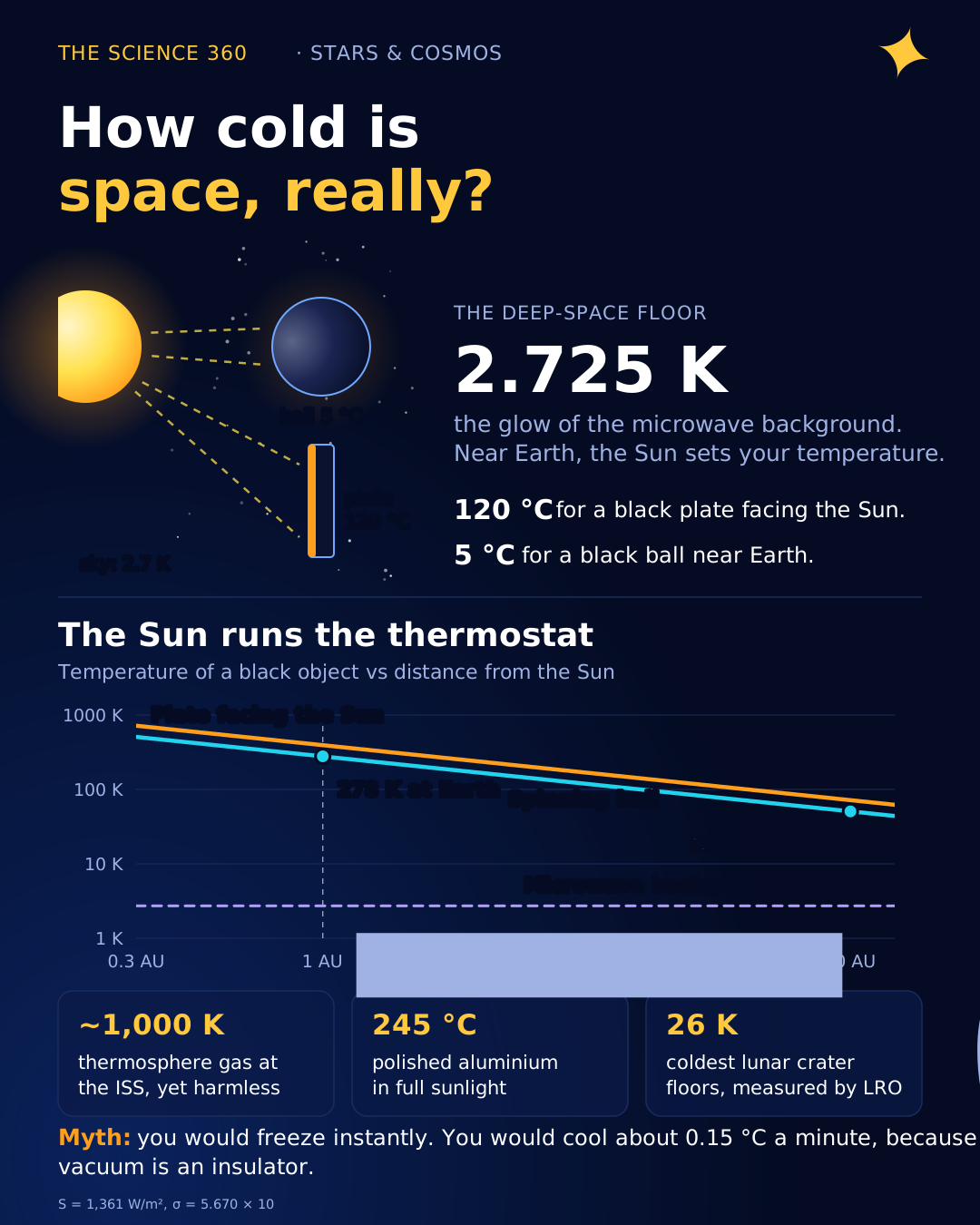
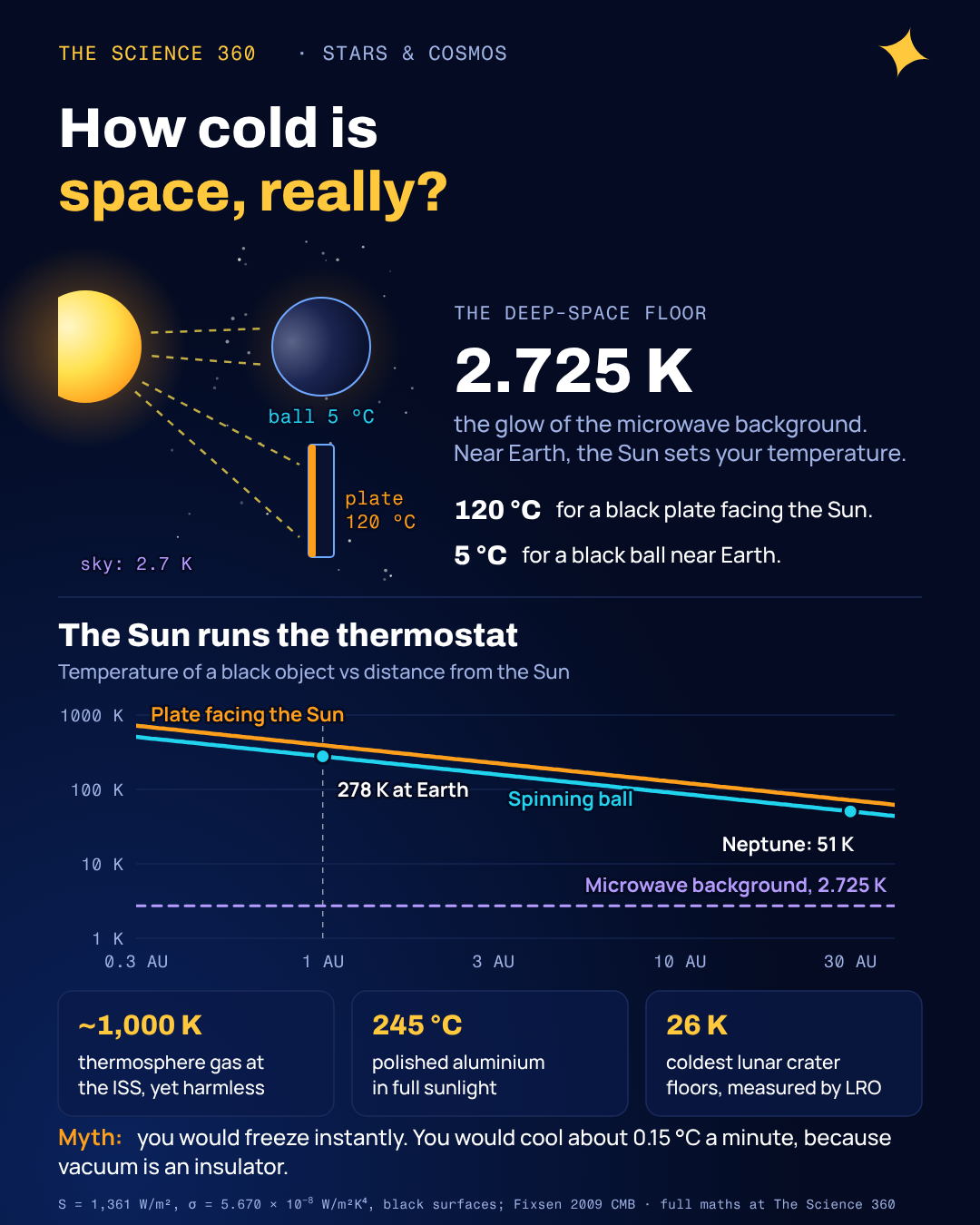
Case B is the origin of the "121 °C in sunlight" figure that circulates for the ISS. It is not a measurement of space. It is the temperature a black surface facing the Sun would reach with nowhere else to lose heat. Figure 1 extends the same calculation across the solar system.
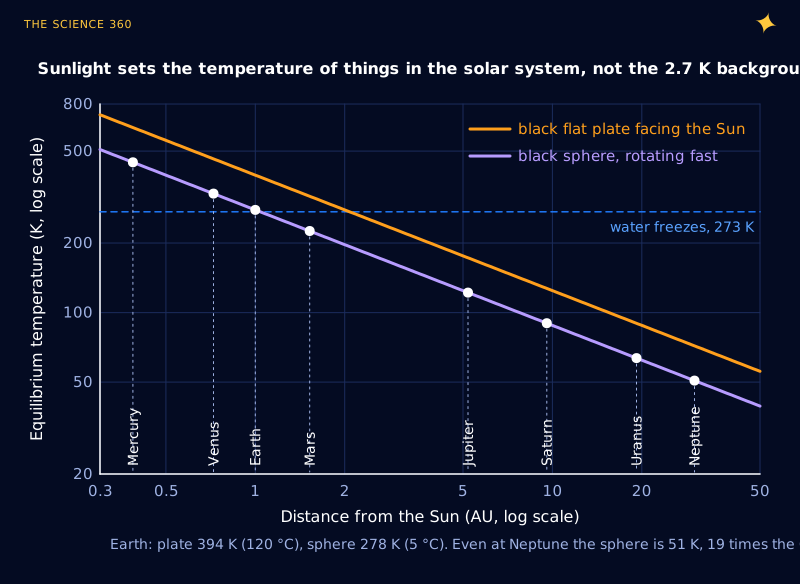
Notice what is missing from the formula: the 2.7 K background. At Earth's distance it contributes about 3 millionths of a watt per square metre, less than a billionth of what the Sun supplies. Inside the solar system, the Sun runs the thermostat.
The misconception: “space is cold, so you would freeze instantly”
Films love the astronaut who freezes solid the moment the airlock opens. Physics says the opposite. A vacuum is the best insulator there is; that is why a vacuum flask keeps coffee hot. With no air to carry heat away by conduction and convection, a body in space can lose heat only by radiation and by evaporation.
Worked example: how fast would a person cool in deep shade?
Skin temperature 33 °C = 306 K; skin emissivity . Effective radiating area about 1.5 m² (total skin area is about 1.8 m², but arms and legs partly face each other).
Net loss after 100 W resting metabolism: about 625 W.
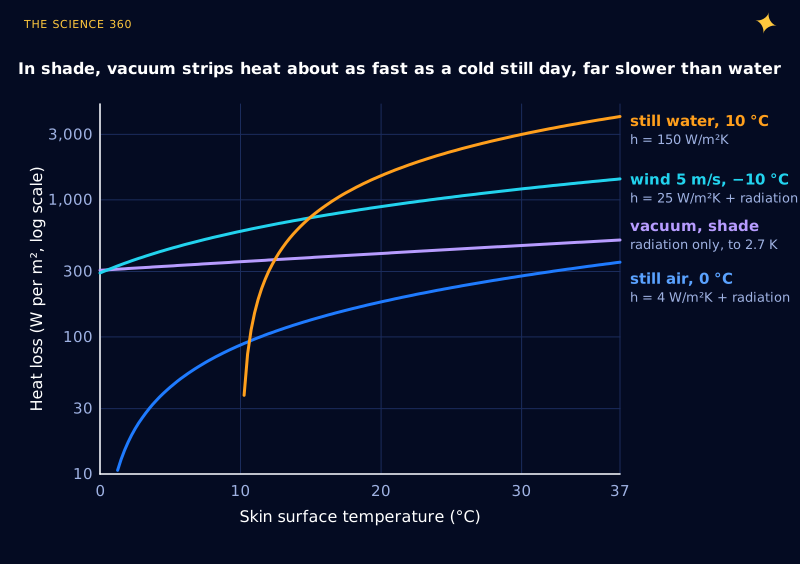
That rate is an upper bound, because as the skin cools it radiates less. It would take hours to drop your core temperature into serious hypothermia, and far longer to freeze. Figure 4 puts the radiative loss next to losses we know from Earth. Per square metre of skin, deep space in shade pulls heat out somewhat faster than still air at 0 °C, slower than a cold breeze, and about seven times slower than water at 10 °C.
What would actually get you is the missing pressure. Above the Armstrong limit, about 6.3 kPa, water at body temperature boils, so moisture in your mouth, eyes and lungs starts to vaporize, and tissue swells (ebullism). Evaporation does cool those wet surfaces quickly, which is why exposed saliva can frost, but the main threat is that the oxygen in your blood is pulled out through the lungs. You would lose consciousness in seconds and die within a few minutes. In 1966 NASA technician Jim LeBlanc's suit lost pressure in a test chamber in Houston. He passed out almost at once, the chamber took 87 seconds to repressurize to a safe level, and he recovered with no lasting harm, reportedly remembering the saliva on his tongue starting to bubble.
Spacesuits, in fact, have the opposite problem. The working body produces several hundred watts during a spacewalk, and the suit is wrapped in multilayer insulation that is designed to stop radiation getting in or out. So the suit carries a liquid cooling garment and a water sublimator to throw that heat away.
How cold is it outside the ISS?
You will often see minus 157 °C to plus 121 °C. I could not trace that range to a primary NASA document, though it appears in NASA-derived educational material, and it matches Case B above almost exactly on the hot end. It is a statement about surfaces, and it depends enormously on what the surface is made of.
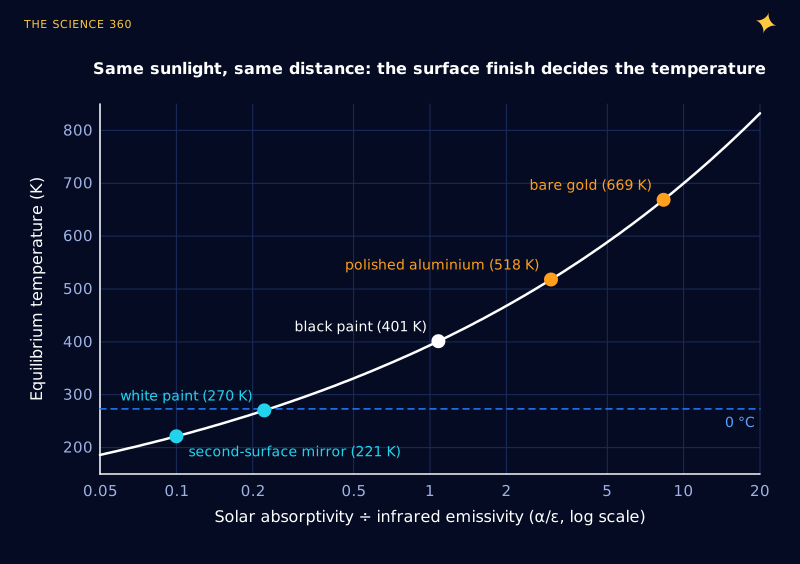
Two properties matter: absorptivity α, the fraction of sunlight a surface soaks up, and emissivity ε, how well it radiates in the infrared. For a sun-facing plate, the equilibrium temperature scales as (α/ε)1/4.
Worked example: white paint versus polished aluminium at 1 AU
White paint, , ratio 0.22:
Polished aluminium, , ratio 3.0:
Same sunlight, same distance, a 250 °C difference. Shiny metal feels like it should stay cool, but it is a poor radiator, so it cannot shed what little sunlight it does absorb. That is why spacecraft radiators are painted white or covered in second-surface mirrors (silvered glass or film with a high-emissivity top layer), and why bare gold, used for its infrared properties, runs extremely hot if left in sunlight. Figure 3 shows the whole curve.
The ISS lives inside this trade-off. Every 92 minutes it passes through about 35 minutes of Earth's shadow, so surfaces swing between sunlit and dark. In shadow, a surface that faces Earth still receives the planet's own infrared glow, roughly 240 W/m² at the top of the atmosphere, so it stays far warmer than one facing deep space. The station's External Active Thermal Control System pumps liquid ammonia through the modules' heat exchangers and out to large radiators, rejecting up to 70 kW of heat. Ammonia was chosen partly because it freezes at about minus 78 °C. Inside, the water loops run at 4 °C and 17 °C. The design worry, throughout, is rejecting heat.
What is the coldest place in the solar system?
Shadows that never see the Sun. Near the Moon's poles, the Sun skims the horizon, and crater floors can stay in darkness for billions of years. NASA's Lunar Reconnaissance Orbiter measured winter night temperatures of about 26 K in the coldest north polar craters with its Diviner radiometer, and 35 to 40 K in parts of the south polar region. Those crater floors are not cooling toward 2.7 K, because they still receive a little heat from the Moon's interior and from sunlight scattered off nearby crater rims.
Engineers build similar shadows deliberately. The James Webb Space Telescope's five-layer sunshield faces the Sun at up to 358 K on its hot side, while the telescope behind it settles near 40 K. That is passive cooling done well: the layers each re-radiate heat out of the gaps between them, so very little reaches the next layer. The mid-infrared instrument needs 7 K, which no shadow can provide near Earth, so it carries an active cryocooler.
So, how cold is space?
If you mean the radiation that fills the universe, 2.725 K. If you mean the thin gas around a spacecraft in low Earth orbit, hot, at roughly 1,000 K, and irrelevant. If you mean what happens to you or your satellite, the honest answer is "whatever temperature balances the sunlight you absorb against the heat you radiate," which near Earth ranges from about minus 150 °C in deep shade to well over 100 °C in full sun. The coldness of space is mostly the absence of a warm environment to lean on, not an active chill.
FAQ
Is space absolute zero?
No. Even far from any star, space is filled with the cosmic microwave background, radiation left over from the early universe with a temperature of 2.725 K, about 2.7 degrees above absolute zero. An object shielded from all starlight would cool toward that value, never below it, unless something like expanding gas cools it further.
Would you freeze instantly in space?
No. Vacuum is an insulator, so a body can only lose heat by radiation and evaporation. A person radiates roughly 700 W into dark space, which would lower average body temperature by well under a degree per minute. Lack of pressure and oxygen would kill you within a couple of minutes, long before cold mattered.
How cold is it outside the International Space Station?
It depends on the surface, not on the space around it. A black sun-facing plate at Earth's distance settles near 120 °C, a white-painted one near 0 °C, and a surface in Earth's shadow facing deep space can drop below minus 100 °C. The widely quoted range of minus 157 °C to 121 °C describes hull surfaces, not the vacuum.
Why is space cold if the Sun is hot?
Sunlight carries a lot of energy, about 1,361 W per square metre at Earth's distance, but it arrives from a small patch of sky. The rest of the sky radiates almost nothing back. An object warms until it radiates away what it absorbs, which for a black sphere at 1 AU is about 278 K. Shade it and the only incoming energy left is the 2.7 K background.
What is the coldest place in space?
The coldest known natural place is the Boomerang Nebula, about 5,000 light-years away, where rapidly expanding gas has cooled to about 1 K, colder than the cosmic microwave background. In our solar system, permanently shadowed lunar craters reach about 26 K.
Related on The Science 360
Sources
- Fixsen, D. J. (2009), "The Temperature of the Cosmic Microwave Background", ApJ 707, 916 (T = 2.72548 ± 0.00057 K): arxiv.org/abs/0911.1955
- Kopp, G. and Lean, J. (2011), "A new, lower value of total solar irradiance" (1,360.8 W/m²): agupubs.onlinelibrary.wiley.com/doi/10.1029/2010GL045777
- NASA, "How Does Webb Stay Cold?" (sunshield hot side up to 358 K, instruments near 40 K, MIRI 7 K): science.nasa.gov/mission/webb/.../how-does-webb-stay-cold
- NASA, "ISS Active Thermal Control System Overview" (EATCS 70 kW, ammonia loops, internal loops at 4 °C and 17 °C): nasa.gov/.../473486main_iss_atcs_overview.pdf
- EarthSky, "David Paige measures extreme cold on surface of Moon" (Diviner, 26 K in north polar craters): earthsky.org/space/david-paige-measures-extreme-cold-on-surface-of-moon
- Paige, D. A. et al. (2010), "Diviner Lunar Radiometer Observations of Cold Traps in the Moon's South Polar Region", Science 330, 479: authors.library.caltech.edu/records/d4acs-jm175
- NASA JPL, "Ghostly Specter Haunts the Coldest Place in the Universe" (Boomerang Nebula, about 1 K): jpl.nasa.gov/news/ghostly-specter-haunts-the-coldest-place-in-the-universe
- UCAR COMET, thermosphere scale height simulation (exospheric temperature about 900 K at solar minimum and 1,670 K at solar maximum): meted.ucar.edu/hao/aurora/scale_height.htm
- Interstellar medium phases and temperatures (orientation): en.wikipedia.org/wiki/Interstellar_medium
- Guinness World Records, "Highest equivalent altitude exposure survived" (Jim LeBlanc, 1966, 87 s to repressurize): guinnessworldrecords.com/world-records/447311
Method note: equilibrium temperatures assume steady state and ignore internal heat sources. The thermosphere heat flux, the in-galaxy blackbody temperature and the body cooling rate are the author's order-of-magnitude estimates from the stated inputs.
Header image: NASA, ESA, CSA, STScI (image carina_nebula), regraded for this article.