Why Is the Sun's Corona Hotter Than Its Surface?

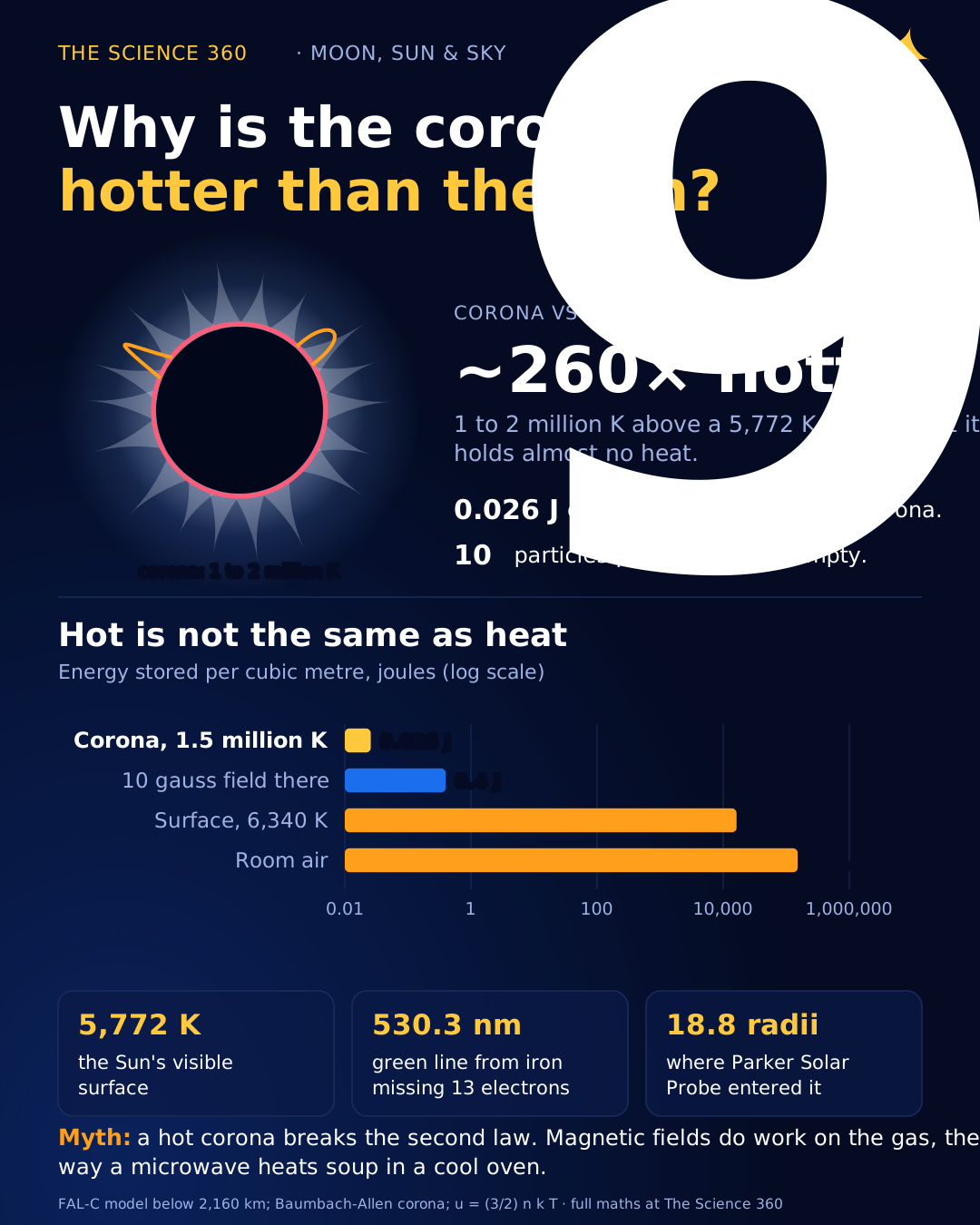
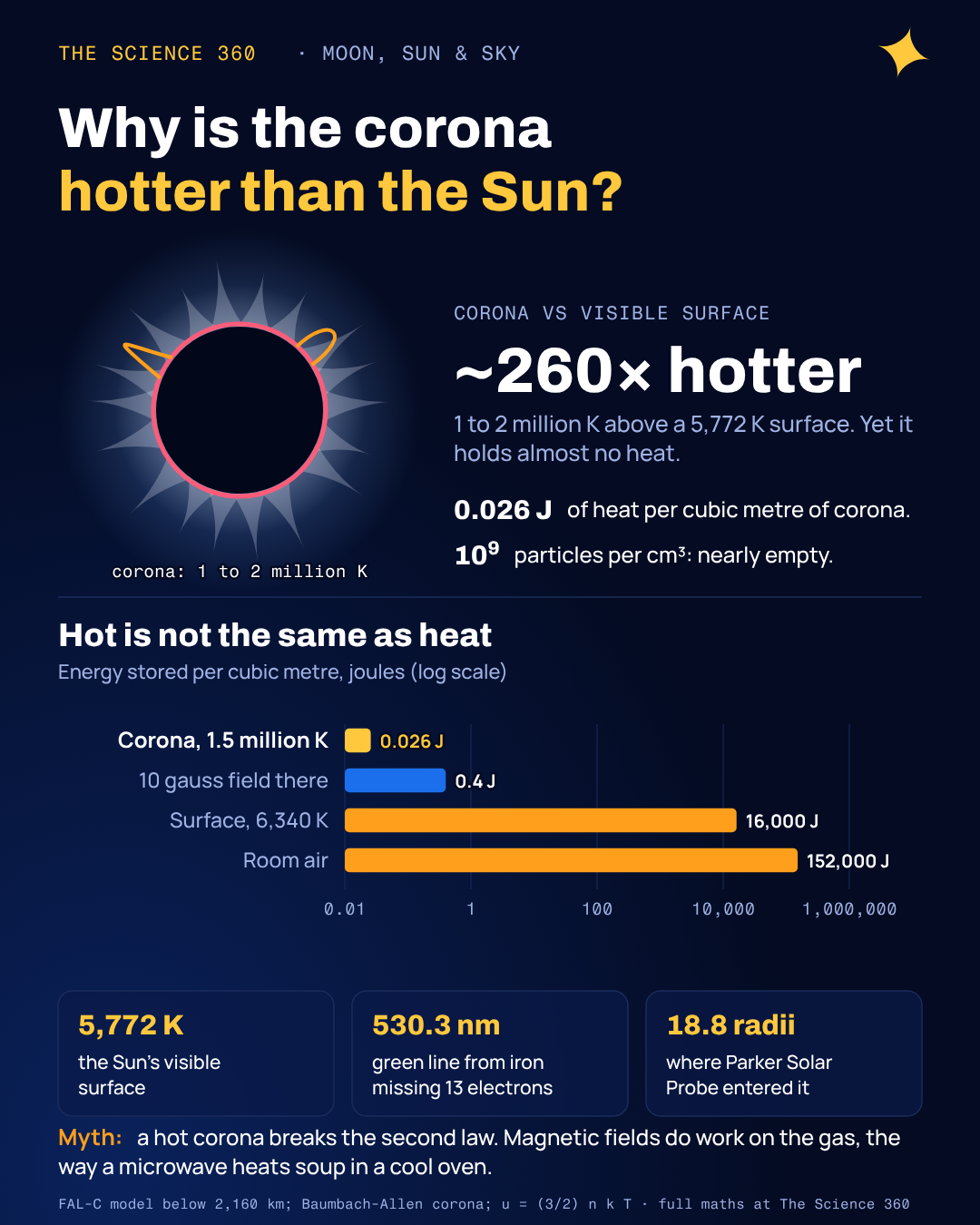
The Sun's visible surface radiates like a body at 5,772 K. Climb about 2,000 km and the temperature has risen a little, to roughly 10,000 K. Then, within a few hundred kilometres, it jumps past a million. The corona, the pearly halo you see around the Moon in a total eclipse, sits at 1 to 2 million kelvin, around 260 times hotter than the surface it floats on. It is like walking away from a campfire and getting burned.
Most explanations stop at "this is a mystery". That is overstated. Physicists know where the energy comes from (magnetic fields), roughly how much is needed (very little), and why nothing in thermodynamics is broken. What is still argued over is exactly how the magnetic energy turns into heat. To see why, you need two numbers most articles skip: how thin the corona is, and how little heat it holds.
How hot is each layer of the Sun’s atmosphere?
Figure 1 shows the standard picture, from the FAL-C model of Fontenla, Avrett and Loeser, a one-dimensional fit to the quiet Sun's spectrum that is used as a reference in solar physics. We took the model as distributed with the RH radiative transfer code and rebuilt the heights from hydrostatic balance.
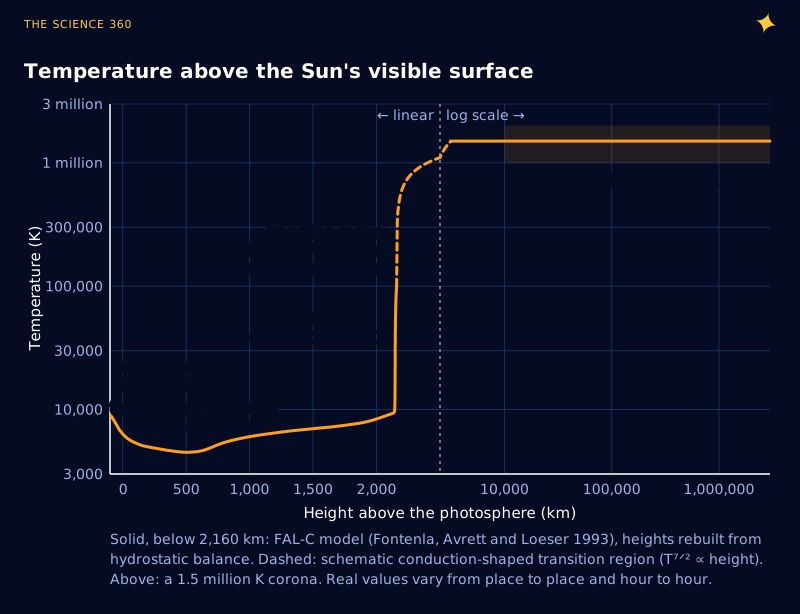
Four zones show up:
- Photosphere, the layer you see, effective temperature 5,772 K (NASA fact sheet). Temperature falls with height, as you would expect.
- Temperature minimum, about 4,500 K at 520 km in FAL-C, the last place where intuition works.
- Chromosphere, the thin pink layer seen in eclipses, slowly warming from 6,000 to 10,000 K. NASA gives it a thickness of about 2,500 km.
- Transition region and corona. Temperature leaps from about 20,000 K to over a million in a layer only tens to hundreds of kilometres thick, then stays at 1 to 2 million K for millions of kilometres.
So the puzzle is really two puzzles: why the chromosphere warms at all above the temperature minimum, and why the corona is a thousand times hotter again. Both need energy delivered by something other than ordinary heat flow.
How do we even know it is a million degrees?
Nineteenth-century eclipse observers saw a bright green line at 530.3 nm in the corona's spectrum that matched no known element. They called the mystery element coronium. In 1939 to 1940, Walter Grotrian and Bengt Edlén showed the line comes from iron that has lost 13 of its 26 electrons (written Fe XIV). Ripping off that many electrons by collisions requires electrons moving at speeds typical of about a million kelvin. Spectral line widths, X-ray emission and radio brightness all agree. The temperature is not in doubt.
Does a hot corona break the second law of thermodynamics?
This is the misconception worth fixing. Popular articles often say the hot corona "defies the laws of physics" because heat should not flow from a cooler surface to a hotter atmosphere. That is correct about heat and irrelevant to the Sun.
The second law says heat does not flow spontaneously from cold to hot. It says nothing against doing work on a gas to heat it above its surroundings. A microwave oven heats soup to 90 °C while the oven walls stay near room temperature, because the energy arrives as microwaves, not as heat from the walls (see how microwave ovens actually heat water). A bicycle pump gets hot when you compress the air.
The Sun does the same thing with magnetism. The surface is a boiling layer of convection cells (granules) carrying heat up from the interior at 15.7 million K in the core. Magnetic field lines are rooted in that moving plasma and reach up into the corona. Convection drags, twists and shakes their footpoints. That does work on the field, storing energy in it or launching waves along it, and the energy is released high up, where there is very little gas to absorb it. The heat engine runs between a 15.7 million K core and 3 K space. Nothing flows uphill.
And once the corona is hot, heat does flow the normal way: downward by conduction into the cooler transition region and chromosphere, and outward in radiation and the solar wind. Those losses are what the heating has to replace continuously.
Hot, but how much heat? The corona is almost empty
Temperature measures how fast particles move; heat content also depends on how many there are. Figure 2 shows the particle density through the same layers, using FAL-C below 2,160 km and the classic Baumbach-Allen formula for the corona, electrons per cm³, with r in solar radii.
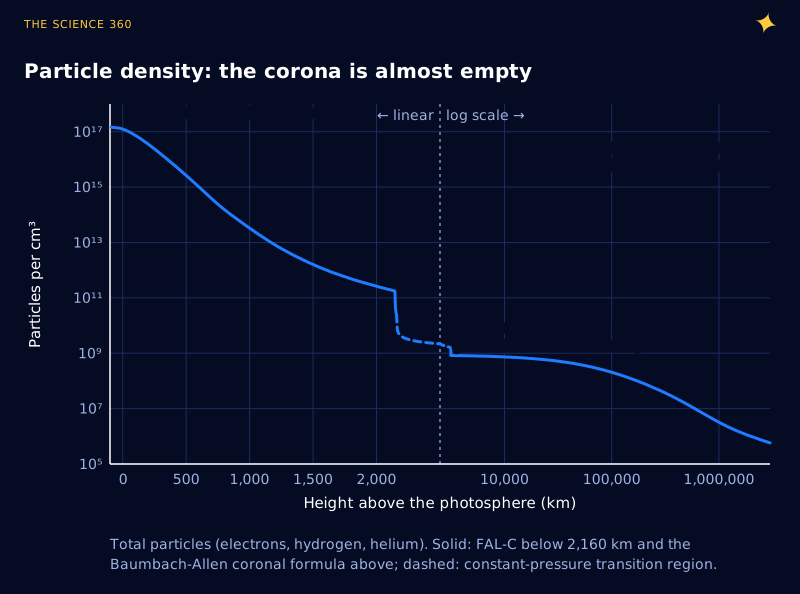
Multiply density by temperature and you get the stored heat. For a fully ionised gas, the thermal energy per cubic metre is .
Thermal energy per cubic metre
Photosphere, :
Corona base, :
Room air, translational energy only, :
So a cubic metre of corona holds about one six-millionth of the heat in a cubic metre of the room you are sitting in.
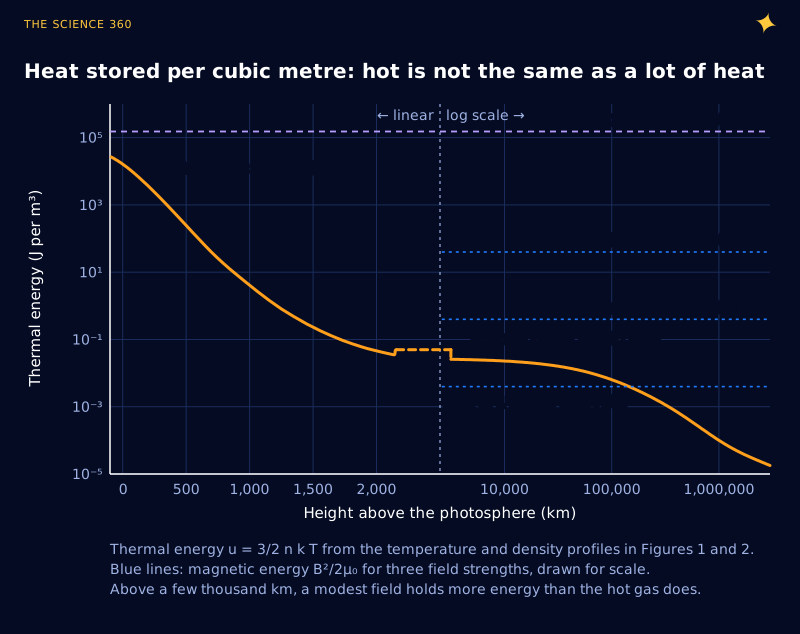
In the photosphere the gas has far more energy than the magnetic field, so convection pushes the field around. In the corona it is the other way round: a 10 gauss field holds about 0.4 J/m³, fifteen times the thermal energy of the gas. The field is in charge, and a little of its energy goes a long way.
How much power does it take to heat the corona?
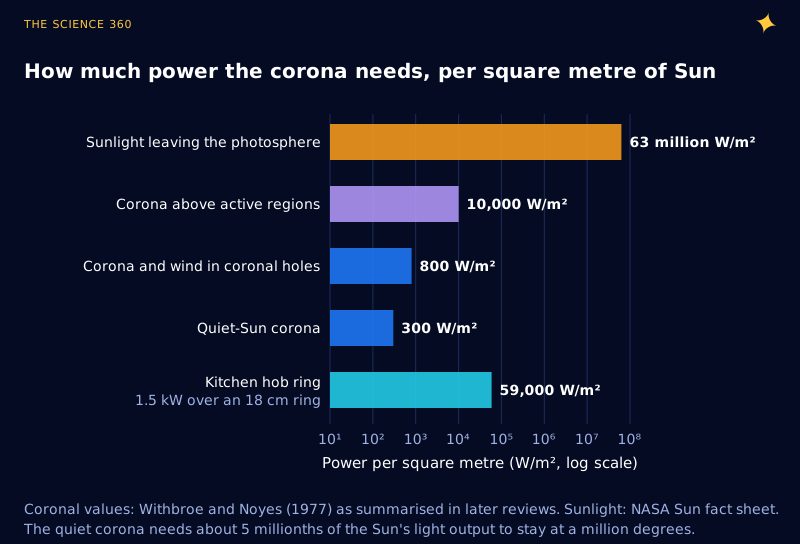
Because the corona holds so little heat, the power needed to keep it hot is tiny compared with what the Sun radiates. The standard budget is from Withbroe and Noyes (1977): about 300 W/m² for the quiet-Sun corona, about 800 W/m² for coronal holes (where the solar wind carries energy away), and about 10,000 W/m² above active regions. Wikipedia's solar corona article puts the general figure at about 1 kW per square metre, in the same range.
The whole corona's energy budget
Sun's surface area:
Quiet-Sun heating:
Fraction of solar luminosity (): , five parts in a million
Thermal energy in the corona out to 3 solar radii (integrating over the shell in our model): . That is the Sun's light output for 0.065 seconds.
Time to drain it with no heating:
That last line is the real constraint on any theory. The corona's heat would leak away in hours, so whatever heats it must deliver a few hundred watts per square metre, all the time, everywhere. Energetically the Sun can afford it easily. The problem is purely about mechanism.
What heats the corona? The two main ideas
Both leading ideas start from the same place: convection moving the footpoints of magnetic field lines. They differ in how fast the footpoints move compared with how fast a disturbance can travel along the field.
Waves (AC heating). Fast jiggling launches Alfvén waves, ripples that travel along field lines like waves on a plucked string. They carry plenty of energy upward; the difficulty is getting them to give it up in the corona rather than passing straight through. Early direct detections, according to the summary on Wikipedia, found magneto-acoustic waves carrying only about 10% of the energy needed, which pushed attention toward Alfvén waves that are harder to see.
Nanoflares (DC heating). Slow shuffling twists and braids field lines, storing energy like a wound spring. Eugene Parker proposed in 1988 that the braided field releases its energy in countless small reconnection events, where tangled field lines snap and reconnect, each one a tiny flare. He called them nanoflares.
These are not rival forces of nature. Both turn convective motion into magnetic energy and then into heat, and most solar physicists expect both to operate, with the balance changing between quiet Sun, coronal holes and active regions.
What have Parker Solar Probe and Solar Orbiter found?
NASA's Parker Solar Probe, launched in August 2018, now dives to within about 6.2 million km of the Sun at about 700,000 km/h, behind a 4.5-inch carbon-composite shield rated to nearly 1,377 °C (NASA mission page). On April 28, 2021 it crossed the Alfvén surface at 18.8 solar radii, the boundary inside which the magnetic field controls the plasma, which counts as the first time a spacecraft was inside the corona.
Its most famous discovery is switchbacks: sudden S-shaped kinks in the magnetic field of the solar wind, where the field briefly reverses direction. They are carried outward in the wind, and analyses of their structure have tied them both to Alfvén waves growing as the wind expands and to reconnection events near the Sun. One 2025 analysis by Trevor Bowen and colleagues followed a single wind stream and found that the switchbacks grow as they expand outward, but by less than wave theory predicts; the missing wave energy matches the observed heating rate of the wind's protons. Both readings point to the same picture: the young solar wind is full of magnetic energy being worked into the plasma, as both heating models predict. No single result has settled which mechanism dominates.
From farther out, ESA's Solar Orbiter has been imaging the smallest brightenings in the quiet corona. Using its 2022 and 2023 close passes at 0.293 AU, a team led by Nancy Narang (A&A, 2025) found EUV "campfires" as small as about 10,000 km² and as short as 3 seconds, the instrument's limit, appearing at a rate of about 3,600 per second across the Sun. Whether their combined energy covers the 300 W/m² budget is the next thing to measure.
Why doesn’t Parker Solar Probe melt in a million-degree corona?
Because "hot" and "lots of heat" are different, as we saw above. You can work out how much heat the corona's electrons deliver to a surface. For a gas of electrons with density n and temperature T, the energy flux onto a wall is the number hitting per second, n v̄ / 4, times the average energy each one brings, 2kT.
A dark plate at the base of the corona
Mean electron speed:
Heat flux onto the plate:
Equilibrium temperature radiating it away:
Sunlight at the same spot: , about 1,800 times more.
A million-degree gas would warm a plate to about 600 °C, a dull red heat, and the probe sits much farther out, where the gas is far thinner still. Its shield exists for the sunlight. This is the same point we make in how cold is space: the temperature of a very thin gas says little about how hot something placed in it will get.
Is the corona hotter than the core?
No. The core is about 15.7 million K (NASA fact sheet), roughly ten times the corona. Flares briefly heat small volumes to tens of millions of kelvin (Wikipedia quotes up to 20 million K in some active regions), but on average the core is hottest, the surface coolest, and the corona in between. You can see the corona yourself only during totality; the August 2027 eclipse offers over six minutes of it.
FAQ
Why is the Sun’s corona hotter than its surface?
Energy reaches the corona as magnetic energy, not as heat flowing outward. Convection at the surface shakes and twists magnetic field lines that reach up into the corona, and that energy is released there as waves and tiny reconnection bursts called nanoflares. Because the corona is so thin, a small energy input of a few hundred watts per square metre heats it to 1 to 2 million kelvin.
Does the hot corona violate the second law of thermodynamics?
No. The second law forbids heat flowing by itself from a colder body to a hotter one. The corona is heated by work done by moving magnetic fields, powered by convection, which is itself driven by the much hotter solar interior. Heat actually flows the expected way: from the corona down into the cooler chromosphere and out into space.
How hot is the Sun’s corona?
Typically 1 to 2 million kelvin, around 170 to 350 times the 5,772 K effective temperature of the visible surface. Above active regions it can reach several million kelvin, and flares briefly heat plasma to tens of millions of kelvin.
Why doesn’t Parker Solar Probe melt in the corona?
The corona is so thin that its particles deliver very little heat. Near the base of the corona, electrons at 1.5 million K would warm a dark plate only to roughly 900 K, while sunlight at the same spot delivers about 1,800 times more power. Parker Solar Probe's heat shield is built for the sunlight, and is rated to nearly 1,377 °C.
How do scientists know the corona is a million degrees?
From its spectrum. The corona's bright green emission line at 530.3 nm comes from iron atoms missing 13 of their 26 electrons (Fe XIV). Stripping that many electrons by collisions needs temperatures around a million kelvin. Bengt Edlén, following Walter Grotrian, made the identification around 1940.
Sources
- NASA NSSDCA, "Sun Fact Sheet" (effective temperature 5,772 K, surface emission 62.94 MW/m², luminosity, radius 695,700 km, central temperature 15.7 MK, chromosphere about 2,500 km): nssdc.gsfc.nasa.gov
- FAL-C model atmosphere (Fontenla, Avrett and Loeser 1993), file FALC_82.atmos distributed with the RH code: github.com/ITA-Solar/rh
- H. Çakmak, "A New Approach to Calculate Coronal Electron Density: Simplified van de Hulst's Method" (states the Baumbach-Allen formula), arXiv:2310.14903: arxiv.org/abs/2310.14903
- Wikipedia, "Solar corona" (1 to 2 million K, base density 1015 m−3, about 1 kW/m² heating, transition region thickness, Grotrian and Edlén, Alfvén surface crossing at 18.8 solar radii on April 28, 2021): en.wikipedia.org/wiki/Solar_corona
- NASA Science, "Parker Solar Probe" mission page (closest approach about 6.2 million km, about 700,000 km/h, shield rated to nearly 1,377 °C): science.nasa.gov
- Royal Observatory of Belgium SIDC, "A blizzard of solar campfires", on Narang et al. 2025, A&A 699, A138: sidc.be
- T. A. Bowen et al., "Formation of Magnetic Switchbacks via expanding Alfvén Waves" (2025), arXiv:2504.13384: arxiv.org/abs/2504.13384
Method note: FAL-C heights were rebuilt by integrating with , ignoring turbulent pressure, and set to zero where T = 6,340 K; the top of the model lands at 2,160 km. The transition region is a schematic profile at constant pressure, and the corona is an isothermal 1.5 MK with Baumbach-Allen densities, so Figures 1 to 3 show orders of magnitude, not a precise model.
Header image: 2017 total solar eclipse photo by NASA/Aubrey Gemignani, recoloured and relit for this article.