How Long Does Sunlight Take to Reach Earth?
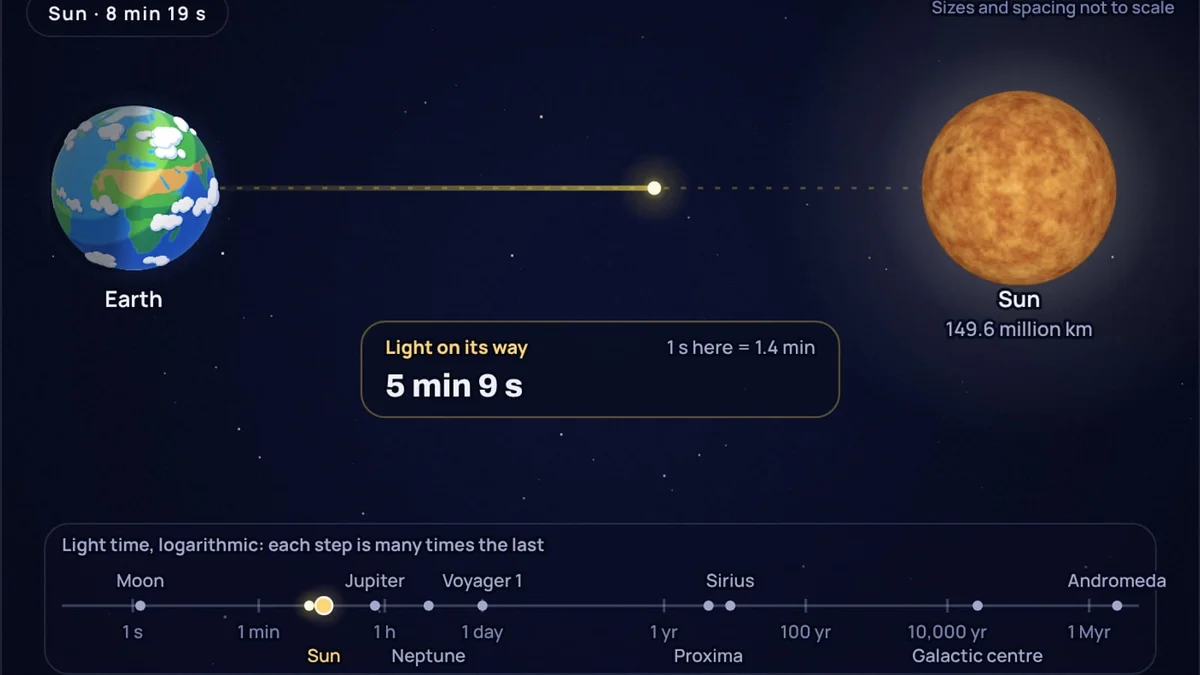
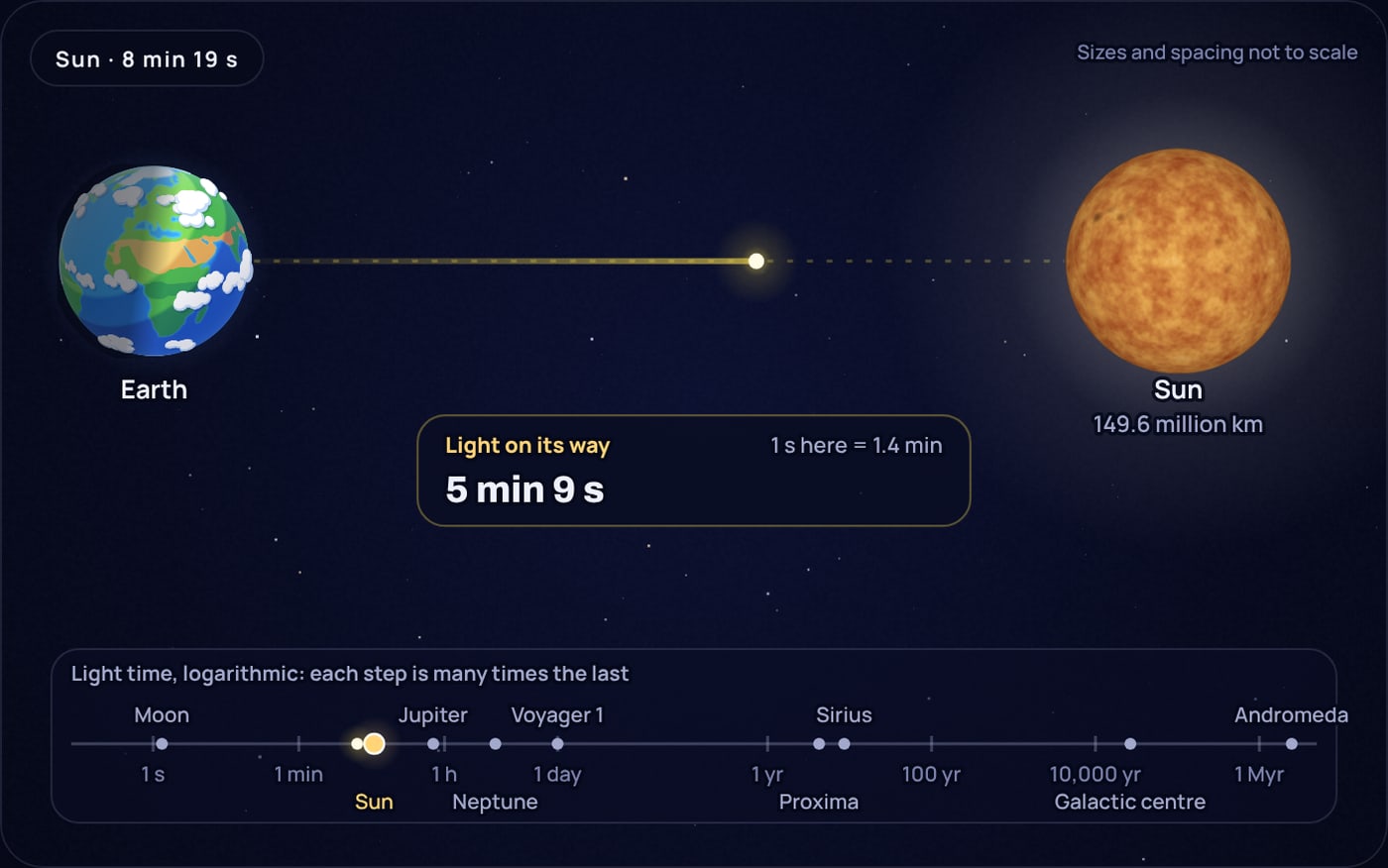
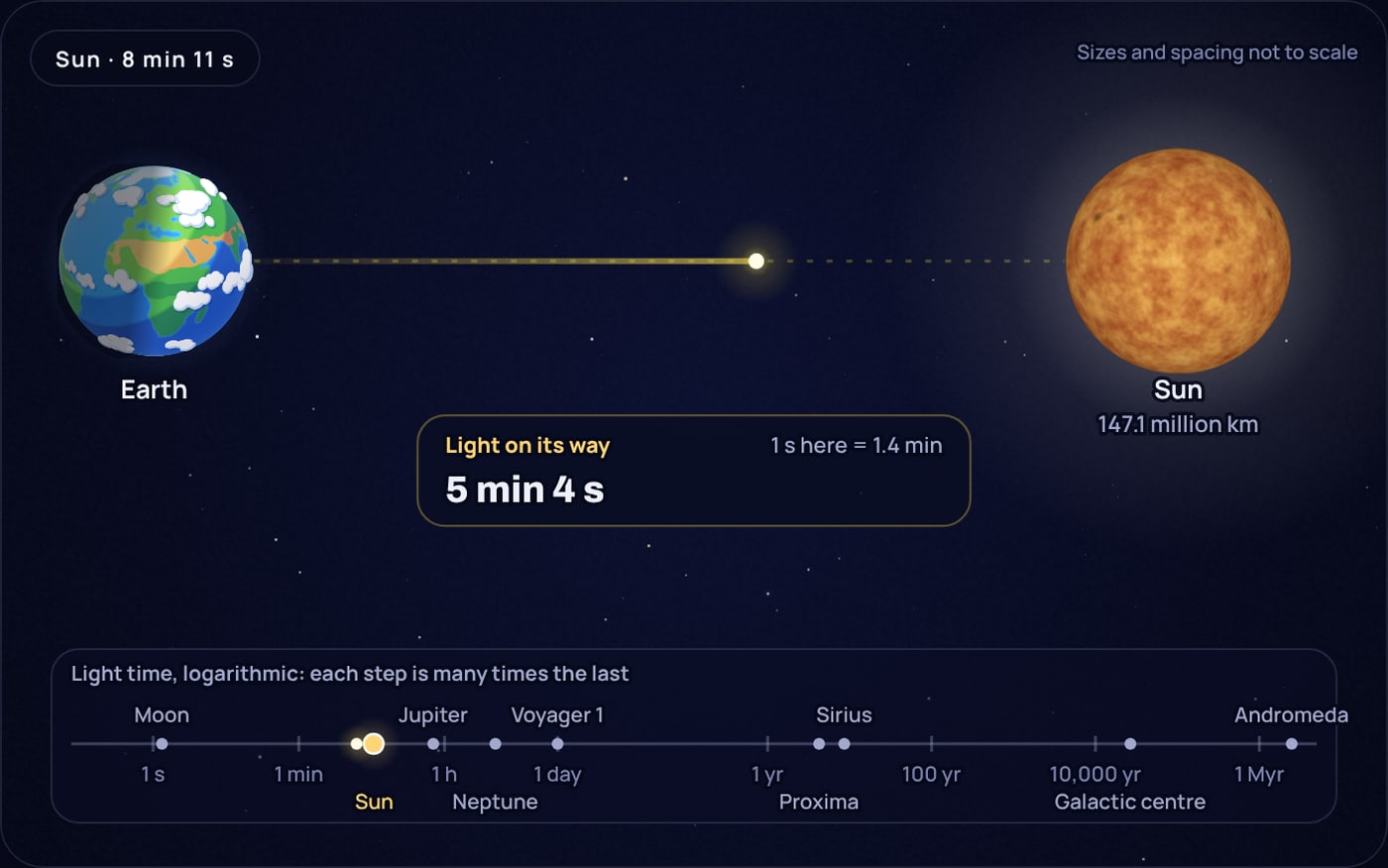
At 12:00 tomorrow, look at the shadow of a lamp post and remember that the light making it left the Sun at about 11:51:41. Every glance at the sky is a glance into the past, and the Sun is the case where the delay is long enough to feel: a little over eight minutes, enough to boil an egg.
The exact figure is easy to work out and changes slightly through the year. This post does the sums, shows why January sunlight is fresher than July sunlight, and then goes further out to the Moon, the planets, Voyager 1 and the nearest star. The light travel time calculator does the same arithmetic for any destination or distance you type, and draws the light making the trip.
How long does sunlight take to reach Earth?
Two numbers do all the work, and both are fixed by definition. The speed of light in vacuum is exactly 299,792.458 km/s, because since 1983 the metre has been defined from it. The astronomical unit, the standard Earth to Sun distance, is exactly 149,597,870.7 km, set by the International Astronomical Union in 2012. JPL lists both on its page of astrodynamic constants.
Example 1: sunlight at the average distance
JPL's constants page gives the same thing as "light time for 1 au": 499.004783836 seconds.
That is the number to remember: just under 500 seconds. It is also why astronomers sometimes call the astronomical unit "8.3 light minutes".
Why does the time change during the year?
Earth's orbit is an ellipse with an eccentricity of 0.0167, close to a circle but not quite. NASA's Earth fact sheet gives the closest distance (perihelion) as 147.095 million km and the farthest (aphelion) as 152.100 million km. Perihelion comes in early January and aphelion in early July, which surprises people in the northern hemisphere: the Sun is nearest in the middle of their winter, because seasons come from the tilt of Earth's axis, not the distance.
Example 2: January against July
A difference of 16.7 seconds. JPL's Horizons ephemeris puts the next perihelion on 3 January 2027 at 147.105 million km and the next aphelion on 5 July 2027 at 152.100 million km, which gives the same two times to the nearest tenth of a second.
On the day this post went up, 13 November 2026, Earth was 148.07 million km from the Sun by Horizons, so the light took 8 minutes 14 seconds. The same oval orbit also makes January sunlight about 7% stronger than July sunlight, worked through in the post on how orbital eccentricity changes sunlight.
Is the sunlight you see really 8 minutes old?
Only the last leg is. The light that reaches you left the Sun's visible surface, the photosphere, about 8 minutes ago. But the energy it carries was released by fusion in the core, roughly 700,000 km further in, and it did not stream straight out. In the dense interior, light is absorbed and re-emitted again and again in random directions, and further out the energy is carried up by churning gas. That trip from core to surface takes vastly longer than the trip across space. Estimates of how much longer depend heavily on the solar model, but nobody measures it in minutes.
So the honest statement is: the photons are 8 minutes old, and the energy is ancient.
What would happen if the Sun suddenly disappeared?
For 8 minutes 19 seconds, nothing you could notice. The last light would still be in flight, so the Sun would keep shining in the sky. Earth would also keep curving round where the Sun used to be, because gravity does not act instantly either: a change in the Sun's gravity spreads outward at the speed of light.
This has been tested. In August 2017 the LIGO and Virgo detectors picked up gravitational waves from two neutron stars merging in another galaxy, and gamma rays from the same event arrived 1.7 seconds later. After a trip that long, a gap that short pins the speed of gravity to the speed of light within a few parts in a thousand trillion. The Sun vanishing is impossible, but the thought experiment now has a measured answer.
How long does light take from the Moon and the planets?
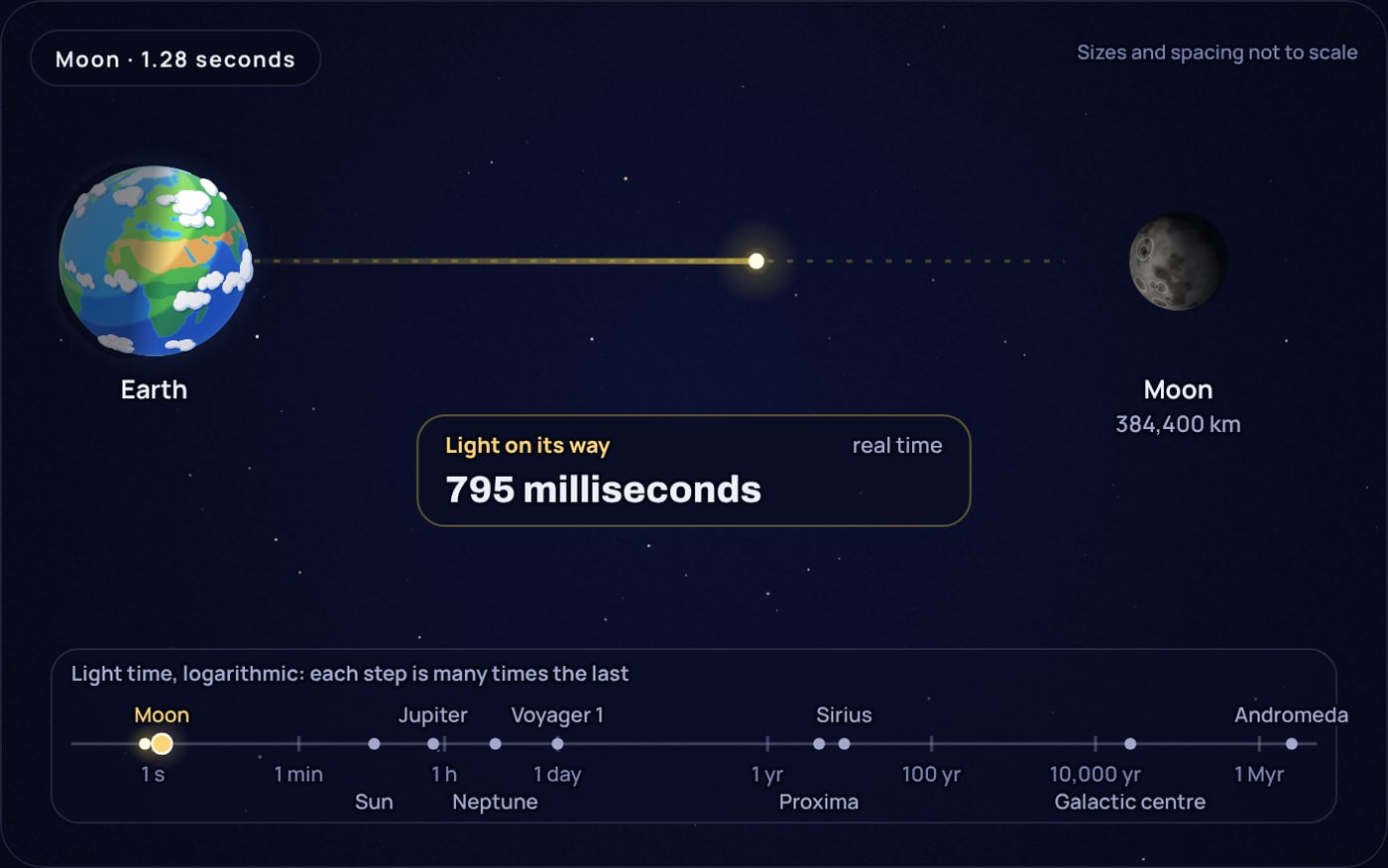
The same division works for anything, and only the distance changes. For the planets the distance swings widely as Earth and the planet move round the Sun, so each has a closest, average and farthest value. Closest and farthest below come from NASA's planetary fact sheets; the averages are the time average over 1800 to 2050, worked out from JPL's orbital elements.
| From | Closest | Average | Farthest |
|---|---|---|---|
| Moon | 1.21 s | 1.28 s | 1.35 s |
| Sun | 8 min 11 s | 8 min 19 s | 8 min 27 s |
| Mercury | 4 min 18 s | 8 min 38 s | 12 min 20 s |
| Venus | 2 min 7 s | 9 min 27 s | 14 min 31 s |
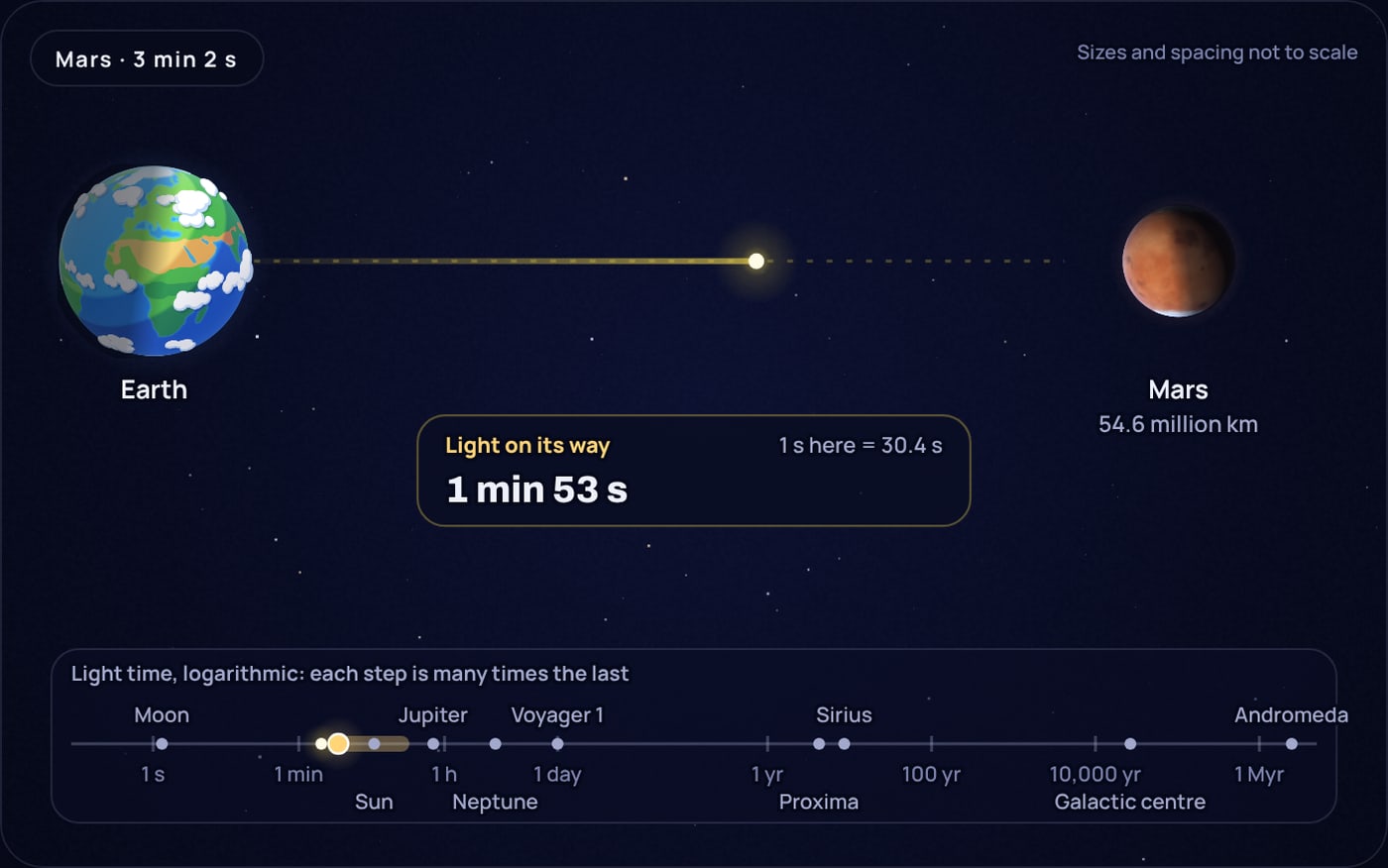
| Mars | 3 min 2 s | 14 min 10 s | 22 min 19 s |
| Jupiter | 32 min 43 s | 43 min 43 s | 53 min 51 s |
| Saturn | 1 h 7 min | 1 h 20 min | 1 h 32 min |
| Uranus | 2 h 23 min | 2 h 40 min | 2 h 55 min |
| Neptune | 4 h 0 min | 4 h 10 min | 4 h 22 min |
| Pluto | 3 h 58 min | 5 h 39 min | 6 h 59 min |
One row deserves a second look. Venus comes closer to Earth than any other planet, but on average Mercury is nearer: 8 minutes 38 seconds against 9 minutes 27 seconds. Mercury never strays far from the Sun, while Venus spends long stretches on the far side of it.
Mars is the case that matters in practice, because people drive rovers there.
Example 3: a command to a Mars rover
A question and its answer double that: from 6 minutes to almost 45 minutes for one exchange. Nobody can steer a rover around a rock with that lag, so rovers are sent a plan of moves to carry out on their own.
Getting a spacecraft to Mars is a different, much slower problem; the post on how long it takes to get to Mars covers the months of coasting along a transfer orbit.
Which spacecraft is one light day away?
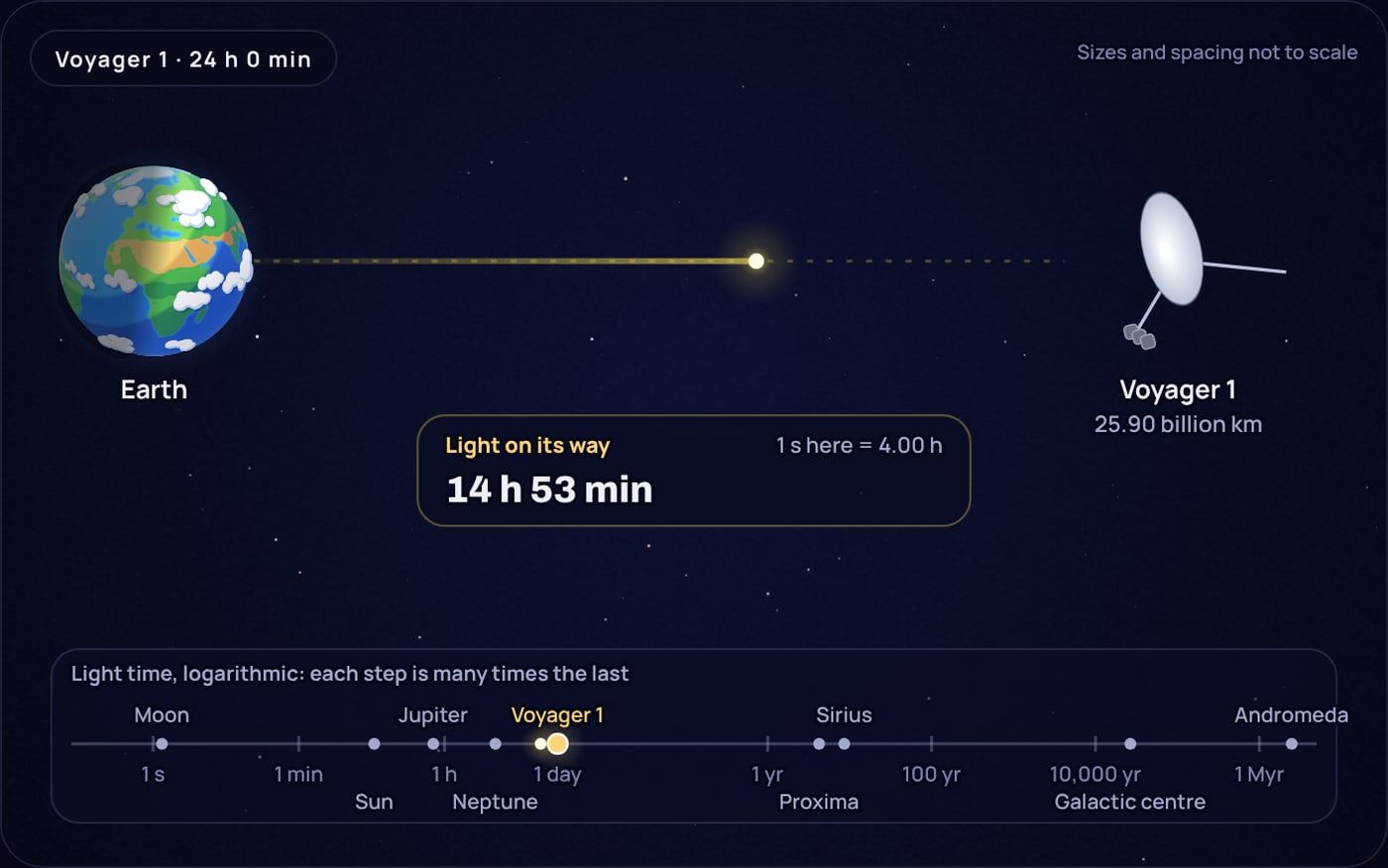
Voyager 1, launched in 1977, is the most distant object people have built. JPL's Horizons ephemeris puts it 173.05 au from Earth on 13 November 2026, which is 23 hours 59 minutes of light time. One light day is 25.90 billion km, and by the same ephemeris Voyager 1 crosses that distance from Earth on 19 November 2026. After that, every command sent from the Deep Space Network takes more than a day to arrive, and the confirmation another day to come back.
The light time does not grow evenly. Voyager 1 recedes from the Sun at about 16.9 km/s, but Earth's own orbit, at nearly 30 km/s, swings it towards the spacecraft for part of each year, so for a few months the signals actually get a little quicker.
How long does light take from the nearest star?
Past the Solar System the distances are so large that astronomers turn the light time into the unit. A light year is the distance light covers in a Julian year of 365.25 days: 9,460,730,472,580.8 km, about 9.46 trillion km.
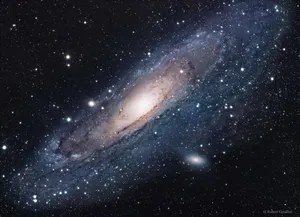
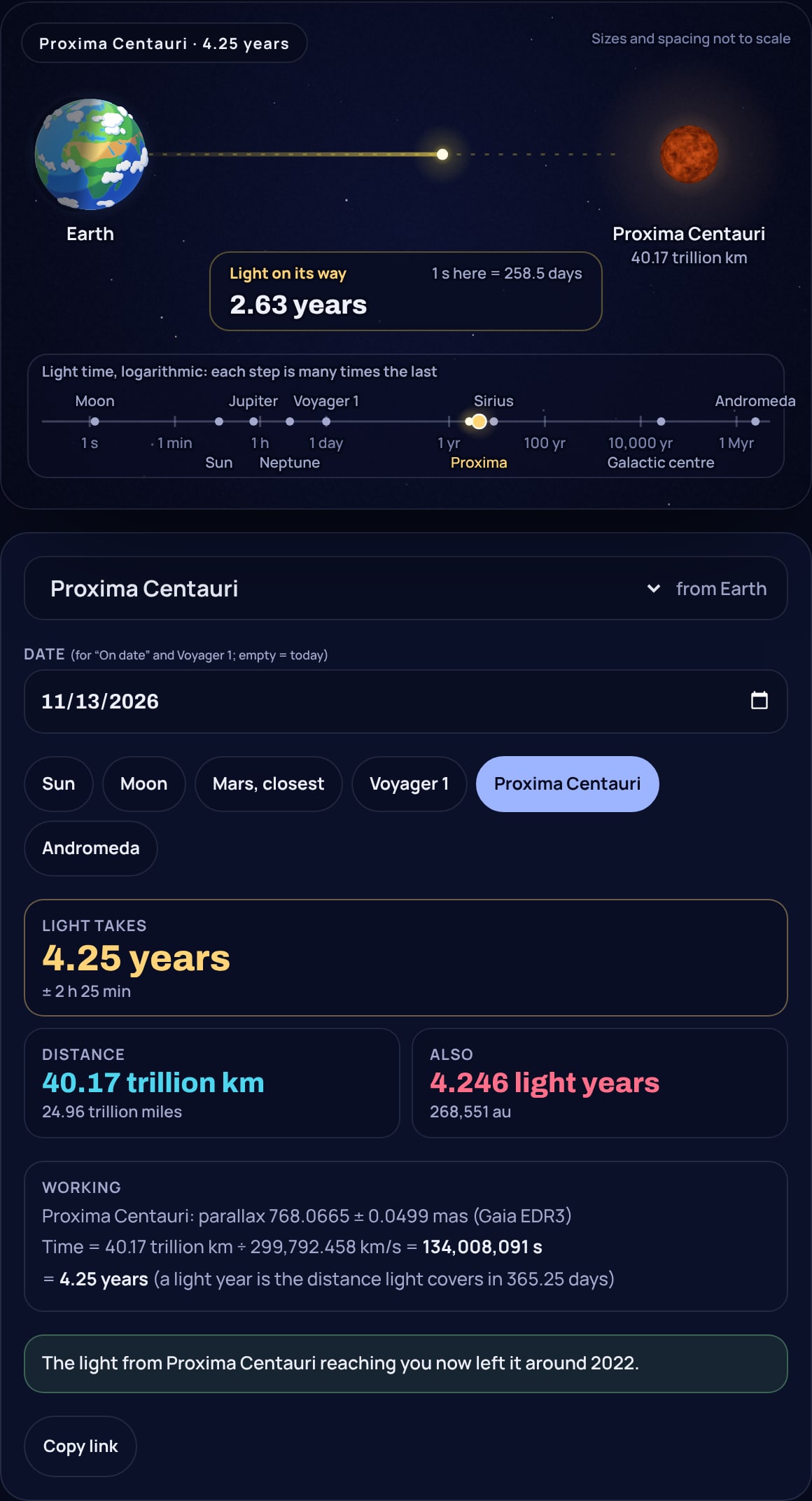
Proxima Centauri, the nearest star to the Sun, has a parallax of 768.0665 ± 0.0499 milliarcseconds from the Gaia mission. That puts it 4.2465 light years away, 40.17 trillion km, so its light takes 4.25 years to arrive. Sirius, the brightest star in the night sky, is 8.60 light years away. The light from the centre of the Milky Way, 8,178 parsecs away by the GRAVITY team's measurement, set off about 26,700 years ago, and the light from the Andromeda Galaxy about 2.48 million years ago. The parallax post explains how those star distances are measured.
Can anything get here faster than sunlight?
No signal, no matter and no information. A few things do appear to move faster than light, such as the spot of a laser swept across the Moon or a shadow's edge, but none of them carries anything from one place to another. The post on things that can travel faster than light goes through them one by one. For anything that carries a message, 8 minutes 19 seconds from the Sun is the floor.
Try it yourself
Open the light travel time calculator with Mars at its closest, then switch between Closest, Average and Farthest to watch the light time triple, or pick "On date" to see where Mars is today. Choose "Custom distance" to time a trip in km, miles, astronomical units, light years or parsecs.
Sources
- NASA JPL Solar System Dynamics, astrodynamic parameters: speed of light 299,792,458 m/s, astronomical unit 149,597,870,700 m, light time for 1 au 499.004783836 s.
- NASA NSSDCA, Earth fact sheet: perihelion 147.095 and aphelion 152.100 million km, eccentricity 0.0167. Moon fact sheet and the planet fact sheets (Mars, with the others linked from the planetary fact sheet): minimum and maximum distances from Earth.
- NASA JPL, Horizons system: Sun and planet distances on 13 November 2026, perihelion and aphelion in 2027, Voyager 1’s range from 2020 to 2040.
- NASA JPL, approximate positions of the planets: orbital elements used for the average distances.
- SIMBAD, Proxima Centauri: Gaia EDR3 parallax 768.0665 ± 0.0499 mas.
- GRAVITY Collaboration (2019), a geometric distance to the Galactic Center black hole: 8,178 ± 13 ± 22 pc. Li et al. (2021), a sub-2% distance to M31: 761 ± 11 kpc.
- LIGO, Virgo and others (2017), GW170817 and GRB 170817A: the 1.74 s delay and the bound on the speed of gravity.
Frequently asked questions
How long does it take sunlight to reach Earth?
8 minutes 19 seconds on average. One astronomical unit, 149,597,870.7 km, divided by the speed of light, 299,792.458 km/s, is 499.0 seconds.
Does sunlight take the same time all year?
No. Earth’s orbit is slightly oval, so the trip takes about 8 minutes 11 seconds at perihelion in early January and 8 minutes 27 seconds at aphelion in early July, a difference of about 17 seconds.
If the Sun disappeared, how long before we noticed?
About 8 minutes 19 seconds. The last light would still be on its way, and Earth would keep orbiting for the same time, because changes in gravity also travel at the speed of light.
How long does light take to reach Earth from the Moon and Mars?
From the Moon about 1.28 seconds. From Mars between 3 minutes 2 seconds at the closest and 22 minutes 19 seconds at the farthest, depending on where the two planets are in their orbits.
Is the sunlight we see really 8 minutes old?
The light left the Sun’s surface about 8 minutes ago. The energy it carries was made in the Sun’s core much earlier and took far longer to work its way out to the surface.