How Long Does It Take to Get to Mars? The Orbital Math

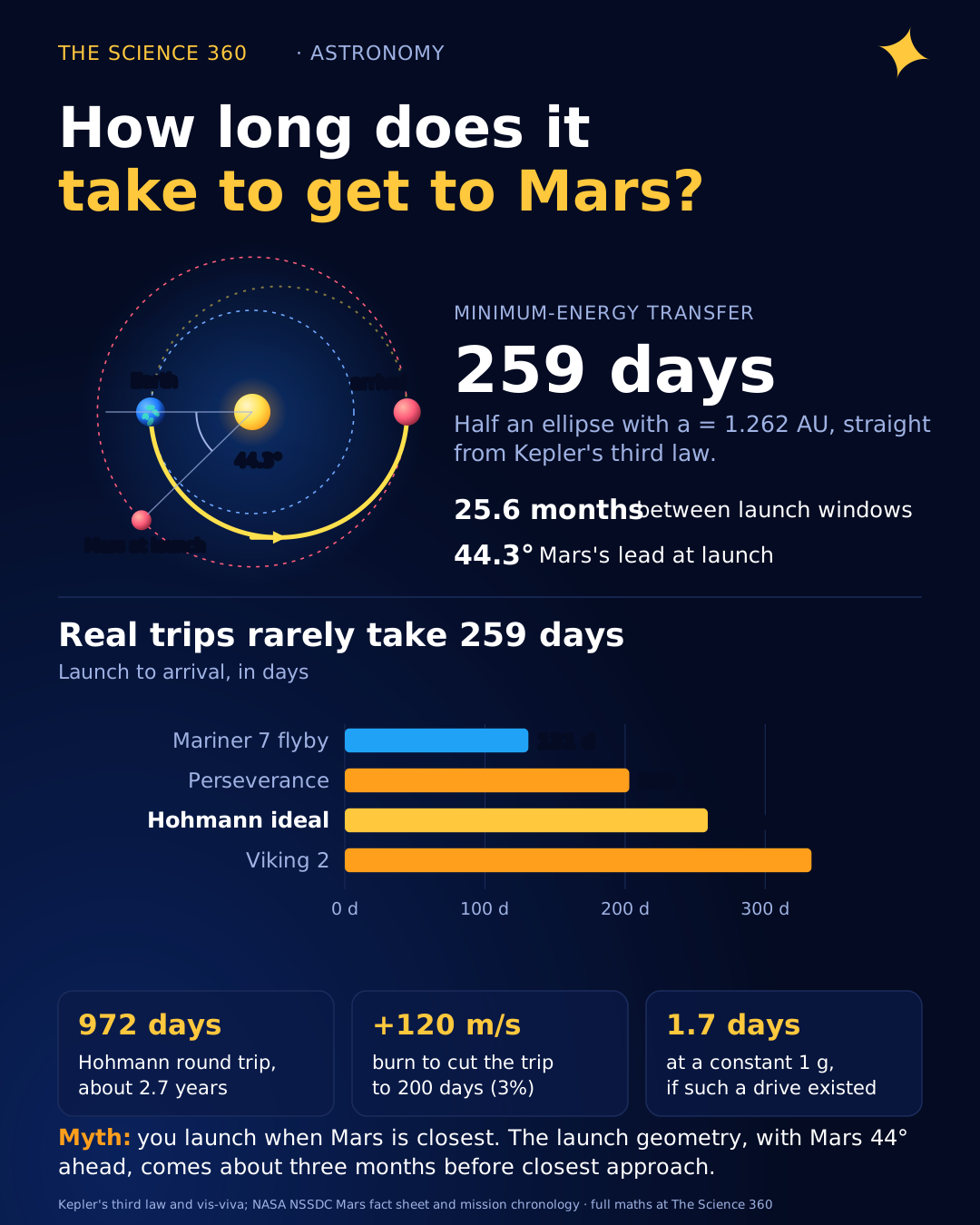
Perseverance left Cape Canaveral on 30 July 2020 and touched down in Jezero Crater on 18 February 2021: 203 days. Over that time it travelled roughly 470 million kilometres around the Sun, while Mars, at its closest during the cruise in October 2020, was only about 62 million kilometres from Earth. That is not inefficiency. It is the cheapest way to get there, and the reasons it works out that way answer the question better than any average.
Why don’t spacecraft fly straight to Mars?
Because a spacecraft leaving Earth is already doing 29.8 km/s around the Sun, the same as Earth. To fly "straight" at Mars you would first have to cancel most of that sideways motion, and then fight the Sun's gravity on the way out. Nobody has a rocket for that.
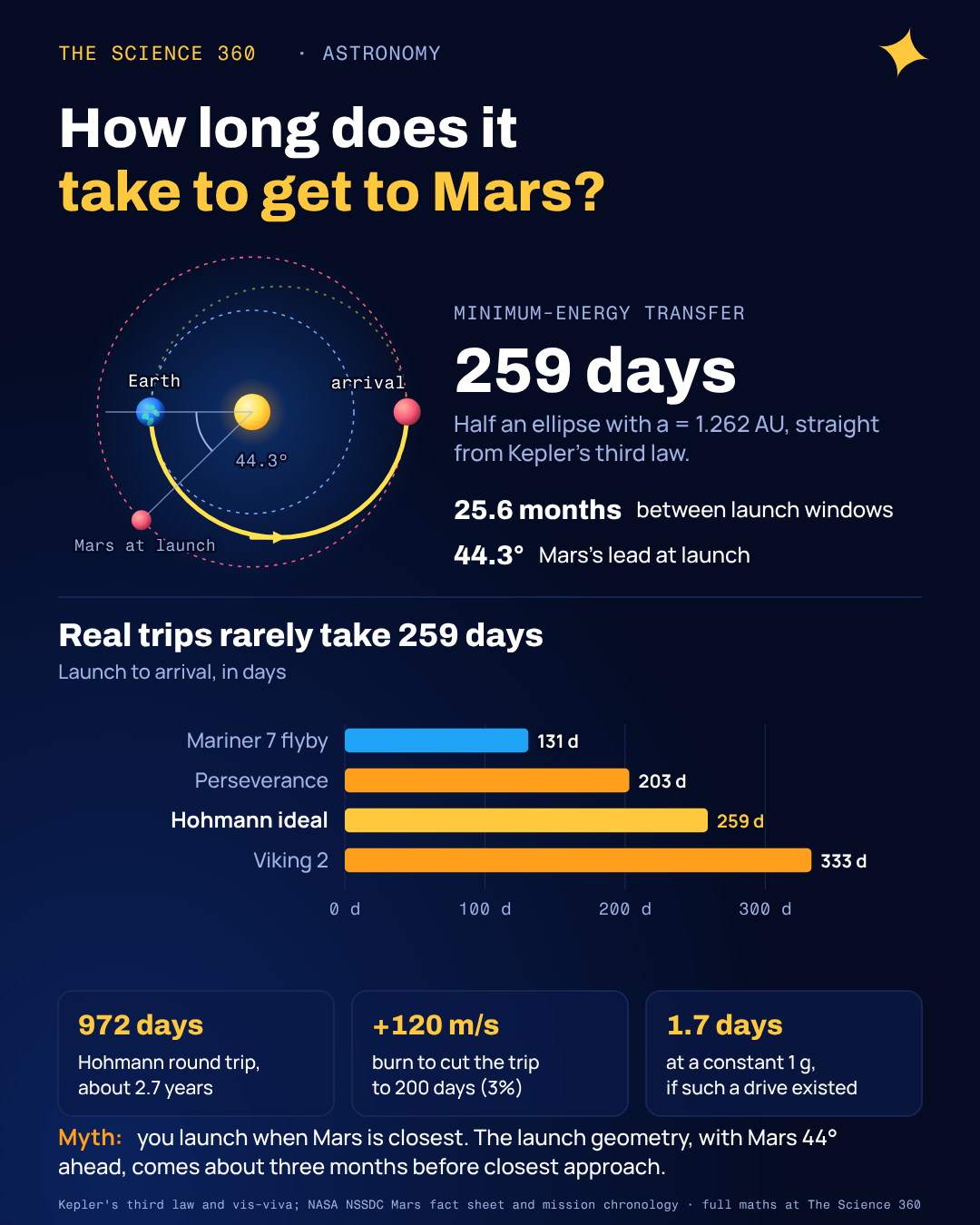
Instead, you add a little speed in the direction Earth is already moving. That stretches your solar orbit into an ellipse whose closest point to the Sun is at Earth's orbit and whose farthest point just touches Mars's orbit. You then coast for half an ellipse. This path, worked out by Walter Hohmann in 1925, is the minimum-energy route between two circular orbits, and it fixes the travel time with nothing but Kepler's third law.
How long is a Hohmann transfer to Mars?
Kepler's third law says that, for anything orbiting the Sun, the period in years squared equals the semi-major axis in astronomical units (AU) cubed: T² = a³. The transfer ellipse runs from Earth's orbit at 1 AU to Mars's mean orbit at 1.524 AU.
Step 1. Size of the transfer ellipse
Step 2. Full orbital period
Step 3. You only fly half of it
That is about 8.5 months.
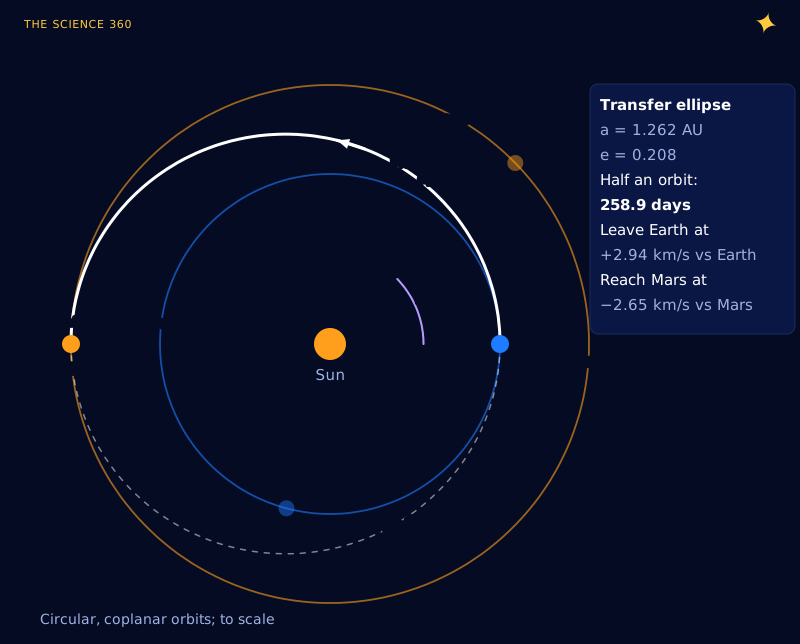
Along the way you cover half the circumference of that ellipse, about 3.92 AU or 587 million kilometres, to reach a planet whose average distance is a fraction of that. The figure that matters is not distance but the energy needed to change orbits.
How much speed does it take?
The vis-viva equation gives the speed anywhere on an orbit: . Compare the transfer speeds at each end with the planets' own orbital speeds:
Earth's orbital speed:
Transfer speed at 1 AU:
Excess needed leaving Earth's influence:
Transfer speed at 1.524 AU: 21.48 km/s. Mars's orbital speed: 24.13 km/s. Mars catches up from behind at .
From a 300 km parking orbit, getting that 2.94 km/s of escape excess takes a burn of about 3.59 km/s. The spacecraft arrives with Mars overtaking it at 2.65 km/s, which a lander sheds by plunging into the atmosphere and an orbiter sheds with a braking burn or by skimming the upper air.
Why are Mars launch windows 26 months apart?
The phasing in Figure 1 is unforgiving. During the 259-day coast Mars moves 360° × 258.9 / 687.0 = 135.7° around the Sun. For it to meet the spacecraft at the 180° point, it must start 180 − 135.7 = 44.3° ahead of Earth. That relative geometry recurs once per synodic period, the time Earth takes to lap Mars:
That is the famous "every 26 months". It also explains a common misconception: you do not launch when Mars is closest. Closest approach (opposition) comes when Mars and Earth are lined up on the same side of the Sun. The launch geometry, with Mars 44° ahead, comes about three months earlier, and by the time you arrive Earth has pulled about 75° ahead of Mars. Figure 3 shows this on a real calendar, computed from the planets' actual elliptical orbits.
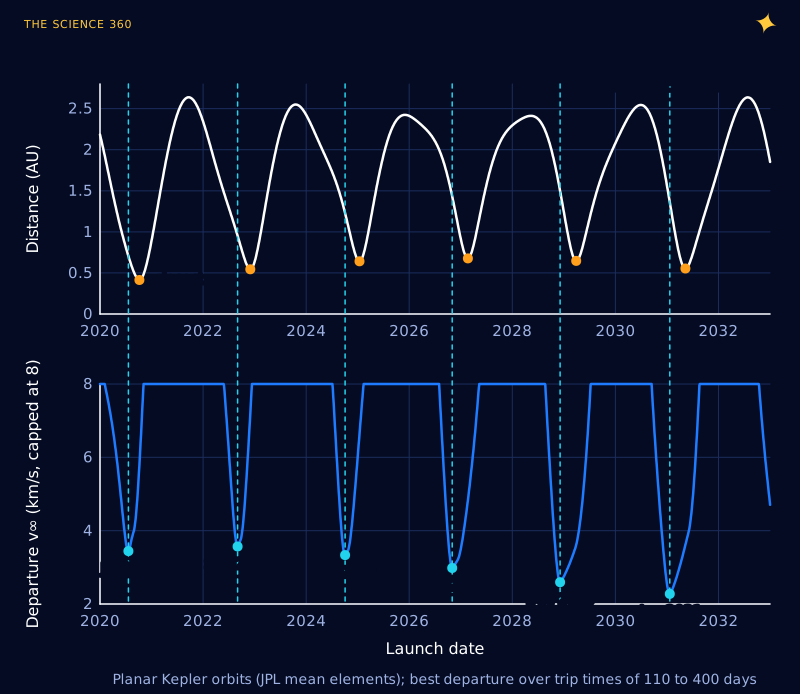
Two more things fall out of that plot. First, not all windows are equal. Mars's orbit is noticeably eccentric (), so it ranges from 1.38 to 1.67 AU from the Sun. Windows that deliver you to Mars near its perihelion are cheaper, which is why the minimum in Figure 3 drifts from 3.4 km/s in 2020 to 2.3 km/s in 2031, and the pattern repeats over roughly 15 to 17 years. Second, the Hohmann time itself shifts with that eccentricity: a transfer to Mars at its closest to the Sun takes 237 days, one to Mars at its farthest takes 281.
The 2026 window is open about now. In my simplified model its cheapest departure falls on 1 November 2026; real mission designs, which include Mars's 1.85° orbital tilt, shift that by weeks.
Why do most Mars missions take about 7 months, not 8.5?
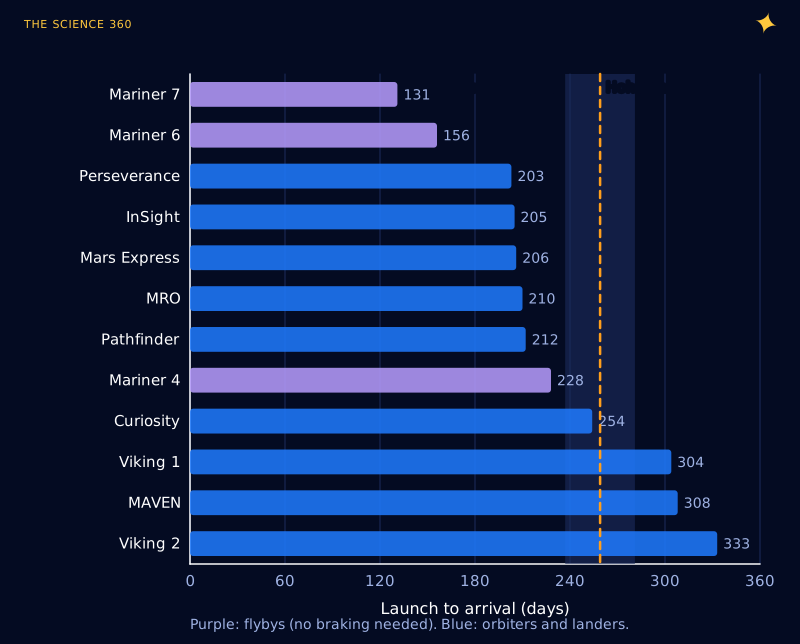
Look at the record. Figure 4 lists launch-to-arrival times for twelve missions. Very few sit on the 259-day Hohmann line.
There are three reasons for the spread.
An exact half-orbit is a trap in three dimensions. Mars's orbit is tilted 1.85° to Earth's. For a transfer of exactly 180°, the start point, the end point and the Sun lie on a straight line, so they do not define a plane, and the trajectory has to make an expensive plane change. Mission designers therefore pick either a "Type I" path a bit shorter than 180° (Perseverance, MRO, InSight) or a "Type II" path a bit longer (Viking, MAVEN).
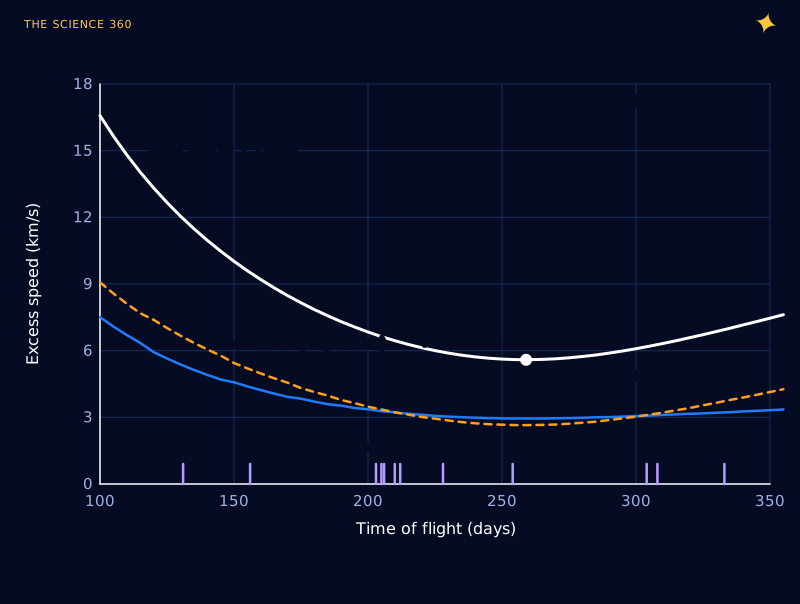
Faster is cheaper than it looks, thanks to the Oberth effect. I solved Lambert's problem (finding the orbit that connects two points in a given time) for every trip time, picking the best transfer angle each time. Figure 2 shows the result, and the table shows the burns that matter:
| Trip time | v∞ at Earth | Burn from 300 km orbit | v∞ at Mars | Burn into 250 km Mars orbit |
|---|---|---|---|---|
| 259 days (Hohmann) | 2.95 km/s | 3.59 km/s | 2.65 km/s | 2.10 km/s |
| 200 days | 3.36 km/s | 3.71 km/s | 3.48 km/s | 2.54 km/s |
| 180 days | 3.71 km/s | 3.81 km/s | 4.14 km/s | 2.95 km/s |
| 150 days | 4.58 km/s | 4.12 km/s | 5.44 km/s | 3.86 km/s |
| 120 days | 5.94 km/s | 4.71 km/s | 7.39 km/s | 5.41 km/s |
Cutting 59 days off the trip raises the departure burn by only 120 m/s, about 3%, because the burn happens deep in Earth's gravity well where each extra metre per second of burn buys much more than a metre per second of escape excess. Here is that calculation for the 200-day case:
At 300 km altitude: escape speed , circular speed
Hohmann:
200 days:
For landers the arrival side costs nothing in fuel either, since the atmosphere does the braking. The real limit there is heating and parachute loads, which is why rover missions stay near 200 days rather than pushing to 150.
Flybys do not have to stop. Mariner 6 and 7 were flybys, so they could arrive at any speed. Mariner 7's 131 days is the fastest trip to Mars on the list, and no orbiter or lander has come close to it.
How long would a round trip to Mars take?
This is where Mars hurts. When you arrive, Earth is 75° ahead of Mars. To come home on a Hohmann orbit, Earth needs to be 75° behind Mars at departure. Earth gains on Mars at per day, and it has to gain .
NASA's long-stay ("conjunction class") reference missions look similar: transits of about six months each way and roughly 500 to 540 days at Mars. The alternative, a short-stay "opposition class" mission, spends only a few weeks at Mars but pays for it with a much longer, higher-energy return leg, often with a swing past Venus.
What is the fastest possible trip to Mars?
With chemical rockets you can buy speed, as the table shows, but the cost climbs quickly below about 150 days: you arrive so fast that capture or atmospheric entry becomes the problem. To do radically better you need an engine that keeps pushing for the whole trip.
For constant acceleration with a flip at the midpoint, ignoring the Sun's gravity and the planets' motion, the time to cover distance is .
1 all the way (9.81 m/s²), closest approach of 2003 (55.8 million km)
Peak speed at the midpoint:
0.01 (0.098 m/s²), same distance:
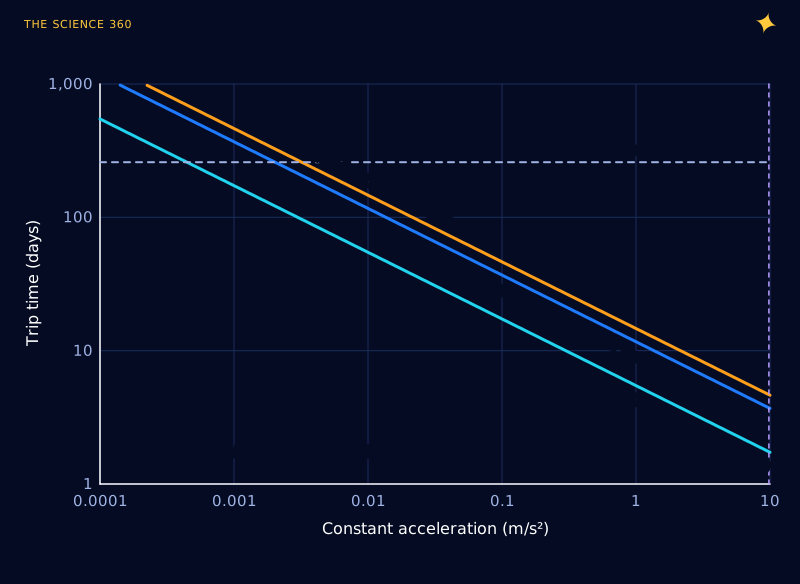
Ion engines already deliver continuous thrust, but at accelerations around 10−4 m/s² or less for a loaded spacecraft, where Figure 5 shows no advantage over coasting. The gap between that and 1 g is a factor of about 100,000.
How far away is Mars, and why “225 million km” is misleading
The closest approach in recorded history was 55.76 million km on 27 August 2003. The farthest is about 401 million km, when Mars is on the far side of the Sun. The "average distance" often quoted is 225 million km, but if you average the actual Earth to Mars distance over time using the orbits in Figure 3, you get about 1.70 AU, or 254 million km. The two planets spend more time on opposite sides of the Sun than near each other. Either way, distance is the wrong number for travel time. The right ones are 259 days, 44°, and 780 days.
Radio signals have it easier: at the speed of light the one-way delay ranges from 3.1 minutes at closest approach to 22.3 minutes at the farthest.
FAQ
How long does it take to get to Mars?
Usually about 6 to 8 months. The minimum-energy Hohmann transfer between idealised circular orbits takes 259 days. Real missions have ranged from 131 days (the Mariner 7 flyby) to 333 days (Viking 2), and most recent landers and orbiters arrived after 203 to 212 days.
Why can we only launch to Mars every 26 months?
For a low-energy transfer, Mars must be about 44 degrees ahead of Earth at launch. Earth laps Mars once every synodic period of about 780 days, which is 25.6 months, so that alignment repeats roughly every 26 months.
How long would a round trip to Mars take?
With minimum-energy transfers both ways, about two and a half to three years: roughly 8 to 9 months out, about 15 months waiting on Mars for the planets to realign, and 8 to 9 months back. In the circular-orbit model that totals about 970 days.
What is the fastest possible trip to Mars?
With chemical rockets, trips of 4 to 5 months are possible at the cost of much higher speeds at both ends, roughly 10 km/s of combined excess speed for 150 days versus 5.6 km/s for the 259-day Hohmann path. A hypothetical engine sustaining 1 g of thrust could make it in 2 to 5 days.
Related on The Science 360
Sources
- NASA NSSDC, Chronology of Mars Exploration (launch dates for Mariner 4, 6, 7, Viking 1, 2, Pathfinder, Mars Express, MRO, MSL, MAVEN, InSight, Mars 2020): nssdc.gsfc.nasa.gov/planetary/chronology_mars.html
- NASA NSSDC, Mars Fact Sheet (semi-major axis 1.524 AU, eccentricity 0.0934, inclination 1.85°, orbital period 687 days, synodic period 779.9 days): nssdc.gsfc.nasa.gov/planetary/factsheet/marsfact.html
- E. M. Standish, JPL Solar System Dynamics, "Approximate Positions of the Planets" (mean orbital elements used for Figure 3): ssd.jpl.nasa.gov/planets/approx_pos.html
- NASA JPL / Universe Today, 2003 close approach of Mars at 55.76 million km: universetoday.com/articles/mars-is-close-and-getting-closer
- British Astronomical Association, Data for the Great Perihelic Opposition, 2003: britastro.org (Mars section, 2003 opposition data)
- Viking 2 orbit insertion on 7 August 1976, NASA Mars Exploration Program archive: mars.jpl.nasa.gov/missions/past/viking.html (archived)
- NASA NTRS 20140013259, nuclear thermal propulsion study for Mars Design Reference Architecture 5.0 (about 6-month transits, roughly 540 days at Mars): ntrs.nasa.gov/citations/20140013259
- Space.com, "How long does it take to get to Mars?" (typical figures as reported by NASA, light-time): space.com/24701-how-long-does-it-take-to-get-to-mars.html
Header image: NASA/JPL-Caltech/MSSS (image PIA22487), regraded for this article.