Could a Mars Dust Storm Knock Over a Rocket? The Physics

The Viking landers sat on Mars for years with wind sensors on a boom about a metre and a half off the ground. During dust storms they recorded winds of 17 to 30 m/s, which is 61 to 108 km/h. On Earth, 108 km/h is a severe gale. It snaps branches and pushes cars across lanes. On Mars, that same wind speed pushed on the landers about as hard as a 12 km/h breeze pushes on you when you walk to the shops.
That one number explains why the opening of The Martian, where a storm shreds the camp, flings an antenna into Mark Watney and threatens to tip the ascent vehicle over, is the story's biggest piece of fiction. Andy Weir has said as much himself. But "the air is thin, so the wind is weak" is where most explanations stop, and it leaves out the parts that matter for a rocket: how you convert a Martian wind into an Earth wind, why gravity changes the answer, and what wind speed it would actually take to topple something. Let's do it properly.
How strong is the wind on Mars?
NASA's Mars fact sheet summarises the Viking lander measurements: 2 to 7 m/s in summer, 5 to 10 m/s in autumn, and 17 to 30 m/s during dust storms. NASA's own explainer on the movie puts the top of the range at "about 60 miles per hour", which is 27 m/s and consistent with Viking. Dust devils can locally spin as fast or faster: tracking of dust clouds in HiRISE orbital images shows tangential winds of 20 to 30 m/s, and analyses of Viking data have suggested core winds above 40 m/s in some vortices, though that estimate depends on assumptions about how far away the devil passed.
Those speeds are not small. The problem is what they are pushing. The force wind exerts on an object scales with the dynamic pressure, , where is the air density. Speed enters squared, density enters once. So you cannot compare winds on two planets by speed alone, any more than you can compare a ping-pong ball and a golf ball by speed alone.
How thin is the Martian atmosphere, exactly?
The figure usually quoted is "1% of Earth's", and the pressure is often given as 0.6% of Earth's. Neither is quite the number you want. Pressure is not what pushes a rocket sideways; density is. Martian air is cold and made mostly of carbon dioxide, which is heavier per molecule than nitrogen and oxygen, so it is denser than its pressure alone suggests.
Density from the ideal gas law
Mean surface pressure (6.36 mbar), mean molecular weight 43.49, and average surface temperature.
Earth sea level (standard atmosphere):
The pressure ratio is only .
That calculation matches NASA's quoted surface density of 0.016 ± 0.006 kg/m³. The large uncertainty is real: surface pressure swings from about 4.0 to 8.7 mbar with the seasons as carbon dioxide freezes onto and sublimates off the polar caps, and temperature swings over 50 K between night and day. A deep basin at night in the cold season is several times denser than a high plateau on a summer afternoon. I use 0.016 kg/m³ for the central case and carry 0.010 to 0.022 kg/m³ as a band in the figures.
What does a 100 km/h Martian wind feel like on Earth?
Set the dynamic pressures equal and solve for the Earth speed that gives the same push:
Step 1. Dynamic pressure of the strongest Viking storm wind
Step 2. The Earth wind with the same
Step 3. The general conversion factor
For comparison, the same 30 m/s on Earth: , which is 77 times more.
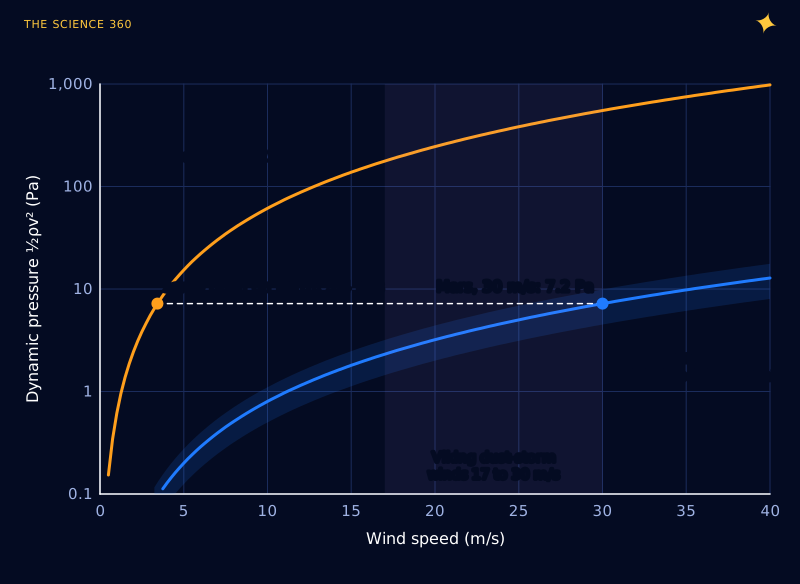
This is where the oft-quoted NASA line comes from. A NASA scientist told Space.com that a 60 mph storm would feel more like 6 mph, which follows from . Using the measured density instead of the rounded 1% gives a factor of 0.114, so 60 mph feels like about 7 mph and the strongest Viking storm feels like 12 km/h. The rounding hardly matters for the movie, but it is a reminder that the "1%" is a rough figure and that the factor is a square root: a hundredfold thinner atmosphere makes the wind only tenfold gentler, not a hundredfold.
Why does lower gravity matter for tipping over?
Here is the part every explainer I found skips. Whether a parked object tips over is a contest between the wind's push and the object's weight. Mars gravity is 3.71 m/s², 38% of Earth's. Everything on Mars is lighter, so it takes less push to tip it. That claws back some of the advantage of thin air.
For tipping, what matters is the ratio of wind force to weight. Wind force scales with ρv², and weight scales with g. So the Earth wind that is equally good at knocking something over obeys:
A 30 m/s Mars storm becomes Earth equivalent for tipping.
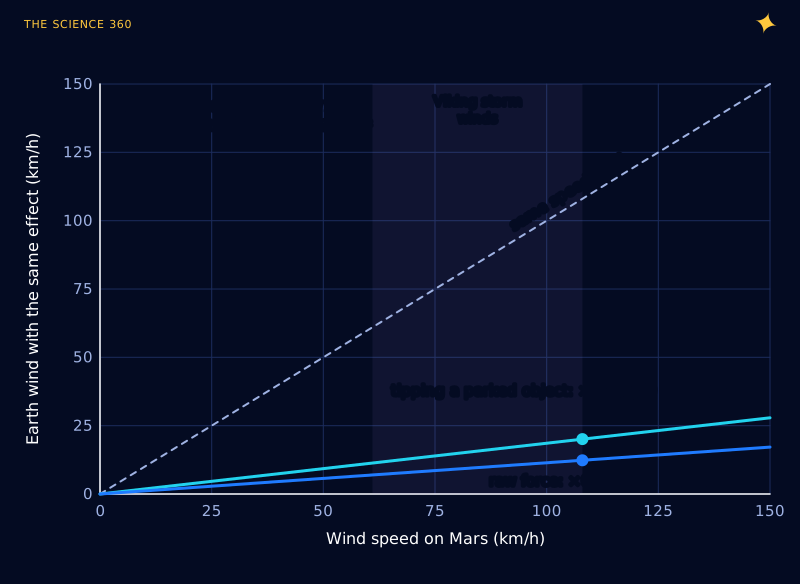
Twenty kilometres an hour is a "gentle to moderate breeze" on the Beaufort scale. It lifts dust and paper on Earth. It does not knock over a parked anything, unless that anything is very tall, very light and standing on a very narrow base. Which brings us to the rocket.
Could a Martian storm tip over a rocket? A worked example
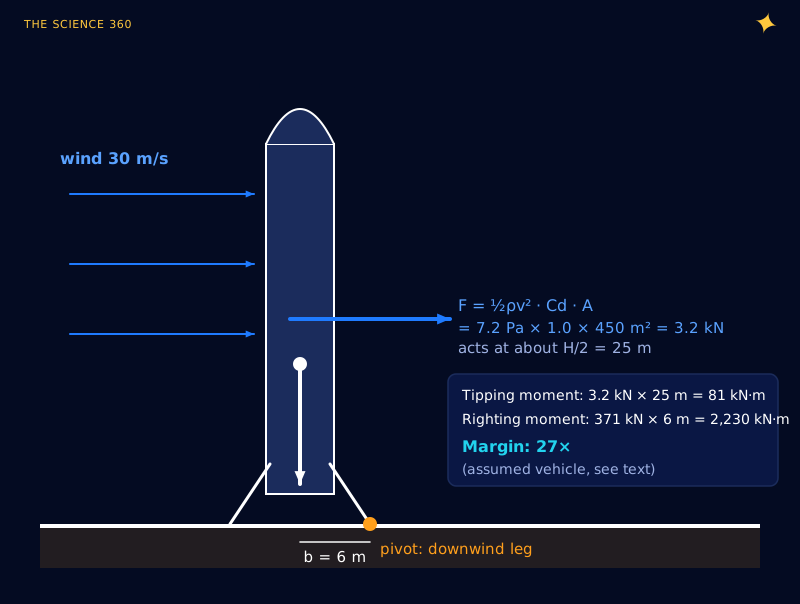
Real Mars ascent vehicles do not exist yet, so I need to pick one. To be generous to the wind, take something big and slab-sided, roughly Starship-like: 50 m tall, 9 m in diameter, standing on legs that put the downwind foot 6 m from the centreline. For mass, take 100 tonnes, roughly an empty vehicle; a fuelled one would be many times heavier and harder to tip. These are my assumptions, not SpaceX figures, and the point is the scale of the answer, not the third digit.
Step 1. Side area and drag coefficient
A cylinder side-on near this Reynolds number has of roughly 0.6 to 1.2; take 1.0.
Step 2. Wind force and tipping moment
That is about the weight of a 330 kg mass on Earth.
Step 3. Righting moment from weight
Step 4. Margin and the wind needed to tip
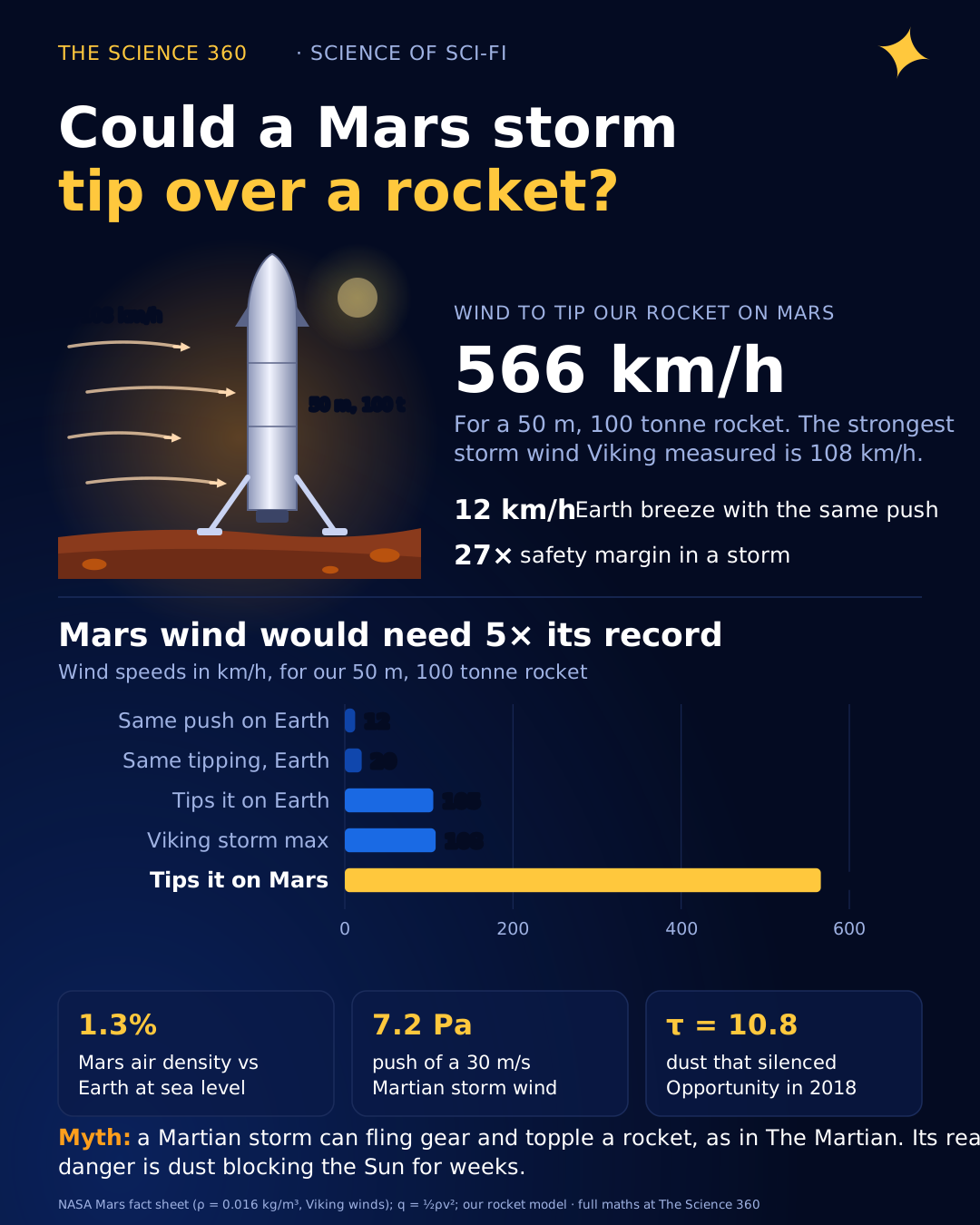
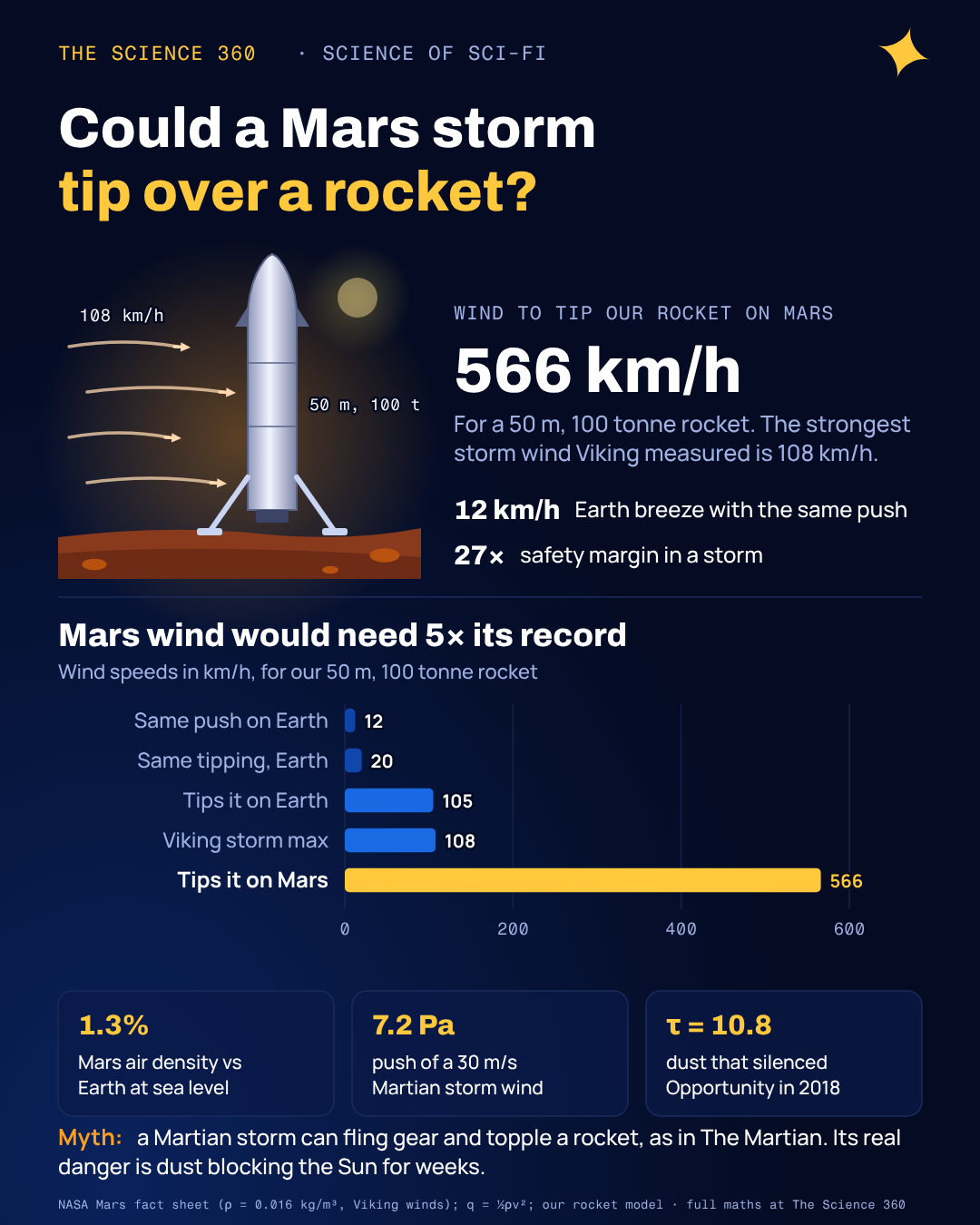
566 km/h is faster than any surface wind ever recorded on Earth, let alone on Mars, and about five times the top of the Viking storm range. Even if you shrink the footprint, double the drag coefficient and take the densest plausible air (0.022 kg/m³), you remain well above anything Mars has shown us.
Now put the same 100 tonne empty rocket on Earth, in Earth air and Earth gravity. The righting moment rises to 5.9 MN·m because it weighs more, but the air is 77 times denser. The tipping wind drops to about 105 km/h. That is a storm-force wind, not a hurricane. In other words, the empty rocket is in more danger at a coastal launch site on Earth than it would be anywhere on Mars.
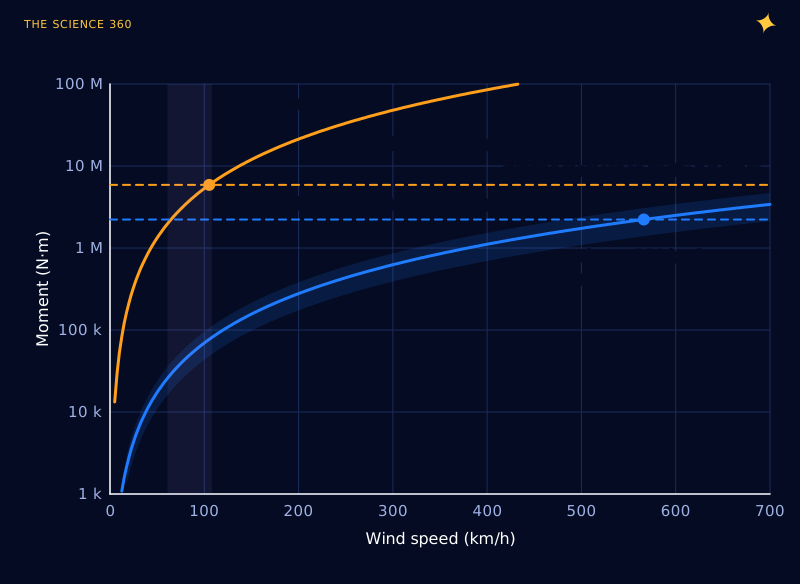
Gusts, flexible structures and resonance can raise loads above the steady value, and a light, top-heavy vehicle on soft ground could settle unevenly. Those are real engineering concerns. None of them close a factor of 27.
What about the antenna that hit Watney?
Smaller objects fare the same way. A 1 m² panel side-on to a 30 m/s Martian wind, with a drag coefficient of about 1.2 for a flat plate, feels . That is the weight of a 2.3 kg bag of sugar on Mars, spread across a square metre. The same panel in a 100 km/h Earth wind feels about 570 N. A dish antenna bolted to a habitat would not notice a Martian storm, and if one did come loose, it would drift rather than fly.
NASA's explainer reaches the same conclusion in words: even the wind in the largest dust storms "likely could not tip or rip apart major mechanical equipment."
Are Martian dust storms dangerous at all?
Yes, but not because of the wind. The real threat is that they switch off the Sun.
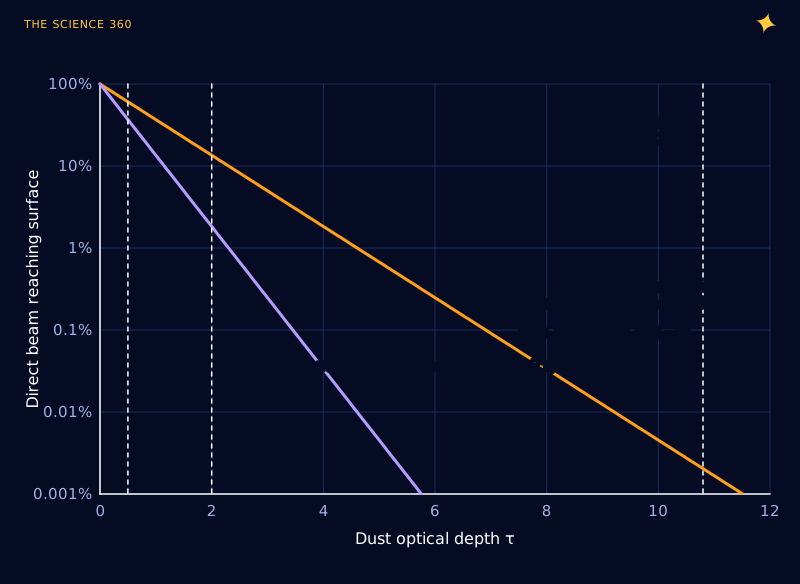
Martian storms can grow enormous. Local storms happen every year; on average about once every three Mars years (about five and a half Earth years), they merge into a planet-encircling event that hides the surface for weeks. Atmospheric scientists measure how much the dust blocks with the optical depth, . The direct beam of sunlight is reduced by a factor of when the Sun is overhead, and by more when it is low.
Direct sunlight through dust
Clear-ish sky, : , so 61% of the direct beam
: , so 13.5%
: , so 0.002%
Scattered light makes the real situation less extreme than those numbers suggest, because dust scatters much of the sunlight forward and some still reaches the panels as a dim, diffuse glow. But the trend is brutal. In June 2018, a planet-encircling storm pushed τ over the Opportunity rover to about 10.8, a record for surface measurements on Mars and roughly double the previous rover record. Mission team members had said the rover probably needed τ below about 2 to recharge. Opportunity's last transmission arrived on 10 June 2018. The storm cleared; the rover never called back, and NASA ended the mission in February 2019.
Weir got this part right, by the way. In the book Watney sweeps his solar panels daily, and on his long drive the first sign of a huge storm is that his panels are underperforming. That is precisely how a real astronaut would notice one.
The other real hazard is the dust itself. Martian dust grains are tiny, a few micrometres across, and slightly electrostatic, so they cling to everything: suits, seals, optics, bearings and gears. Over months that is a maintenance problem, not a catastrophe, but it is the kind of problem that kills machines slowly. Dust devils occasionally help, by sweeping panels clean; both Spirit and Opportunity enjoyed unexpected power boosts from them.
So what would a realistic version of the opening look like?
A realistic Martian storm is slow, huge and dark. It arrives over days as a brown haze that steals the sunlight and the view. The wind gusts, but you could stand in it in a suit without bracing. The danger to a crew is power: solar arrays dropping to a few percent of normal for weeks, a habitat running on batteries or a reactor, and an ascent vehicle that is perfectly upright but surrounded by people who cannot see the horizon. That is a quieter scene, and a much harder one to film, which is probably why Weir chose the wind.
FAQ
Could a Mars dust storm knock over a rocket?
Almost certainly not. The strongest measured Martian storm winds, about 30 m/s, produce a dynamic pressure near 7 Pa, roughly what a 12 km/h breeze produces on Earth. For a 50 m, 100 tonne rocket on a 12 m leg footprint, the wind's tipping moment is about 27 times smaller than the weight's righting moment.
How strong is the wind on Mars?
The Viking landers measured 2 to 7 m/s in summer, 5 to 10 m/s in autumn and 17 to 30 m/s during dust storms. Because Martian air is only about 1.3% as dense as sea-level air on Earth, a 30 m/s (108 km/h) gust pushes about as hard as a 3.4 m/s (12 km/h) breeze on Earth.
Was the dust storm in The Martian realistic?
No, and Andy Weir has said so: it is the novel's main deliberate inaccuracy, kept because the plot needed a reason to strand Watney. Real Martian storms are large and long-lasting and can block sunlight for weeks, but their winds are far too weak to rip off antennas or topple a launch vehicle.
What is actually dangerous about Martian dust storms?
Loss of sunlight. In June 2018 the dust optical depth over Opportunity reached about 10.8, and the solar-powered rover never woke up again. Fine, electrostatically clingy dust also coats solar panels, gets into mechanisms and seals, and obscures cameras.
Related on The Science 360
Sources
- NASA NSSDC, Mars Fact Sheet (surface pressure 6.36 mbar, range 4.0 to 8.7 mbar; surface density 0.016 ± 0.006 kg/m³; mean molecular weight 43.49; average temperature 214 K; Viking wind speeds 2 to 7, 5 to 10 and 17 to 30 m/s): nssdc.gsfc.nasa.gov/planetary/factsheet/marsfact.html
- NASA, "The Fact and Fiction of Martian Dust Storms" (strongest storms about 60 mph, atmosphere about 1% as dense as Earth's, global storms about every three Mars years, equipment unlikely to be tipped): nasa.gov/solar-system/the-fact-and-fiction-of-martian-dust-storms/
- Space.com, "'The Martian' Dust Storm Would Actually Be a Breeze" (NASA scientist Michael Smith: a 60 mph storm would feel like about 6 mph): space.com/30663-the-martian-dust-storms-a-breeze.html
- The Planetary Society, "Opportunity Pummeled by Massive Dust Storm, Hunkers Down to Sleep" (tau about 10.8, record; previous rover record 5 to 5.5; tau below about 2 needed): planetary.org/articles/06-mer-update-opportunity-dust-storm-sleep
- NASA JPL, "NASA's Opportunity Rover Mission on Mars Comes to End" (last contact 10 June 2018): jpl.nasa.gov/news/nasas-opportunity-rover-mission-on-mars-comes-to-end/
- Yale Scientific, "Debunking Science: The Martian (2015)" (Weir acknowledges the storm as the book's main scientific inaccuracy): yalescientific.org/2016/02/debunking-science-the-martian-2015/
- Choi and Dundas (2011), "Measurements of Martian Dust Devil Winds with HiRISE", Geophysical Research Letters (tangential winds of 20 to 30 m/s; discusses Viking-derived estimates above 40 m/s and their uncertainty): arxiv.org/abs/1301.6130
Header image: NASA/JPL-Caltech/MSSS (image PIA23513), regraded for this article.