Could the Dune Ornithopter Fly? Hover Power, Calculated
In 2022 a team of University of Leicester physics students sat down with Denis Villeneuve's Dune, estimated the size of the Atreides ornithopter from the actors standing next to it, and worked out what it would take to hover. Their answer: eight wings flapping 1.78 times a second, burning 1,460 horsepower. For comparison, an AgustaWestland AW109, a helicopter that carries about the same number of people, has two engines of 560 hp each.
That sounds like a verdict against flapping. It is not quite, and the reason is one of the most useful equations in aeronautics. Run it on the ornithopter and the huge wings turn out to be the best thing about the design. The trouble lives somewhere the drag calculation does not look.
How does an ornithopter work?
An ornithopter is any aircraft that flies by flapping wings instead of spinning a rotor or using fixed wings with a propeller. They are real. Percival Spencer's engine-powered, remotely piloted Orniplane flew in 1961, and in August 2010 Todd Reichert flew the University of Toronto's human-powered Snowbird: 32 m of wingspan, 42 kg empty, almost 20 seconds aloft over 145 m after a tow launch. What no one has built is a flapping machine that hovers with a crew, which is precisely what the films show.
Villeneuve's design (by production designer Patrice Vermette) is dragonfly-inspired: a long fuselage with four wings per side that beat in a blur during takeoff and landing. Frank Herbert's novels never give an engineering spec, so everything below uses the Leicester team's estimates: wings 20 m long including a 2 m connecting rod, 2.5 m wide, and a 3,000 kg loaded mass borrowed from the AW109's maximum.
How much power does it take to hover?
Any hovering machine, helicopter or hummingbird, stays up the same way: it throws air downward continuously, and the reaction holds it up. Momentum theory (also called actuator-disk theory) models the lifting device as a disk of area A that accelerates air from rest. Newton's laws and conservation of energy then give the minimum possible power, with no assumptions about blades or wings:
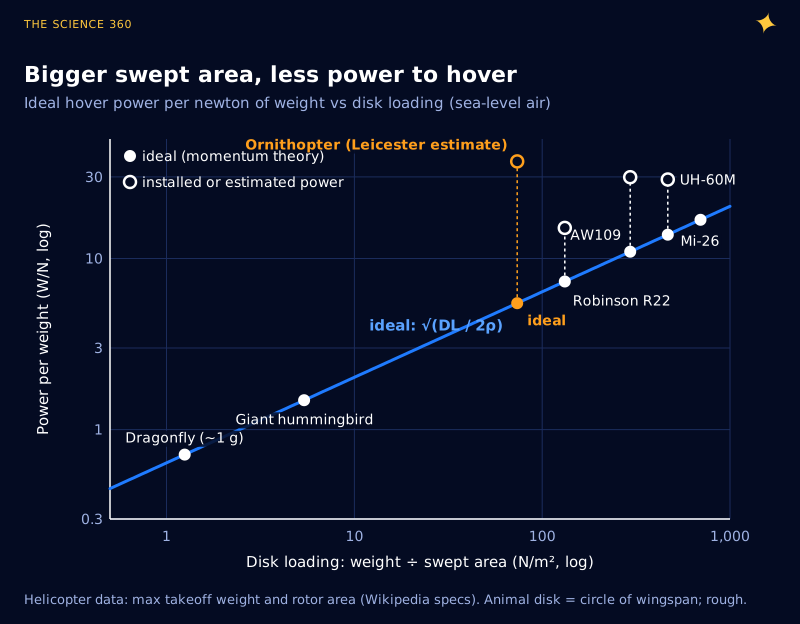
is the thrust (equal to weight in hover), the air density and the area swept. The quantity is called the disk loading. The key insight: power grows as but falls as . Push a lot of air gently and you need much less power than pushing a little air hard.
Worked example: the ornithopter vs the AW109
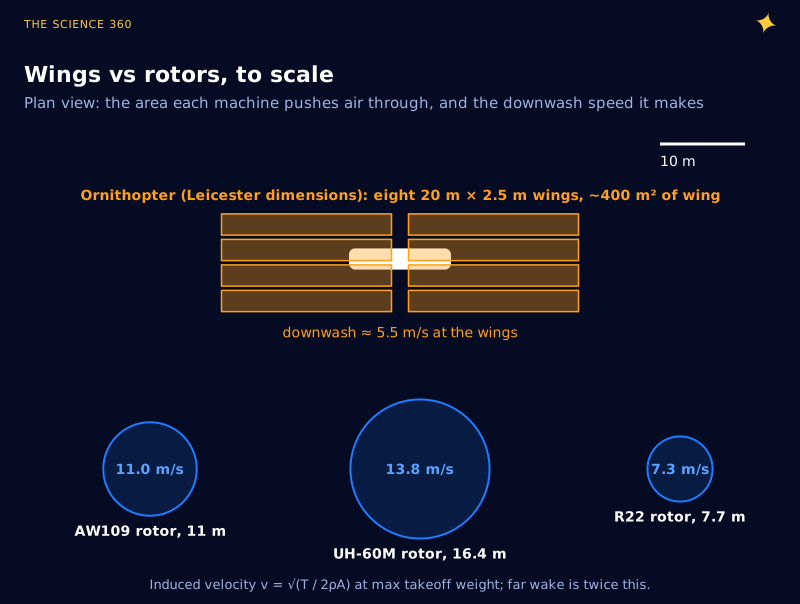
For a flapping wing in hover, the area that accelerates air downward is roughly the plan area the wings cover. Eight wings of 20 m by 2.5 m give about 400 m2. The AW109's 11.0 m rotor sweeps .
Ornithopter (3,000 kg, A = 400 m², ρ = 1.225 kg/m³)
AW109 (2,850 kg max takeoff, A = 95.0 m²)
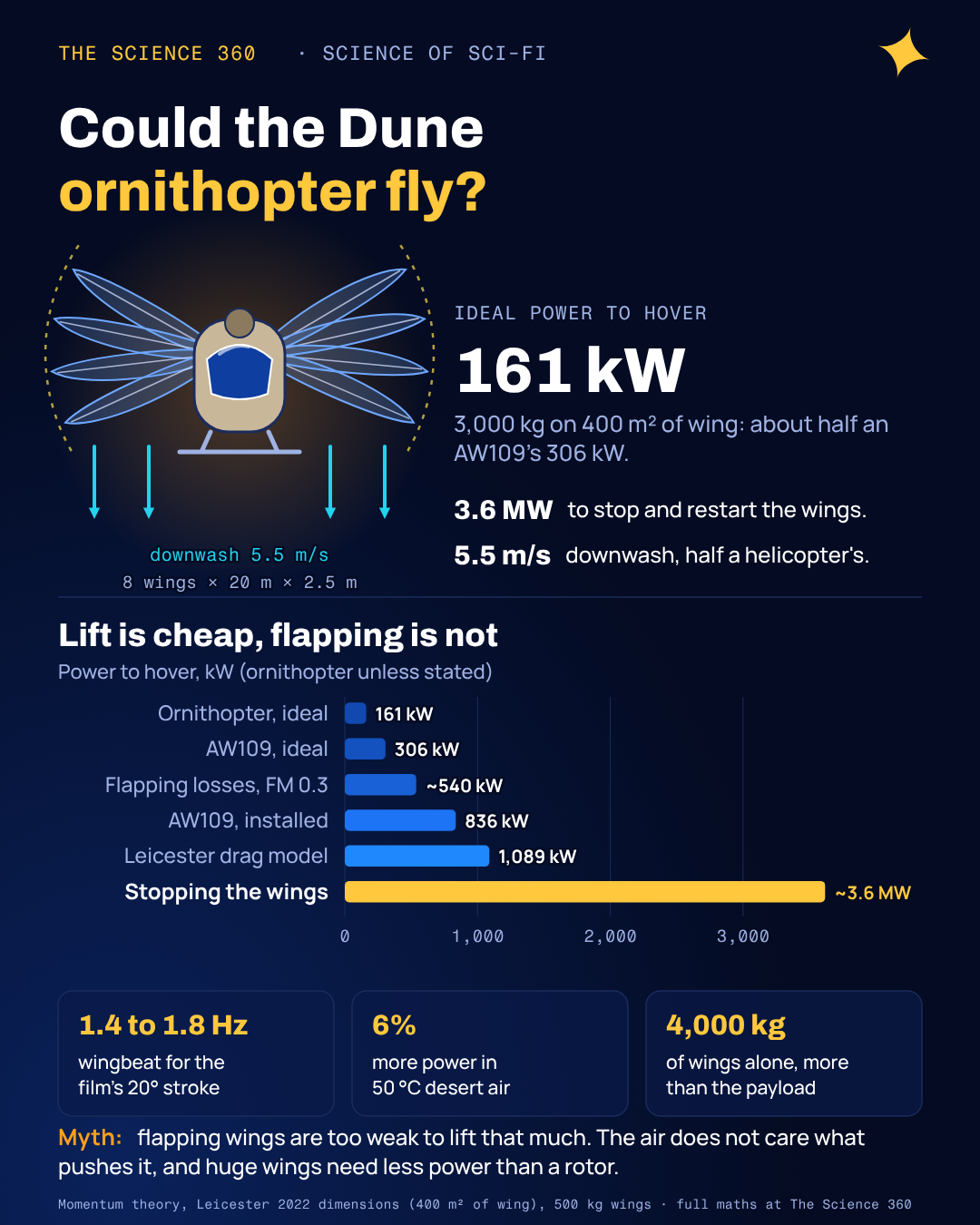
Installed: 2 × 418 kW = 836 kW.
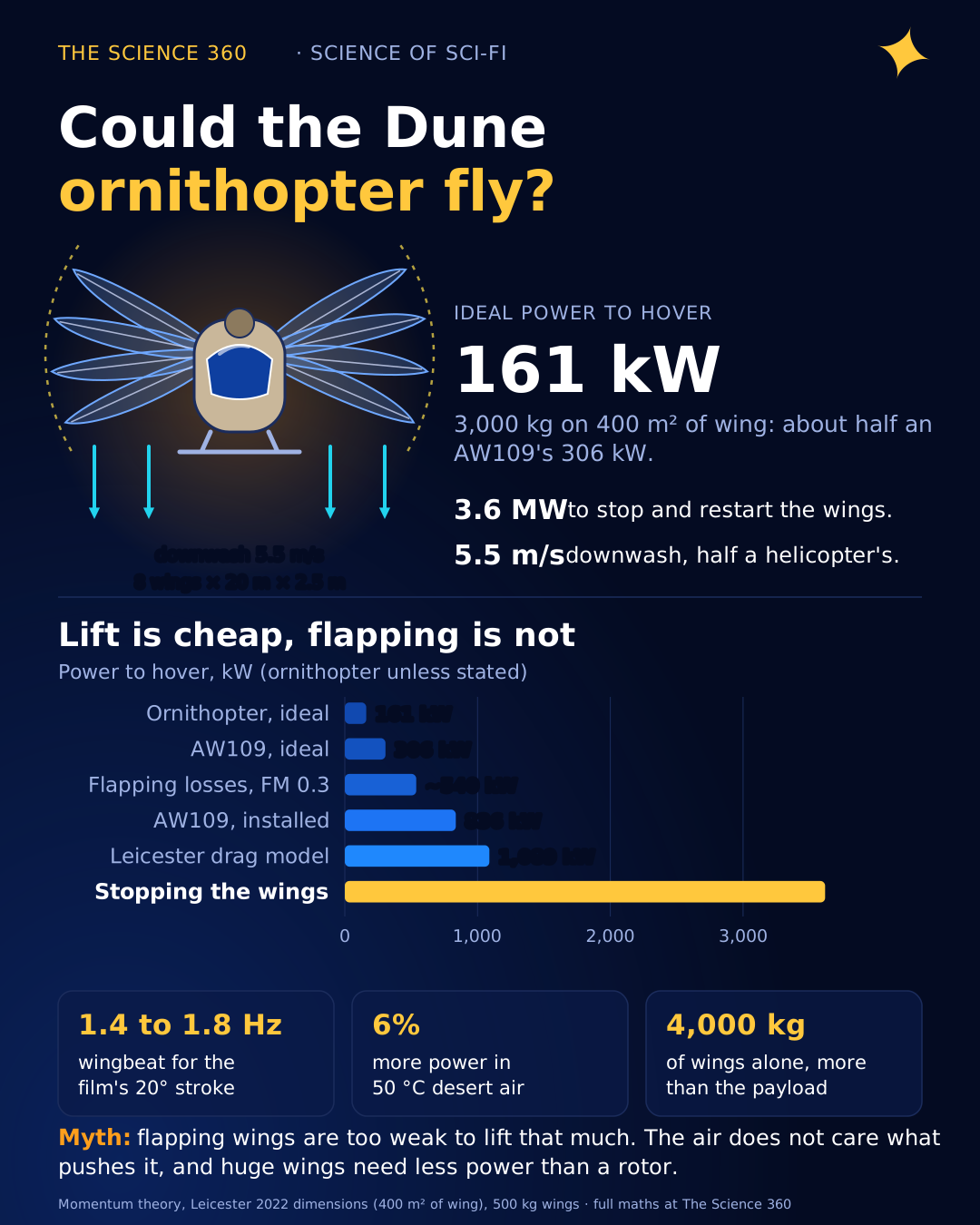
The ornithopter, carrying slightly more, needs about half the ideal power of the helicopter. Its wings sweep four times the area, so it can hover by pushing air downward at half the speed.
Why the Leicester estimate is so much higher
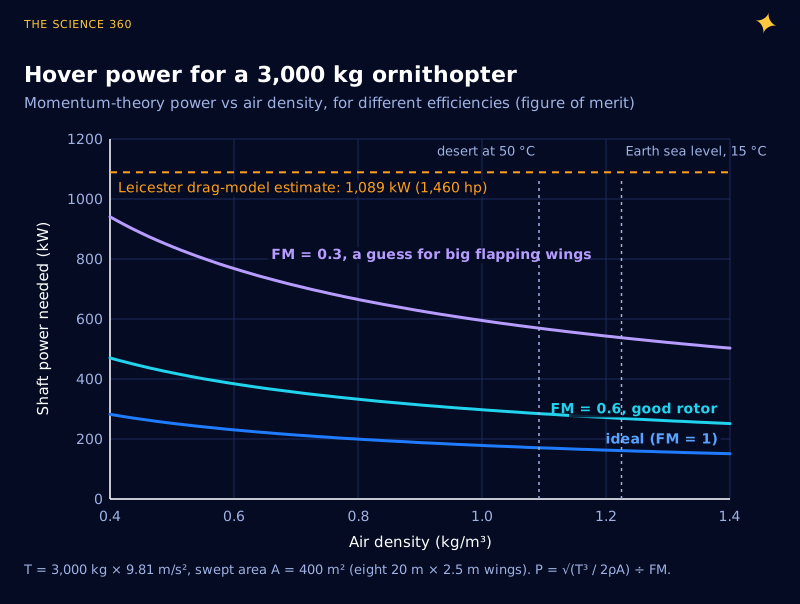
The students treated each wing as a flat plate pushed straight down through still air, with lift equal to drag (drag coefficient 1.17 for a flat rectangle), and half the wings working at any instant. That gives 136 kW per wing and 1,089 kW (1,460 hp) for all eight.
That approach captures a real loss that momentum theory ignores: a plate slapping downward wastes energy in turbulent eddies instead of producing a smooth downward jet. Engineers fold all of those losses into one number, the figure of merit, the ratio of ideal to actual power. From the specs above, the AW109's installed power is 2.7 times its ideal and a Robinson R22's is 2.1 times, and that installed power also covers climb, tail rotor and reserve. A big, slow, unsteady flapping wing would almost certainly do worse than a rotor. Figure 2 shows where the answer lands for different assumptions.
What is the air like on Arrakis?
Herbert never gives Arrakis a surface pressure or air density, but characters walk around unmasked (stillsuits are for water, not oxygen), so an Earth-like atmosphere is the reasonable assumption. The variable that matters most is temperature. At sea-level pressure, ideal-gas density is :
So about 6% more power in deep-desert heat.
Because power scales as , the thin-air penalty is mild unless the air gets truly thin. Mars is the extreme case: at about 1% of Earth's density, NASA's 1.8 kg Ingenuity helicopter needed two 1.21 m rotors spinning at roughly 2,400 to 2,900 rpm and about 350 W of motor power, several times its ideal figure.
The downwash itself is gentle by helicopter standards. Figure 3 compares the ornithopter's footprint with real rotors, to scale. Its 5.5 m/s induced velocity (about 11 m/s in the far wake) is half of an AW109's, which matters on a planet made of sand: less blasted grit and less brownout.
How fast would the wings have to flap?
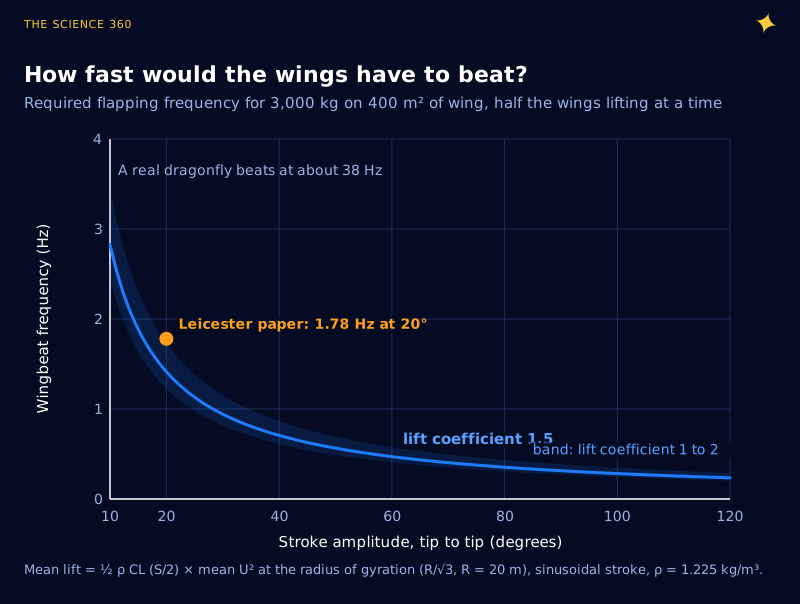
Momentum theory says how much power; it does not say how fast the wings move. For that we need the lift each wing makes: , where is the wing area working at that moment, the wing's speed through the air, and a lift coefficient. Flapping insects reach unusually high lift coefficients (around 1 to 2) thanks to a vortex that clings to the leading edge of the wing.
A wing rocking through a stroke angle at frequency moves fastest at the tip. Using the wing's radius of gyration ( for a uniform 20 m wing, about 11.5 m) as the representative point and half the wings lifting at a time, the required frequency follows directly. With the 20° stroke the Leicester team estimated from the film and , we get about 1.4 beats per second; with their drag coefficient of 1.17 in place of , about 1.6. Their own number, 1.78, used a different averaging, so the two methods agree to within about 25%.
Worked example: scale up a dragonfly
The ornithopter is a giant dragonfly, so let's grow a real one. A large hawker dragonfly weighs roughly 1 g, spans about 10 cm and beats its wings around 38 times a second. Scale every length by the same factor , and mass grows as .
The film's machine spans about 42 m. Weight scales as and area as , so disk loading scales as : .
Wing speed needed scales as , and frequency as speed over length, :
Ideal power per newton scales as : 12 times worse than the insect.
This is the square-cube law at work. A dragonfly-shaped ornithopter at true scale would need 180 N/m2 of disk loading, more than a Robinson R22. Villeneuve's design cheats in the right direction: by giving the machine wings three times longer than a scaled dragonfly, it brings the disk loading back down to 74 N/m2.
The real problem: stopping a 20 m wing twice a second
A rotor blade spins at a steady speed. Once it is turning, keeping it going only costs aerodynamic drag. A flapping wing must accelerate, stop, and reverse every half-stroke. In insects this inertial cost is large; the classic textbook example has the wing's kinetic energy per stroke comparable to the useful aerodynamic work, and insects recover part of it with springy proteins such as resilin in the wing hinge.
For the ornithopter we have to assume a wing mass. Suppose each 20 m × 2.5 m wing is built at 10 kg per square meter of planform (light for a structure that must carry over 7 kN of lift on each downstroke, since only half the wings lift at a time), so 500 kg per wing.
Moment of inertia of a uniform wing about its root:
Stroke ±10° (20° total) at 1.78 Hz gives a peak angular speed of
Energy thrown away if stopped twice per cycle with no springs:
Eight wings: about 3.6 MW.
That is more than ten times the aerodynamic power and more than four times the AW109's installed power, and the wings alone would weigh 4,000 kg, more than the payload. The numbers swing with the assumed wing mass, but the shape of the problem does not. To fly, a real ornithopter would need elastic energy storage at the wing roots (springs or tuned resonance, the way insects do it), plus a structure strong enough to take loads reversing direction twice a second for every flight hour without fatigue cracking.
So, could the Dune ornithopter fly?
Here is how the pieces stack up.
- Aerodynamic power: fine. About 160 kW ideal, perhaps 300 to 550 kW in practice, within reach of an AW109-class pair of turboshafts.
- Wingbeat: plausible. Roughly 1.4 to 1.8 Hz for the film's short stroke, which is about what the movie shows.
- Wing inertia: the deal-breaker without resonant springs, at megawatts of wasted power and a wing mass larger than the payload.
- Control and reliability: eight independently reversing wings, each with a fatigue-critical hinge, versus one rotor head.
The honest conclusion is that physics does not forbid the Atreides ornithopter, and its designers made a smarter aerodynamic choice than most people assume. Engineering is what kills it: helicopters won because spinning is cheaper than shaking. If you want the full set of sci-fi physics checks, the same kind of energy budget sinks the lightsaber, while chaos (not power) is what dooms the planet in the 3 Body Problem.
Frequently asked questions
Could the ornithopter from Dune really fly?
Aerodynamically, its huge wings help: momentum theory puts ideal hover power at about 160 kW for 3,000 kg on 400 m2 of wing, less than an AW109 needs. The impractical part is the mass of 20 m wings and the power to stop and restart them every stroke.
Do real ornithopters exist?
Yes. Engine-powered models have flown since at least 1961, and the human-powered UTIAS Snowbird flew for almost 20 seconds in 2010. None has hovered with a crew.
How fast would the Dune ornithopter’s wings flap?
About 1.4 to 1.8 beats per second for a 20° stroke. A dragonfly scaled to 3,000 kg would beat about 3 times per second, against 38 for the real insect.
Why don’t helicopters flap their blades?
A spinning rotor never has to stop its blades, so it spends no energy reversing them. Flapping wings reverse twice per cycle, which wastes energy unless springs store it.
Related on The Science 360
More science of sci-fi:
Sources
- C. Keany, T. Graham, F. Kaiser, R. Newland, K. Pankhania, "Exploration of Dune's Ornithopters", Physics Special Topics 21(1), University of Leicester (2022): journals.le.ac.uk
- Momentum theory, ideal hover power P = √(T³/2ρA): Wikipedia; disk loading examples: Wikipedia
- AgustaWestland AW109 specifications (2,850 kg MTOW, 11.0 m rotor, 2 × 418 kW): Wikipedia
- Robinson R22 specifications (621 kg, 7.67 m rotor, 92 kW): Wikipedia
- Sikorsky UH-60M specifications (9,979 kg, 16.36 m rotor, 210 m², 2 × 1,418 kW): Wikipedia
- Ingenuity Mars helicopter (1.8 kg, 1.21 m rotors, ~350 W): Wikipedia
- Insect flight (aeshnid dragonfly 38 beats/s, wing inertia and resilin energy example): Wikipedia
- Ornithopter history (Spencer Orniplane 1961, UTIAS Snowbird 2010): Wikipedia
- Common green darner size (wingspan up to 10 cm): Wikipedia; giant hummingbird wingspan and mass range: Wikipedia
Header image: NASA/JPL-Caltech/Univ. of Arizona (image PIA18244), regraded for this article.