3 Body Problem: The Real Physics of Trisolaris
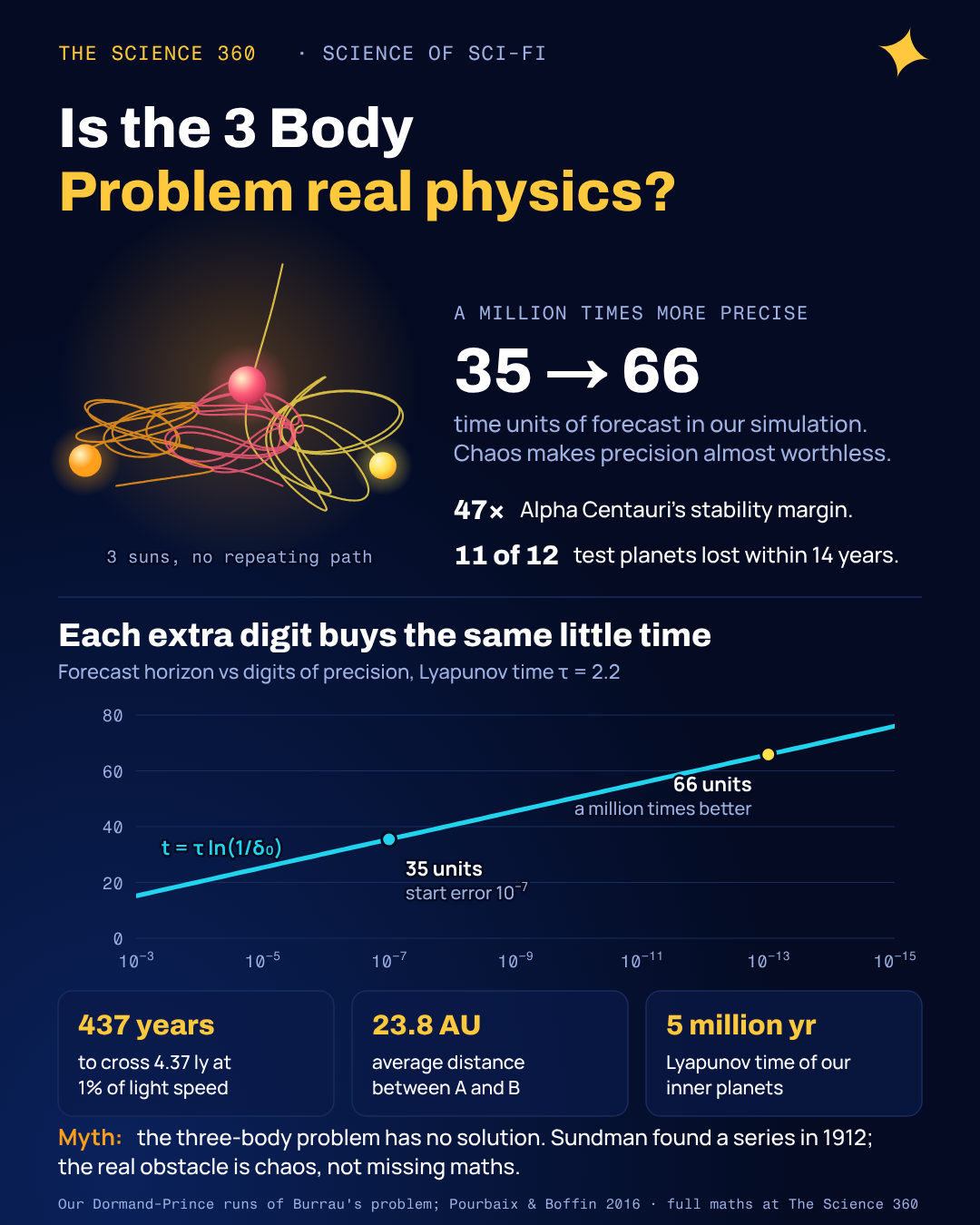
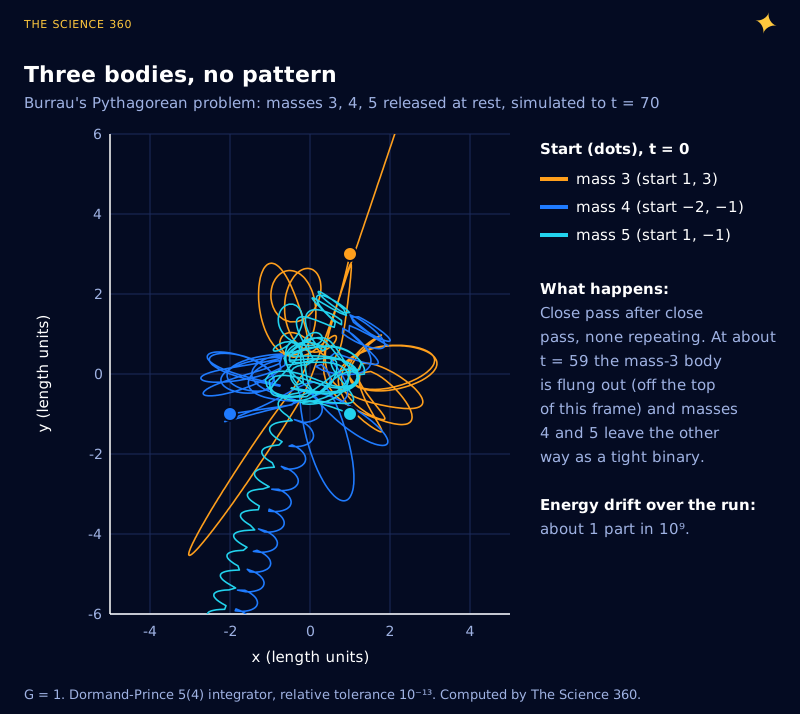
Put three masses on the corners of a 3-4-5 triangle, give them masses of 3, 4 and 5, and let go. That is all. No spin, no initial velocity, nothing hidden. Mathematicians expected this "Pythagorean problem" to settle into a repeating pattern when it was posed in 1893. It took until 1967 and an early computer for Victor Szebehely and C. F. Peters to show what really happens: the bodies swing through a long series of near misses, and then the lightest one is thrown out of the system forever.
We ran it ourselves for this post, with under 100 lines of Python, and it does exactly that at around . It is the cleanest demonstration of the physics behind Liu Cixin's novel and Netflix's 3 Body Problem: a planet whose suns follow no pattern, so its people can never know whether the next century will be mild or apocalyptic.
Below we separate what the show gets right (more than you might think) from what it invents, and we check it against the star system it names, Alpha Centauri.
What is the three-body problem?
Two bodies under gravity are solved completely. Kepler and Newton showed that each follows an ellipse (or a parabola or hyperbola) around their shared center of mass, forever. Write down the positions and velocities today and you can compute them for any date with one formula.
Add a third body and that formula disappears. In 1889 Henri Poincaré won King Oscar II of Sweden's prize for work on this problem, and in correcting an error in his own prize essay he discovered what we now call chaos: trajectories that are fully determined by Newton's laws but depend so sensitively on starting conditions that they cannot be predicted far ahead.
Simulating three bodies in Python
To show chaos honestly we wrote a small integrator: Newton's law of gravity for every pair of bodies, stepped forward with an adaptive Dormand-Prince Runge-Kutta method, the same family of algorithm behind many standard ODE solvers. Units are chosen so that . The step size shrinks automatically during close passes, when bodies whip around each other in a tiny fraction of a time unit.
A good sanity check for any orbit code is energy conservation. Over the whole 70-unit run our total energy drifted by about 2 parts in a billion, and the escape happens at the same moment the literature reports (around ), with masses 4 and 5 leaving together as a tight binary.
How sensitive is a three-body system to initial conditions?
Chaos has a precise meaning: two nearly identical starting states separate exponentially fast. To measure it we ran the Pythagorean system twice, side by side in the same integrator, with one starting coordinate shifted by 10-7. In Solar System terms that is like misplacing the Earth by 15 kilometers out of 150 million.
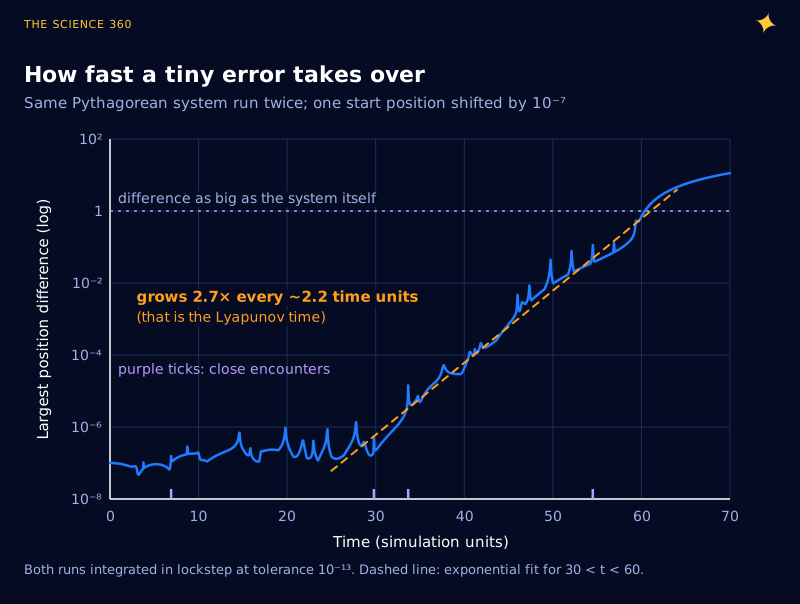
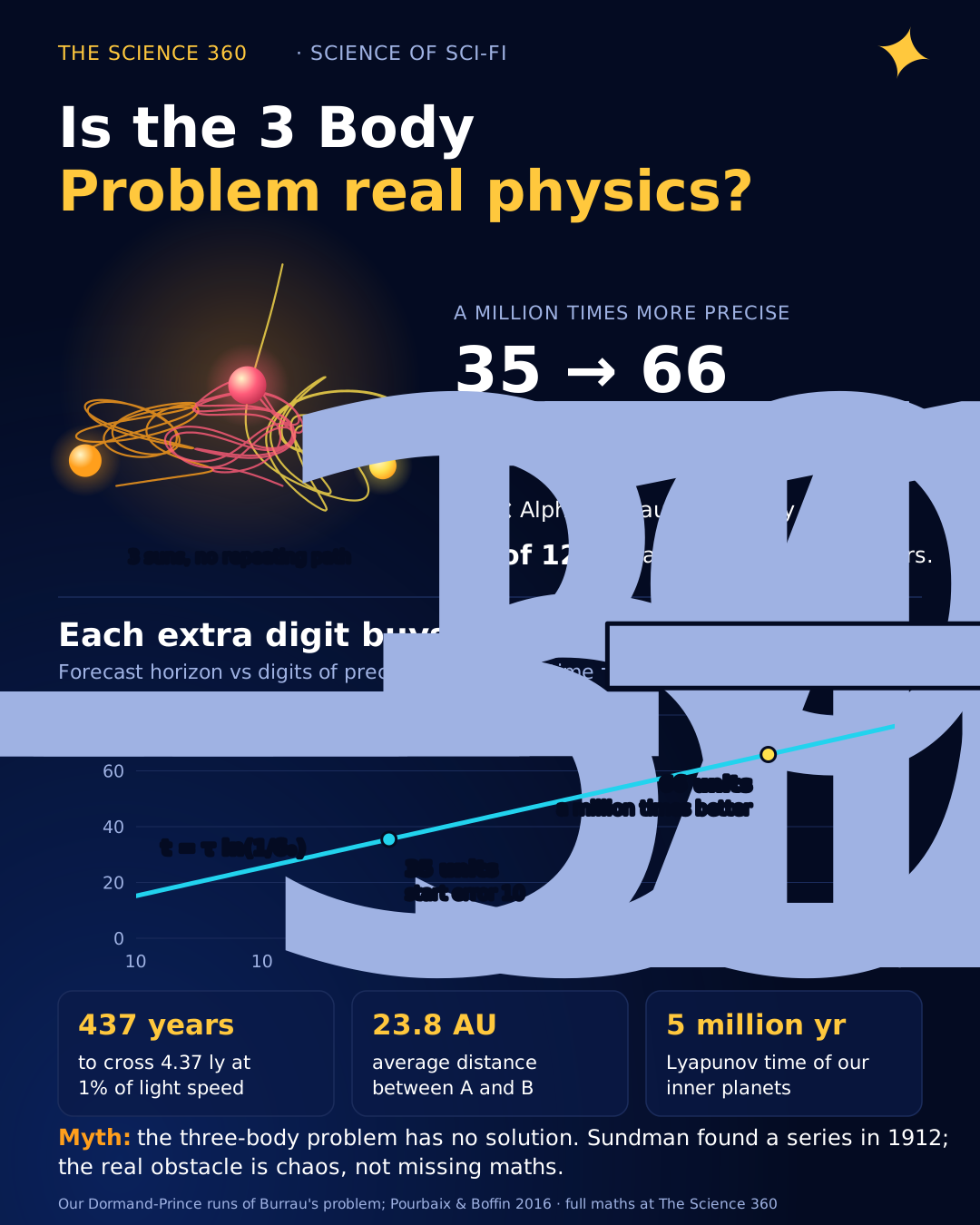
The slope of that straight section is the key number. If the separation grows as , then is called the Lyapunov time: the time for any error to grow by a factor of e (about 2.718). For this system we measure time units, roughly the time two bodies take to swing around each other once.
Worked example: what does extra precision buy you?
The cruel part of chaos is what happens when you try to fix it with better measurements. Solve the growth law for the time when an initial error reaches a size that ruins your forecast:
Our run: , , (error as large as the system).
Now measure a million times more precisely, :
A million-fold better measurement less than doubles the forecast.
(Our actual curve stays flat for the first stretch, so the real horizon here is about 60 units; the logic is the same.) Every factor of 10 in precision buys the same fixed amount of extra time, τ × ln(10) ≈ 2.3τ. This is why the Trisolarans in the novel can never compute their way out. It is also true of our own Solar System, just slowly: Jacques Laskar found in 1989 that the inner planets have a Lyapunov time of about 5 million years. As he put it, you lose roughly one digit of accuracy every 10 million years. Earth's orbit is predictable for tens of millions of years, not billions.
Could a planet like Trisolaris survive three suns?
The show's premise is a planet that alternates between "Stable Eras", when it orbits one sun calmly, and "Chaotic Eras", when it is flung between suns and either roasted or frozen. We tested that directly. We invented a system of three Sun-like stars (1.0, 0.9 and 0.8 solar masses) a few AU apart with random velocities, put an Earth-like planet on a circular 1 AU orbit around the first star, and recorded how much starlight it received.
Most of our random systems were brutal: in 11 of 12 trials the planet was ripped away from its star within 14 years. The run below is the one in which the planet lasted longest, and it reads like the plot of the novel.
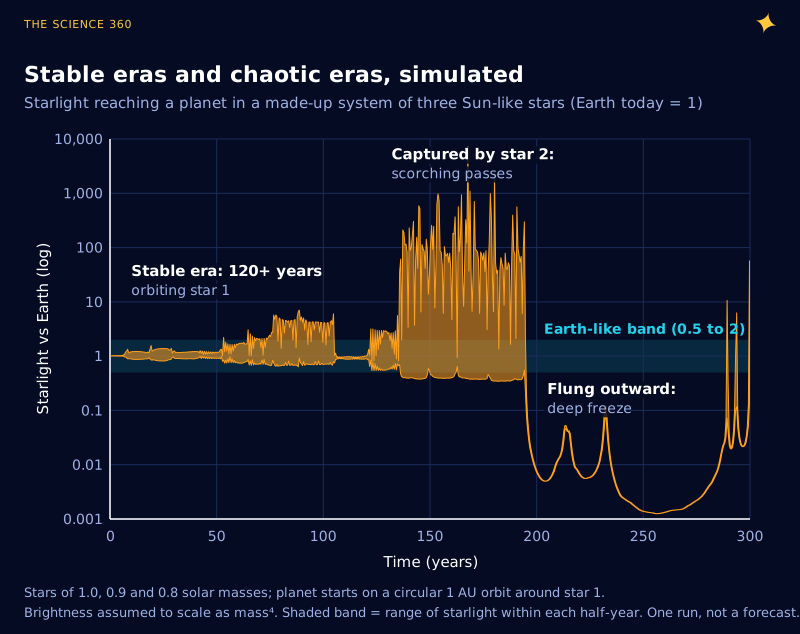
So the "eras" are not fantasy. If a planet were stuck in a genuinely chaotic triple, this is the kind of history it would have. The problem is the next step: a planet like ours almost never survives long enough for life to evolve. Our best run lasted 300 years; life on Earth needed hundreds of millions. Real astronomers would expect Trisolaris to have been ejected into interstellar space or swallowed by a star long before anyone built a civilization on it.
What does the real Alpha Centauri system look like?
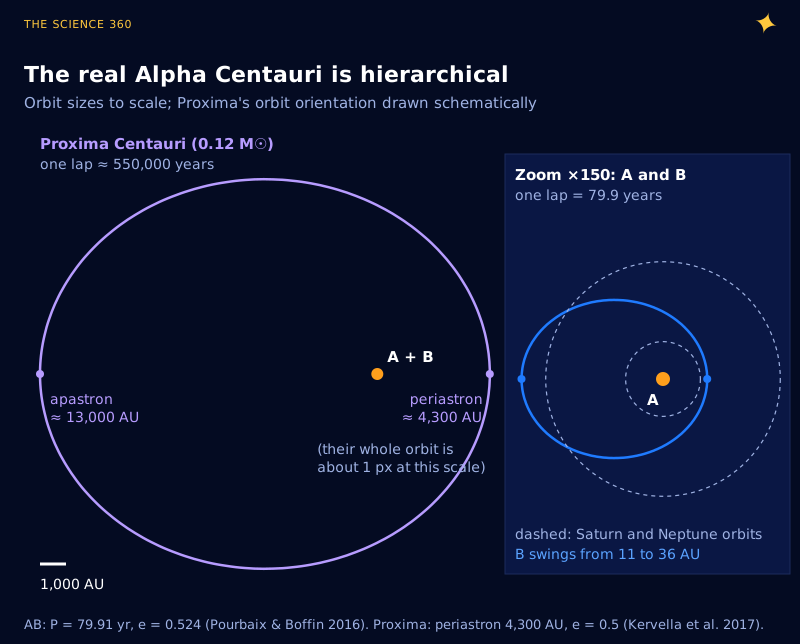
Liu Cixin places Trisolaris in Alpha Centauri, our nearest stellar neighbor at about 4.37 light-years. It really does have three stars: Alpha Centauri A (about 1.1 solar masses), Alpha Centauri B (about 0.9 to 1.0) and the red dwarf Proxima Centauri (0.12). But they are not a chaotic tangle. They are a hierarchical triple: a tight pair with a distant companion.
Worked example: how far apart are A and B?
Kepler's third law in solar units says , with in astronomical units, in solar masses and in years. Pourbaix and Boffin (2016) measured the orbit with HARPS spectra plus astrometry.
years, ,
With eccentricity : closest approach , farthest .
That is a separation swinging from a bit beyond Saturn to a bit beyond Neptune. Proxima is in another league. Kervella and colleagues showed in 2017 that it is gravitationally bound to the pair, on an orbit with eccentricity about 0.5 that comes within about 4,300 AU and swings out to about 13,000 AU, taking roughly 550,000 years per lap.
Worked example: is Alpha Centauri stable?
For hierarchical triples, Rosemary Mardling and Sverre Aarseth (2001) derived a widely used stability rule and checked it against many simulations. For a coplanar, prograde system (the least stable orientation) the outer orbit must satisfy:
Required:
Actual: , so 8,650 / 23.8 ≈ 363. Safety margin: about 47 times.
Proxima is far too distant to do anything dramatic to A and B. The same kind of reasoning applies to planets inside the pair. Holman and Wiegert's 1999 fit for planets orbiting one star of a binary gives a stability limit of about 0.116 times the binary separation for Alpha Centauri's masses and eccentricity, or about 2.8 AU around A. Alpha Centauri A's habitable zone sits near 1.2 AU, comfortably inside. In 2025 a JWST team reported a candidate giant planet imaged around A at roughly 1 to 2 AU; it still needs confirmation.
What would the sky look like from there? B delivers between about 0.0004 and 0.004 of the light Earth gets from the Sun, depending on where it is in its 80-year orbit. That sounds faint until you remember the full Moon is about 400,000 times dimmer than the Sun: B would shine like 150 to 1,600 full Moons, a dazzling point that would make some nights bright enough to read by. A beautiful sky, but no chaotic eras.
What is fiction in 3 Body Problem?
| Story element | Verdict | Why |
|---|---|---|
| Three-body chaos, unpredictable eras | Real physics | Exponential error growth, as in Figures 2 and 3 |
| Trisolaris in Alpha Centauri | Wrong system | Alpha Centauri is hierarchical with a 47 times stability margin |
| A civilization evolving on a chaotic planet | Very unlikely | Planets in chaotic triples are ejected in centuries, not eons |
| Fleet arriving in about 400 years | Consistent arithmetic | 4.37 light-years at 1% of light speed takes 437 years |
| Sophons: protons unfolded into 2D supercomputers | Fiction | No known physics lets a proton unfold into extra dimensions |
| Instant messaging via entanglement | Ruled out | The no-communication theorem forbids sending information by entanglement alone |
The entanglement point is the one worth correcting most loudly, because it is everywhere in pop science. Entangled particles do show correlations that no local hidden variables can explain, as the 2022 Nobel Prize in Physics recognized. But each side's measurement results look completely random on their own. You only see the correlation after comparing notes through an ordinary channel, which is limited by the speed of light. The sophons' real-time reports to Trisolaris would need physics nobody has found.
Why the show still gets the hard part right
Strip out the sophons and the core of the story holds up remarkably well. The three-body problem is real, unsolvable in closed form, and chaotic in exactly the way the novel dramatizes. A civilization that understood chaos would know that more computing power cannot buy a long forecast, because every extra decimal place of precision adds only a fixed slice of time. That is a much more interesting scientific idea than any alien superweapon, and it is true of the planets in our own Solar System, merely on a time scale of millions of years.
The irony is the address. If Trisolarans existed, they would have to live almost anywhere except Alpha Centauri, which is one of the calmer multiple-star systems we know.
Frequently asked questions
Is the three-body problem real?
Yes. It is the problem of predicting the motion of three masses pulling on each other by gravity. Newton's laws still apply, but for most starting conditions there is no simple formula and the motion is chaotic, so small measurement errors grow exponentially.
Is the three-body problem unsolvable?
Not exactly. Sundman found a convergent series solution in 1912, but it converges far too slowly to use. What does not exist is a general closed-form formula. Computers solve specific cases numerically, up to a horizon set by chaos.
Does Alpha Centauri really have three suns?
It has three stars, but A and B orbit each other every 79.9 years at about 24 AU, while Proxima circles the pair thousands of AU away. A planet near A would see one sun plus a very bright star, not chaotic eras.
Could sophons exist?
No known physics supports them. Protons cannot be unfolded into planet-sized computers, and entanglement cannot carry messages faster than light.
How long would it take to travel from Alpha Centauri to Earth?
At 1% of light speed, about 437 years for the 4.37 light-year trip, matching the story's roughly 400-year timeline.
Related on The Science 360
More science of sci-fi:
Sources
- V. Szebehely and C. F. Peters, "Complete solution of a general problem of three bodies", Astronomical Journal 72, 876 (1967): adsabs.harvard.edu
- Three-body problem overview (Poincaré, Sundman series, Beloriszky estimate): Wikipedia
- D. Pourbaix and H. M. J. Boffin, "Parallax and masses of α Centauri revisited", A&A 586, A90 (2016): arxiv.org/abs/1601.01636
- P. Kervella, F. Thévenin, C. Lovis, "Proxima's orbit around α Centauri", A&A 598, L7 (2017): arxiv.org/abs/1611.03495
- R. A. Mardling and S. J. Aarseth, "Tidal interactions in star cluster simulations", MNRAS 321, 398 (2001); criterion as restated in arXiv:2306.09400
- M. J. Holman and P. A. Wiegert, "Long-term stability of planets in binary systems", AJ 117, 621 (1999): arxiv.org/abs/astro-ph/9809315
- F. Mogavero, N. H. Hoang, J. Laskar, "Timescales of chaos in the inner Solar System", Physical Review X 13, 021018 (2023): arxiv.org/abs/2305.01683; Laskar quote via Live Science
- C. Beichman et al., "Worlds Next Door: a candidate giant planet imaged in the habitable zone of α Cen A" (2025): arxiv.org/abs/2508.03814
- NASA, Proxima Centauri b: science.nasa.gov
- Nobel Prize in Physics 2022 (entanglement experiments): nobelprize.org
Header image: NASA/JPL-Caltech (image PIA03520), regraded for this article.