Why Is James Webb at L2? The Physics, Computed

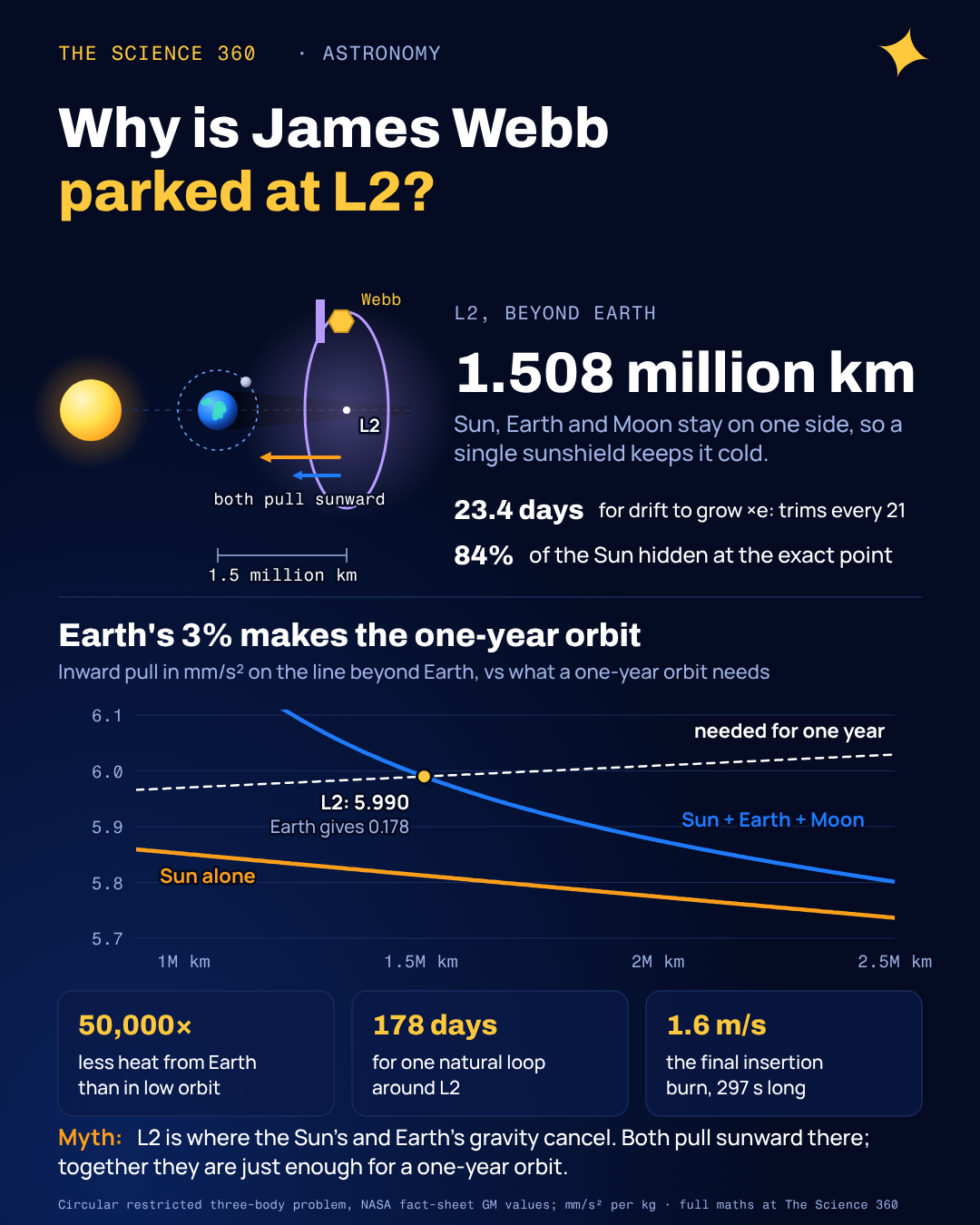
If the James Webb Space Telescope sat exactly at the second Lagrange point, it would spend its whole life in an eclipse. From there Earth's disk is 0.484° across and the Sun's is 0.528°, so Earth would cover 84% of the Sun, leaving a thin ring of sunlight forever. Webb's solar panels would starve and its thermal design would make no sense. So Webb does not sit at L2. It loops around it on an orbit bigger than the Moon's orbit around Earth.
Most explanations of why Webb went to L2 get the main reason right (it needs to stay cold) but describe L2 as "a point where the gravity of the Sun and Earth balance". It isn't. At L2 the Sun and Earth pull in the same direction. And the fact that L2 is unstable, a hilltop rather than a valley, is the reason Webb fires its thrusters every three weeks. All of this falls out of a few lines of Newtonian mechanics, so let's do them.
What is L2, really?
Anything orbiting the Sun farther out than Earth should take longer than a year to go round. Kepler's third law says the period grows as distance to the power 3/2. A spacecraft 1.5 million km beyond Earth (1% farther from the Sun) should take about 1.5% longer, so it would slowly fall behind Earth.
L2 is the spot on the far side of Earth where Earth's extra pull exactly makes up the difference. Earth's gravity adds to the Sun's, giving just enough extra inward pull to whip the spacecraft round in one year, keeping pace with Earth. In a frame that rotates with Earth, the spacecraft feels no net force, which is where the "balance" description comes from. But the balance is between gravity and the centrifugal effect of that rotating frame, not between the Sun and Earth.
Forces at L2, per kilogram
Distance from Sun: 149.598 + 1.508 = 151.106 million km; distance from Earth: 1.508 million km.
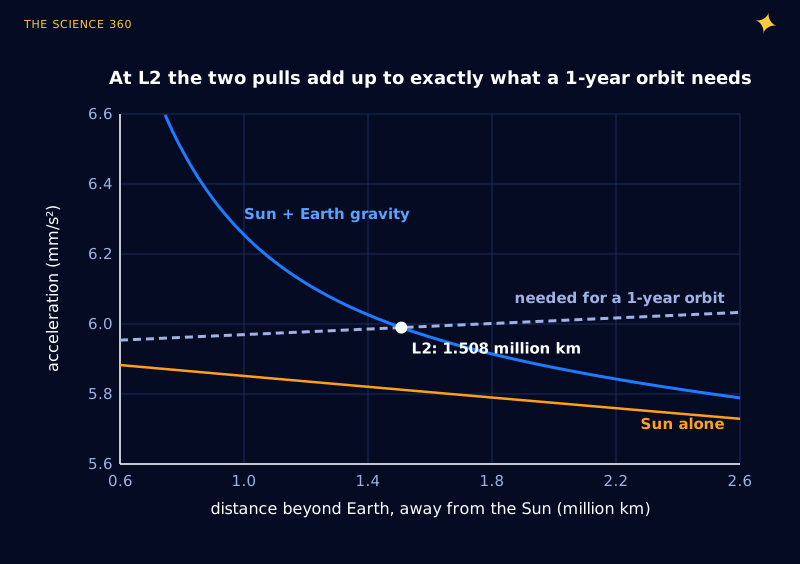
Each pull is , and both point toward the Sun. Total inward pull: 5.990 mm/s². Needed for a one-year circle at that radius:
Without Earth, an orbit at that distance would take 1.0152 years, 5.5 days longer.
Earth supplies only 3% of the pull, and that 3% is the whole effect. Figure 1 shows the two curves crossing.
How far is L2 from Earth? The worked calculation
In the circular restricted three-body problem (the same framework behind the Trisolaris three-body problem, simplified to one tiny body), the distances are scaled so the Sun-Earth separation is 1 and the mass ratio is . The L2 distance beyond Earth solves a fifth-order polynomial, and for small there is a handy approximation.
Mass ratio, from NASA fact sheet GM values
Hill approximation
Exact
Numerical root: , so = 1.508 million km from the Earth-Moon barycentre. The approximation is 5,000 km short, an error of 0.33%. For comparison L1, on the sunward side, comes out at 1.498 million km.
That is about four times the Moon's distance, the "1.5 million kilometres (1 million miles)" NASA quotes. L2 and L1 are not quite symmetric because the Sun's pull changes across the 3 million km between them.
Why L2 is a hilltop, not a valley
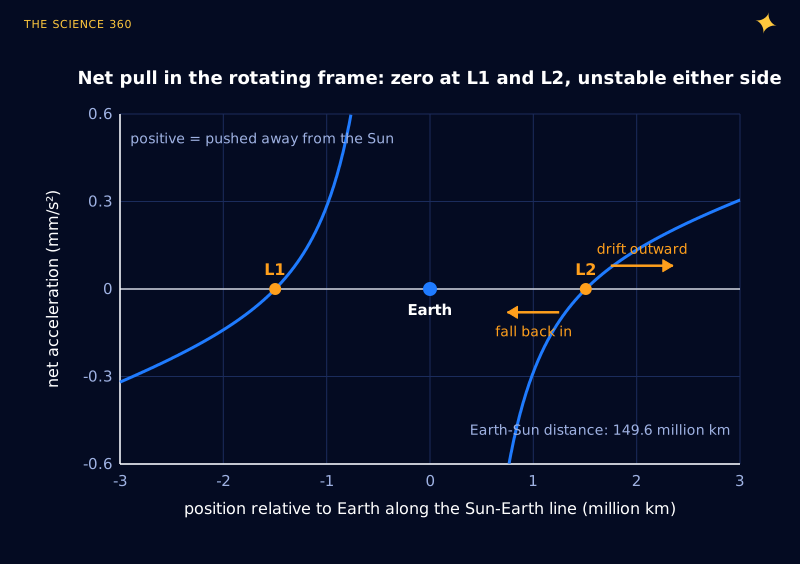
Move a little beyond L2 and the Sun-plus-Earth pull drops faster than the required centripetal pull rises (the blue line in Figure 1 falls below the dashed one), so the spacecraft drifts outward. Move a little inside and the pull wins, so it falls back toward Earth. Either way the error grows. Figure 2 plots the net acceleration felt in the rotating frame along the whole Sun-Earth line near Earth.
Linearising the equations of motion around L2 gives the growth rate. In the scaled units, the coefficient is
and the unstable eigenvalue is
How fast an error grows near L2
That is in units of Earth's orbital rate, per day. The e-folding time is how long an error takes to grow by a factor of e; the last two lines are the growth over 21 and 100 days.
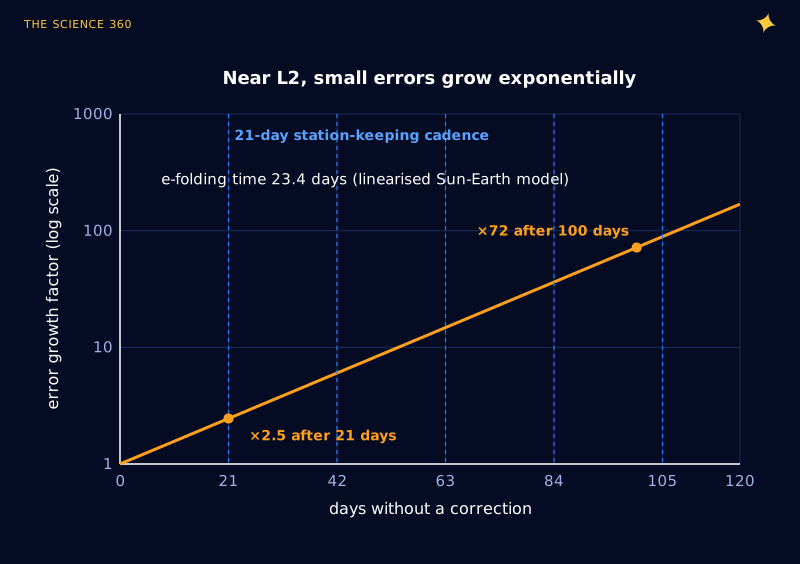
That number lines up neatly with Webb's operations. NASA's flight dynamics paper on Webb's station-keeping strategy says manoeuvres are performed on a 21-day cadence. Leave it much longer and each correction gets exponentially bigger; do it sooner and you spend more effort on measurement noise. The instability is also a convenience: an unstable point has a matching stable direction, and pushing along it is the cheapest correction there is, which is how the team minimises fuel.
Webb has an extra complication. Its sunshield, roughly the size of a tennis court, acts like a solar sail, and the push of sunlight depends on how the observatory is pointed. The operations team models that solar radiation pressure from the planned attitude timeline. Webb's thrusters also cannot point well toward the Sun without exposing the cold side, so the team deliberately aims each correction so that the next one will also be a push away from the Sun, which their paper says is much more fuel-efficient.
Why isn’t Webb exactly at L2?
Two reasons, one geometric and one practical. The geometric one is the eclipse in the opening paragraph. Earth's umbra, its full shadow cone, ends at
L2 is 1.51 million km out, beyond the tip of the cone, where Earth looks slightly smaller than the Sun. The result would be a permanent annular eclipse.
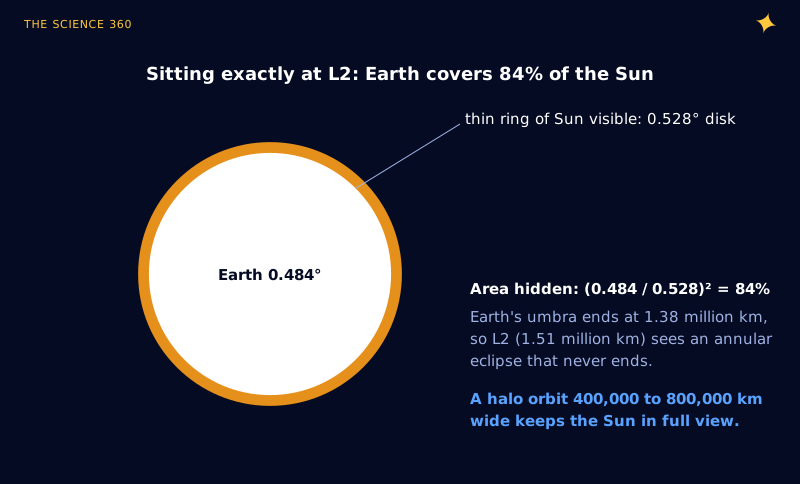
To stay clear, Webb needs to be well outside the shadow, whose partial (penumbral) region at L2 is only about 13,400 km in radius. The halo orbit it actually flies is enormous by comparison. The pre-launch reference orbit in NASA's station-keeping paper had amplitudes of about 771,000 km in the ecliptic plane and 418,000 km perpendicular to it. Seen from Earth, Webb traces a big loop around the anti-Sun direction, never coming close to Earth's shadow.
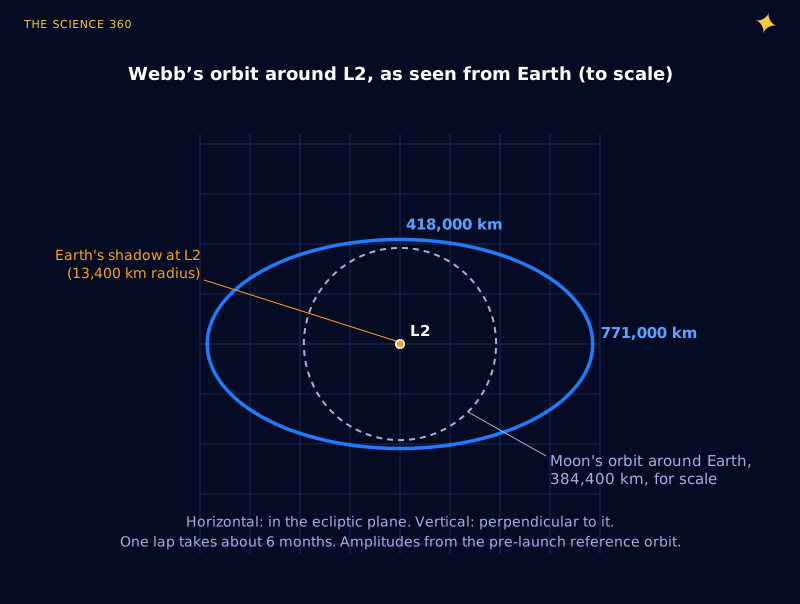
The practical reason: a large loop around L2 is a natural motion, so it costs almost nothing to fly once you are on it. The linearised equations have natural oscillations about L2 with a period of , where
times Earth's orbital rate. That gives 365.256 / 2.06 = 178 days, close to the "about 6 months" NASA gives for one loop. A halo orbit is simply one of those natural loops, picked large enough that the in-plane and out-of-plane frequencies lock together. The spacecraft coasts around it and only needs to cancel the slow exponential drift.
Why not put Webb in Earth orbit like Hubble?
Webb's mirror and instruments operate at about −225 °C (48 K), because a warm telescope glows in exactly the infrared wavelengths it is trying to detect. In low Earth orbit, that is close to impossible. The Earth, a big source of infrared, would fill much of the sky and keep moving around the spacecraft.
How much of the sky Earth fills, and how much heat it sends
From 550 km altitude:
From L2: angular radius 0.24°; fraction of the sky = 0.0004%.
Earth's infrared output, blackbody at 254 K (NASA fact sheet):
Flux on a surface facing Earth:
That is about 50,000 times less. Sunlight at L2:
always from the same side.
The Sun is still a hot lamp at L2, but it is one lamp in one direction, with Earth and the Moon within a few degrees of it. That is what makes the five-layer sunshield work: it only has to block one part of the sky. NASA describes the shield as the equivalent of "SPF one million". In low orbit, the Sun and the warm Earth swap sides every 90 minutes, which is exactly what Hubble lives with as it passes in and out of Earth's shadow. (For what "cold" means in space at all, see how cold is space.)
Other options have their own problems. L1, on the sunward side, puts the Sun and Earth on opposite sides of the spacecraft, which is great for solar observatories and useless for a cold telescope. A drift-away orbit trailing behind Earth around the Sun gets cold too, but the distance to Earth keeps growing, and the radio link weakens as the square of the distance (the same law that limits the Voyager 1 signal). At L2 the distance stays near 1.5 million km for the whole mission, so the Deep Space Network can talk to Webb continuously, with command uploads and data downlinks up to twice a day.
How did Webb get there?
Webb launched on 25 December 2021 and took about a month to coast out. The trip was deliberately aimed slightly short: the launch vehicle gave it a little less energy than needed, and Webb's own thrusters made up the rest, because Webb cannot safely brake by pointing its thrusters at the Sun. The final insertion burn on 24 January 2022 lasted 297 seconds and changed its speed by just 1.6 m/s, according to NASA. Since then, the 21-day trims have kept it on its halo.
FAQ
Why is the James Webb Space Telescope at L2?
Webb observes in the infrared, so it must stay colder than about minus 225 °C. Around the Sun-Earth L2 point the Sun, Earth and Moon all stay in roughly the same direction, so one sunshield can block all three at once. Earth is also far enough away that its heat is negligible, and the spacecraft never passes through Earth's shadow.
How far is L2 from Earth?
About 1.5 million km, roughly four times the distance to the Moon, on the line from the Sun through Earth. Solving the exact equation for the Sun-Earth-Moon system gives 1.508 million km from the Earth-Moon barycentre. The quick Hill-sphere approximation gives 1.503 million km.
Is the gravity of the Sun and Earth balanced at L2?
No. At L2 the Sun and Earth both pull toward the Sun. Their combined pull is exactly the extra inward force needed for an object farther from the Sun than Earth to still orbit once per year. In a frame rotating with Earth, gravity and the centrifugal effect cancel there, which is why it looks like a balance point.
Is Webb exactly at L2?
No. Webb circles L2 in a halo orbit roughly 800,000 km by 400,000 km across, larger than the Moon's orbit around Earth, taking about six months per loop. Sitting exactly at L2 would put it in a permanent partial eclipse, with Earth covering about 84% of the Sun's disk.
Why does Webb need to fire thrusters at L2?
L2 is unstable: a small drift grows by a factor of e about every 23 days. NASA's flight dynamics team planned station-keeping burns on a 21-day cadence to cancel that drift and the push of sunlight on the large sunshield.
Related on The Science 360
Sources
- NASA Science, "Webb Orbit" (1.5 million km, orbit similar in size to the Moon's, about 6 months per loop, Sun, Earth and Moon in the same direction, SPF one million, about −225 °C, DSN contacts up to twice per day, Hubble's 90-minute shadow cycle): science.nasa.gov/mission/webb/orbit
- J. Petersen et al., "L2 Station Keeping Maneuver Strategy for the James Webb Space Telescope", NASA Goddard, AAS 2019 (21-day station-keeping cadence; reference orbit amplitudes of about 771,000 km and 418,000 km; stable-eigenvector minimum-Δv strategy): ntrs.nasa.gov
- Logan, Verma, Cavanaugh and Yu, NASA GSFC Flight Dynamics Facility, ISSFD 2024 (solar radiation pressure modelling from planned attitudes; anti-sunward manoeuvres more fuel-efficient): issfd.org
- NASA Webb blog, "Orbital Insertion Burn a Success, Webb Arrives at L2" (297 s burn, 1.6 m/s): science.nasa.gov
- NASA NSSDC fact sheets for the Sun (GM 132,712 × 106 km³/s², radius 695,700 km), Earth (GM 0.39860 × 10⁶ km³/s², radius 6,371 km, semimajor axis 149.598 × 10⁶ km, blackbody temperature 254 K, solar irradiance 1,361 W/m²) and Moon (GM 0.00490 × 10⁶ km³/s²): sun, earth, moon
Method note: L1 and L2 distances come from the circular restricted three-body problem with the Earth and Moon combined at their barycentre; the growth rate and loop period come from the linearised equations about L2. The real halo orbit is shaped by the Moon, the planets and sunlight pressure, so the figures show sizes and timescales, not Webb's exact track.
Header image: NASA Goddard Space Flight Center (image GSFC_20171208_Archive_e001803), regraded for this article.