How Fast Must a Space Station Spin for 1 g?
Stanley Kubrick spent $750,000 of his $6 million budget on one prop for 2001: A Space Odyssey: a 30-ton wheel, 38 feet across, that turned slowly so Gary Lockwood could jog around the inside of the Discovery's centrifuge. It is still the image everyone has of artificial gravity. Run the numbers on it, though, and that wheel gives you lunar gravity, a head that weighs a third less than your feet, and a cup of coffee that pours sideways.
The usual answer to "how fast does a space station need to spin" is a one-line textbook formula, and the formula is right. What the top results skip is that the spin rate is almost never the hard part. The real constraint is radius, because three effects that ruin small stations (motion sickness, the head-to-foot gradient and Coriolis forces) all depend on how big the wheel is. Here are the numbers that decide whether spin gravity feels like a planet or like a fairground ride.
The formula: a = ω²r
A spinning station does not make gravity. It makes a floor that keeps pushing you sideways off a straight line. Anything moving in a circle of radius r at angular speed ω needs an inward acceleration of ω²r, and the floor supplies it by pressing on your feet. Your body cannot tell that push from standing on the ground. Set ω²r equal to the gravity you want and solve:
Spin rate for 1 g
Here is in metres. For Mars gravity (0.38 g), multiply by ; for the Moon (0.165 g), by 0.41.
Two things stand out. The spin rate only falls as the square root of radius, so making a station 100 times bigger only slows it by a factor of 10. And the floor's speed, , grows with radius: about 10 m/s for a 10 m station, 47 m/s at 224 m. That floor speed turns out to matter as much as the spin rate.
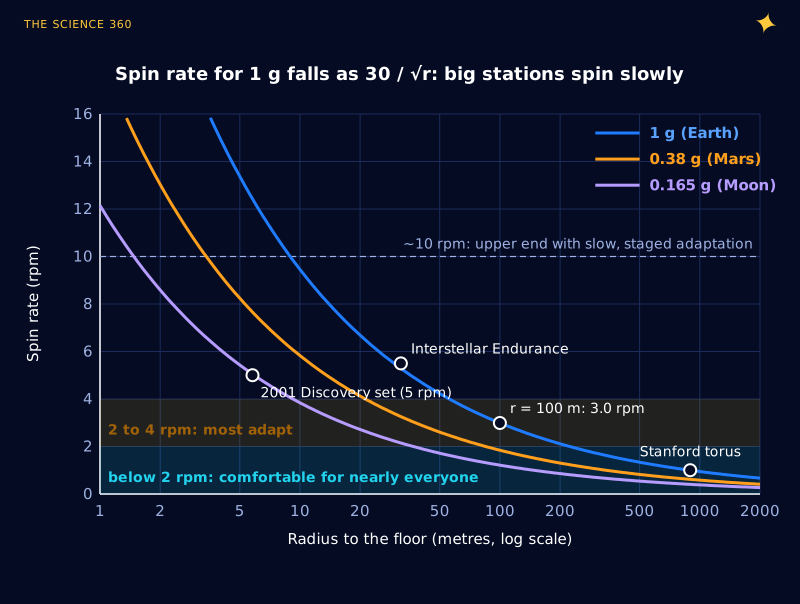
Why is 2 rpm the magic number?
The limit on spin rate comes from your inner ear. The semicircular canals measure rotation. In a spinning room, if you turn your head about any axis that is not parallel to the room's spin axis, the canals report a tumble about a third axis that your eyes say is not happening. The size of that false tumble scales with the product of the two rotation rates, so it grows with the spin rate. The mismatch between eyes and ears is a classic trigger for motion sickness.
The best data come from rotating-room experiments in the 1960s and 70s. Ashton Graybiel, who ran many of them, summarised them in 1975, as quoted by architect Theodore Hall in his review of artificial-gravity design limits:
"At 1.0 rpm even highly susceptible subjects were symptom-free, or nearly so. At 3.0 rpm subjects experienced symptoms but were not significantly handicapped. At 5.4 rpm, only subjects with low susceptibility performed well and by the second day were almost free from symptoms."
Design guidelines from that era are scattered. NASA's Robert Gilruth suggested 6 rpm for "comfort" and 2 rpm for "optimum comfort" in 1969; Cramer in 1985 used 3 rpm. More recent work by James Lackner and Paul DiZio at Brandeis is more optimistic: if you spin people up in gradual steps and have them make lots of head and body movements at each stage, they adapt fully, and "rotation rates as high as 7.5 to 10 rpm are likely feasible." The catch is that the adaptation takes days of deliberate effort.
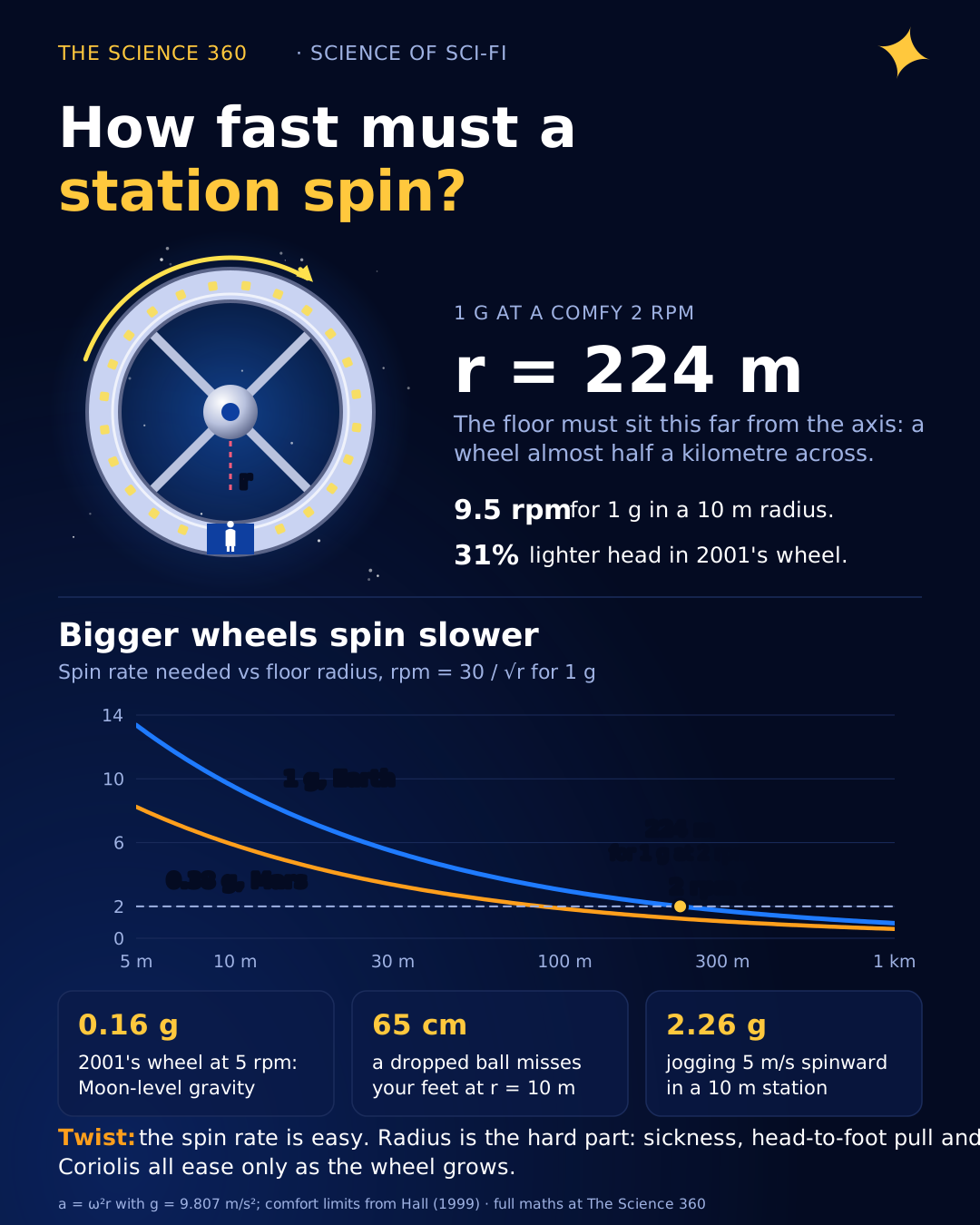
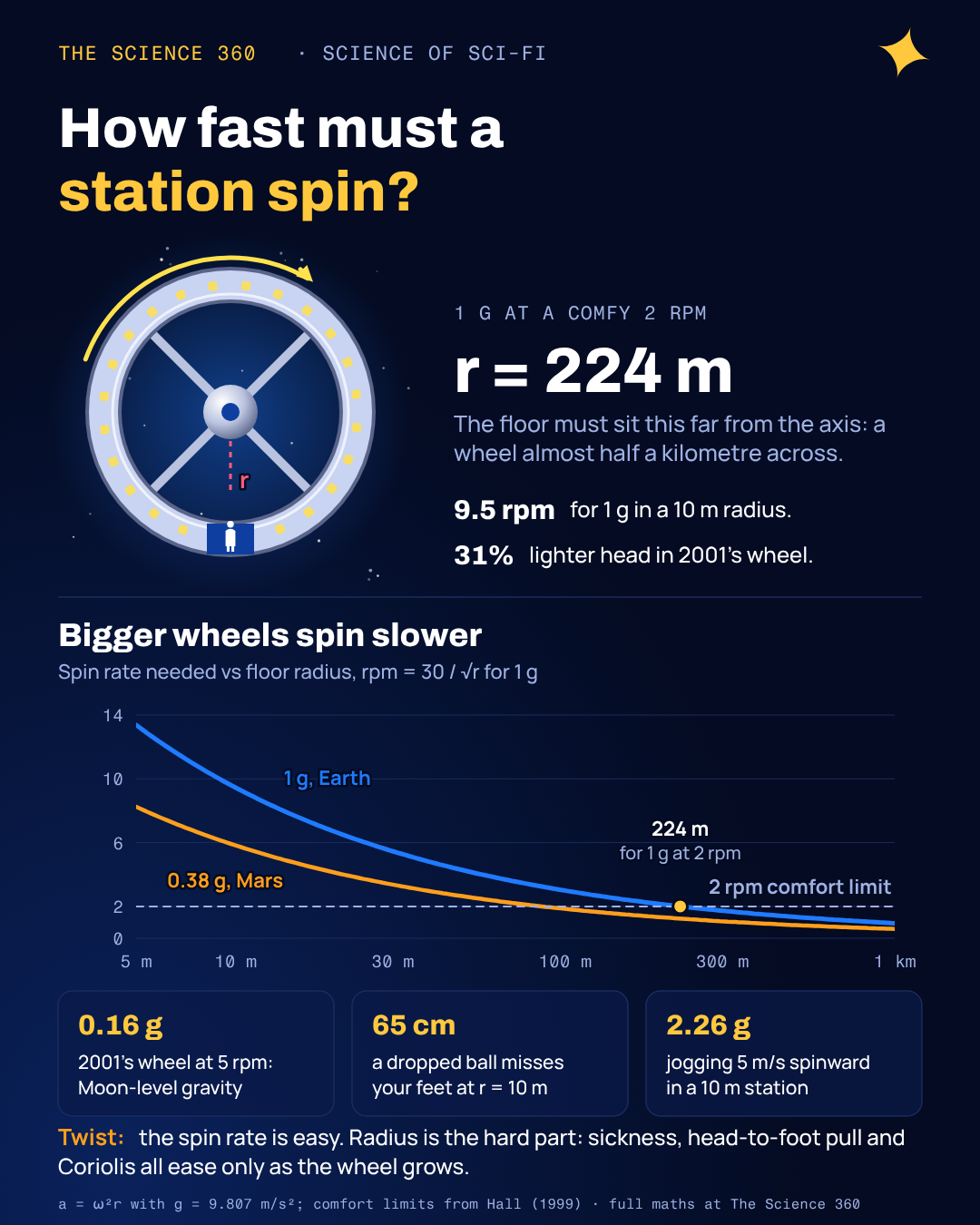
So a realistic design rule is: under 2 rpm and almost anyone is fine from day one; 2 to 4 rpm with a few days of adjustment; up to about 10 rpm for selected, trained crews. Plug 2 rpm and 4 rpm into the formula and you get the radii that matter: 224 m and 56 m for full Earth gravity.
Your head weighs less than your feet
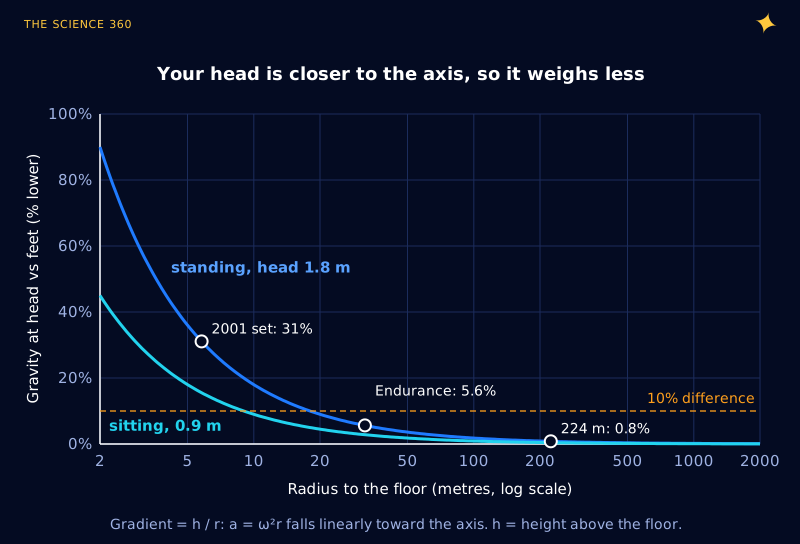
Spin gravity is proportional to distance from the axis, so it gets weaker as you go "up" toward the hub. On Earth gravity changes by about 3 parts in 10 million per metre. In a spinning station it changes by h/r: your head, 1.8 m above the floor, sits at a radius 1.8 m smaller than your feet.
Head-to-foot gradient, standing person,
The 5.79 m radius is the 2001 set, where the head is 31% lighter than the feet.
The early design studies tabulated by Hall used limits of 8% per metre (Gilruth, and Gordon and Gervais) up to 25% (Stone). An 8% per metre limit sets a minimum floor radius of . That is where the "you need at least a 12 m radius" figure you sometimes see comes from. Nobody has lived in a gradient like that for weeks, so treat it as an informed guess. Fluid shifts toward the feet and the blood pressure difference along the body are the physiological worries.
Coriolis: why running in a small station is strange
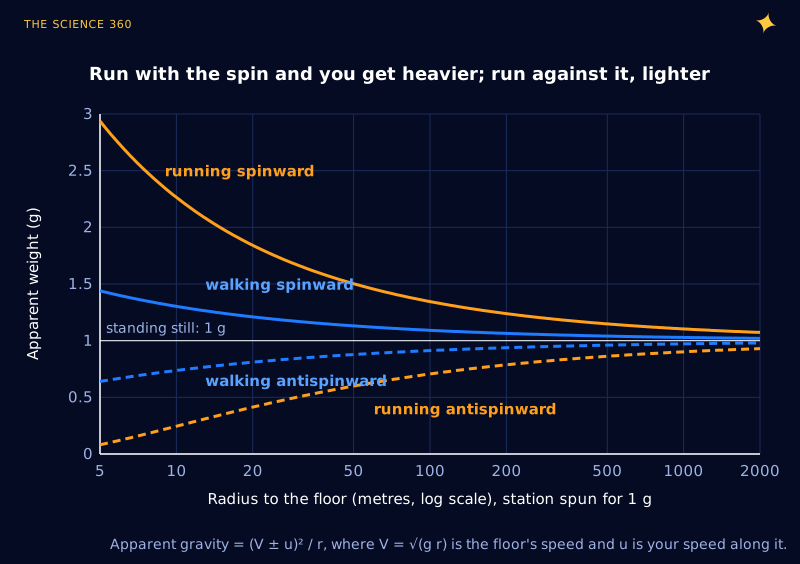
Here is the effect that most explainers leave out, and it is the one you would notice first. Your weight in a spinning station is set by your total speed around the axis, not just the floor's. If you run in the direction of spin (spinward), you are going around faster than the floor, so you need more centripetal force and the floor pushes harder: you get heavier. Run the other way and you get lighter. Run antispinward at the floor's own speed and you are not going around at all. You float.
Running at in a 10 m radius station spun for 1 g
Running spinward (with the spin) gives ; antispinward gives . Same runner, same floor: almost a factor of ten in weight depending on direction.
The cure is a high floor speed, which means a large radius. Hall points out that the ratio of the Coriolis acceleration to the centripetal "gravity" is 2u/V for motion along the floor. Hill and Schnitzer (1962) wanted at least 6 m/s of floor speed; Stone (1973) proposed 10.2 m/s so that something carried at 1.2 m/s would change weight by no more than 25%. At a 224 m radius, V is 47 m/s, and a jogger sees only about ±20% (Figure 3).
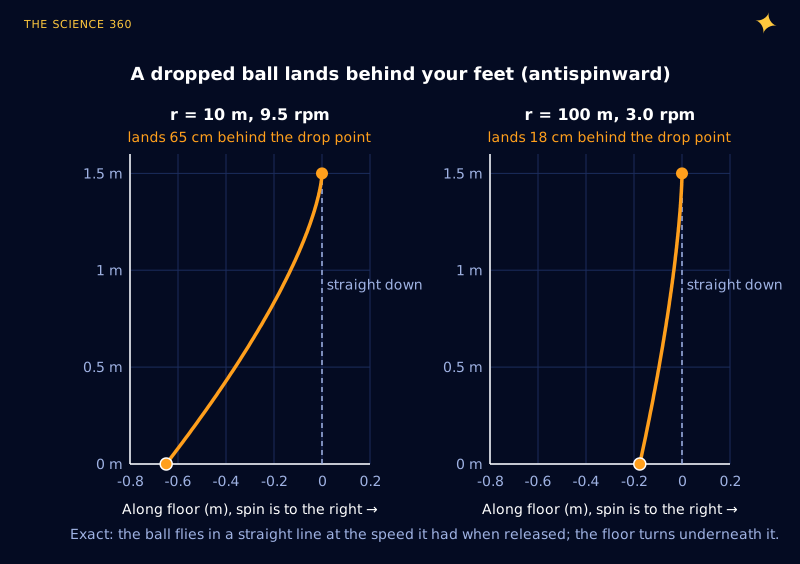
Moving radially is just as odd. Climb a ladder toward the hub and the Coriolis force pushes you sideways, toward the spinward direction, while your weight falls off linearly. Drop something and it does not land at your feet. It keeps the sideways speed it had at hand height, which is less than the floor's speed, so the floor carries your feet ahead of it.
Dropping a ball from 1.5 m, exact straight-line path
, : the ball is released at radius 8.5 m with speed 8.42 m/s and takes 0.626 s to reach the floor.
The ball lands 3.7° behind the drop point:
That is 65 cm antispinward.
Same drop at : 18 cm.
Earth does this too, by the way: a ball dropped from a tall tower lands slightly east of the base, because the top of the tower moves faster than the bottom. In a space station "down" points away from the axis, so the sign flips and the ball lands behind you.
How realistic are the movie spaceships?
2001: A Space Odyssey (1968). The set was 38 feet (11.6 m) in diameter, so the floor radius was 5.79 m. The ship's carousel is usually described as turning at about 5 rpm to give Moon-level gravity, and that checks out: , or 0.16 g. For Earth gravity it would need 12.4 rpm, well past what most people tolerate. With a 31% head-to-foot gradient and a floor speed of only 3 m/s, Frank Poole's shadow-boxing jog would have been a strange experience, heavier on one lap direction than the other. The real set turned at up to 3 mph (1.34 m/s), which on that radius is 2.2 rpm and 0.03 g.
Interstellar (2014). The Endurance is a ring of modules around a docking hub. Fan and student analyses use a 64 m diameter and a spin of about 5.5 rpm, which gives , about 1.08 g, and a 5.6% gradient. That is a believable design: comfortable for a trained crew after a few days, though below the size where untrained passengers would be happy. The docking scene, where the damaged ship tumbles at a dialogue-quoted 67 to 68 rpm, would put about , roughly 165 g, on anything at the rim. Nobody in those modules survives, which is consistent with the film; Cooper docks at the hub, where the centripetal acceleration is near zero but the rotation would still be violently disorienting. (For what high g does to a body, see how many g a human can survive, and for the planet the Endurance visits, Miller's planet.)
The Stanford torus (NASA, 1975). This is the serious engineering design behind a lot of fiction's ring habitats. NASA's 1975 summer study proposed a wheel about 1.8 km across, rotating once per minute for Earth-normal gravity. Check: . At 1 rpm, a 1.8 m gradient of 0.2% and a floor speed of 94 m/s, it is the only design on this list that would feel like Earth to everyone, and that size is exactly why. The designers chose to spin slowly and build big.
So how big would a comfortable 1 g station have to be?
Put the three limits together and they agree surprisingly well:
- Spin under 2 rpm for nearly everyone: r ≥ 224 m.
- Head-to-foot gradient under 1%: r ≥ 180 m.
- Walking changes weight by less than 15%: V ≥ about 19 m/s, so r ≥ 38 m; jogging at 5 m/s with less than 25% change needs r ≥ 180 m.
A wheel roughly half a kilometre across is the comfortable answer for full Earth gravity. Accept 4 rpm and some adaptation, and you can shrink it to about 110 m across. Accept Mars gravity, 0.38 g, at 2 rpm, and the radius drops to 85 m, which is one reason proposals for spin-gravity Mars ships (useful on a six-to-nine-month trip to Mars) usually aim for partial gravity. Smaller centrifuges a few metres across are better thought of as exercise machines: short, high-spin sessions to load bones and muscles, rather than places to live.
Is there a limit on the big end? Yes, and it is material strength. A freely spinning ring holding itself together needs a hoop stress of , which depends only on the rim speed. For a 1 g station, , so the bare ring fails at .
Largest 1 g steel ring that holds itself together (my own estimate)
Assume steel at a working stress and density .
Anything the ring carries (air, soil, people, shielding) lowers that limit further.
So between "about 200 m" and "a few kilometres" is the band where 1 g spin habitats make sense. That is also why the giant cylinders in The Expanse and Rendezvous with Rama need materials and tonnages far beyond anything launched so far, and why getting even a modest wheel to orbit is dominated by the rocket equation.
Why has nobody built one?
Because microgravity is cheaper to live with than a 450 m wheel is to launch. ISS crews counter bone and muscle loss with daily exercise, which works well enough for six-month stays (and the ISS is full of gravity anyway, about 88% of the surface value at 420 km; it just falls freely). For multi-year missions the trade may change. The physics of spin gravity has been settled since the 1960s. What is missing is data on how people fare after months in a small, fast-spinning wheel, and the only way to get it is to fly one.
FAQ
How fast does a space station need to spin for artificial gravity?
For 1 g at the floor, the spin rate in rpm is about 30 divided by the square root of the radius in metres. A 100 m radius station needs 3.0 rpm, a 10 m one needs 9.5 rpm, and a 224 m one needs 2 rpm, the rate most people tolerate without motion sickness.
What is the smallest radius for comfortable artificial gravity?
If you want 1 g and a spin of 2 rpm or less, the floor must be about 224 m from the axis. Accepting 4 rpm, which most people adapt to within days, brings it down to 56 m. Historical design guidelines put the absolute minimum somewhere around 12 to 22 m, at lower gravity and higher spin.
Why does spinning too fast cause motion sickness?
When you turn your head in a rotating room, your inner ear senses a rotation about a third axis that is not happening visually. This cross-coupling scales with the spin rate. In rotating-room experiments reported by Graybiel, almost everyone was fine at 1 rpm, most were mildly affected at 3 rpm, and only resistant subjects did well at 5.4 rpm.
Is the artificial gravity in 2001: A Space Odyssey realistic?
The idea is sound, but the Discovery centrifuge set was only 38 feet (11.6 m) across. At the roughly 5 rpm usually quoted, that gives about 0.16 g, close to lunar gravity, and the crew's heads would weigh 31 percent less than their feet. Full Earth gravity at that size would need 12.4 rpm.
Does artificial gravity feel the same as real gravity?
Only in a large station. In a small one, gravity falls off noticeably toward your head, dropped objects land behind where you aimed, and running with the spin makes you heavier while running against it makes you lighter. All of these effects shrink as the radius grows and the floor speed rises.
Related on The Science 360
Sources
- T. W. Hall, "Inhabiting Artificial Gravity", AIAA 99-4524, AIAA Space Technology Conference (1999), Table 1 comfort limits, Graybiel quote, Coriolis ratio, Hill and Schnitzer and Stone tangential-speed limits: spacearchitect.org
- J. R. Lackner and P. DiZio, "Artificial gravity as a countermeasure in long-duration space flight", Journal of Neuroscience Research 62, 169 (2000), NASA NTRS record: ntrs.nasa.gov/citations/20040112732
- Wikipedia, "Discovery (Space Odyssey spaceship)", 38 ft, 30-ton centrifuge set, $750,000, up to 3 mph, carousel just over 5 rpm with Moon-level gravity: en.wikipedia.org
- A. Blewitt et al., "Artificial gravity of Interstellar", Journal of Physics Special Topics, University of Leicester (2019), 64 m diameter and 5.5 rpm assumption: journals.le.ac.uk
- National Space Society, "Stanford Torus Space Settlement" (from NASA SP-413, 1977), one mile diameter, one rotation per minute, Earth-normal gravity: nss.org
- Wikipedia, "Stanford torus", 1,790 m diameter: en.wikipedia.org
Method note: all spin rates, gradients, apparent weights and the dropped-ball path are computed from a = ω²r with g = 9.807 m/s². The ball's path is the exact straight-line trajectory in the non-rotating frame, transformed to the rotating floor. The steel-ring limit is my own estimate with an assumed working stress.
Header image: NASA (image iss071e373018), regraded for this article.