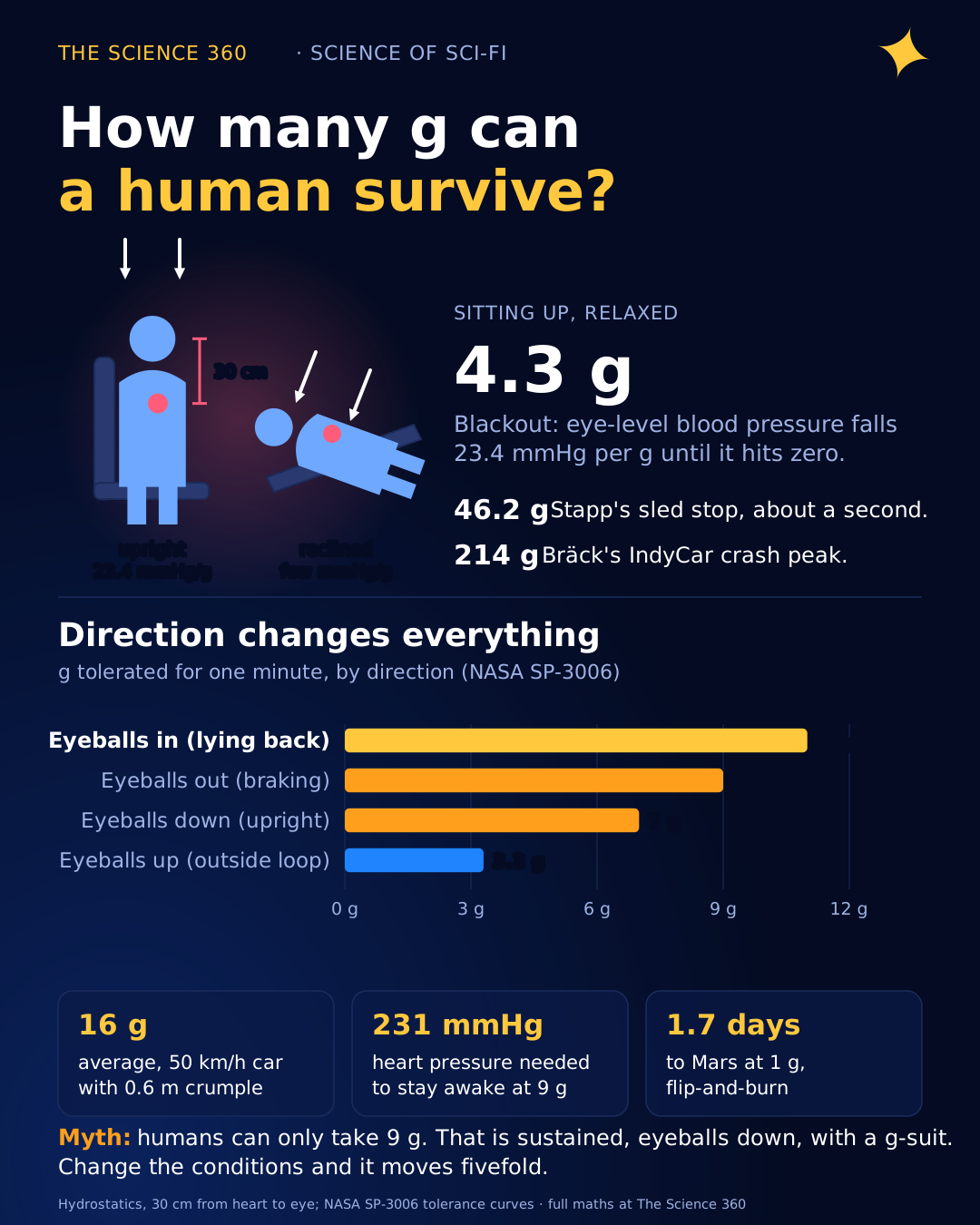
How Many G Can a Human Survive? Duration and Direction

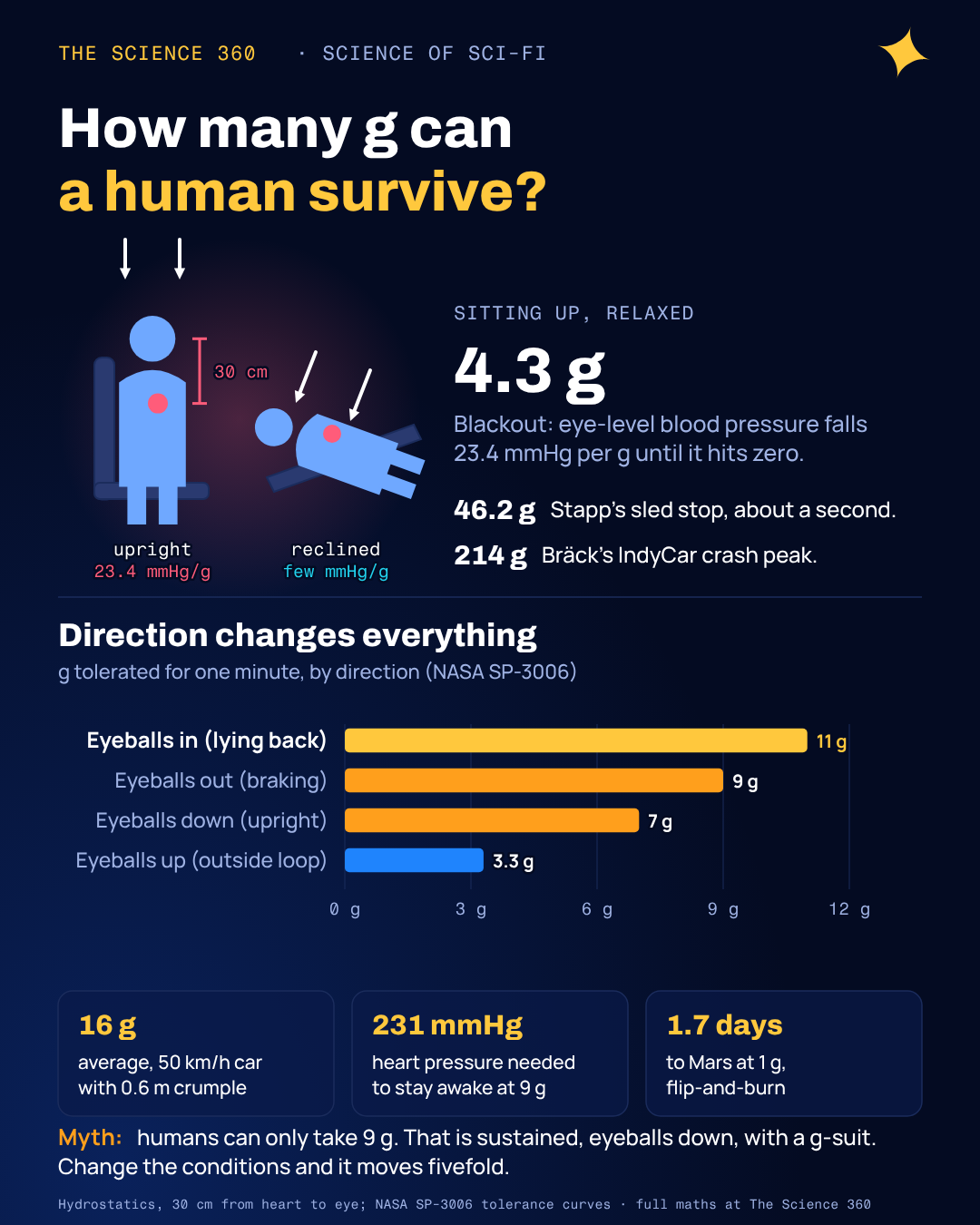
Pull 5 g in a centrifuge, sitting up, relaxed, and there is a good chance you will be unconscious within seconds. John Stapp rode a rocket sled to a stop from 632 mph in 1954 and took a peak of 46.2 g. He walked away. Kenny Bräck's IndyCar hit a fence in 2003 with a recorded peak of 214 g, and he survived too. Those three numbers are not contradictory. They are telling you that "how many g" is the wrong question until you add two more words: for how long, and in which direction.
What does “g” actually measure?
One g is the acceleration of 9.81 m/s². When an aircraft pulls 5 g, your seat has to push on you with five times your weight to bend your path, and everything inside you, blood included, behaves as if it weighs five times as much. The direction matters because your body is not symmetric. Aerospace medicine names the axes by which way your eyeballs would be pushed:
- +Gz, eyeballs down: a pilot pulling out of a dive, sitting upright. Blood is driven toward the feet.
- −Gz, eyeballs up: an outside loop. Blood is driven into the head.
- +Gx, eyeballs in: lying on your back on a launching rocket. The load presses you into the seat.
- −Gx, eyeballs out: a forward-facing car or sled braking hard. You are thrown into the harness.
Why do people pass out at only 4 to 5 g?
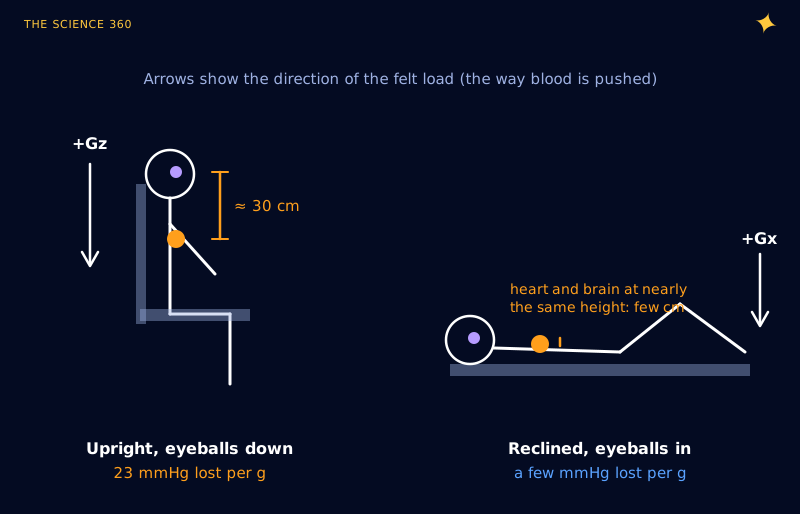
The brain sits roughly 30 cm above the heart when you sit up. The heart has to push blood up that column, and the column gets heavier with every g. This is pure hydrostatics, the same ρgh that sets water pressure at the bottom of a pool.
Pressure lost per between heart and eyes
Relaxed, mean arterial pressure about 100 mmHg at the heart
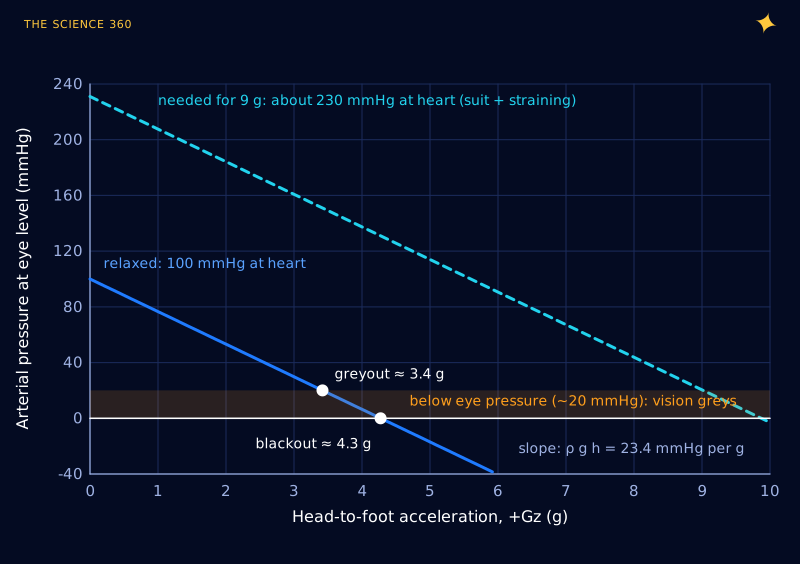
At 1 , eye level: . Retinal flow stops when eye-level pressure drops below intraocular pressure (about 10 to 21 mmHg; take 20):
That crude model lands right where the measurements are. Untrained people typically black out between 4 and 6 g, and vision goes first, as greyout and then tunnel vision, because the retina has to push against the eye's own internal pressure while the brain does not. Blackout comes next, then G-LOC, g-induced loss of consciousness. Once G-LOC happens, the average pilot is completely unconscious for about 12 seconds and confused for about 15 more. In a fast jet near the ground, that is enough to kill.
How do fighter pilots survive 9 g?
Turn the calculation around. To hold eye-level pressure at 20 mmHg at 9 g, the pressure at heart level has to be about 20 + 9 × 23.4 = 231 mmHg. Nobody's resting heart does that. Pilots borrow the extra 130 mmHg two ways.
The anti-g suit inflates bladders around the legs and abdomen, stopping blood from pooling below the heart and keeping venous return up. The anti-g straining manoeuvre is a hard, rhythmic clench of the legs and abdomen against a closed or partly closed throat, a bit like straining to lift something heavy, with a quick breath every few seconds. It raises pressure inside the chest, and that pressure adds directly to what the heart delivers. With both, modern pilots routinely sustain 9 g. Trained, fit people with suits and good technique have reached 12 to 14 g, with difficulty.
The Expanse got this part right, by the way. Co-author Daniel Abraham has described the show's "juice" as controlling blood pressure and the elasticity of blood vessels to keep people from stroking out under sustained high-g burns. That is the correct target. The limit on sustained g is mostly a plumbing problem.
Why is eyeballs-in g so much easier?
Lie back and the heart and brain end up at nearly the same height relative to the force. The column the heart pushes against shrinks from 30 cm to a few centimetres. With 5 cm, say, the loss is about 3.9 mmHg per g instead of 23.4. That is why crewed capsules, from Mercury and Soyuz to Crew Dragon, recline their crews for launch and entry, putting the load through the chest.
Something else fails instead. At high +Gx the limit becomes breathing: your chest wall and the organs on top of it get many times heavier, and the diaphragm has to lift them on every breath. Vision blurs as the eyeballs themselves deform. Old NASA design data, tabulated in Paul Webb's 1964 Bioastronautics Data Book (NASA SP-3006), give the trade-off in four directions:
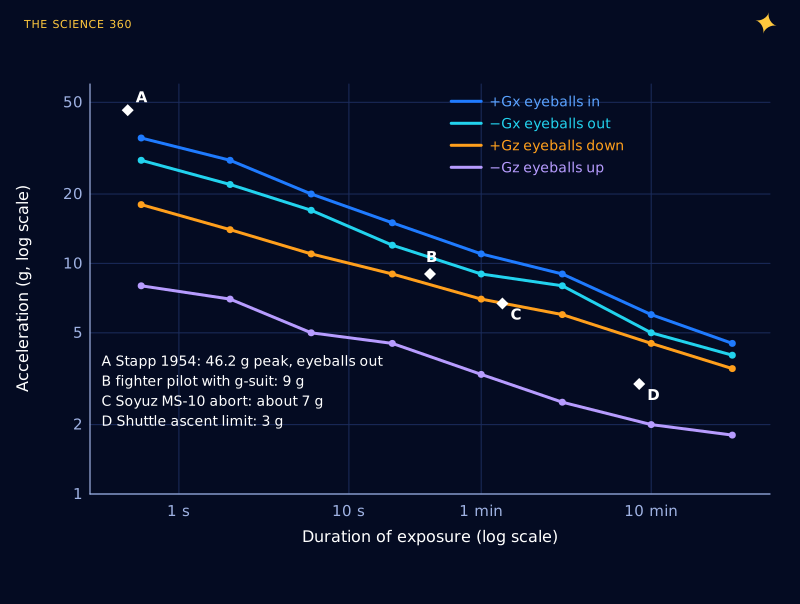
Read across at one minute: about 11 g eyeballs-in, 9 eyeballs-out, 7 eyeballs-down, and only 3.3 eyeballs-up. Negative g is miserable because the column now pushes blood into the head. People typically tolerate only −2 to −3 g before "redout," and the pressure can damage small vessels in the eyes and brain. Real spacecraft sit far inside these curves. The Space Shuttle limited ascent to 3 g, and NASA's occupant protection brief notes capsules are expected to peak around 3.8 g eyeballs-in on nominal ascent. When Soyuz MS-10's booster failed in October 2018, the crew's ballistic descent subjected them to about 6 to 7 g, inside the curve for its duration, and both men walked away.
How did Stapp survive 46 g?
By keeping it short. Stapp's record run on 10 December 1954 accelerated to 632 mph (1,017 km/h) in five seconds, then stopped in 1.4 seconds. Work out the average:
Stapp, 10 December 1954
Peak: 46.2 , eyeballs out, with more than 25 sustained for 1.1 s.
On a timescale of a second or less, the hydrostatic problem never develops: blood has mass and cannot drain out of your head instantly, and the brain carries a few seconds of oxygen. What limits you instead is mechanical. Can the harness spread the load? Do the organs tear their attachments as they surge forward? Does the neck hold the head? Stapp was well harnessed and still collected broken ribs, a broken wrist and burst blood vessels in his eyes across his many runs, with temporary vision loss after this one. His real legacy is the seat belt work that followed.
What g forces happen in a car crash?
The same arithmetic covers ordinary crashes. Average deceleration depends only on speed and stopping distance:
50 km/h (13.9 m/s) into a rigid wall, 0.6 m of crumple zone:
Same speed, stopping in 0.1 m (no crumple zone, unbelted into a dashboard): 98 .
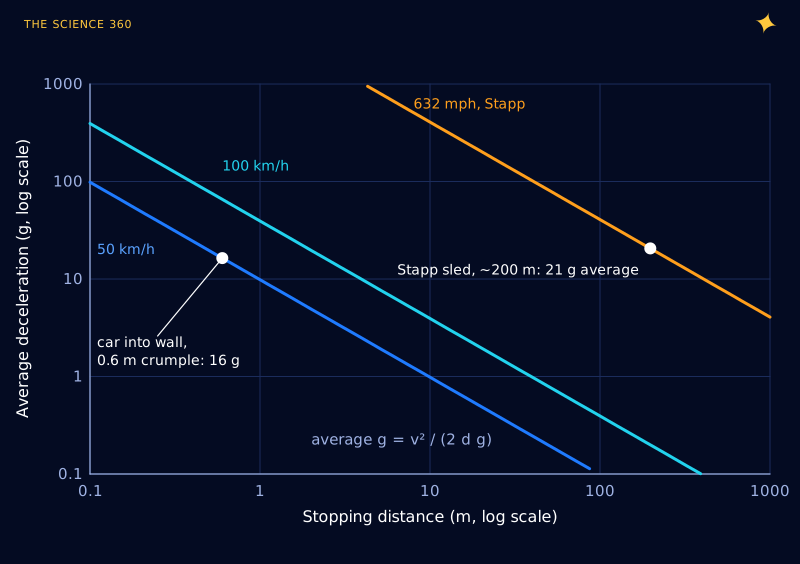
Bräck's 214 g is the extreme case: an IndyCar's survival cell and a custom-moulded seat spread a pulse lasting a tiny fraction of a second over his whole body. He survived with serious injuries and raced again. The lesson is not that humans can take 214 g. It is that for a few milliseconds, with perfect support, the body behaves more like a structure than a fluid system, and structures can take brief overloads.
The misconception: “humans can only survive about 9 g”
You will see "9 g" quoted as the human limit. It is a limit for a specific, demanding case: sustained, eyeballs-down, with a g-suit, for seconds to tens of seconds, while still flying a jet. Relax the conditions and the number moves by a factor of five in either direction. A relaxed, untrained passenger can be out cold at 4.5 g. A reclined, well-supported person takes 15 g for about 18 seconds in the old NASA data. A properly restrained person can survive tens of g for a fraction of a second. There is no single number, and anyone who gives you one without a duration and a direction is giving you half an answer.
Could you survive The Expanse’s high-g burns?
The show's ships fly flip-and-burn trajectories: accelerate for half the trip, turn around, decelerate for the other half. That makes the physics simple. With constant acceleration over distance , the trip time is . Take Mars at its 2003 closest approach, about 55.8 million km.
0.3 : 3.2 days
1 :
3 : 1.0 day. 10 : 13 hours.
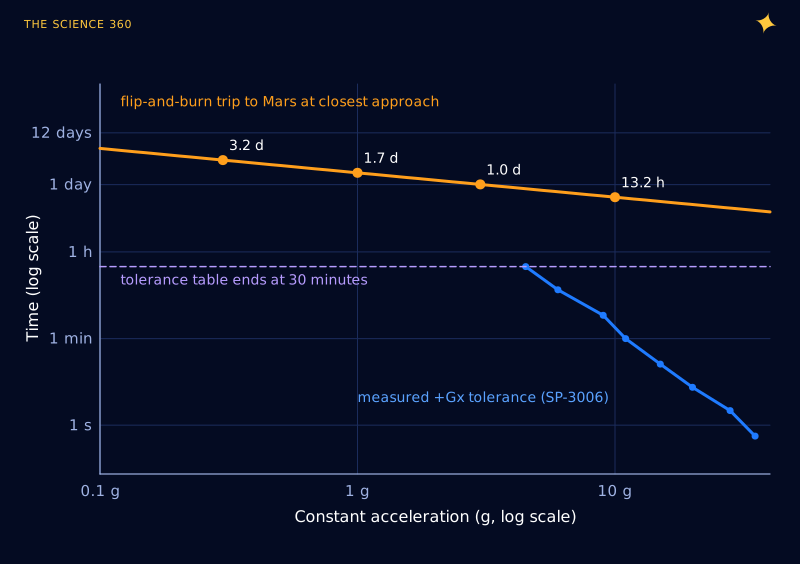
Here the honest answer is: nobody knows. The tolerance table stops at 30 minutes, where it gives 4.5 g eyeballs-in. Every high-g trip to Mars takes hours to days. There is no human data for 3 g held for a day, let alone 10 g for 13 hours. Extrapolating the curve suggests something like 2 to 3 g might be bearable lying down for many hours, which would make 1 to 1.5 day trips to Mars at closest approach physiologically conceivable. The Expanse's multi-g burns with drugs and form-fitting couches are a reasonable guess at what it would take, not a demonstration that it works. The show is right that the limiting factor would be blood pressure and vessel strength, which is exactly what the juice is for.
FAQ
How many g can a normal person take before passing out?
Sitting upright with the force pushing blood toward the feet, most relaxed, untrained people grey out around 3 to 4 g and lose consciousness somewhere between 4 and 6 g, depending on how fast the load builds. The limit is blood pressure at head level, which falls by roughly 23 mmHg for every extra g.
What is the highest g force a human has survived?
Racing driver Kenny Bräck's 2003 IndyCar crash recorded a peak of 214 g and he survived, though with serious injuries. The highest deliberately endured was John Stapp's 46.2 g rocket sled stop in 1954. Both peaks lasted a small fraction of a second.
How many g do fighter pilots pull?
Modern fighter pilots routinely sustain about 9 g. They need an anti-g suit that squeezes the legs and abdomen plus a trained straining manoeuvre that raises chest pressure. Together these must keep arterial pressure at the heart around 230 mmHg so that some blood still reaches the brain.
Why is eyeballs-in g easier to tolerate than eyeballs-down?
Lying back puts the heart and brain at nearly the same height relative to the force, so the blood column the heart must push against is a few centimetres rather than 30 cm. That is why spacecraft seats recline for launch and entry. Old NASA tolerance data give roughly 11 g for a minute eyeballs-in versus 7 g eyeballs-down.
Could people survive the high-g burns in The Expanse?
Brief spikes of 10 g or more while lying in a couch, yes. Hours at several g, no one knows: published tolerance data stop at about 30 minutes, with roughly 4.5 g tolerated eyeballs-in for that long. The show's drug, the juice, targets the right problem, since g tolerance is largely a blood pressure limit.
Related on The Science 360
Sources
- Webb, P. (ed.), Bioastronautics Data Book, NASA SP-3006 (1964), "G tolerance in 4 vectors", as transcribed by Jordin Kare: yarchive.net/space/science/g_tolerance.html
- NASA Office of the Chief Health and Medical Officer, Technical Brief OCHMO-TB-024 Occupant Protection (Shuttle 3 g limit; capsule ascent about 3.8 Gx): nasa.gov (PDF)
- NASA/TM-20205008196, Artemis Sustained Translational Acceleration Limits: Human Tolerance Evidence from Apollo to ISS: nasa.gov (PDF)
- John Stapp (10 December 1954 run, 632 mph, stop in 1.4 s, 46.2 g, injuries): en.wikipedia.org/wiki/John_Stapp
- G-force, human tolerance section (about 5 g relaxed, 9 g with suit and straining, −2 to −3 g negative, Stapp more than 25 g for 1.1 s, Bräck 214 g): en.wikipedia.org/wiki/G-force
- G-LOC (blackout at 4 to 6 g untrained, 12 to 14 g with suit and straining, intraocular pressure 10 to 21 mmHg, 12 s absolute and 15 s relative incapacitation): en.wikipedia.org/wiki/G-LOC
- Soyuz MS-10 (ballistic descent at about six to seven g): en.wikipedia.org/wiki/Soyuz_MS-10
- SYFY, "The Science of The Expanse, Episode 5" (Daniel Abraham on the juice and sustained high-g burns): syfy.com
Method note: the hydrostatic model uses a 30 cm heart-to-eye distance, blood density 1,060 kg/m³ and 100 mmHg mean pressure at the heart, all round textbook values; real people vary. Mars trip times assume constant acceleration with a midpoint flip and ignore fuel.
Header image: NASA (image GRC-1956-C-41773), regraded for this article.