What is the terminal velocity of a human, a cat and a raindrop?
A skydiver falling belly down tops out at about 55 m/s (198 km/h, 123 mph) near the ground, and about 75 m/s head down. A cat with its legs spread reaches about 26.8 m/s (60 mph), a big raindrop 9 m/s and a tumbling penny 11.2 m/s. Terminal velocity is the speed at which air drag pushes up as hard as gravity pulls down, so the object stops speeding up.
The formula is vₜ = √(2mg ÷ ρCd·A): mass m, gravity g, air density ρ, drag coefficient Cd and frontal area A. The simulation goes one step further than a calculator. It integrates the whole fall with air that thins with height, so you can see how long the speed takes to level off (a skydiver reaches 95 percent in about 12 s), what happens when a canopy opens, and why Felix Baumgartner went supersonic at 28 km but not lower down. For the penny myth, see can a penny from the Empire State Building kill you.
Key results from the simulation
- Belly down vs head down: the same 85 kg skydiver falls at 55 m/s belly down and 75 m/s head down, because the head-down body shows the air less than half the area.
- 95 percent in about 1.8 vₜ/g seconds: in still air of fixed density, 10.3 s and 359 m for a belly-down skydiver, 2.1 s and 15 m for a penny, 1.7 s for a raindrop.
- Thin air, faster fall: at 4,000 m the air is 1.50 times thinner than at sea level, so the skydiver's terminal velocity there is 67 m/s, not 55.
- Stratos, 2012: from 38,969 m the model peaks at 1,358 km/h (Mach 1.26) after 51 s, close to the 1,357.6 km/h FAI record.
- A parachute multiplies drag about 106 times: that drops the speed from 55 m/s to 5.8 m/s, the US Army T-11 figure of 19 ft/s.
Six falls worth watching
Each section gives the numbers the simulation shows for that drop and has a button that loads it. Speeds are for still air. Masses, areas and drag coefficients are in the table further down, with sources.
A skydiver belly down from 4,000 m
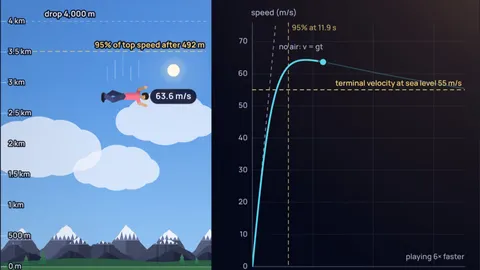
85 kg, Cd·A 0.45 m²Out of the plane at 4,000 m the skydiver starts at zero vertical speed and gains about 9.8 m/s every second at first. Drag grows with the square of speed, so the curve bends early. The model reaches 95 percent of the local terminal speed after 11.9 s and 492 m of falling, a little later than the textbook 10.3 s because the air up there is thinner and the target is higher.
The speed peaks around 64 m/s high up and then eases down toward 55 m/s as the air gets denser. That slow deceleration is real and skydivers feel it as the wind noise building on the way down. Without air the same drop would end at 280 m/s.
Related reading: How many g can a human survive?
A full jump: free fall, then the canopy at 1,500 m
Belly down, canopy opens at 1,500 mOpening a canopy at 1,500 m, a common student altitude, ends free fall after 44 s in the model. The canopy multiplies the drag area about 106 times, so the terminal speed collapses from about 59 m/s to 5.8 m/s and the jumper lands at 5.3 m/s, the same speed as jumping off a wall 1.5 m high. That is why students are taught to land with feet together and roll.
The simulation inflates the canopy over 3 seconds, which keeps the opening force to a few g. A canopy that slammed open instantly at 55 m/s would cost about 106 g, which is why real canopies use a slider to slow the opening.
Felix Baumgartner from 38,969 m: why he broke the sound barrier
118 kg in a pressure suitAt 39 km the air density is 4.5 g/m³, about 273 times thinner than at sea level. Terminal velocity scales with one over the square root of density, so up there it is about 915 m/s: there is almost nothing to stop the fall. The model speeds up for 51 s, to 1,358 km/h at 27.5 km, Mach 1.26.
Then the air thickens faster than the speed can follow, and drag slows him down even though he is still falling. By the time he reaches normal skydiving heights he is back near 65 m/s. The FAI ratified 1,357.6 km/h. Our single drag coefficient is fitted to that number, so the agreement on the peak is by construction; the timing (about 50 s) and height of the peak are what the model predicts on its own.
A cat falling ten floors
4 kg, legs spreadA cat spreads its legs like a flying squirrel, which gives a lot of area for not much mass. Its terminal velocity is about 26.8 m/s (60 mph), half a human's. From 30 m, about ten floors, the model lands at 20.0 m/s after 2.6 s, 75 percent of terminal speed.
To get to 95 percent a cat needs about 85 m of fall in the model. That fits the vets' observation that injuries stop rising above about seven floors: past that height the cat is near its terminal speed, so extra height adds little. It is still a dangerous fall, and the famous New York data never counted cats that died on the spot.
A raindrop from a 1,500 m cloud
5 mm drop, flattened underneathA big 5 mm raindrop weighs 65 mg and reaches 9.0 m/s in under 2 s, after about 11 m. The rest of its 161 s trip from a 1,500 m cloud base is at constant speed. With no air it would hit at 172 m/s, about the speed of a rifle bullet, and rain would be lethal.
Big drops are not teardrops. The air pushes the underside flat, like a burger bun, which is how the simulation draws it. Drops much bigger than about 5 mm break up, which is why rain never falls much faster than about 9 m/s.
Related reading: Why is a rainbow 42 degrees?
A penny from the top of the Empire State Building
2.5 g, tumblingA tumbling US penny settles at 11.2 m/s, the speed Louis Bloomfield measured in a wind tunnel. It gets there after 2.1 s and only 15 m, so from 381 m almost the whole fall is at that speed. It lands with 0.16 J, about a flick on the forehead.
Compare a golf-ball hailstone: 40 g and compact, it falls at 28.6 m/s and lands with about 16 J, a hundred times more. Mass per unit of drag area is what matters. The penny myth post runs the full numbers.
Related reading: Can a penny from the Empire State Building kill you?
Terminal velocity of everyday falling objects
| Object | Mass | Cd | Area | vₜ (m/s) | km/h | mph | 95% after |
|---|---|---|---|---|---|---|---|
| Skydiver, belly down | 85 kg | 0.64 | 0.7 m² | 55 | 198 | 123 | 10.3 s |
| Skydiver, head down | 85 kg | 0.81 | 0.3 m² | 75 | 270 | 168 | 14.0 s |
| Pressure suit (Stratos) | 118 kg | 0.87 | 0.7 m² | 56 | 201 | 125 | 10.4 s |
| Open parachute | 100 kg | 0.79 | 60 m² | 5.8 | 21 | 13 | 1.1 s |
| Cat, legs spread | 4 kg | 1.49 | 0.06 m² | 27 | 96 | 60 | 5.0 s |
| Hailstone, golf ball | 40.1 g | 0.52 | 15.2 cm² | 29 | 103 | 64 | 5.3 s |
| US penny, tumbling | 2.5 g | 1.12 | 2.9 cm² | 11.2 | 40 | 25 | 2.1 s |
| Raindrop, 5 mm | 65 mg | 0.66 | 0.2 cm² | 9.0 | 32 | 20 | 1.7 s |
| Ping-pong ball | 2.7 g | 0.47 | 12.6 cm² | 8.6 | 31 | 19 | 1.6 s |
Sea-level air (1.225 kg/m³). "95% after" is the time to reach 95 percent of terminal velocity from rest in still air of constant density, 1.83 vₜ/g. Drag coefficients for the people, the cat, the penny, the hailstone, the raindrop and the parachute are fitted so the sea-level speed matches a published figure (sources in the "how it works" section). The ping-pong ball uses the textbook sphere value of 0.47.
How the simulation works
Two forces act on the object: its weight mg pulling down and air drag ½ρv²Cd·A pushing up. Newton's second law gives the acceleration a = g − ρv²Cd·A ÷ 2m. The simulation steps this forward with a fourth-order Runge-Kutta method, tens to hundreds of steps per second of fall, from rest at the drop height to the ground.
Air density comes from the US Standard Atmosphere 1976, the model NASA and NOAA publish: 1.225 kg/m³ at sea level, 0.736 at 5 km, 0.413 at 10 km and 0.0180 at 30 km. Gravity weakens slightly with height (inverse square from Earth's centre), which matters only for the 39 km jump.
Masses and areas are set from real objects: a 2.5 g US penny 19.05 mm across, a regulation 40 mm 2.7 g ping-pong ball, a 4.4 cm hailstone of 900 kg/m³ ice, a 5 mm water drop, an 85 kg skydiver with rig and an 118 kg Baumgartner in his suit (the figure Colino and Barbero used). The drag coefficient is then chosen so the sea-level terminal speed matches a published figure: about 200 km/h belly down (FAI), 240 to 290 km/h head down (FAI, we use 270), 60 mph for a cat, 25 mph for a tumbling penny (Bloomfield), 64 mph for golf-ball hail (NOAA's updraft table), 9 m/s for a 5 mm raindrop and 19 ft/s for a T-11 parachute.
The "time to 95%" readout is measured from the run itself: the first moment the speed reaches 95 percent of the terminal speed for the air at that height. For constant density the exact answer is t = (vₜ ÷ g) × artanh(0.95) = 1.83 vₜ ÷ g, and the distance fallen by then is 1.16 vₜ² ÷ g. Long falls play back faster than real time, and the chart says by how much.
What the model leaves out
- Body position changes: real skydivers move their arms and legs, track, turn and flare. The model keeps one drag area for the whole fall, except during a canopy opening.
- Transonic drag: above about Mach 0.8 the drag coefficient of a body rises. Our pressure-suit preset uses one fitted coefficient, so it matches the record peak speed by design, not by modelling shock waves.
- Wind and updrafts: the air is still. In a thunderstorm the updraft that grows hail can be faster than the hail falls, and gusts swing a falling penny about.
- Tumbling and flutter: the penny and the cat are given one average drag. A penny that fell edge-first would go about three times faster, see the penny post.
- Drop shape and break-up: raindrops flatten and oscillate; the model treats a 5 mm drop as one rigid body with a fitted drag coefficient.
- Humidity and weather: the standard atmosphere is a yearly mid-latitude average. Hot days and high pressure systems shift the density by a few percent, and the speed by about half that.
Common misconceptions
“Heavier things fall faster.” In a vacuum everything falls together, as Apollo 15 showed with a hammer and a feather. In air, what matters is mass divided by drag area. A 4 kg cat falls slower than an 85 kg skydiver because it has about half as much mass per square metre of drag, not because gravity pulls it less.
“Terminal velocity is a fixed number for each object.” It depends on air density. The same skydiver has a terminal velocity of about 67 m/s at 4,000 m and 55 m/s at sea level, and Baumgartner's was over 900 m/s at 39 km.
“Raindrops are tear-shaped.” Small ones are spheres, big ones are flattened underneath like a burger bun. The tear shape is a cartoon.
Frequently asked questions
What is the terminal velocity of a human?
About 55 m/s (198 km/h, 123 mph) falling belly down in sea-level air, and about 75 m/s (270 km/h) head down. At typical jump altitudes the air is thinner and both are 10 to 20 percent higher. Speed skydivers in tight suits reach over 500 km/h.
How long does it take to reach terminal velocity?
Strictly, forever: the speed approaches it like a tanh curve. In practice, 95 percent takes 1.83 vₜ ÷ g seconds in still air, about 10 s and 359 m for a skydiver, 5.0 s for a cat and under 2 s for a raindrop or a ping-pong ball.
What is the terminal velocity of a cat?
About 26.8 m/s, or 60 mph, with its legs spread. That is roughly half a human's, because a cat has a lot of drag area for its mass. In the model it gets close to that speed after about 85 m of fall.
How fast do raindrops fall?
A large 5 mm drop falls at about 9 m/s (32 km/h). Smaller drops are slower: drizzle falls at about 2 m/s and cloud droplets at about 1 cm/s, which is why clouds float.
Can you survive hitting the ground at terminal velocity?
Usually not, but people have: a handful of airmen and skydivers survived falls without a working parachute by landing in snow, trees or on slopes, which stretch the stopping distance. At 55 m/s you carry the energy of a fall from about 154 m in vacuum. The g-force post explains why stopping distance decides survival.
Does air density change terminal velocity?
Yes. Terminal velocity goes as one over the square root of density. Air at 4,000 m is 1.50 times thinner than at sea level, so a skydiver falls about 22 percent faster up there. At 39 km the air is so thin that Felix Baumgartner broke the sound barrier.
Keep learning
How Fast Does a Skydiver Fall? Belly, Head Down, Canopy
Belly down a skydiver tops out near 55 m/s (200 km/h), head down near 75 m/s, under canopy about 5 m/s. Here is the drag math and a jump timeline.

Can a Penny From the Empire State Building Kill You?
A tumbling penny tops out at 11 m/s and lands with 0.15 J, about 100 times too little to crack a skull. Here is the drag math, and what would be dangerous.

How Many G Can a Human Survive? Duration and Direction
5 g knocks out a relaxed person; 46 g didn't kill John Stapp; 214 g didn't kill Kenny Bräck. The difference is duration and direction. Here is the physics.

Gravity is still strong at the space station. Why do astronauts float?
The station, crew and loose objects fall together. Weightlessness is about the missing support force, not gravity switching off above the atmosphere.