Can a Penny From the Empire State Building Kill You?

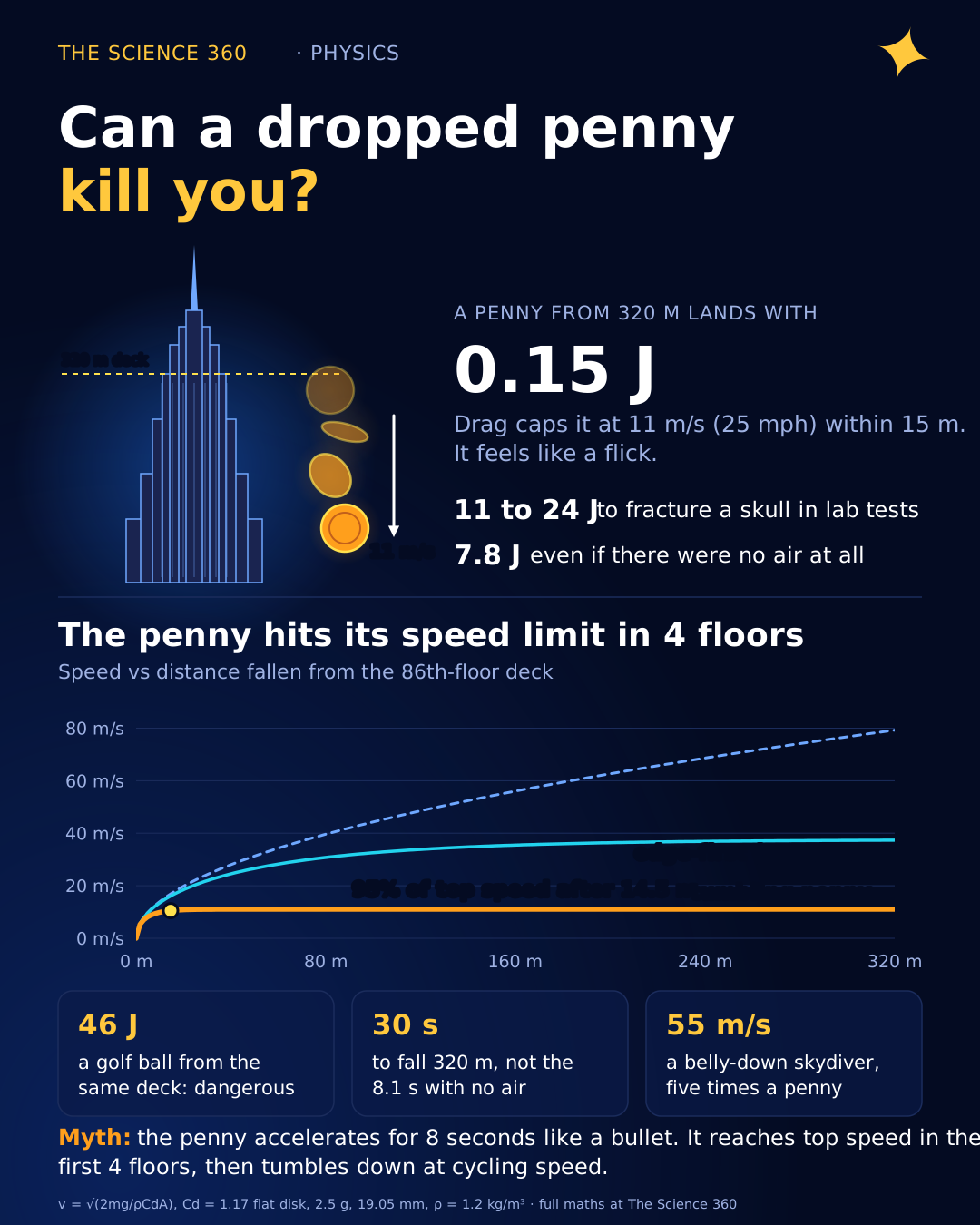
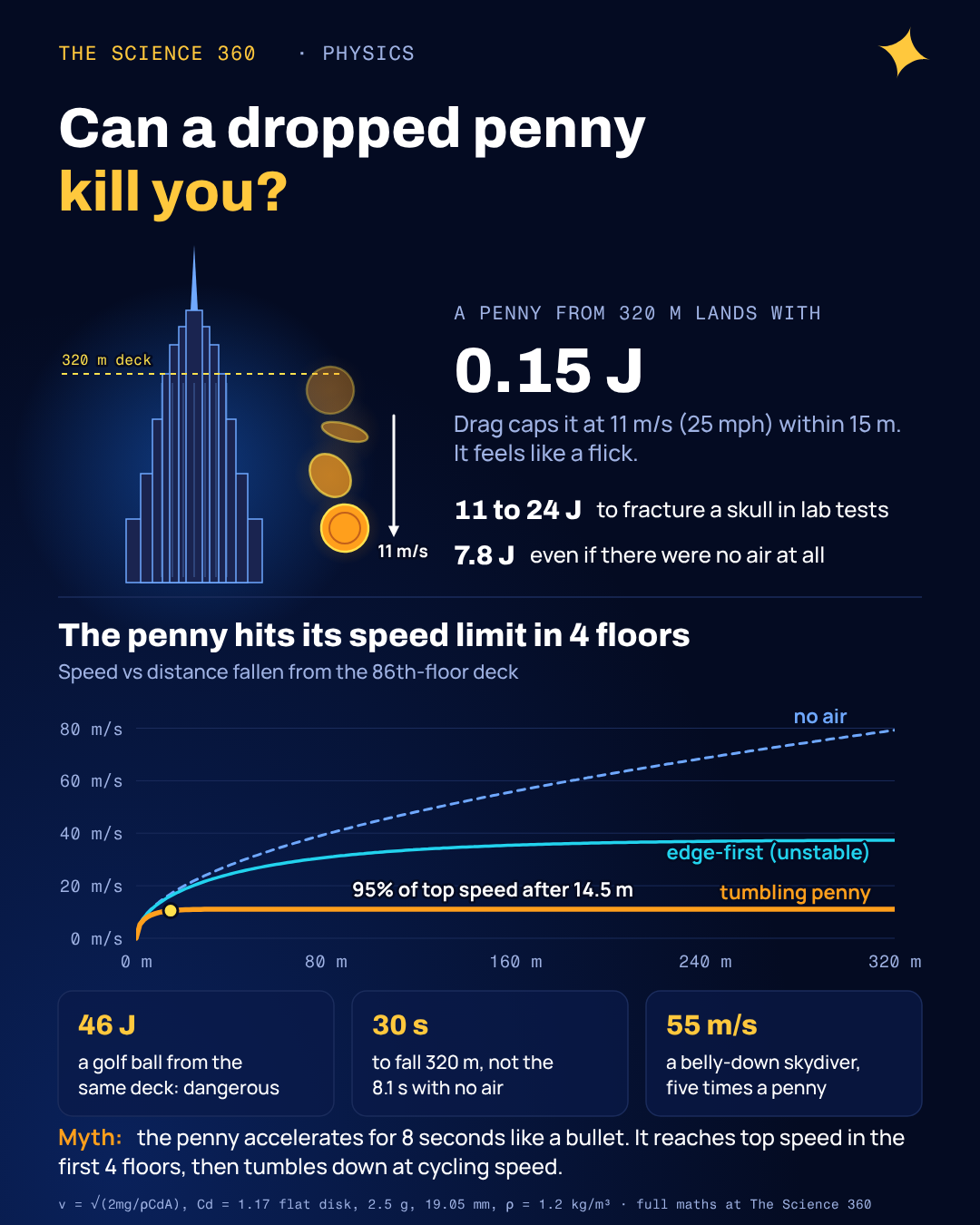
The United States Mint struck its last circulating penny in Philadelphia on 12 November 2025. Billions are still around, and one of the oldest pieces of urban folklore goes with them: drop one from the top of the Empire State Building and it will punch through a pedestrian's skull. Run the numbers and the penny lands with about 0.15 joules. Cracking a skull takes something like 100 times that.
Most pages that debunk the myth quote a speed (25 mph, or 64 mph, or "terminal velocity") and stop. The interesting part is why the penny is so slow, why the quoted speeds disagree by a factor of three, and which things you could drop from 320 m that really would be dangerous. All of that falls out of one equation.
How fast would a penny fall with no air?
This is the number the myth is built on, so start there. The Empire State Building's roof is 381 m (1,250 ft) up, its tip 443 m, and the open-air 86th-floor deck, the place a tourist could actually drop a coin, is at 320 m (1,050 ft). In a vacuum, speed after falling height is :
No air, 320 m deck
Kinetic energy, 2.5 g penny
From the 443 m tip: 93 m/s (208 mph), 10.9 J.
Here is the first thing nobody mentions. Even in a vacuum, the penny is not a bullet. A low-powered .22 round has a similar mass but leaves the barrel at 800 to 1,100 ft/s with about 75 foot-pounds (around 100 J), as Cecil Adams pointed out in The Straight Dope decades ago. The airless penny has a tenth of that. It would hurt and might cut, but the "drills through your head" picture is wrong even before air enters the story.
What is the terminal velocity of a penny?
With air, the penny stops accelerating when drag equals weight. Drag on a bluff object goes as:
Set and solve:
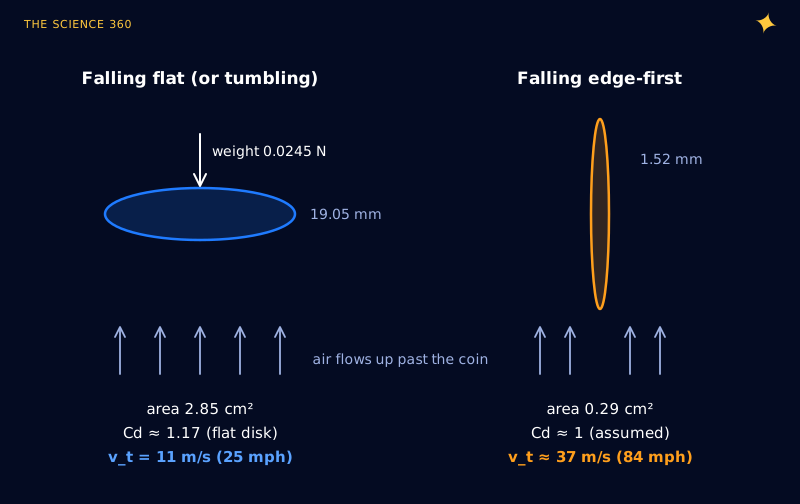
A post-1982 US cent is 2.5 g, 19.05 mm across and 1.52 mm thick. Air at sea level is about 1.2 kg/m³. The one awkward number is , the drag coefficient, which depends on which way the coin faces. A thin disk broadside to the flow has , the standard handbook value.
Penny falling flat
Penny falling edge-first ( assumed)
The flat-disk answer matches what Louis Bloomfield, a physicist at the University of Virginia, measured. Using wind tunnels and pennies released from helium balloons, he found they reach terminal velocity within about 50 feet and then flutter down at about 25 mph. He let test pennies hit him; one bounced off his face. His verdict was that it felt like a flick on the forehead, "but not even very hard."
Why do sources disagree: 25 mph or 64 mph?
Search around and you will see 25 mph, 50 mph, 64 mph and "up to 100 mph." The spread is the edge-on versus flat question. MythBusters' 2003 penny episode is widely reported to have found about 64 mph in a wind tunnel and then fired pennies at around 65 mph into a gelatin and skull model without serious damage. I could not find a primary source for the 64 mph figure, so treat it as approximate. It sits between our two limits, which is what you would expect if the coin in the tunnel was held or spun closer to edge-on.
A freely falling penny does not stay edge-on. A disk falling edge-first is aerodynamically unstable: any small tilt produces a torque that swings the face into the flow. Field, Klaus, Moore and Nori mapped this in a 1997 Nature paper on falling disks, finding steady, fluttering, tumbling and chaotic regimes depending on the Reynolds number and a dimensionless moment of inertia I*. For a penny I calculate I* ≈ 19 and Re ≈ 14,000, which puts it firmly among the tumblers. A tumbling coin presents its face to the air for much of each turn, so its average drag sits close to the broadside value. That is why 11 m/s is the number that matches experiment.
How quickly does a penny reach terminal velocity?
With quadratic drag the equations of motion have a closed-form solution. Speed as a function of distance fallen y is:
Distance to reach 95% of :
Time to fall 320 m at that rate: about 30 s (versus 8.1 s with no air).
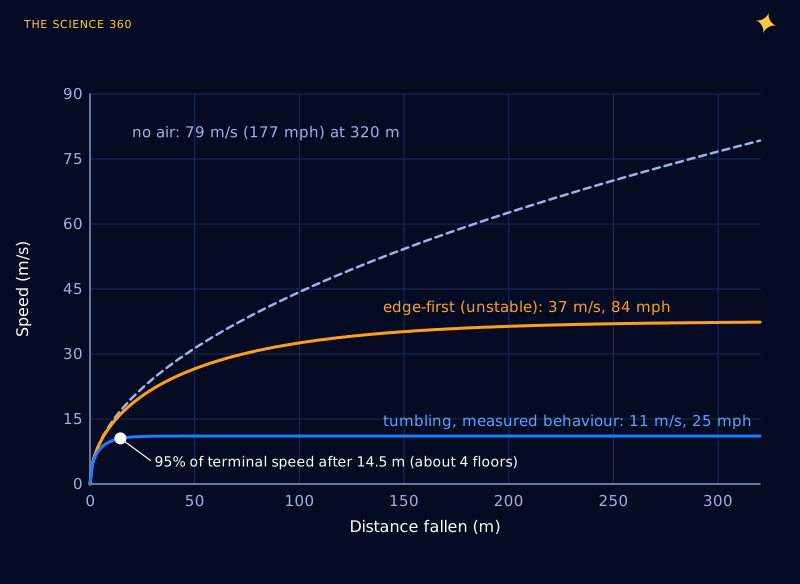
Bloomfield's "about 50 feet" and our 14.5 m are the same number. After that, the remaining 300 m of the building makes no difference at all. A penny dropped from a 5-storey walk-up and one dropped from the Empire State Building land at the same speed.
How hard would the penny actually hit?
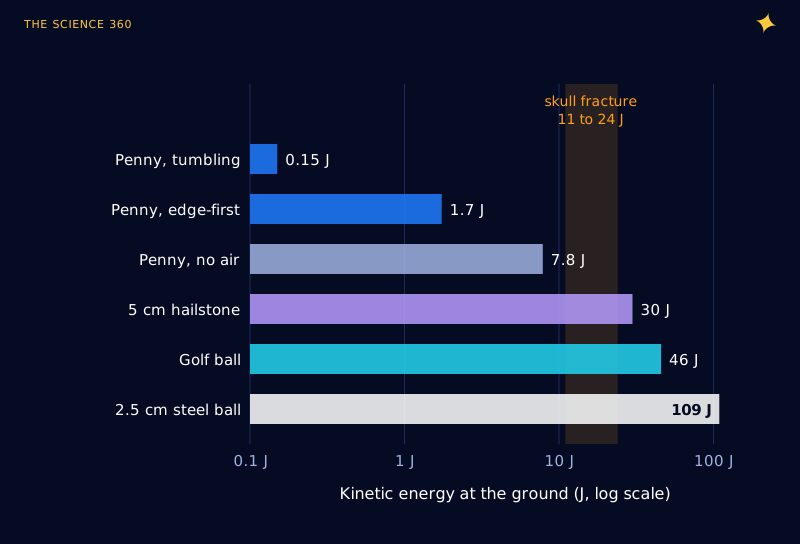
For comparison, lab work on skull fracture puts the energy needed somewhere in the range of about 11 to 24 J for blunt impacts. Siegenthaler and colleagues measured 11.0 to 13.6 J on a gelatin-filled head model, and pendulum tests on cadaver heads suggested 22 to 24 J for frontal impacts. Those are fracture thresholds, not lethality thresholds, and a coin edge concentrates force more than a blunt impactor does, so the comparison is rough. But the margin is a factor of 70 to 160. Rough is good enough.
What could you drop that would be dangerous?
The terminal velocity formula says what matters is mass per unit of drag area, . A penny is light for its face area. Make the object denser and more compact and both the terminal speed and the energy climb fast, because energy goes as and is itself proportional to .
Golf ball (45.9 g, 42.7 mm, Cd ≈ 0.25)
After 320 m it reaches 44.7 m/s:
2.5 cm steel ball bearing (64 g, ): , reaches 58 m/s, 109 J.
Both of those are well past skull fracture energies. Bloomfield made the same point about ballpoint pens: depending on the design, a pen either flutters or falls like a dart, and point-first it "might well come down at 200 mph." The penny myth survives because it gets the conclusion right for the wrong object.
Nature runs this experiment for us with hail. A 5 cm ice sphere comes out at about 32 m/s in our model, right at the top of the 44 to 72 mph range the US National Severe Storms Laboratory gives for 2 to 4 inch hailstones (NSSL notes that real, lumpy stones fall somewhat slower than spheres). Hail that size dents cars and does injure people. Pennies do not fall from the sky in storms, but if they did, they would be a nuisance, not a hazard.
Why does a human fall five times faster than a penny?
Same equation, different ratio. A skydiver belly-down reaches about 55 m/s. Run the formula backwards and that implies , against 7.5 kg/m² for a tumbling penny. Tuck in the arms and legs and the speed rises to around 90 m/s. Figure 4 puts everything on one line.
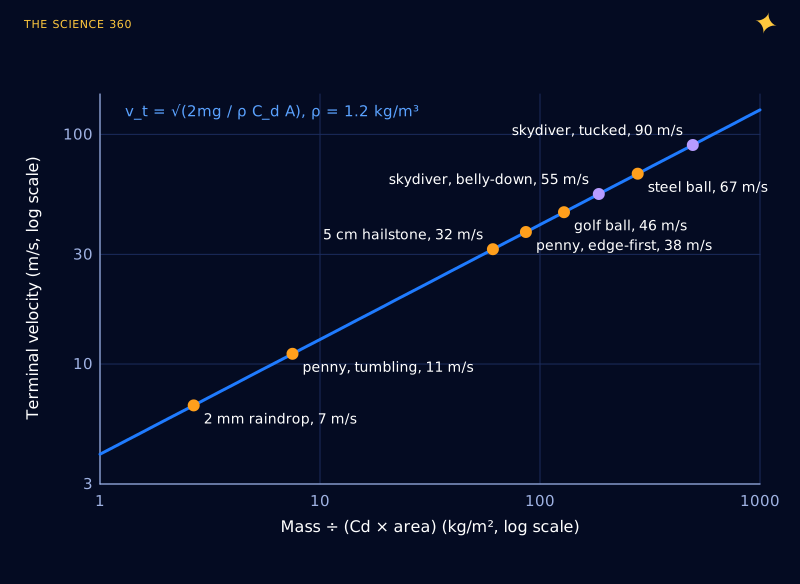
This is also the square-cube law at work. Scale any object up and its mass grows as length cubed while its drag area grows as length squared, so bigger objects of the same shape fall faster. J. B. S. Haldane made the point memorably in 1926: drop a mouse down a mine shaft and it walks away, while a horse splashes.
Could updrafts blow the penny back up?
Sometimes, yes. A tall building facing the wind forces air to deflect up and around its faces. When the building was new, docking airships at its mast was abandoned partly because of powerful updrafts the building itself created. A tumbling penny falls through still air at 11 m/s, so any updraft faster than about 11 m/s (25 mph) carries it upward, and the wind up there is no gentle breeze: the 1931 airship attempt met winds of about 45 mph (20 m/s) and unpredictable eddies. A penny caught in that can be lifted, stalled or carried sideways for a long way before it lands at the same harmless speed. Wind adds sideways speed, but it does not change the conclusion: a penny moving with the wind has almost no speed relative to the air or to you.
FAQ
What is the terminal velocity of a penny?
A US penny tumbling through air settles at about 11 m/s, or 25 mph, the figure physicist Louis Bloomfield measured with wind tunnels and balloons. If it could somehow stay edge-first the whole way, the drag equation gives about 37 m/s (84 mph), but a falling disk does not stay edge-first.
How fast would a penny be going if there were no air?
Dropped 320 m from the Empire State Building's 86th-floor deck with no air, a penny would reach about 79 m/s (177 mph). From the 443 m tip it would reach 93 m/s (208 mph). Even then it would carry only 8 to 11 joules, close to the low end of measured skull fracture energies.
What would happen if a penny hit you from the Empire State Building?
It would sting a little. At 11 m/s a 2.5 g penny carries 0.15 joules, about the energy of a flick to the forehead. Bloomfield was hit by test pennies and reported that it did not hurt.
What is the terminal velocity of a human?
A skydiver falling belly-down reaches about 55 m/s (200 km/h, 120 mph). Pulling the arms and legs in raises it to around 90 m/s. Humans have far more mass per square metre of drag area than a penny, which is why they fall about five times faster.
Is it illegal to throw things off the Empire State Building?
Do not try it. The 86th-floor terrace has been fenced since 1947, and dropping objects onto a crowded street can bring criminal charges for endangering people below. A penny is harmless, but heavier, more compact objects such as a golf ball or a steel bolt can land with enough energy to fracture a skull.
Related on The Science 360
Sources
- Scientific American / Live Science, "Could a penny dropped off a skyscraper actually kill you?" (Bloomfield: terminal velocity reached in about 50 ft, flutters at about 25 mph; pens up to 200 mph): scientificamerican.com
- Penny (United States coin), specifications (2.5 g, 19.05 mm, 1.52 mm) and end of circulating production in November 2025: en.wikipedia.org/wiki/Penny_(United_States_coin)
- Empire State Building (roof 381 m, tip 443 m, 86th-floor deck 320 m, updrafts and airship docking): en.wikipedia.org/wiki/Empire_State_Building
- The Straight Dope, "Would a penny dropped from the Empire State Building kill someone on the ground?" (.22 bullet comparison): straightdope.com
- Field, S. B., Klaus, M., Moore, M. G. and Nori, F. (1997), "Chaotic dynamics of falling disks", Nature 388: 252 to 254: doi.org/10.1038/40817
- Siegenthaler, L. et al. (2020), "Threshold of the skull injury for blunt force impacts under free and constraint boundary conditions", International Journal of Legal Medicine: link.springer.com
- Skull fracture energy in unembalmed post-mortem heads (22 to 24 J frontal): lirias.kuleuven.be
- NOAA National Severe Storms Laboratory, Severe Weather 101: Hail (fall speeds by size): nssl.noaa.gov
- Terminal velocity (skydiver 55 m/s belly-down, about 90 m/s tucked): en.wikipedia.org/wiki/Terminal_velocity
- Gunn, R. and Kinzer, G. D. (1949), "The terminal velocity of fall for water droplets in stagnant air", Journal of Meteorology 6: 243: doi.org
- Haldane, J. B. S. (1926), "On Being the Right Size": marxists.org/archive/haldane
- Secondary reports of the MythBusters penny drop (about 64 to 65 mph): todayifoundout.com
Method note: all speeds and energies are computed from the quadratic drag equation with air density 1.2 kg/m³ and the drag coefficients stated in Figure 3. The edge-first case is a hypothetical bound, not a stable way for a coin to fall.
Header image: NASA/Bill Ingalls (image NHQ202102160054), regraded for this article.