How Fast Does a Skydiver Fall? Belly, Head Down, Canopy
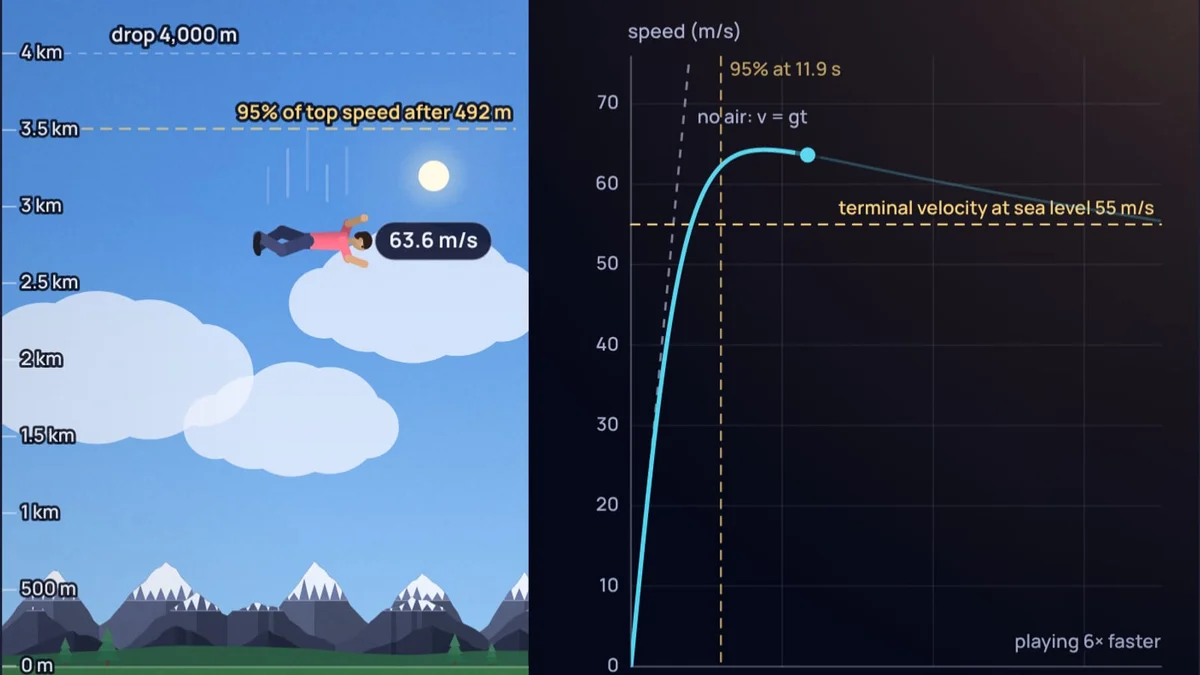
Step out of a plane at 4,000 metres and for the first second you hardly feel the wind. By the third second you are doing 28 m/s and the air is a solid push on your chest. Somewhere around the twelfth second the push equals your weight, and the speed stops climbing. For a typical belly-down skydiver that ceiling is about 55 m/s near the ground, 200 km/h, the number every first-jump briefing quotes.
Change the shape and the ceiling moves. Tuck into a head-down dive and it rises past 75 m/s. Open a canopy and it collapses to 5 m/s. You can drop all three in our terminal velocity simulator, which integrates the whole fall with air that thins with height. This post walks through what it shows, with the numbers.
What sets a skydiver’s top speed?
Two forces. Gravity pulls down with the jumper's weight, . Air pushes back with a drag force that grows with the square of speed:
Here is the air density, the drag coefficient and the frontal area. Only the product , the drag area, really matters for a body as lumpy as a person. Terminal velocity is the speed where drag equals weight:
Our model skydiver weighs 85 kg with rig and has a belly-down drag area of 0.45 m². That value was chosen to reproduce the textbook figure: the FAI and the US Parachute Association both describe stable belly-to-earth fall as about 200 km/h, and the Physics Factbook collects four textbook sources that land between 53 and 56 m/s.
That is 198 km/h or 123 mph.
The square root is why weight matters less than people expect. A 100 kg jumper with the same shape falls at 59.7 m/s, a 60 kg jumper at 46.2 m/s. A group of friends who want to fall together fixes that difference with kit: the heavy jumper wears a baggy suit with more area, the light one a tight suit and often a weight belt.
Belly down vs head down vs under canopy
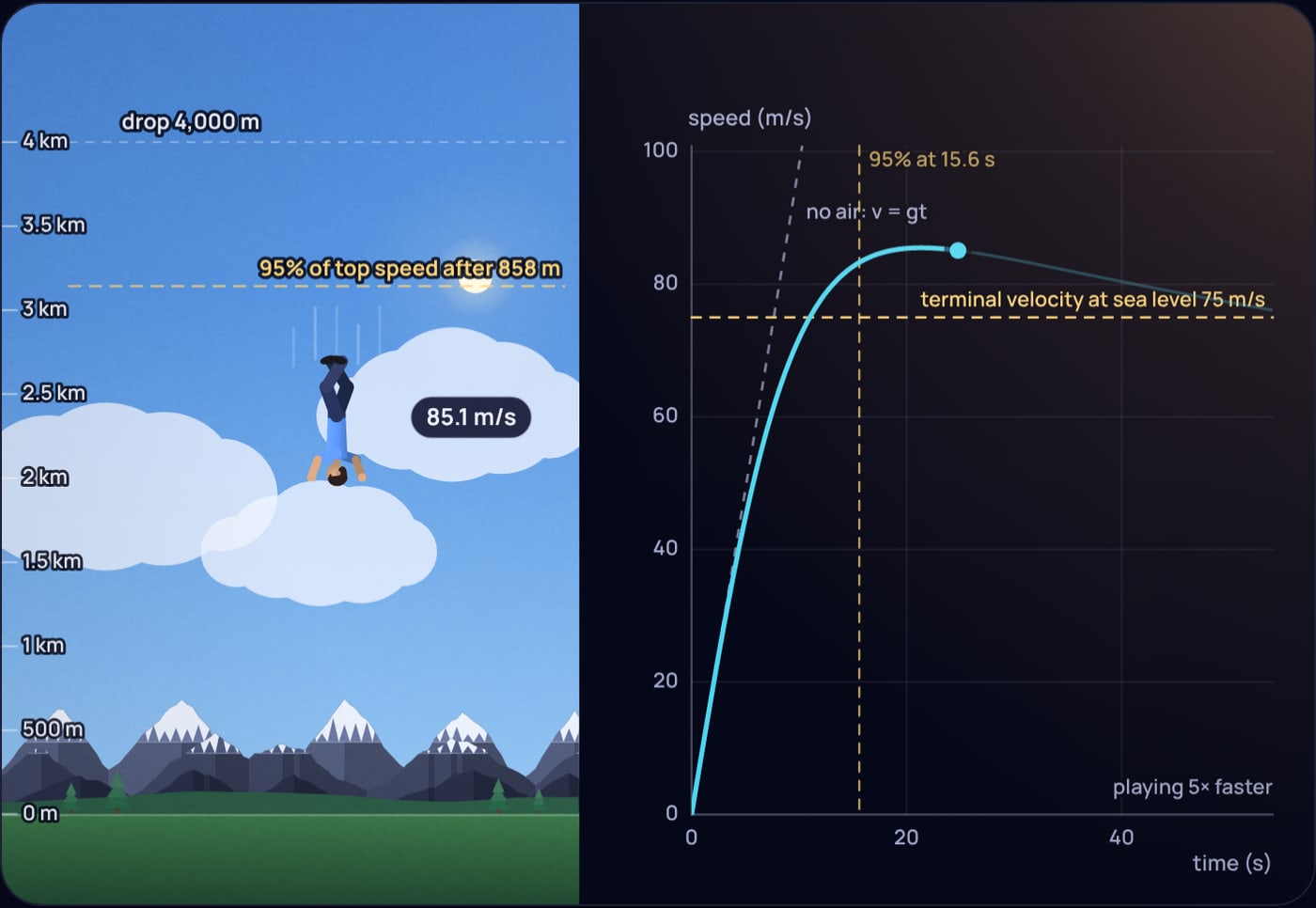
Head-down flying, the freefly discipline, turns the body into a vertical column. The air now sees shoulders and a helmet instead of a whole torso, and the drag area falls to roughly half. The FAI gives 240 to 290 km/h for stable head-down flight; our model uses 270 km/h, which needs a drag area of 0.24 m². The parachute goes the other way: a round military T-11 canopy is designed to bring a soldier down at 19 ft/s, 5.8 m/s, and to do that it needs a drag area of about 48 m².
| Position | Drag area CdA | vt at sea level | vt at 4,000 m | 95% of vt after |
|---|---|---|---|---|
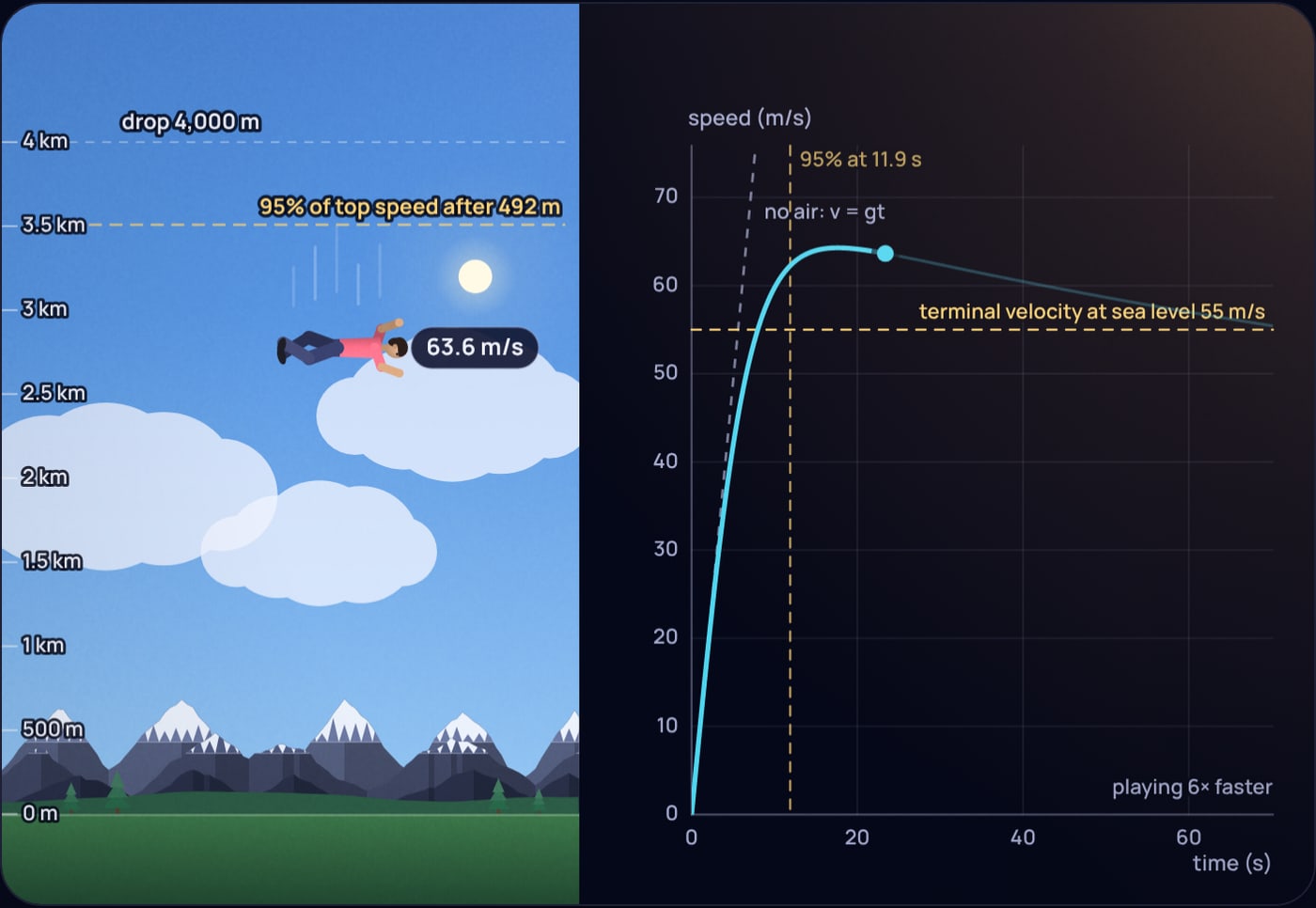
| Belly down (box position) | 0.45 m² | 55 m/s (198 km/h) | 67 m/s | 11.9 s, 492 m |
| Head down (freefly) | 0.24 m² | 75 m/s (270 km/h) | 92 m/s | 15.6 s, 858 m |
| Open round canopy | 47.6 m² | 5.4 m/s (19 km/h) | 6.5 m/s | about 1 s |
All for an 85 kg jumper. The "95% after" column comes from the simulation's own run from 4,000 m, which is why it is a little longer than the textbook formula gives: the air up there is thinner, so the target speed is higher.
How long does it take to reach terminal velocity?
Strictly, forever: the speed approaches the limit without touching it. With constant air density the exact solution is a hyperbolic tangent, , and setting gives a clean rule of thumb.
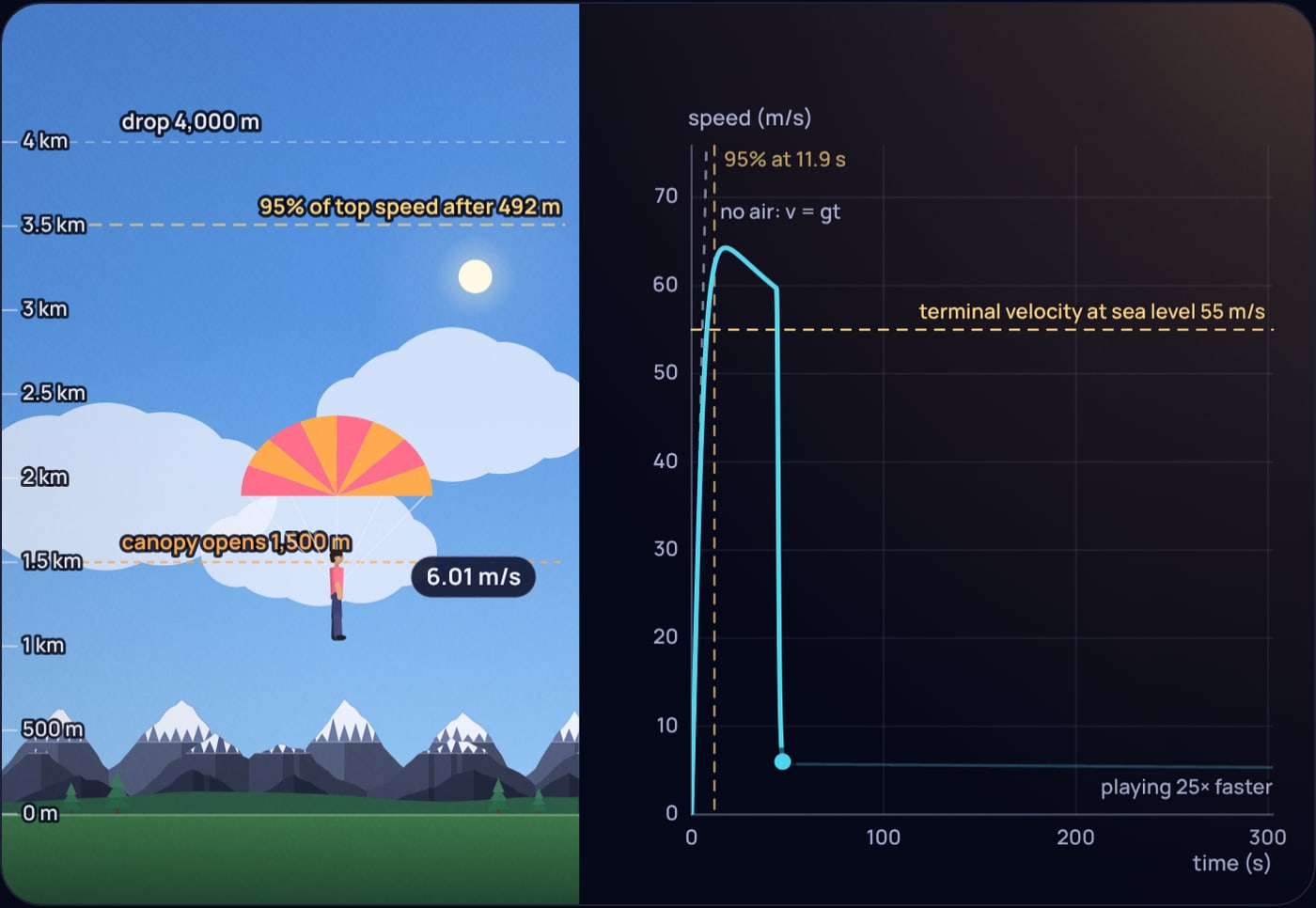
That is the sea-level answer. Out of a plane at 4,000 m the simulation needs 11.9 s and 492 m, because the limit up there is 64 to 67 m/s rather than 55. Here is how the belly-down speed builds second by second in the model:
| Time after exit | 1 s | 2 s | 3 s | 5 s | 8 s | 10 s | 15 s |
|---|---|---|---|---|---|---|---|
| Belly down (m/s) | 9.7 | 19.1 | 27.6 | 41.8 | 55.0 | 59.7 | 64.0 |
| Head down (m/s) | 9.8 | 19.3 | 28.4 | 44.8 | 63.4 | 71.8 | 82.7 |
For the first two seconds the two positions are almost identical, because drag is still small and both jumpers are close to free fall. The head-down jumper only pulls ahead once drag starts to bite. After 10 seconds the belly-down jumper has fallen 376 m.
Why do skydivers fall faster at altitude?
Density sits under the square root. Air at 4,000 m is 0.819 kg/m³, about two thirds of the sea-level value, so terminal velocity there is higher by the square root of the ratio.
So the speed graph in Figure 1 does something people do not expect. It rises to a peak of 64 m/s high up, then slowly falls as the jumper sinks into denser air, even though nothing about the body has changed. By 1,500 m the limit is 59 m/s. It is a gentle effect for an ordinary jump. For a jump from the stratosphere it is the whole story.
How did Felix Baumgartner break the sound barrier?
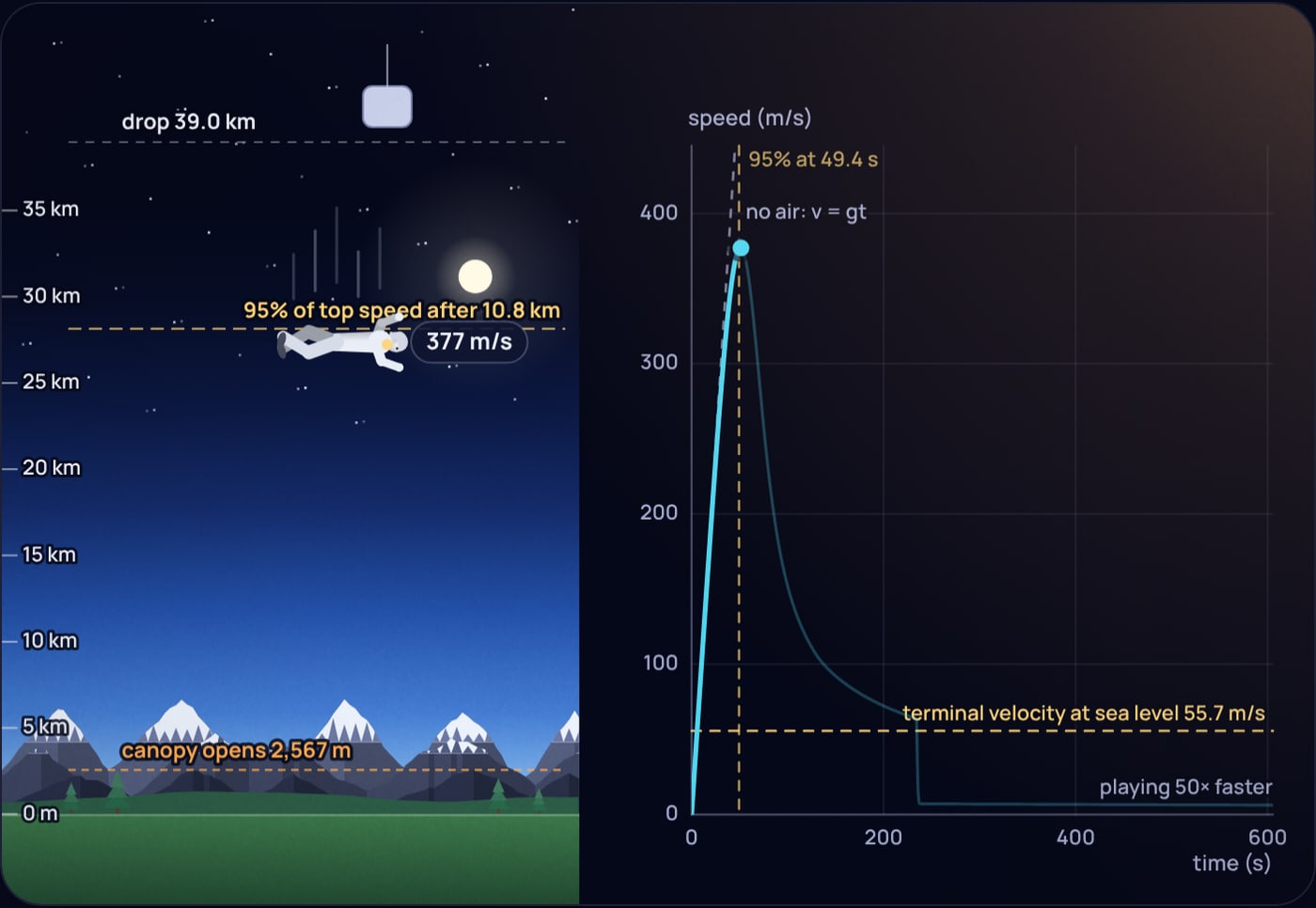
On 14 October 2012 Baumgartner stepped off a capsule at 38,969 m. The FAI ratified a maximum vertical speed of 1,357.6 km/h, Mach 1.25, and a free-fall distance of 36,402.6 m before he opened his canopy. At 39 km the air density in the standard atmosphere is 4.5 grams per cubic metre, 270 times thinner than at sea level. Terminal velocity scales with one over the square root of density, so up there it was over 900 m/s: in practice there was nothing to stop him speeding up.
The simulation uses the 118 kg mass (Baumgartner plus suit and gear) from Colino and Barbero's analysis in Physics Today. With one drag area of 0.61 m², fitted to the record, it peaks at 1,358 km/h after 51 s at 27.5 km, where the local speed of sound is 300 m/s. Their own estimate for the transonic, head-low part of the fall was a drag coefficient of 2.0 to 2.4 on 0.25 m², which is 0.50 to 0.60 m², so the fitted number is in the right place. After the peak the air thickens faster than he can follow, and drag slows him even while he falls.
What happens when the parachute opens?
The drag area jumps from 0.45 m² to about 48 m², a factor of 106. Terminal velocity scales as one over the square root of drag area, so it falls by a factor of about 10, from 59 m/s at 1,500 m to under 6 m/s.
Near the ground it is 5.35 m/s, the speed of a jump off a wall 1.46 m high.
How fast the canopy opens decides how hard it hits. If all 48 m² appeared instantly at 59.7 m/s, the drag would be , about 108 times body weight. Real canopies are packed to open over a few seconds, and sport canopies carry a fabric slider that holds the lines together while the canopy fills. The simulation spreads the opening over 3 s, and the peak load comes out near 5 g, in line with the firm but comfortable openings jumpers describe. The free fall from 4,000 m to 1,500 m lasts 44 s belly down and 35 s head down in the model, and the canopy ride to the ground takes about 4 minutes more.
How fast do other things fall compared with a skydiver?
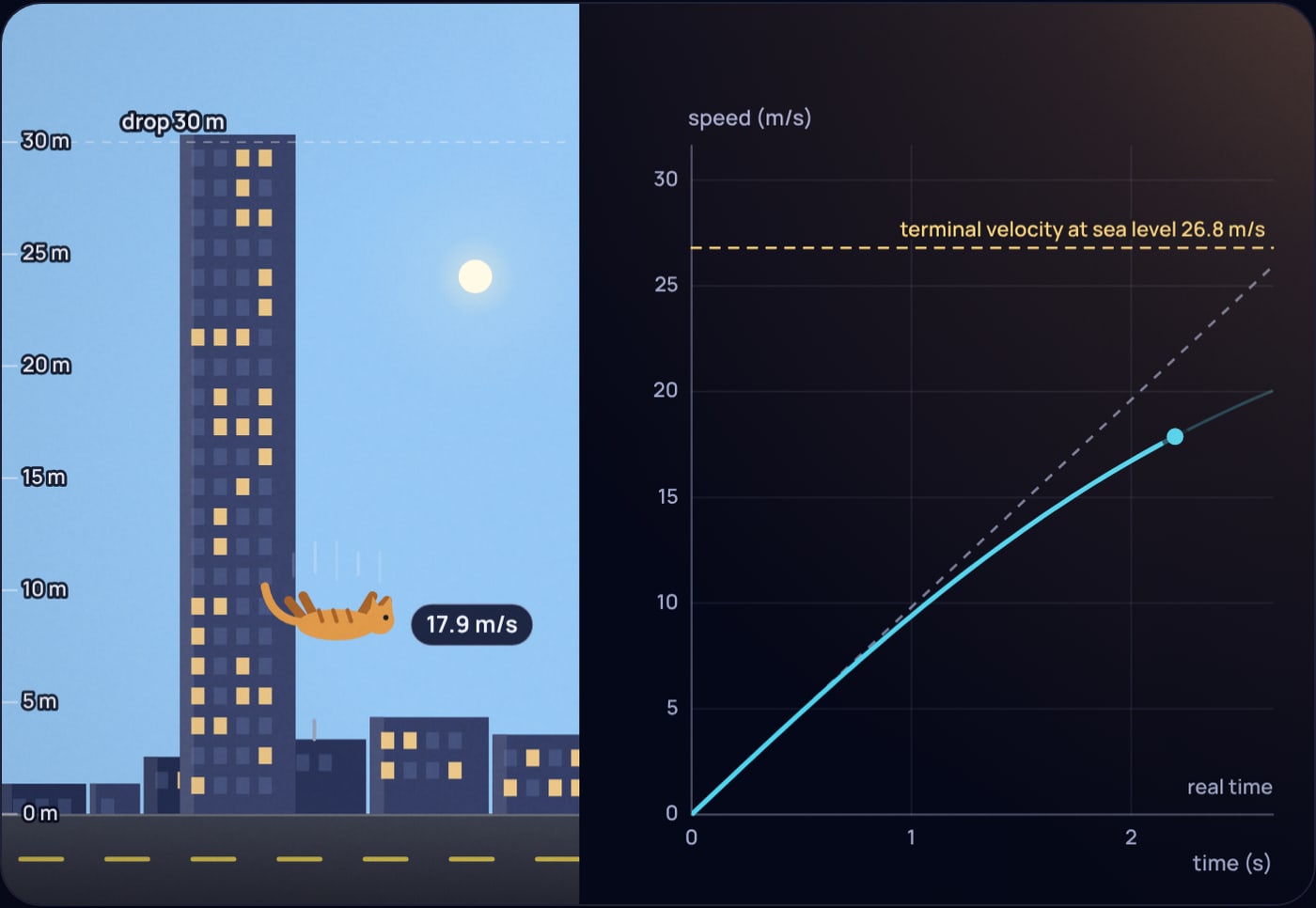
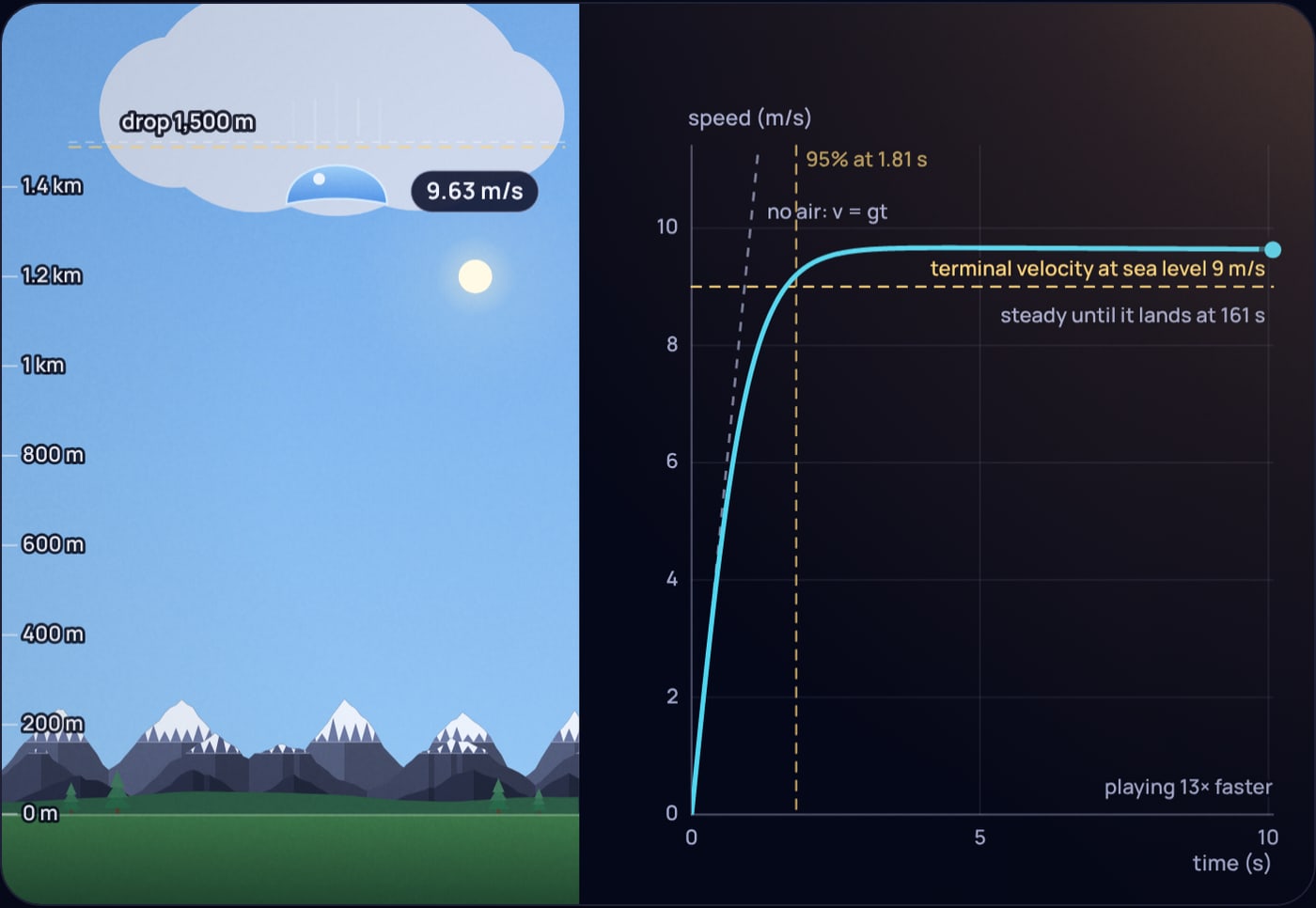
Mass per unit of drag area sets the order. An 85 kg skydiver carries about 190 kg per square metre of drag area belly down. A cat spread like a flying squirrel carries about 45, and falls at roughly 27 m/s (60 mph). A tumbling penny carries about 8 and settles at 11 m/s, which is why it is harmless, as our Empire State penny post works out. A 5 mm raindrop carries about 5 and falls at 9 m/s.
How hard is the landing, and why does stopping distance matter?
Speed alone does not hurt. Stopping does. At 5.4 m/s a jumper who lands stiff-legged stops in perhaps 10 cm and feels around 15 g for a moment; one who rolls stretches that to a metre and feels under 2 g. The g-force post has the full argument about why distance, not speed, decides survival. The same physics explains why astronauts float: in free fall with no air there is no drag to push back, so nothing tells your body which way is down.
What the model leaves out
Real skydivers move. They track forward, flare, turn and change their drag area every few seconds. The model holds one shape per fall. It also uses one fitted drag area for the Stratos jump, so its agreement with the 1,357.6 km/h record is by construction; the time of the peak and the slowdown afterwards are what it predicts on its own. The air is still and follows the US Standard Atmosphere, so a hot day or a strong updraft would shift the numbers by a few percent.
Try it yourself: load the full jump preset, then drag the parachute slider down to 800 m and watch how much longer the free fall gets, or switch to head down and see the extra 9 seconds of time you lose.
Sources
- Physics Factbook: Speed of a skydiver (terminal velocity)
- Wikipedia: Speed skydiving (belly 200 km/h, head down 240 to 290 km/h, citing the FAI and USPA)
- Wikipedia: T-11 parachute (19 ft/s average rate of descent)
- Phys.org: Supersonic skydiver’s records confirmed (FAI ratified figures)
- Colino and Barbero, Dynamics of a skydiver’s epic free fall, Physics Today
- Wikipedia: Cat righting reflex (60 mph terminal velocity)
- U.S. Standard Atmosphere, 1976 (NASA Technical Reports Server)
Frequently asked questions
How fast does a skydiver fall?
Belly down, about 55 m/s (200 km/h, 120 mph) in sea-level air and 60 to 67 m/s at the heights where skydivers actually fall. Head down, about 75 m/s near the ground and close to 90 m/s at 4,000 m. Under an open canopy the descent rate drops to about 5 to 6 m/s.
How long does it take a skydiver to reach terminal velocity?
About 10 to 12 seconds belly down, after roughly 400 to 500 metres of fall. Head down it takes about 15 seconds and 850 metres, because the target speed is higher. The speed creeps up to the limit rather than hitting it, so these times are for 95 percent of terminal velocity.
How long is the free fall from 4,000 metres?
In our model, 44 seconds belly down and 35 seconds head down if the canopy opens at 1,500 metres. Real jumps vary with body position, weight and jumpsuit, so most drop zones quote 40 to 60 seconds.
Do skydivers go up when the parachute opens?
No. The canopy slows the jumper from about 60 m/s to about 6 m/s in a few seconds. The camera flyer filming them keeps falling at full speed, so on video the jumper appears to shoot upward. Relative to the ground they are always going down.
Does a heavier skydiver fall faster?
Yes, in air. Terminal velocity goes as the square root of mass divided by drag area. With the same body shape, a 100 kg jumper falls at about 60 m/s and a 60 kg jumper at about 46 m/s, which is why light jumpers add weight belts and tight suits while heavy jumpers wear baggy ones when a group wants to fall together.
 50 Hilarious Physics Jokes That Will Make You Laugh
 Could Ant-Man Really Shrink? The Physics Says No