Gravity is still strong at the space station. Why do astronauts float?

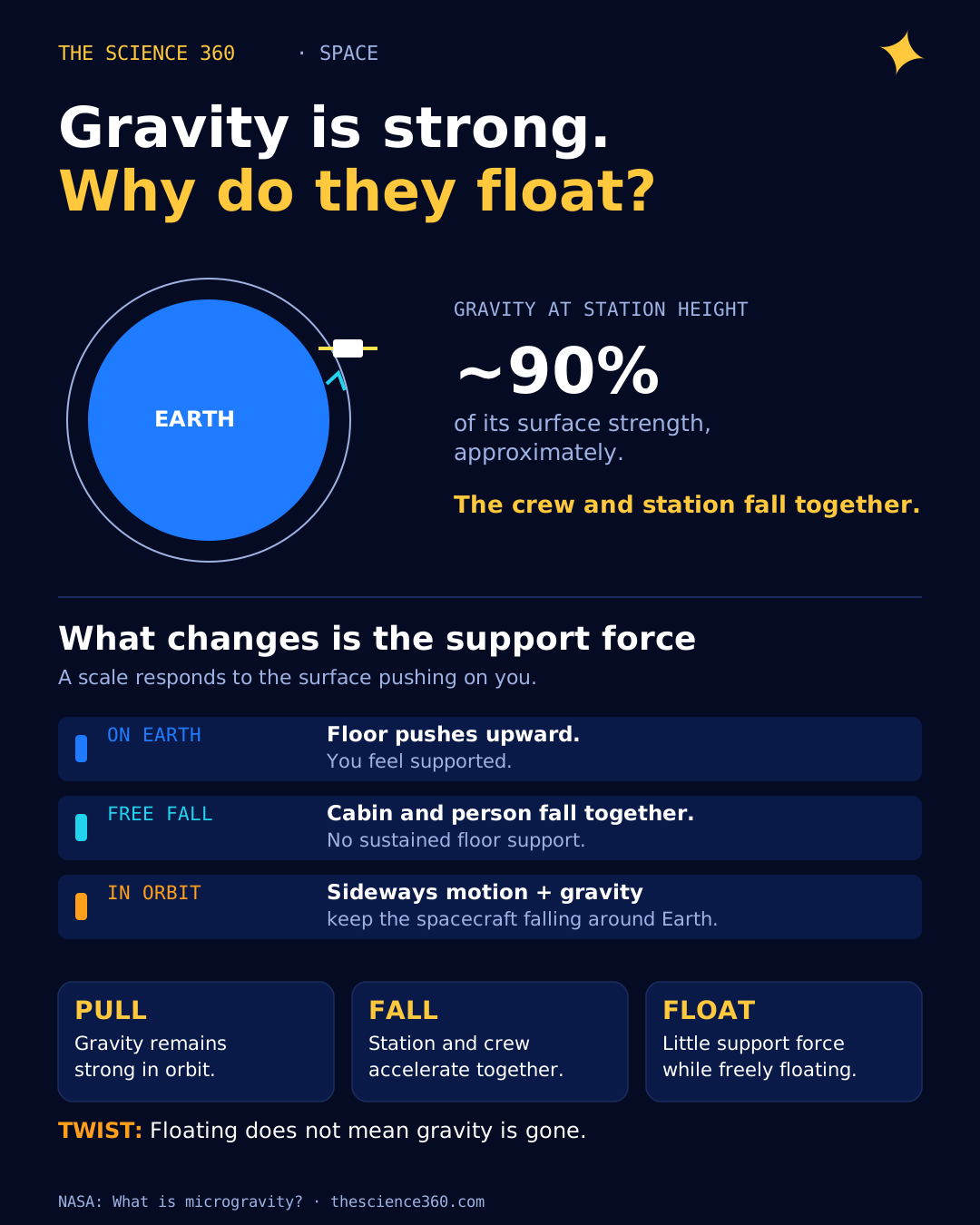
Astronauts float inside an orbiting space station because they and the station are falling together. Earth still pulls on them strongly. What is missing during free fall is the steady push from a floor that normally supports your body.
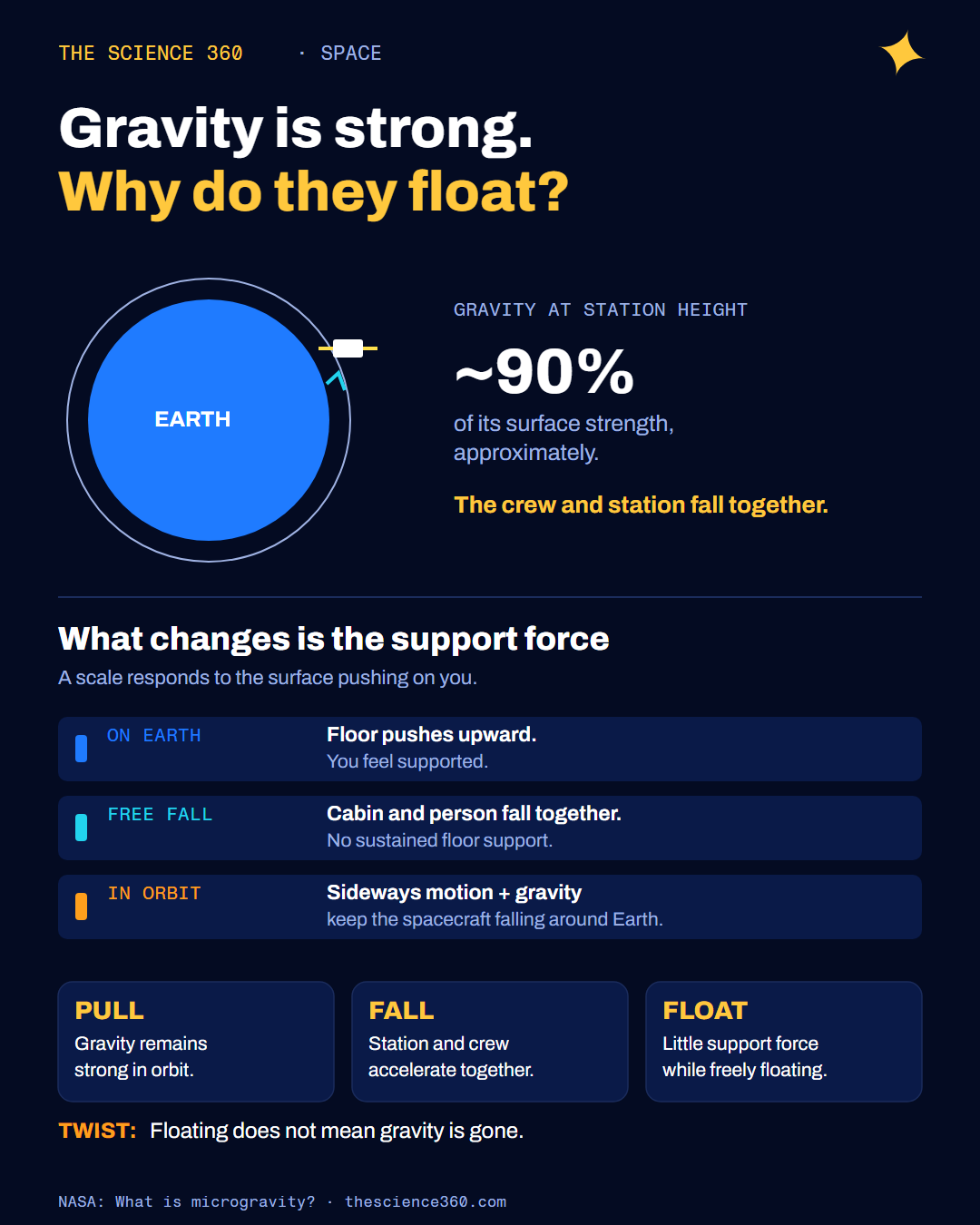
NASA’s microgravity explanation for students gives a useful contrast: at space-station heights, Earth’s gravitational field is still roughly 90% of its strength at the surface. That is an approximate educational figure, not a measurement of the station’s altitude at this moment. It is more than enough to rule out the idea that astronauts float because they have travelled beyond Earth’s gravity.
The puzzle becomes easier if we separate the gravitational force from what a scale, a floor or your body senses as support.
Your bathroom scale does not measure gravity directly
When you stand on a floor, Earth pulls you downward and the floor pushes you upward. A scale responds to the contact force pressing on it. In a simple stationary situation, that force balances the gravitational pull, so the scale is a useful way to infer weight.
Change the motion and the scale’s reading can change even before gravity has changed appreciably. The important distinction is between the force pulling you toward Earth and the force of a surface pushing back against you. In ideal free fall, you and a freely falling scale accelerate together, with essentially no supporting contact force between them.
This is the meaning of apparent weightlessness in the explanation below. Your mass has not disappeared. Neither has the gravitational interaction. NASA Glenn’s account uses the scale example and continuous free fall to explain why orbit can feel weightless.
| Situation | Gravity acting? | Sustained supporting contact force? | What changes? |
|---|---|---|---|
| Standing still on Earth | Yes | The floor supports you | Your body presses against a surface |
| Ideal freely falling cabin | Yes | No floor support while both fall together | Objects can remain beside you without resting on a shelf |
| Freely orbiting spacecraft | Yes | Essentially none while you float freely | Shared fall continues around Earth |
These are simplified mechanical situations. A person strapped into a seat, pushing off a wall or being accelerated by an engine has contact forces that the freely floating example does not include.
Why the station does not simply hit the ground
Falling does not mean moving only straight downward. An orbiting spacecraft also has sideways motion. Gravity continually changes its velocity, bending its path around Earth. With the appropriate trajectory, it keeps falling while Earth’s surface curves away beneath it.
NASA Glenn illustrates the idea using Newton’s cannonball thought experiment: launch a projectile faster sideways and it travels farther before reaching the ground; in the ideal orbital case, its curved path keeps missing the surface. This is a thought experiment, not a plan to launch anything from a mountain.
An orbit is therefore not a place where gravity has stopped working. Its curved path is evidence that a force is changing the motion. Without that gravitational pull, the spacecraft would not keep following the same orbit.

The diagram separates a force arrow from a motion arrow. The orbit’s sideways velocity is not an outward force holding the spacecraft up. In the simplified circular case, the net force points inward and changes the direction of the velocity.
Why a loose pen can stay beside an astronaut
Suppose an astronaut releases a pen without giving it a push. The pen, astronaut and surrounding station already have nearly the same orbital motion. They continue falling together. Relative to the astronaut, the pen can appear to hover even while all of them move rapidly around Earth.
That appearance depends on their shared initial motion. Release an object with a small push and it will move relative to the cabin. Air currents, contact and small differences in trajectory can matter too. “Everything floats” does not mean objects are frozen in place or that they have no inertia.
Imagine filming only the pen and hand, with no window or view of Earth. The clip tells you about their motion relative to each other. It does not, on its own, tell you whether gravity is present. That is the central interpretive trap: an object can look stationary in one moving setting while its path curves in another description.
Why scientists say microgravity
Real spacecraft are not perfect laboratories with every disturbance removed. ESA’s overview of microgravity and the ISS describes residual effects such as air drag and solar pressure. Equipment, motion inside the station and differences in the gravitational field across an extended object can complicate the ideal picture.
The label microgravity describes the near-weightless experimental environment. It should not be read as a claim that Earth’s gravitational field at the station is a tiny fraction of the field at the surface. Those are different statements, and the roughly 90% comparison makes the distinction explicit.
There is also no single altitude where gravity suddenly ends. The atmosphere is not a lid that contains it. Moving farther from Earth weakens Earth’s pull, but crossing from air into space does not switch gravity off.
You do not need orbit to understand the mechanism
A falling cabin is a useful thought experiment because it separates the support force from gravity without changing the location to deep space. It is not an experiment to attempt. NASA uses controlled drop facilities and parabolic aircraft to create short intervals of near-weightlessness for research; the details and duration depend on the facility.
The distinction also explains why “no gravity” is a misleading caption for a floating astronaut. The more accurate short version is: gravity accelerates the astronaut and spacecraft together, so the astronaut does not need to rest on the floor to share the spacecraft’s motion.
For another example of gravity changing motion without a simple “speed up everywhere” story, read how a gravity assist changes spacecraft speed. In both cases, naming the reference frame and the forces makes the apparently strange behaviour understandable.