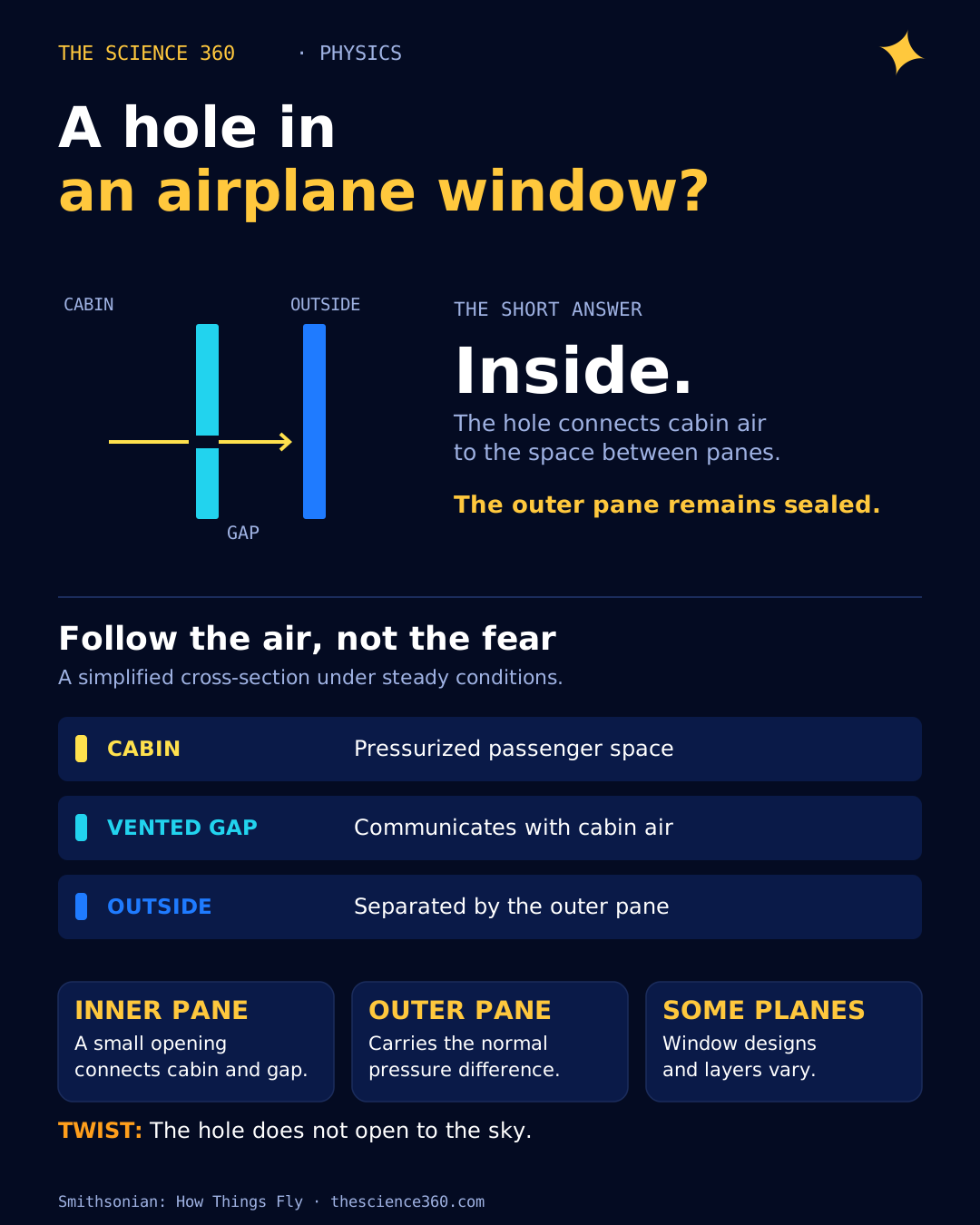
Why is there a tiny hole in an airplane window?

The tiny hole visible in some passenger windows is a breather hole in an inner structural pane. It lets air move between the cabin and the narrow space between panes. It is not a hole through the outside of the aircraft.
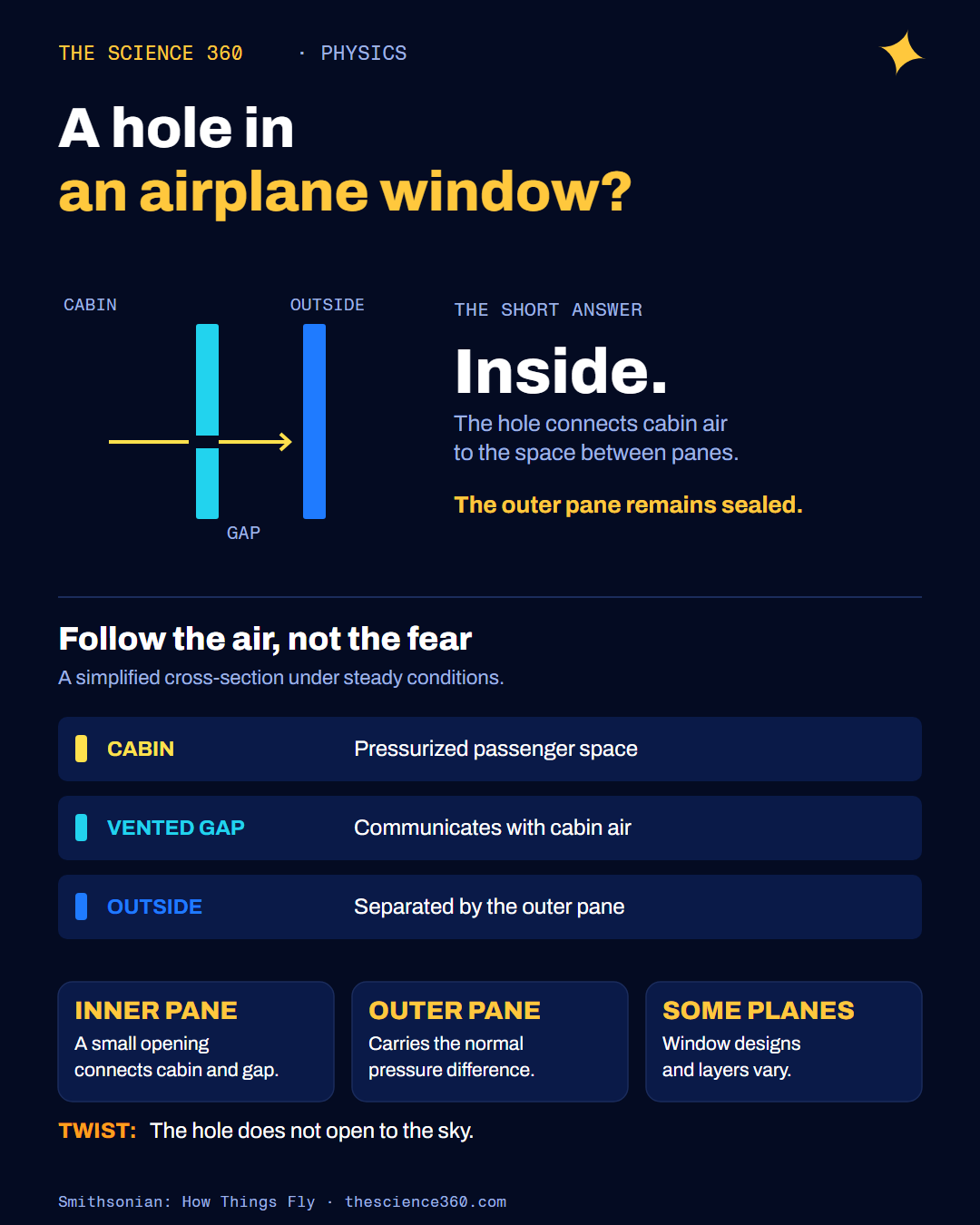
That detail changes the pressure story. With the cabin-side gap able to communicate with cabin air, the outer pane carries the normal pressure difference between the pressurized cabin and the thinner outside air. The Smithsonian National Air and Space Museum explains this role and describes the small hole in the middle pane.
First, imagine two barriers and a gap
Imagine the passenger cabin on the left and the outside air on the right. Between them sit an inner pane, a narrow air gap and an outer pane. For clarity, our diagram leaves out the protective scratch pane that may sit closest to the passenger. Actual window construction and layer names vary by aircraft.
If a small opening connects the cabin to the gap, air can move between those spaces until their pressures are approximately equal under steady conditions. The two faces of the inner structural pane then have similar pressures. The outer pane still separates that gap from the lower-pressure outside air, so it carries the main normal pressure difference.

Simplified explanatory schematic, not to scale and not a model-specific maintenance drawing. It shows steady conditions, not the transient response during climb or descent.
The diagram is not a recipe for judging an aircraft’s safety. The actual window is a certified assembly with multiple components and model-specific requirements. The Boeing 737 maintenance excerpt refers to a vent hole and inspection conditions for that aircraft family; it should not be treated as documentation for every passenger aircraft.
Why the hole is not a leak to the sky
The unsettling mental picture is a pinhole opening a continuous path from the cabin to the outside. In the arrangement shown here, that is not what the hole does. It connects the cabin to the inter-pane gap. The outer pane is still the boundary between that gap and the outside.
Think of a sealed container with a divider inside it. Making a hole in the divider can let air move between two internal spaces without making a hole in the container’s outside wall. The analogy is only about which spaces connect; it does not reproduce an aircraft window’s strength, seals, temperature or certification.
If the gap and cabin have approximately equal pressure, the inner pane has a small pressure difference across it in normal steady operation. If the outside air is at a lower pressure, the outer pane has a larger difference across it. Pressure acts over an area, so even a modest difference can mean a substantial distributed force. But our schematic does not provide aircraft dimensions, actual pressures or a structural load calculation.
Why not seal every layer separately?
An isolated air gap could have its own pressure history as outside and cabin conditions change. A vented gap provides a connection to the cabin side in this common design, allowing pressure to equalize rather than treating the gap as a permanently sealed pocket. The exact pressure while the aircraft is climbing or descending depends on the vent and system response; the steady-state picture is a simplification.
Some explanations also mention condensation. Venting and moisture management matter in a real assembly, but they depend on the specific design and conditions. The pressure-routing explanation is the central point supported by the Smithsonian source; we cannot infer that the same hole performs every claimed role in every aircraft.
Is the hole in every aircraft window?
No. The familiar visible hole is a feature of some passenger-window designs, not a rule for all aircraft, and windows can use different materials and layers. Other mechanisms and designs exist. Do not infer a missing or damaged part simply because a different aircraft’s window looks different.
Likewise, “there are three layers” is a useful teaching shortcut for many layouts, but counting can differ depending on whether a protective inner cover is included. Our drawing labels the two structural panes relevant to the pressure explanation and leaves other details out.
A thought experiment you can do without a plane
Draw two rectangles with a narrow space between them. Label one side “cabin” and the other “outside.” Put a small opening in the first rectangle and trace a line from the cabin through that opening: it stops at the second rectangle. Now erase the second rectangle. The path is different: it reaches the outside.
That simple tracing exercise is the answer to the mystery. The surprising dot connects two spaces inside the boundary, while the outer pane continues to separate cabin pressure from the outside. It is not evidence that the aircraft cabin has been left open to the sky.
Explore another everyday perception puzzle in our Moon illusion camera test.