Why Food Takes Longer to Cook in the Mountains
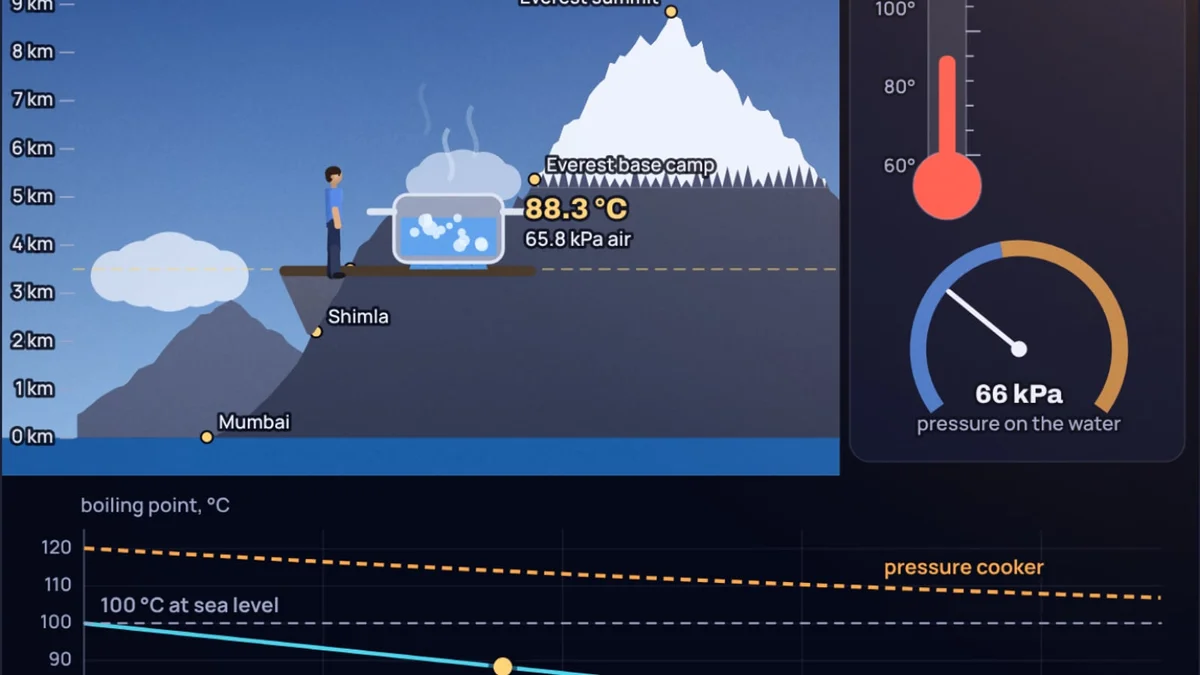
Put a pot of dal on the stove in a guesthouse in Leh and it will boil quickly, with big lively bubbles. Stick a thermometer in and it reads about 88 °C. The same pot in Mumbai would read 100 °C. Those missing 12 degrees are why the dal that takes half an hour at home can take well over an hour in Ladakh, and why every kitchen there has a pressure cooker whistling on the stove.
The boiling point at altitude calculator lets you drag a pot from sea level to the summit of Everest and watch the boiling point, the air pressure and the cooking time change together. Here is the physics behind it, with the numbers for the places people actually cook.
Why does water boil at a lower temperature at altitude?
Boiling is not a fixed temperature. It is the point where water's vapour pressure, the push of molecules escaping from the liquid, matches the pressure of the air pressing on the surface. Then bubbles of steam can form inside the water and survive, and you see a rolling boil.
Air pressure is the weight of the air above you. At sea level that is 101.3 kPa. Climb and you leave some of the atmosphere below your feet, so less presses down on the pot, and the water reaches the matching vapour pressure at a lower temperature. The standard atmosphere, which assumes 15 °C at sea level and air cooling 6.5 °C per kilometre, gives the pressure at height :
, so
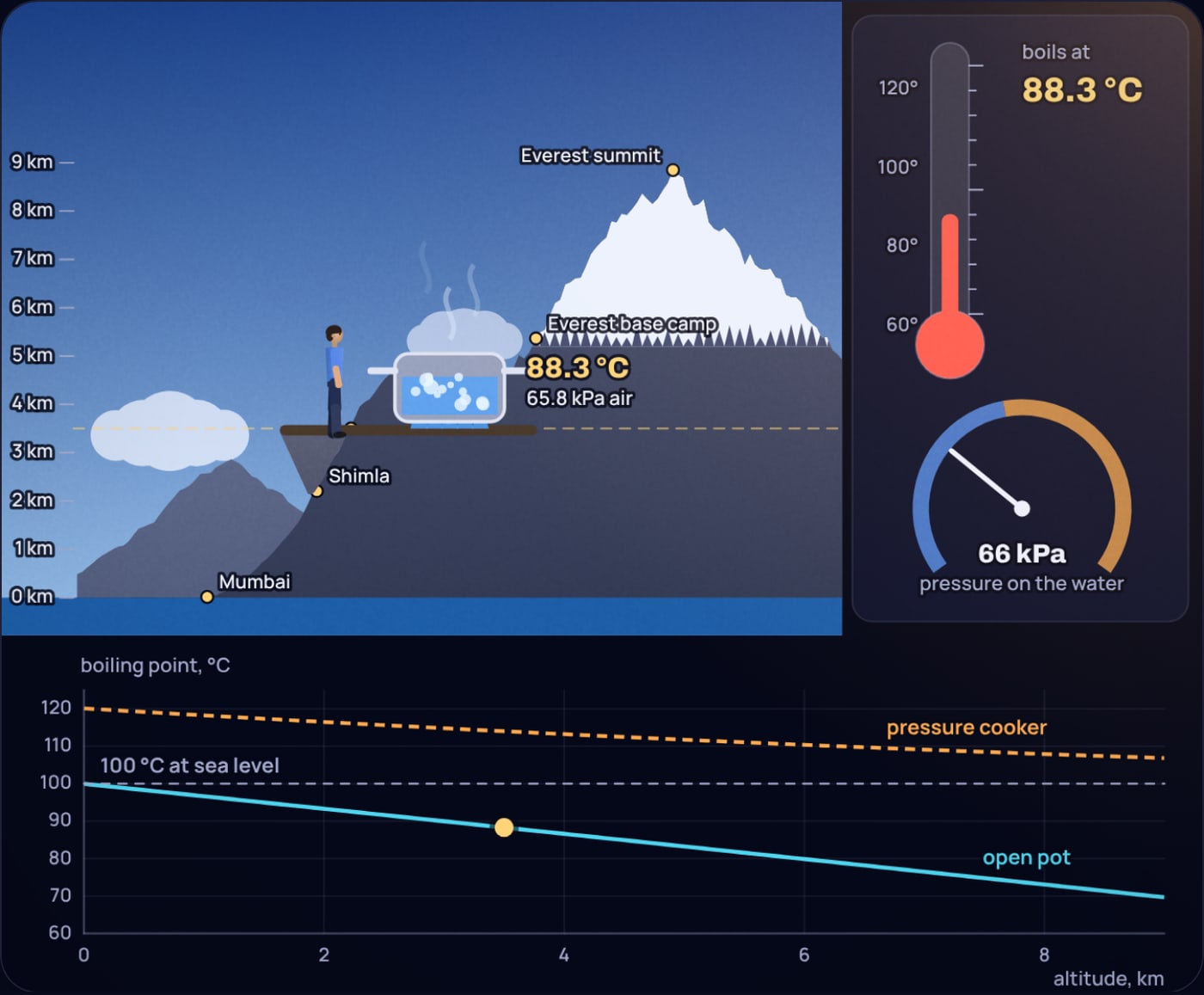
Water's vapour pressure reaches 65.8 kPa at 88.3 °C, so that is where it boils.
The calculator gets the boiling point from the IAPWS-IF97 steam-table equations, the international standard used for power station boilers, and cross-checks it against the Antoine constants for water published in the NIST Chemistry WebBook. The two agree to a few hundredths of a degree at every altitude people live at.
Boiling point at altitude: the numbers
| Place | Altitude | Air pressure | Water boils at | 30 min dal takes |
|---|---|---|---|---|
| Mumbai | 14 m | 101.2 kPa | 99.9 °C | 30 min |
| Denver | 1,609 m | 83.4 kPa | 94.6 °C | 45 min |
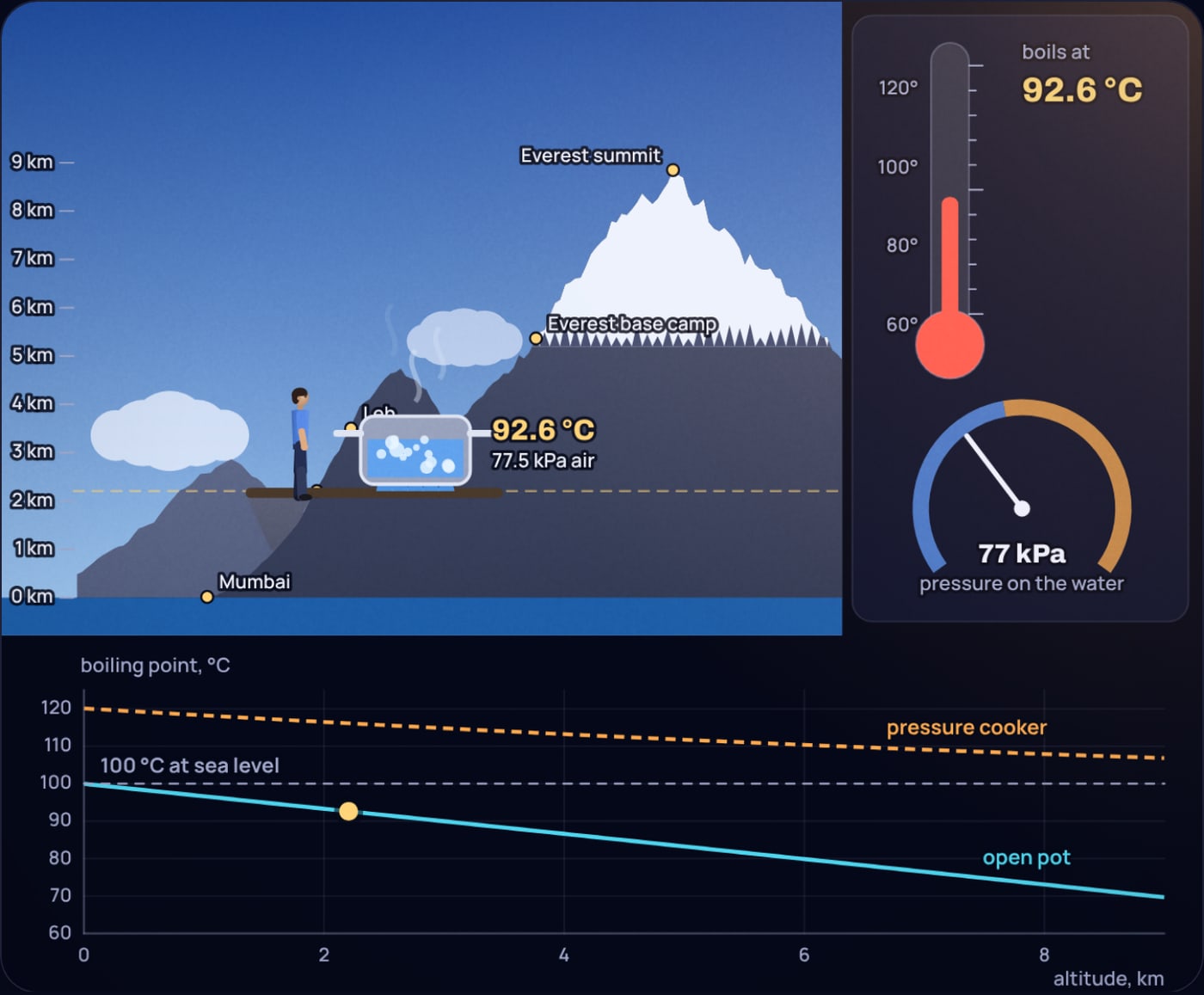
| Shimla | 2,205 m | 77.5 kPa | 92.6 °C | 53 min |
| Leh | 3,500 m | 65.8 kPa | 88.3 °C | 74 min |
| La Paz | 3,650 m | 64.5 kPa | 87.8 °C | 77 min |
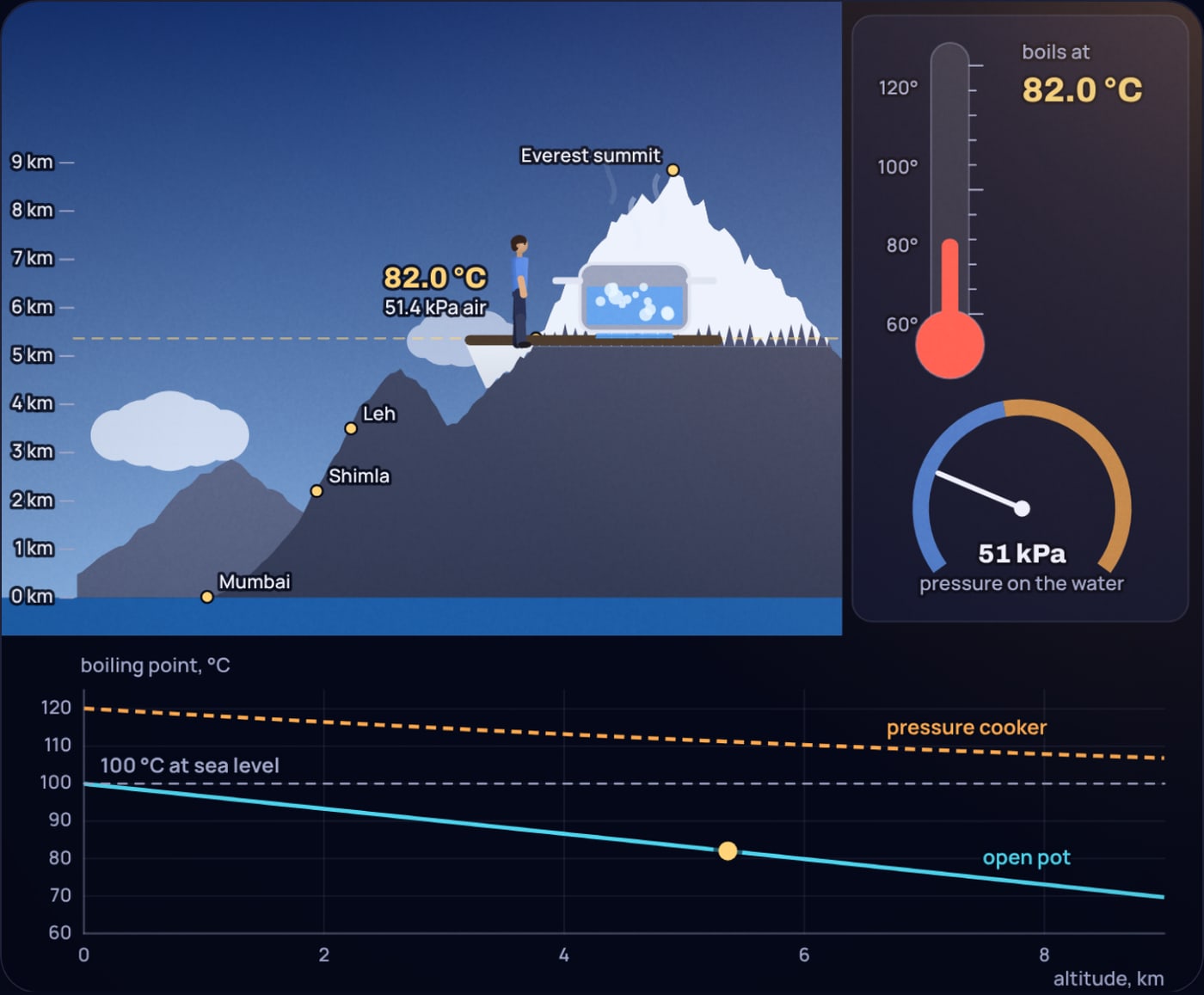
| Everest base camp | 5,364 m | 51.4 kPa | 82.0 °C | 2 h 3 min |
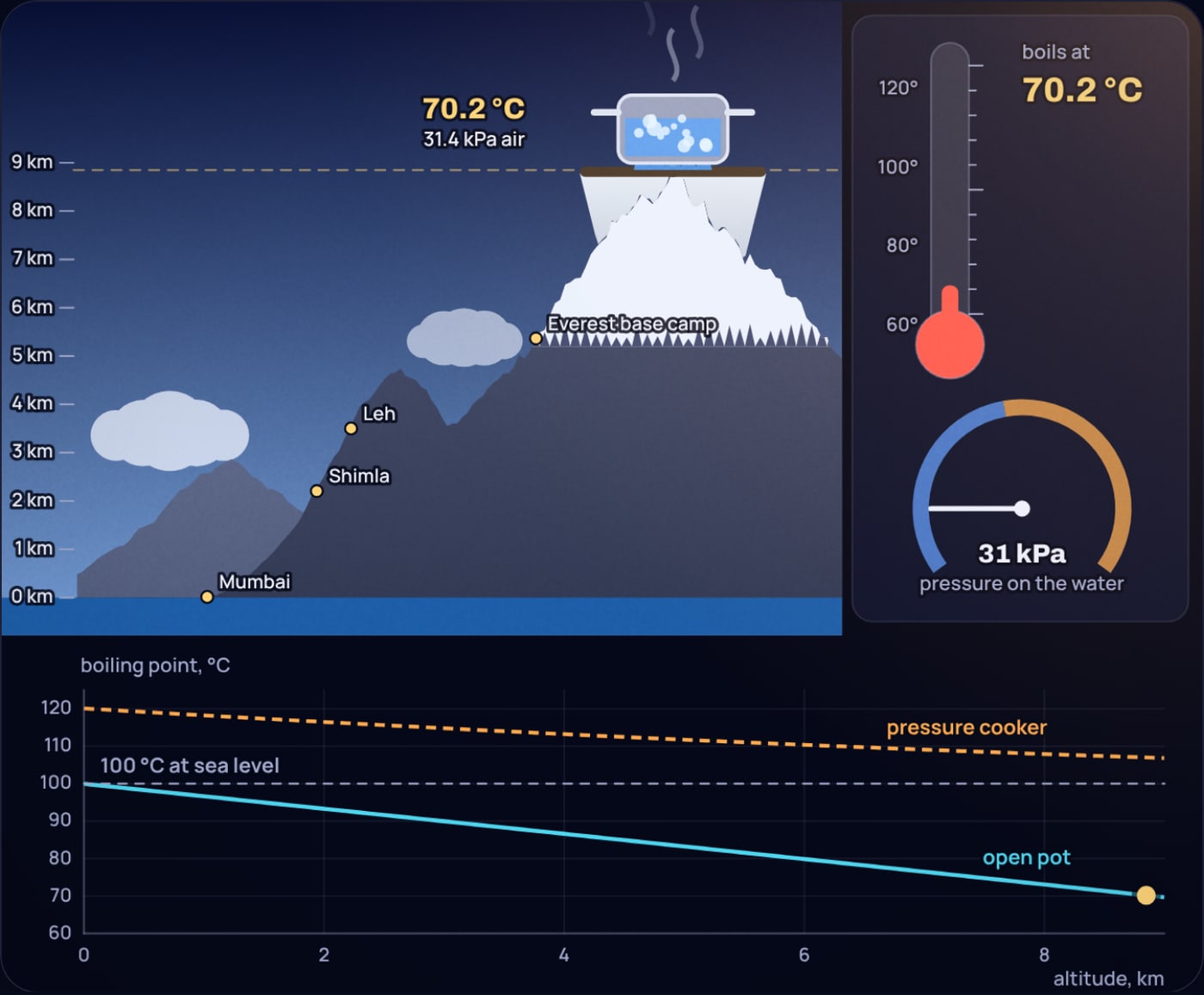
| Everest summit | 8,849 m | 31.4 kPa | 70.2 °C | 5 h 37 min |
The rule of thumb that falls out is about 1 °C lower for every 300 m, or 3.3 °C per kilometre. The Everest row uses the standard atmosphere. The real summit is a little kinder: in October 1981 Chris Pizzo measured 253 mmHg (33.7 kPa) there during the American Medical Research Expedition, because the warm air at that latitude is denser than the model assumes. That gives a boiling point of 71.8 °C instead of 70.2 °C.
How much longer does food take to cook in the mountains?
Cooking is chemistry. Softening a lentil means breaking down cell walls and swelling starch, and like most chemical reactions it slows down sharply as the temperature falls. The usual way to describe that is the Arrhenius law: the time needed scales as , where is an activation energy for the process.
For lentils there is a measured value. Varoquaux and colleagues, cooking lentils for catering in 1995, found an apparent activation energy of 86.5 kJ/mol for the loss of firmness. The calculator uses it for dal.
So dal that takes 30 minutes in Mumbai takes about 74 minutes in Leh.
The same number works out to roughly a doubling of cooking time for every 10 °C cooler. Treat it as a guide, not a recipe. Different foods have different activation energies, soaking cuts the time a lot, hard water slows pulses, and old dal is slower than fresh. But the direction and the size are right: it is the water temperature, not the boil, that cooks the food.
The misconception: a bigger flame makes it cook faster
Once water is boiling, turning the flame up does not make it hotter. The extra heat goes into making steam faster, and the temperature stays pinned at the boiling point for that pressure. In Leh a furious rolling boil and a gentle simmer are both at 88 °C. Turning the flame down to a steady boil cooks just as fast and saves gas, which matters when every cylinder has come up the Manali or Srinagar road.
The other half of the confusion is that water reaches the boil faster at altitude. It does, because the target is lower. People see the pot boiling quickly and expect quick cooking, then wonder why the rajma is still hard an hour later.
Can you cook rice or make tea on Everest?
Rice needs its starch to gelatinise: the granules absorb water and swell, which is what turns a hard grain soft. For many rice varieties that finishes somewhere between 68 and 78 °C, depending on the cultivar. At Everest base camp the water still reaches 82 °C, so rice cooks, slowly. On the summit, at 70 to 72 °C, an open pot struggles to get many varieties fully done at all.
Tea is similar. The flavour compounds in tea leaves extract best in water close to 100 °C, and at 70 °C the result is thin. Climbers mostly melt snow for drinks and rehydrate food designed for it. Eggs are a happier story: egg proteins set at temperatures well below 88 °C, so a boiled egg in Leh just needs a few more minutes.
How does a pressure cooker fix it?
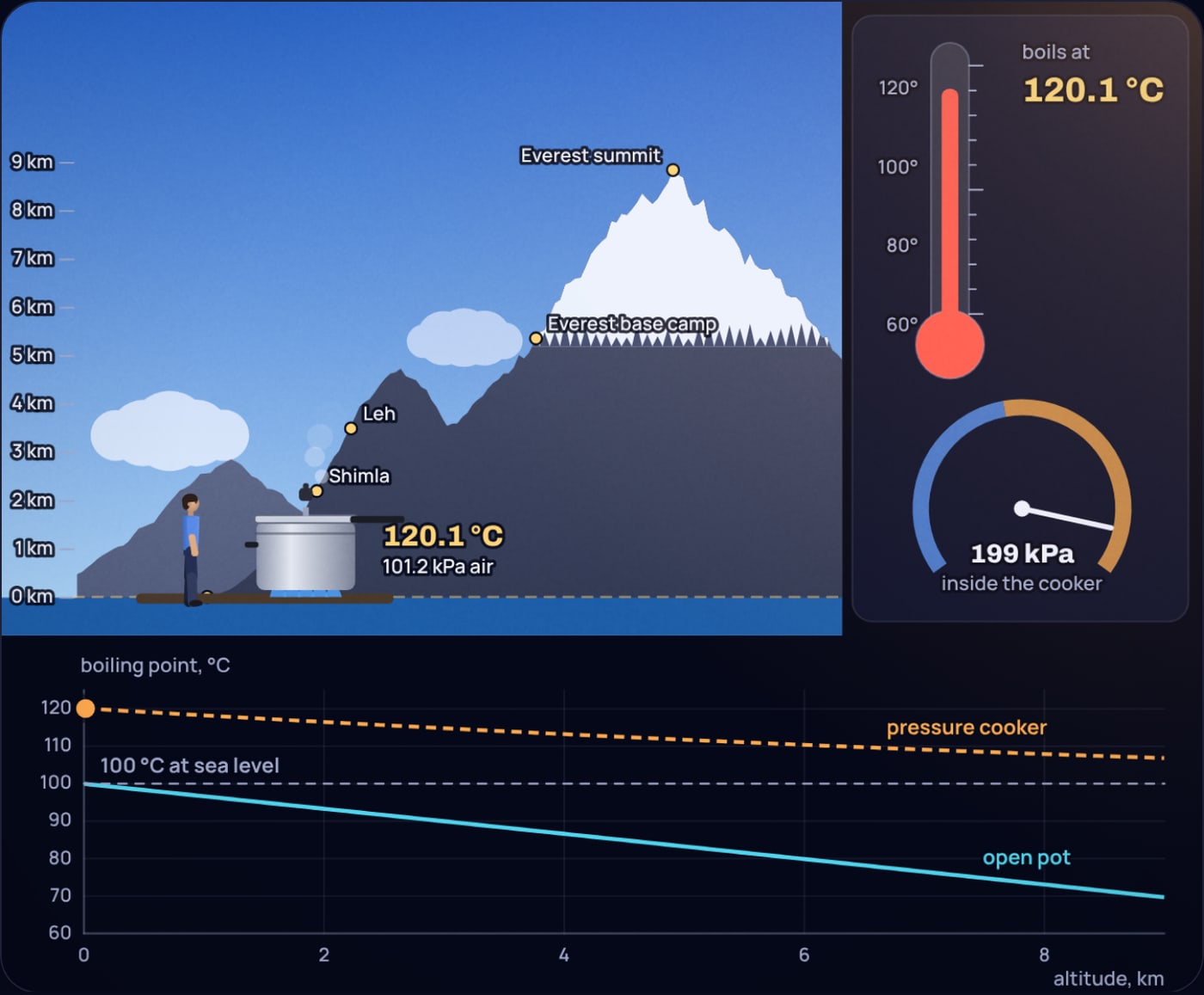
A pressure cooker turns the problem round. It seals the pot and lets the steam build up until the weight on the vent lifts and lets some out, which is the whistle. The Indian standard for domestic cookers, IS 2347, sets the nominal cooking pressure at 1.0 kgf/cm² above the outside air, which is 98.07 kPa.
Mumbai: inside, so water boils at 120.1 °C
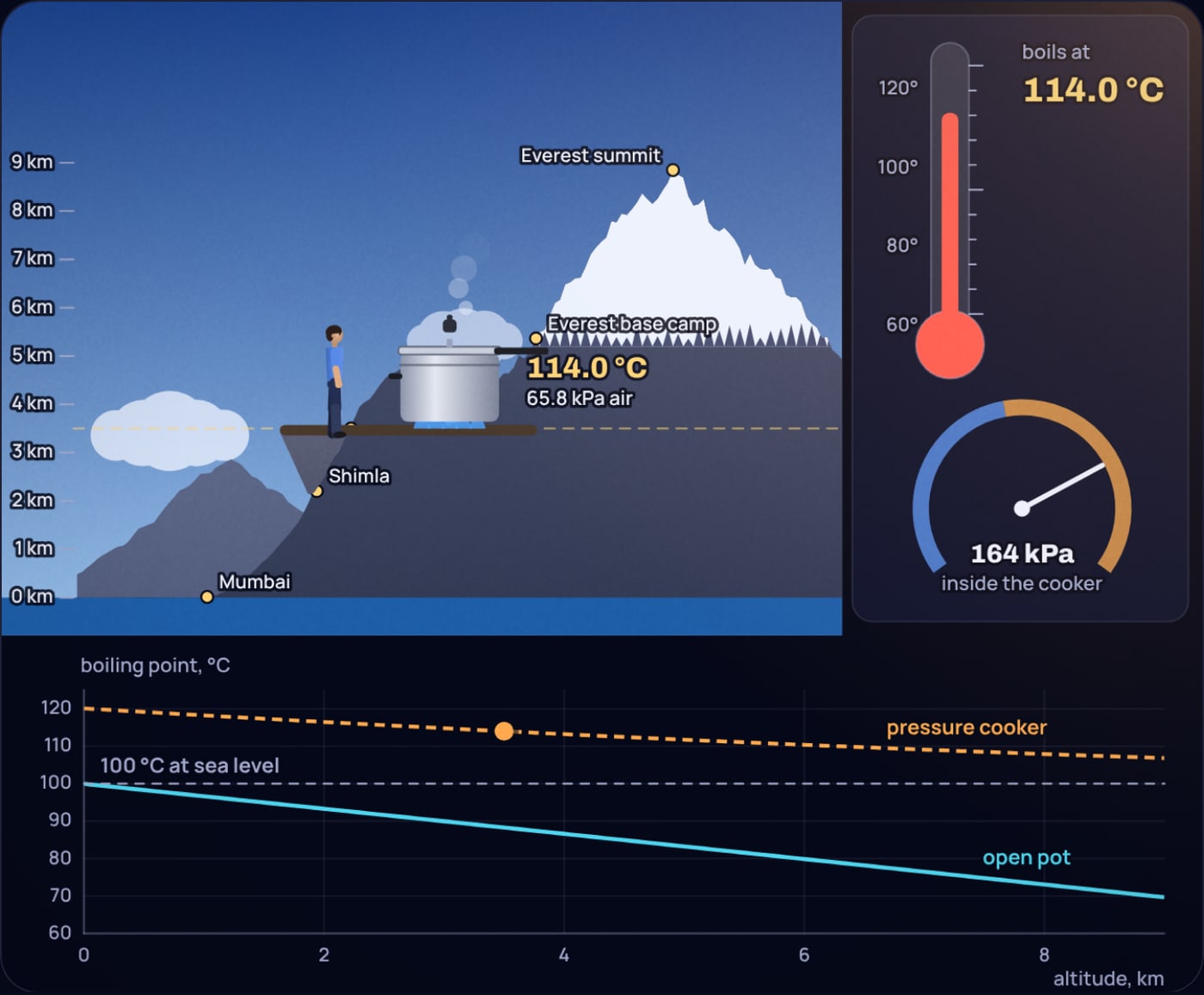
Leh: inside, so water boils at 114.0 °C
Cooking factor in Leh with the lentil numbers: , about 11 minutes for 30 minute dal.
Two things follow. The cooker is a big win everywhere, about four times faster than an open pot at sea level. And because the weight adds a fixed amount to the outside pressure, the cooker runs cooler at altitude too, 114 °C in Leh instead of 120 °C. It still beats an open pot in Mumbai comfortably, which is why it is the single most useful thing in a mountain kitchen.
Does salt or weather change the boiling point?
A little, compared with altitude. Salt raises the boiling point by about 0.5 °C for 30 g in a litre, a heavily salted pot. Weather moves the air pressure by a few kPa: a deep monsoon low of 990 hPa lowers the boiling point by about 0.65 °C. Altitude is the only one of these that changes cooking times in a way you will notice.
Try it yourself
Open the Everest base camp preset, set your own sea-level cooking time with the slider, then switch to the pressure cooker and watch the time collapse. For more kitchen physics, see how much energy it takes to boil a kettle and why the microwave resonance story is a myth.
Sources
- NIST Chemistry WebBook: water, Antoine equation parameters
- Varoquaux, Offant and Varoquaux (1995), Firmness, seed wholeness and water uptake during the cooking of lentils, International Journal of Food Science and Technology 30(2)
- IS 2347:2006, Domestic pressure cookers (nominal cooking pressure up to 1.0 kgf/cm² gauge)
- American Alpine Club: “Oxygenless” climbs and barometric pressure (Pizzo’s 253 mmHg summit reading, October 1981)
- Leh, Wikipedia (elevation 3,500 m)
- La Paz, Wikipedia (elevation about 3,650 m)
- Everest base camps, Wikipedia (south base camp 5,364 m)
- Incredible India: Shimla (2,205 m)
- Bakerpedia: starch gelatinization temperatures (rice 68 to 78 °C)
Frequently asked questions
Why does food take longer to cook at high altitude?
Because water boils at a lower temperature where the air pressure is lower. In Leh, at 3,500 m, water boils at about 88 °C instead of 100 °C. Cooking reactions slow down sharply as the temperature falls, so food in boiling water cooks more slowly, roughly 2.5 times slower for dal in Leh.
What temperature does water boil at in Leh?
About 88.3 °C. The standard atmosphere gives an air pressure of 65.8 kPa at 3,500 m, about 65 percent of sea level, and water boils when its vapour pressure reaches that value.
Does a pressure cooker work at high altitude?
Yes, and it matters more there. An Indian pressure cooker holds about 1 kgf/cm², or 98 kPa, above the outside air. In Leh that makes 164 kPa inside and a boiling point of about 114 °C, hotter than an open pot at sea level.
Can you cook rice on top of Mount Everest?
Not properly in an open pot. Water boils at about 70 to 72 °C on the summit, and many rice starches only finish gelatinising at 75 to 78 °C, so the grains stay hard. A pressure cooker would raise the boiling point to about 107 °C.
Does turning up the flame make the water hotter?
No. Once water is boiling, extra heat only makes steam faster. The temperature stays at the boiling point for that pressure, so a gentle boil cooks just as fast as a rolling one and uses less fuel.
 50 Hilarious Physics Jokes That Will Make You Laugh
 Why is there a tiny hole in an airplane window?