What temperature does water boil at altitude?
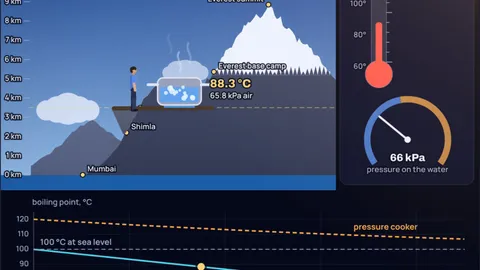
Water boils when its vapour pressure equals the pressure of the air above it, and the air thins as you climb. In Mumbai water boils at 99.9 °C. In Shimla (2,205 m) it boils at 92.6 °C, in Leh (3,500 m) at 88.3 °C and on the summit of Everest at about 70.2 °C. The rule of thumb is a drop of about 3.3 °C for every 1,000 m. The pot looks just as fierce, but the water is cooler, so food cooks slower.
The calculator takes the air pressure from the International Standard Atmosphere and the boiling point from the IAPWS-IF97 steam tables, the same equations engineers use for boilers. It then estimates how much longer dal takes, using the measured temperature sensitivity of lentil softening. Switch on the pressure cooker and the water boils at about 120 °C at sea level and 114 °C in Leh, which is why every kitchen in Ladakh has one.
Key results from the simulation
- About 3.3 °C lower per 1,000 m: 100.0 °C at sea level, 96.6 °C at 1,000 m, 93.3 °C at 2,000 m, 86.6 °C at 4,000 m and 79.9 °C at 6,000 m.
- Air pressure falls faster than you might think: 83.4 kPa in Denver, 65.8 kPa in Leh (65% of sea level) and 31.4 kPa on Everest in the standard atmosphere.
- Cooking slows down: with the lentil activation energy, dal that takes 30 minutes in Mumbai takes about 53 min in Shimla, 74 min in Leh and 2 h 3 min at Everest base camp.
- A pressure cooker more than makes up for it: about 1 kgf/cm² of extra pressure raises the boiling point to 120.1 °C at sea level and 114.0 °C in Leh, so the same dal takes about 7 min and 11 min.
From the coast to the top of the world
Each case loads the place in the simulator. Pressures are the standard atmosphere for that altitude, and cooking times assume dal that takes 30 minutes in an open pot at sea level.
Mumbai: the 100 °C everyone learns
Sea level, 14 mAt 101.2 kPa of air pressure water boils at 99.9 °C. Strictly, 100 °C is the boiling point at exactly 101.325 kPa; since 1990 the temperature scale puts it a hair lower, at 99.97 °C, which is why the numbers here are not a round 100.
Weather moves this by less than you would notice in cooking. A deep monsoon low of 990 hPa lowers the boiling point by only about 0.7 °C. Altitude is the big lever.
Shimla: two degrees short
Hill station, 2,205 mAt 2,205 m the air pressure is 77.5 kPa, 76% of sea level, and water boils at 92.6 °C. That is 7.3 °C cooler than in Mumbai.
A few degrees does not sound like much, but cooking reactions are steep functions of temperature. With the lentil kinetics the same dal takes about 53 min, 1.8 times as long. Tea can brew weaker for the same reason.
Leh: why Ladakh runs on pressure cookers
Ladakh, 3,500 mLeh sits at about 3,500 m, where the air pressure is 65.8 kPa and water boils at 88.3 °C. Pulses cook painfully slowly in an open pot, and the calculator puts dal at 74 min.
With a pressure cooker the water inside sits under the outside air plus about 98 kPa from the weight, 163.8 kPa in all, and boils at 114.0 °C. That is hotter than an open pot in Mumbai, so the dal is done in about 11 min.
La Paz: a capital city at 88 °C
Bolivia, 3,650 mLa Paz, at about 3,650 m, is the highest seat of government in the world. Water boils there at 87.8 °C under 64.5 kPa.
Denver, the "mile high city" at 1,609 m, is the version most American recipes deal with: water boils at 94.6 °C there, which is why packet instructions carry high-altitude notes.
Everest base camp: cooking at 82 °C
Nepal side, 5,364 mAt the south base camp, 5,364 m, the standard atmosphere gives 51.4 kPa and water boils at 82.0 °C. Dal in an open pot would take about 2 h 3 min, which is a lot of fuel carried up by porters.
Expedition kitchens use pressure cookers for exactly this reason. Even at base camp the cooker gets water to about 111 °C.
The summit of Everest: about 70 °C
8,849 mThe standard atmosphere gives 31.4 kPa at 8,849 m and a boiling point of 70.2 °C. The real summit is a little kinder: in October 1981 Chris Pizzo measured 253 mmHg (33.7 kPa) there, because warm tropical air is denser than the standard model assumes, which gives 71.8 °C.
Either way it is cool enough to matter. Many rice starches only finish gelatinising at 75 to 78 °C, and in this model water stops reaching 75 °C above about 7400 m. You cannot make a proper cup of tea or cook rice in an open pot up there.
Boiling point of water by altitude
| Altitude | Air pressure | Boils at, open pot | Boils at, pressure cooker | Dal (30 min at sea level) |
|---|---|---|---|---|
| 0 m (0 ft) | 101.3 kPa | 100.0 °C (212.0 °F) | 120.1 °C | 30 min |
| 500 m (1,640 ft) | 95.5 kPa | 98.3 °C (209.0 °F) | 119.2 °C | 34 min |
| 1,000 m (3,281 ft) | 89.9 kPa | 96.6 °C (206.0 °F) | 118.3 °C | 39 min |
| 1,500 m (4,921 ft) | 84.6 kPa | 95.0 °C (203.0 °F) | 117.4 °C | 44 min |
| 2,000 m (6,562 ft) | 79.5 kPa | 93.3 °C (200.0 °F) | 116.5 °C | 50 min |
| 3,000 m (9,843 ft) | 70.1 kPa | 90.0 °C (194.0 °F) | 114.8 °C | 65 min |
| 4,000 m (13,123 ft) | 61.6 kPa | 86.6 °C (187.9 °F) | 113.2 °C | 84 min |
| 5,000 m (16,404 ft) | 54.0 kPa | 83.3 °C (181.9 °F) | 111.8 °C | 1 h 51 min |
| 6,000 m (19,685 ft) | 47.2 kPa | 79.9 °C (175.8 °F) | 110.4 °C | 2 h 27 min |
| 7,000 m (22,966 ft) | 41.1 kPa | 76.5 °C (169.7 °F) | 109.1 °C | 3 h 15 min |
| 8,000 m (26,247 ft) | 35.6 kPa | 73.1 °C (163.5 °F) | 107.9 °C | 4 h 22 min |
| 8,849 m (29,032 ft) | 31.4 kPa | 70.2 °C (158.3 °F) | 107.0 °C | 5 h 37 min |
Pressure from the International Standard Atmosphere (15 °C at sea level, cooling 6.5 °C per km), boiling point from IAPWS-IF97, pressure cooker at 1 kgf/cm² (98 kPa) above the outside air. Cooking times are an estimate, see the limits below.
How the calculator works
Air pressure. The International Standard Atmosphere assumes 101.325 kPa and 15 °C at sea level, with the air cooling 6.5 °C per kilometre. Integrating the weight of the air above you gives p = 101.325 × (1 − 0.0065 h ÷ 288.15)^5.256 kPa, with h in metres.
Boiling point. Water boils when its saturation vapour pressure equals the pressure on its surface. The calculator inverts the saturation curve with the IAPWS-IF97 equation, the international standard for steam tables, accurate to a few thousandths of a degree. A cross-check with the NIST WebBook Antoine constants (Bridgeman and Aldrich) gives 88.3 °C at 3,500 m against 88.3 °C here.
Pressure cooker. An Indian pressure cooker made to IS 2347 holds a nominal 1.0 kgf/cm² (98.07 kPa) above the outside air, set by the weight on the vent. The water inside sees air pressure plus that, so the boiling point rises to about 120 °C at sea level. At altitude the outside air is lower, so the cooker runs a little cooler.
Cooking time. Softening of pulses and grains is a chemical process whose rate follows the Arrhenius law. The calculator uses the activation energy of 86.5 kJ/mol that Varoquaux and colleagues measured for the firmness of lentils, so the time scales as exp(Ea ÷ R × (1/T − 1/T₀)). That gives about 2.2 times longer for every 10 °C cooler. Rice, beans and eggs follow different numbers; treat the result as a guide.
What the model leaves out
- Real weather: the standard atmosphere is an average. Warm air at low latitudes holds the pressure higher (Everest is about 2 kPa above the model on a climbing day), and passing weather systems move it by 1 to 3 kPa.
- Food specifics: the cooking time factor uses one activation energy. Different foods, soaking, salt, pulse age and hardness of water all change it, and some processes (like rice starch gelatinising) barely happen at all below a threshold temperature.
- Dissolved salt and sugar: salt raises the boiling point slightly, about 0.5 °C for 30 g in a litre. That is far smaller than the altitude effect.
- Above 11 km: the standard atmosphere formula here covers the troposphere only, which includes every mountain.
- Cooker variation: IS 2347 allows the operating pressure to vary around the nominal value, and electric multicookers usually run at lower pressure than stovetop cookers. The 98 kPa setting is the Indian nominal value.
Common misconceptions
"Turning the flame up makes the water hotter." Once water boils, extra heat makes more steam, not hotter water. The temperature stays pinned at the boiling point for the pressure. Lower the flame to a gentle boil and you save fuel without slowing the cooking.
"Water boils faster at altitude, so cooking is faster." It does reach the boil sooner, because the target temperature is lower. But the food then sits in cooler water, so it cooks more slowly.
"Boiling point at altitude depends on how cold it is." It depends on air pressure. Cold air does not change the boiling point except through its small effect on the pressure.
Frequently asked questions
At what temperature does water boil at 3,000 m?
About 90.0 °C (194.0 °F), where the standard air pressure is 70.1 kPa. At 2,000 m it is 93.3 °C and at 4,000 m 86.6 °C.
How much does the boiling point drop per 1,000 feet?
About 1.0 °C (1.8 °F) per 1,000 ft, or 3.3 °C per 1,000 m, for altitudes people live at. The drop gets a little steeper higher up.
What is the boiling point of water on Mount Everest?
About 70.2 °C in the standard atmosphere and about 71.8 °C with the 33.7 kPa actually measured on the summit in 1981. That is too cool to brew good tea or fully cook rice.
At what temperature does water boil in a pressure cooker?
An Indian pressure cooker holds about 1 kgf/cm² (98 kPa) above the outside air, so water boils at about 120.1 °C at sea level and 114.0 °C in Leh. That is why pressure cooking is roughly 4 times faster than an open pot.
Why does food take longer to cook in the mountains?
Because the boiling water is cooler. Cooking reactions slow down sharply as the temperature falls; with the lentil numbers in this calculator, dal that takes 30 minutes in Mumbai takes about 74 min in Leh.
Keep learning
Why Food Takes Longer to Cook in the Mountains
Water boils at 88 °C in Leh and 70 °C on Everest, so dal cooks 2.5 times slower in Ladakh. The physics, the numbers, and why the pressure cooker wins.

A bigger kettle is not the problem. Heating extra water is
A reproducible Python model separates water volume, kettle power and assumed efficiency to show what changes the energy used for a cup of hot water.

Do Microwaves Resonate With Water? No, and Here's Why
2.45 GHz is not water's resonant frequency. We plot water's dielectric loss, compute penetration depth, show why ice won't heat and why WiFi is harmless.
Why planets lose atmospheres: gravity, temperature and molecular speed
Compare escape velocity with a thermal gas distribution, and learn why a fast molecular tail does not directly give an atmospheric lifetime.