A bigger kettle is not the problem. Heating extra water is
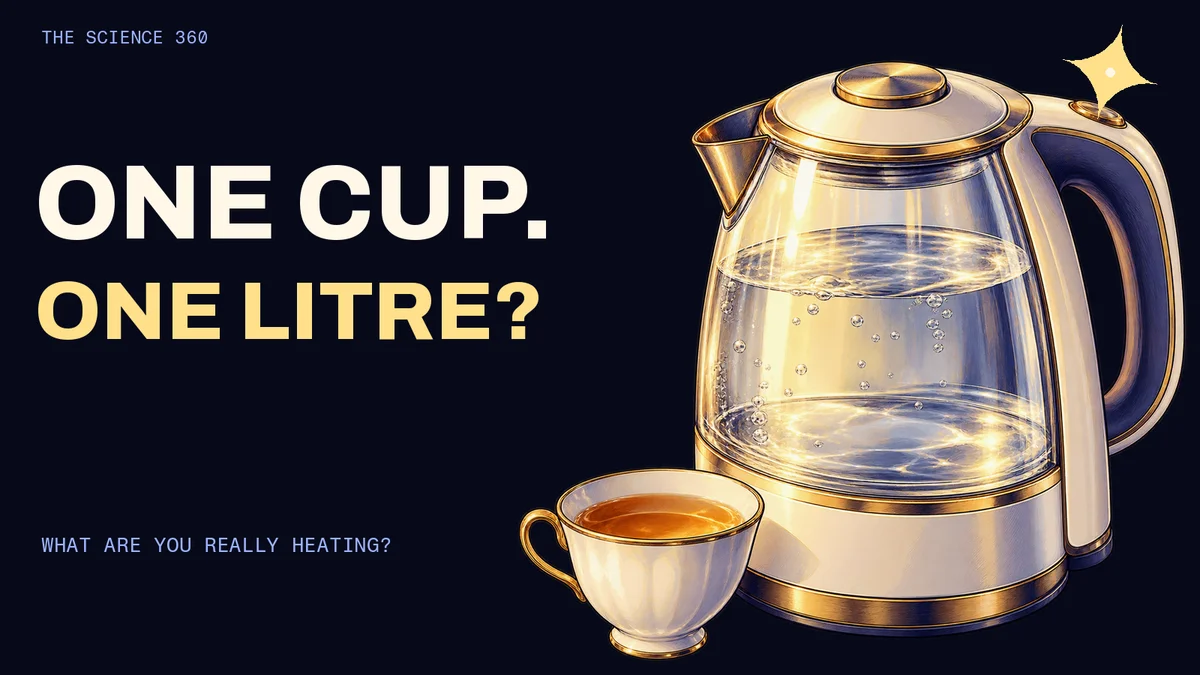
For a cup of hot water, the biggest lever in our simple calculation is how much water you heat, not the wattage printed on the kettle. Under the same assumed conditions, heating 1 litre takes twice the water-heating energy of 0.5 litres. A higher-power kettle can deliver that energy faster; it does not automatically use more total energy.
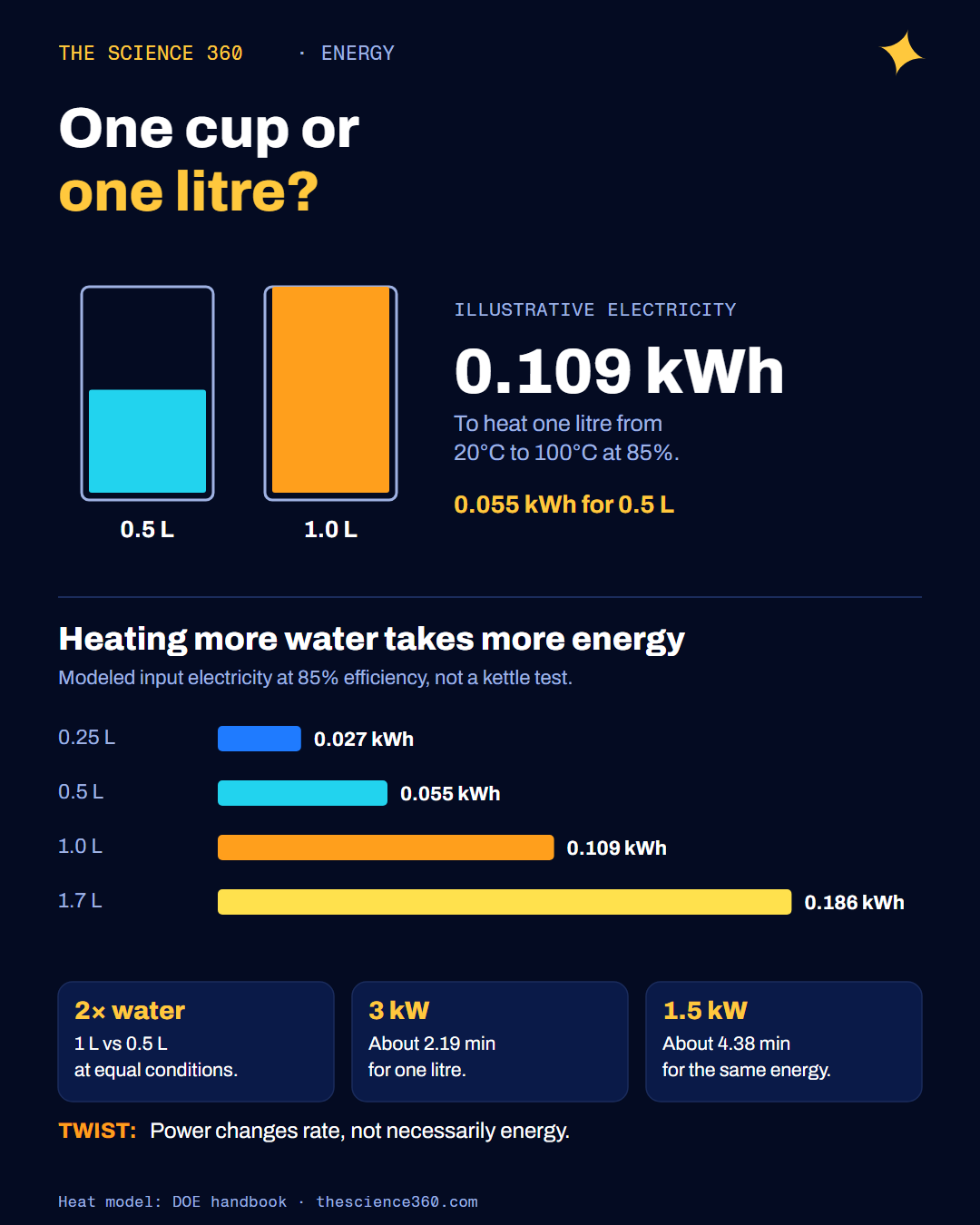
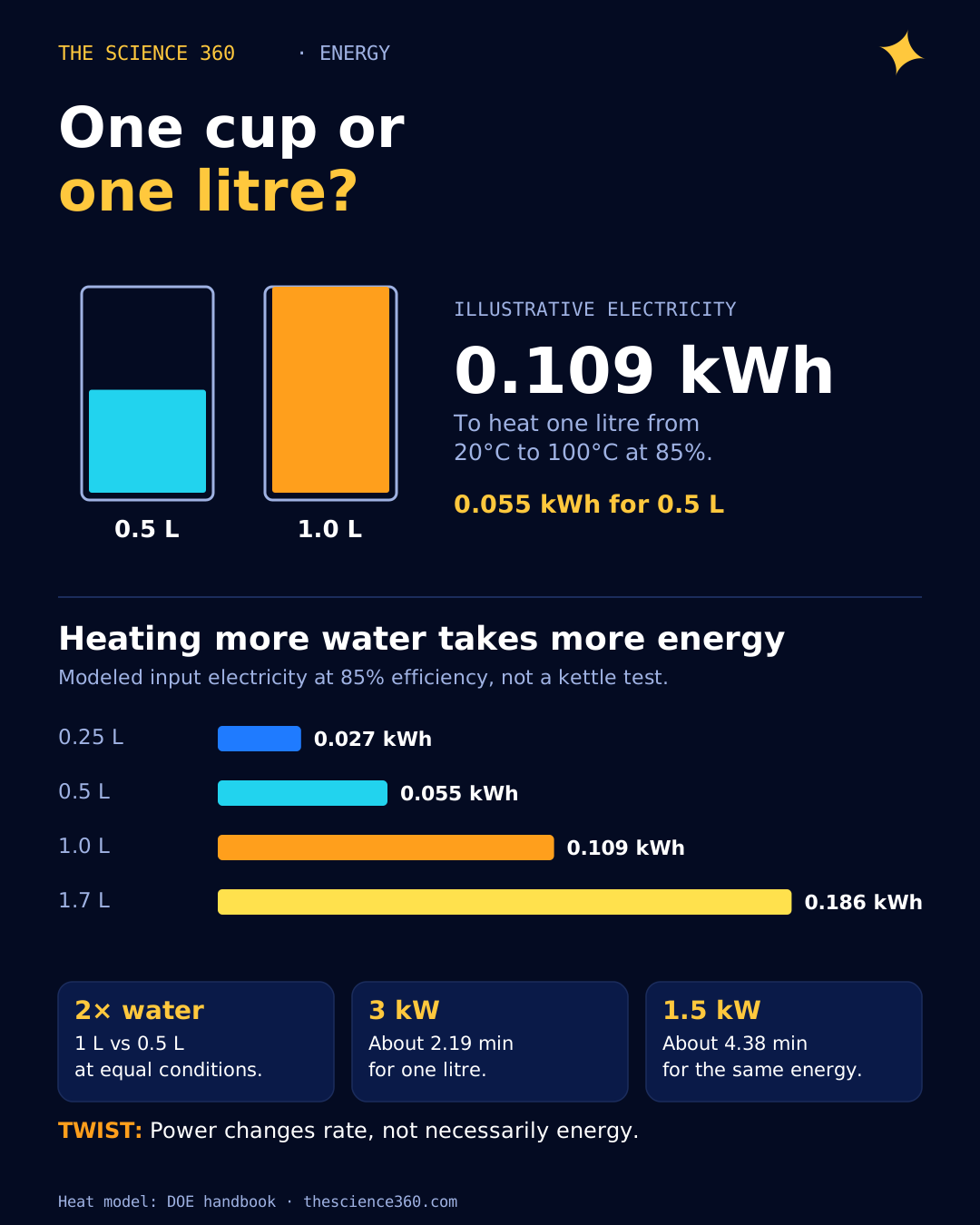
We model heating water from 20°C to 100°C. At an illustrative 85% water-heating efficiency, 1 litre takes about 0.109 kWh of electricity, while 0.5 litres takes about 0.055 kWh. These are calculations, not measurements of a particular kettle. Real appliances, water temperatures and electricity prices differ.
First separate power from energy
Power is the rate at which energy is supplied. A kettle labelled 3,000 watts draws power at up to about twice the rate of a 1,500-watt kettle. If both delivered the same total energy to the water with the same efficiency, the larger rating would shorten the modeled heating time rather than double the energy consumed.
That is a controlled comparison, not a universal result about every pair of appliances. Faster heating can change heat losses, and a real appliance may not draw its rated power continuously. The distinction between energy and rate nevertheless prevents a common mistake: multiplying a power rating without considering how long it runs.
The calculation uses the heat-capacity relationship described in the US Department of Energy’s thermodynamics handbook. We approximate liquid water’s specific heat as 4,184 joules per kilogram per degree Celsius, its density as 1 kilogram per litre, and the temperature increase as 80°C. These are useful rounded assumptions, not exact properties across every condition.
heat into water = mass × specific heat × temperature rise
electricity in = heat into water ÷ assumed efficiency
modeled time = electricity in ÷ electrical power
One kilowatt-hour equals 3.6 million joules. Our model heats the liquid to 100°C; it does not turn the whole litre into steam. Vaporizing water requires additional energy.
The comparison: half a litre or a full litre?
| Water heated | Energy into water | Electricity at assumed 85% | Electricity at assumed 95% |
|---|---|---|---|
| 0.25 litres | 0.023 kWh | 0.027 kWh | 0.024 kWh |
| 0.50 litres | 0.046 kWh | 0.055 kWh | 0.049 kWh |
| 1.00 litre | 0.093 kWh | 0.109 kWh | 0.098 kWh |
| 1.70 litres | 0.158 kWh | 0.186 kWh | 0.166 kWh |
Both efficiency values are deliberately chosen scenarios, not performance measurements or claims about specific products. They let you see what happens when the assumed fraction of electrical energy reaching the water changes. The table follows a linear model with no fixed overhead per boil; a real empty vessel still needs heating, so small-volume results can differ proportionally more.

Calculated scenarios, not measured appliance results. Both start and end temperatures are fixed; the diagram uses the 85% assumption.
What does a faster kettle change?
For 1 litre at the assumed 85% efficiency, the model predicts approximately 0.109 kWh of input. At a constant 1.5 kW, that would take about 4.38 minutes. At a constant 3 kW, it would take about 2.19 minutes. Both scenarios consume the same modeled energy because we deliberately kept efficiency and the amount of water fixed.
The 2026 study in the Journal of Thermal Analysis and Calorimetry discusses electric and gas heating, tariffs and habits. Its cost comparisons depend on local prices and circumstances; our model does not reproduce or claim to measure the study’s appliances. A gas-versus-electric choice cannot be settled by comparing wattage alone, because delivered heat and the price of each fuel matter.
What could the difference add up to?
Suppose someone heats 1 litre twice a day, but could instead heat 0.5 litres each time, while keeping all our other assumptions unchanged. The model difference is about 39.9 kWh over 365 days. This is an illustrative annual scenario, not a forecast of your bill or a claim that half the water is always wasted.
To estimate a cost in your own currency, multiply that kWh difference by your actual marginal electricity price per kWh. We do not insert a generic price: tariffs, taxes and billing structures differ. If the other half-litre is used immediately, the water has not been wasted simply because one cup was served first.
Always follow the appliance’s minimum fill and maximum fill markings. If your kettle requires more than one cup’s water, use a suitable appliance or respect the minimum; do not run it below its stated limit to imitate this calculation.
What the model leaves out
- Water can start colder or warmer than 20°C, and the boiling point varies with altitude and pressure.
- Water and vessel properties vary with temperature. We use one approximate heat capacity and density.
- The kettle body, lid and surroundings absorb heat; fixed losses, residual hot water, standby use and boil-off are not modeled separately.
- Efficiency, electrical power and heating time vary across appliances and conditions. Our values are assumptions, not independent product tests.
- The model does not include the energy or cost of buying a replacement appliance. It does not establish that replacing a working kettle saves money overall.
Reproduce it
Download the Python model, scenario table and results with assumptions. Run python analyze.py --output output with Python’s standard library; the output includes both efficiency cases and the annual example. Change the volumes or temperature difference to explore assumptions, and label any new result accordingly.
The conclusion is narrower than a product recommendation: for the same conditions, heating unneeded extra water requires extra heat. The size of the saving depends on the actual amount you need and the way your appliance operates.
For another reproducible probability example, see our 100-year flood calculation.