Why does the Moon look huge near the horizon? Try this camera test
The Moon rises beside a building and looks enormous. Later, high above an empty street, it seems to have shrunk. Your experience is real, but the dramatic size change is a perceptual effect: the Moon illusion. The atmosphere has not turned into a powerful magnifying glass.
The interesting part is that recognizing the illusion does not necessarily stop it. You can compare what you perceive with what a camera records, and those two measurements may disagree.
Measure the disk, not the feeling
NASA’s explanation of the Moon illusion describes a direct check: photograph the Moon near the horizon and again when it is higher, keeping the camera’s zoom the same. The horizontal width stays approximately the same even though its perceived size can change markedly.
Here is a more controlled version of that experiment:
- Use the same camera and the same physical lens for both pictures. A phone can switch lenses at some zoom settings, so check that it has not done so.
- Keep optical zoom, digital zoom, and image dimensions unchanged. Do not compare a cropped moonrise with an uncropped later photograph.
- Reduce exposure enough to preserve a clear lunar edge. A glowing, overexposed disk is harder to measure consistently.
- Count the pixels across the horizontal diameter in each original image. Record the time and the settings beside each measurement.
- Compare the two widths as a ratio. Use the surrounding scenery only as context, not as a ruler.
The test is about a large perceived difference versus a much smaller physical one. It does not require the two measurements to match to the last pixel: focus, camera processing, changing observer geometry, and the measurement method can introduce small differences.

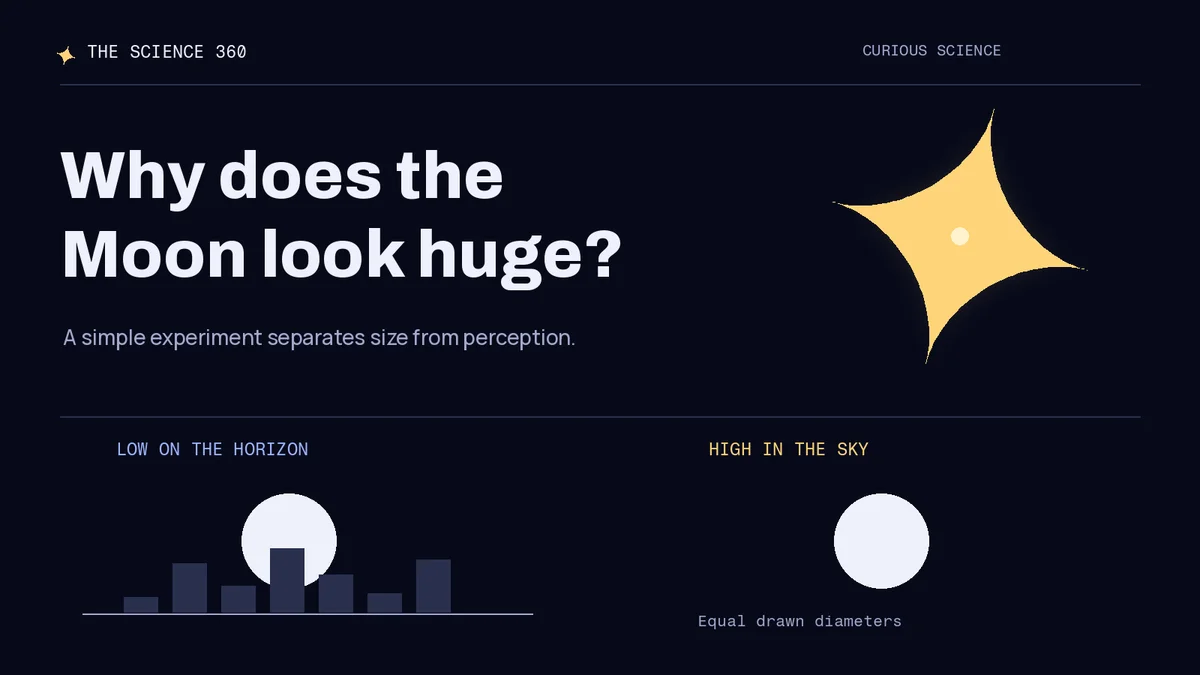
Original schematic, not a photograph. The two disks have equal drawn diameters. It illustrates the distinction between a visual judgment and a measurable width; it is not a model that predicts how strongly any person experiences the illusion.
Why would the brain do this?
The National Astronomical Observatory of Japan also identifies the horizon effect as an illusion, while noting that its explanation is not settled. Buildings, mountains, and other features may provide distance cues that change how we judge apparent size.
In a NASA scientist’s discussion, one candidate explanation is related to the Ponzo illusion. Converging lines suggest distance, and our interpretation of equally sized objects can change with that context. It is a useful hypothesis, not a final answer accepted by every researcher.
That uncertainty is easy to lose when an explanation sounds intuitive. “Your brain compares the Moon with buildings” is a possible part of the story; it should not be presented as a complete, experimentally settled mechanism.
Three changes that are easy to mix up
| What you notice | What could be happening | A useful check |
|---|---|---|
| A much bigger-looking Moon just above the skyline | The Moon illusion | Compare original photographs at the same lens and zoom |
| A different apparent disk size across different parts of the lunar orbit | A real Earth–Moon distance change | Compare measurements across dates with consistent camera settings |
| A flattened or warmer-coloured low Moon | Atmospheric effects on the incoming light | Separate horizontal width, vertical shape, and colour |
A supermoon belongs in the second row. NASA’s supermoon guide describes the coincidence of a full Moon with a relatively close part of the orbit. That affects angular size physically. It is different from the horizon illusion during a single evening, and an ordinary full Moon can look strikingly large as it rises.
The low Moon can also look orange, and refraction can distort its shape. Those are genuine optical effects, but they do not explain the dramatic enlargement people describe. A photograph of a large Moon behind a distant landmark can be genuine too: a long lens frames both tightly. The Moon’s large size within that photograph does not establish that it became larger relative to the camera’s unchanged field of view.
A second experiment without a camera
NAOJ suggests using a small aperture held at arm’s length to compare the lunar disk at different heights. You can make a simple version with a hole in a piece of card. Keep the hole and the eye-to-card distance fixed; changing either changes the comparison.
Use this only for the Moon. Do not aim an aperture, camera, binoculars, or telescope at the Sun without the appropriate solar-safety equipment and procedures.
If you enjoy separating apparent motion from physical motion, our explanation of why planets sometimes appear to move backward explores another case where the view from Earth matters. With the Moon, the satisfying result is that you do not have to choose between enjoying the spectacle and checking it: watch the moonrise, then measure what changed.