How Long Would It Take to Drive to the Moon?
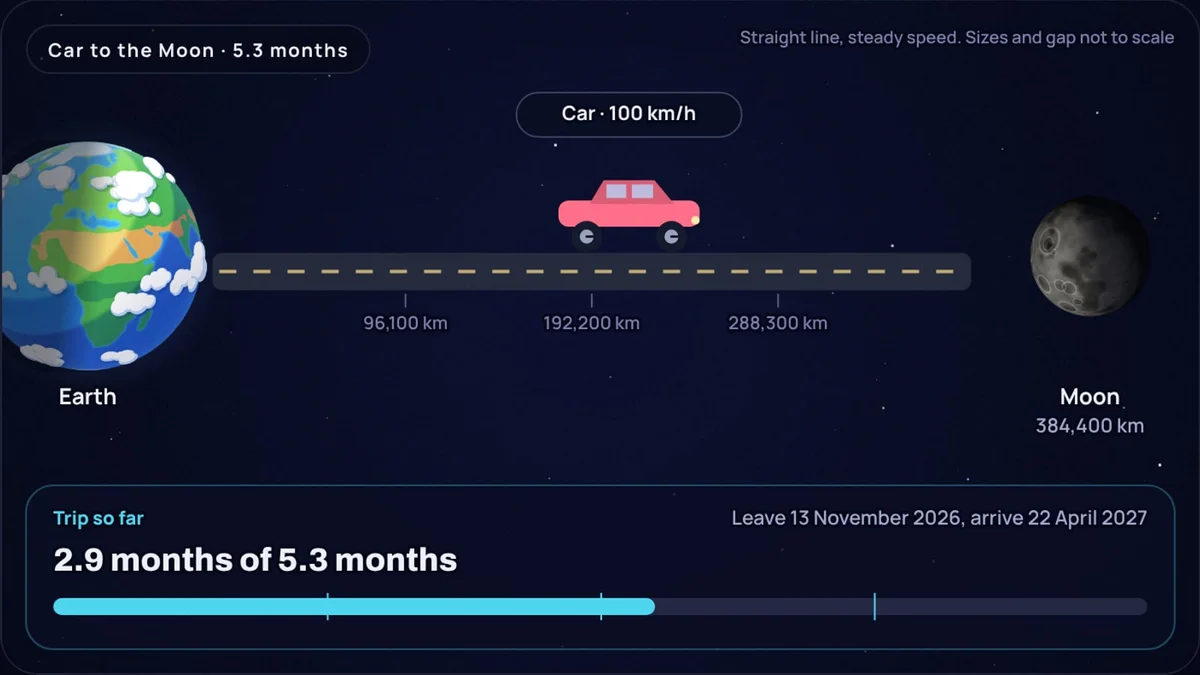
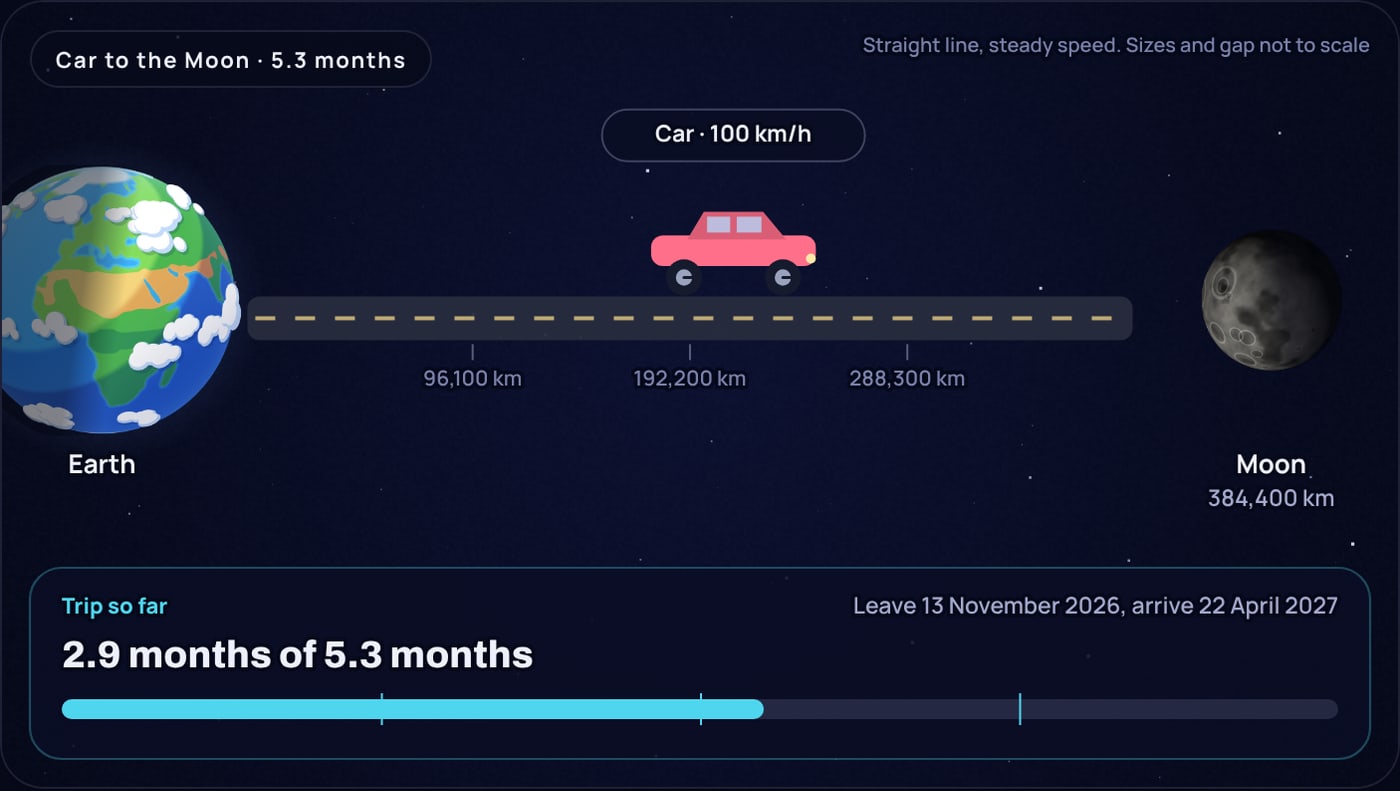
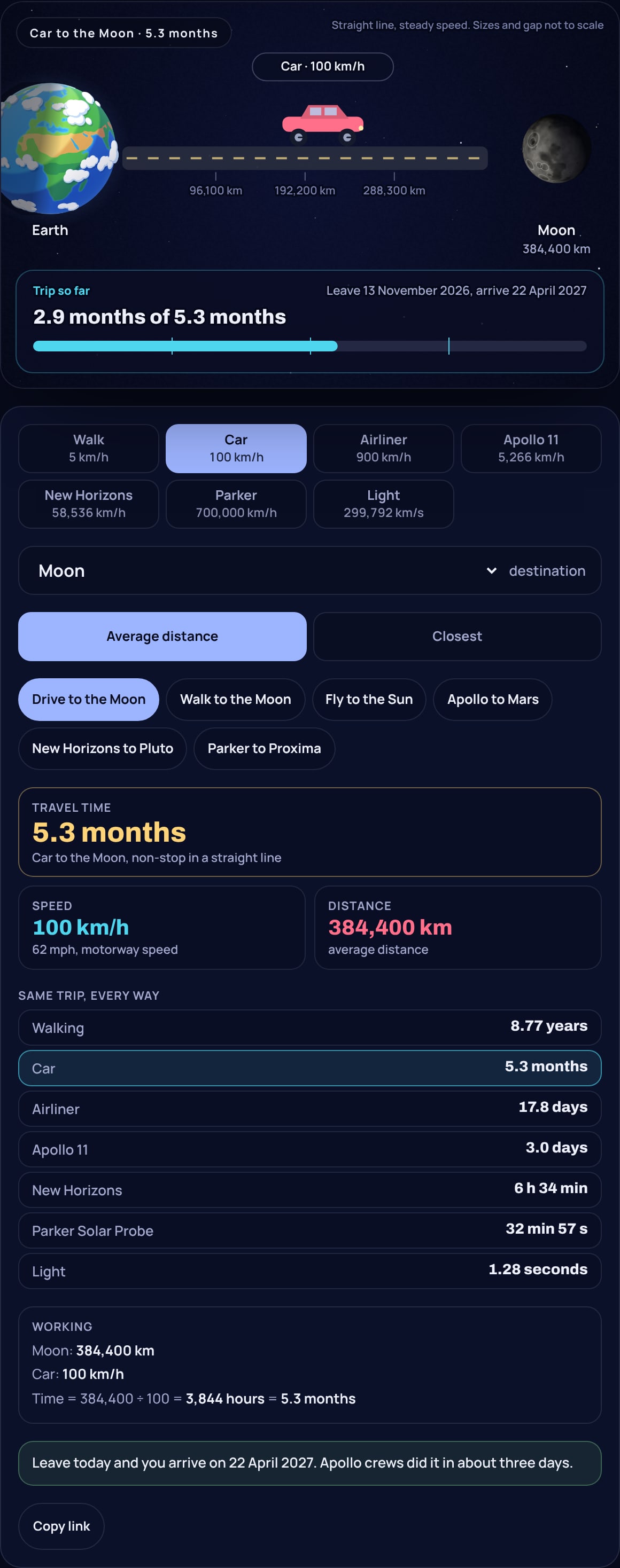
Set the cruise control to 100 km/h, point the bonnet at the Moon and do not stop. If you leave on 13 November 2026, you pull up on 22 April 2027, 160 days and 384,400 km later. It is a silly trip, but it turns a number that means nothing, 384,400 km, into one that does: five months behind the wheel.
This post works through the drive, then walking, flying and the way Apollo 11 actually did it, with every sum shown. The space travel time calculator runs the same arithmetic for seven ways of travelling and eleven destinations, from the Moon out to the nearest star, and draws the trip with a progress bar.
How far away is the Moon?
NASA's Moon fact sheet gives the semimajor axis of the Moon's orbit as 384,400 km. That is the average distance between the centres of Earth and the Moon. The orbit is slightly oval, so the distance swings between about 363,300 km at a typical perigee and 405,500 km at a typical apogee, a difference of 42,200 km, longer than a lap of the equator.
A road would run surface to surface, not centre to centre. Take off Earth's mean radius, 6,371 km, and the Moon's, 1,737.4 km, and the average gap shrinks to 376,292 km. For the headline figure this post sticks with the 384,400 km everyone quotes, and notes the difference where it matters.
How long would it take to drive to the Moon?
Time is distance divided by speed. With the distance in km and the speed in km/h, the answer comes out in hours.
Example 1: the drive at 100 km/h
Surface to surface, 376,292 km, saves 81 hours, about three and a half days. At perigee the drive is 3,633 hours (151 days); at apogee 4,055 hours (169 days).
In miles the Moon is 238,855 miles away on average, so at 60 mph the drive is 3,981 hours, or 166 days. At 70 mph it is 142 days.
What if you only drove eight hours a day?
Nobody drives for 160 days straight. Spread the same 3,844 hours over eight-hour days and the trip takes 480 days, about a year and four months. Take weekends off as well and it stretches to about 673 days on the calendar, roughly 1.8 years.
Fuel is the next problem. A car that uses 6 litres per 100 km, which is an assumption rather than a measured figure for any model, would burn:
Example 2: fuel for the drive
About 23,000 litres, roughly 460 fills of a 50-litre tank, with no filling stations after the first few kilometres. And of course there is no air for the engine to burn it in.
How long would it take to walk to the Moon?
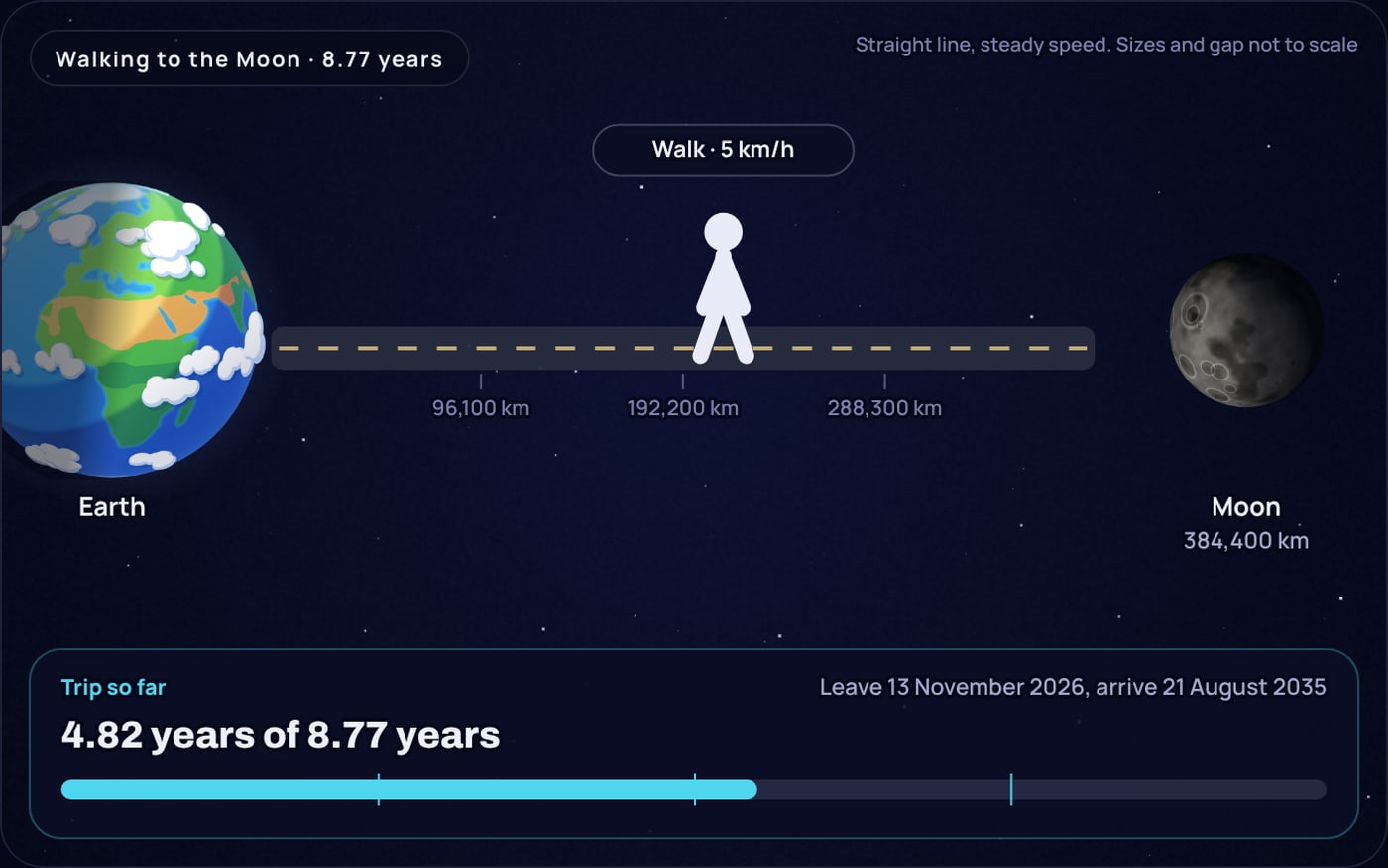
At a steady 5 km/h, 384,400 km takes 76,880 hours. That is 8.77 years of walking without sleep or a single break. Walking eight hours a day, every day, it would take about 26 years. A child setting out at birth would arrive in their mid-twenties.
How long would it take to fly to the Moon in a plane?
An airliner cruising at 900 km/h would need 427 hours, or 17.8 days. It could not actually do it, because jet engines need air and wings need air to push on, and both run out a few tens of kilometres up. But as a yardstick it is useful: the Moon is more than two weeks of non-stop jet flight away.
Here is the whole comparison, all at the Moon's average distance:
| How you travel | Speed | Time to the Moon |
|---|---|---|
| Walking | 5 km/h | 8.77 years |
| Car | 100 km/h | 5.3 months (160 days) |
| Airliner | 900 km/h | 17.8 days |
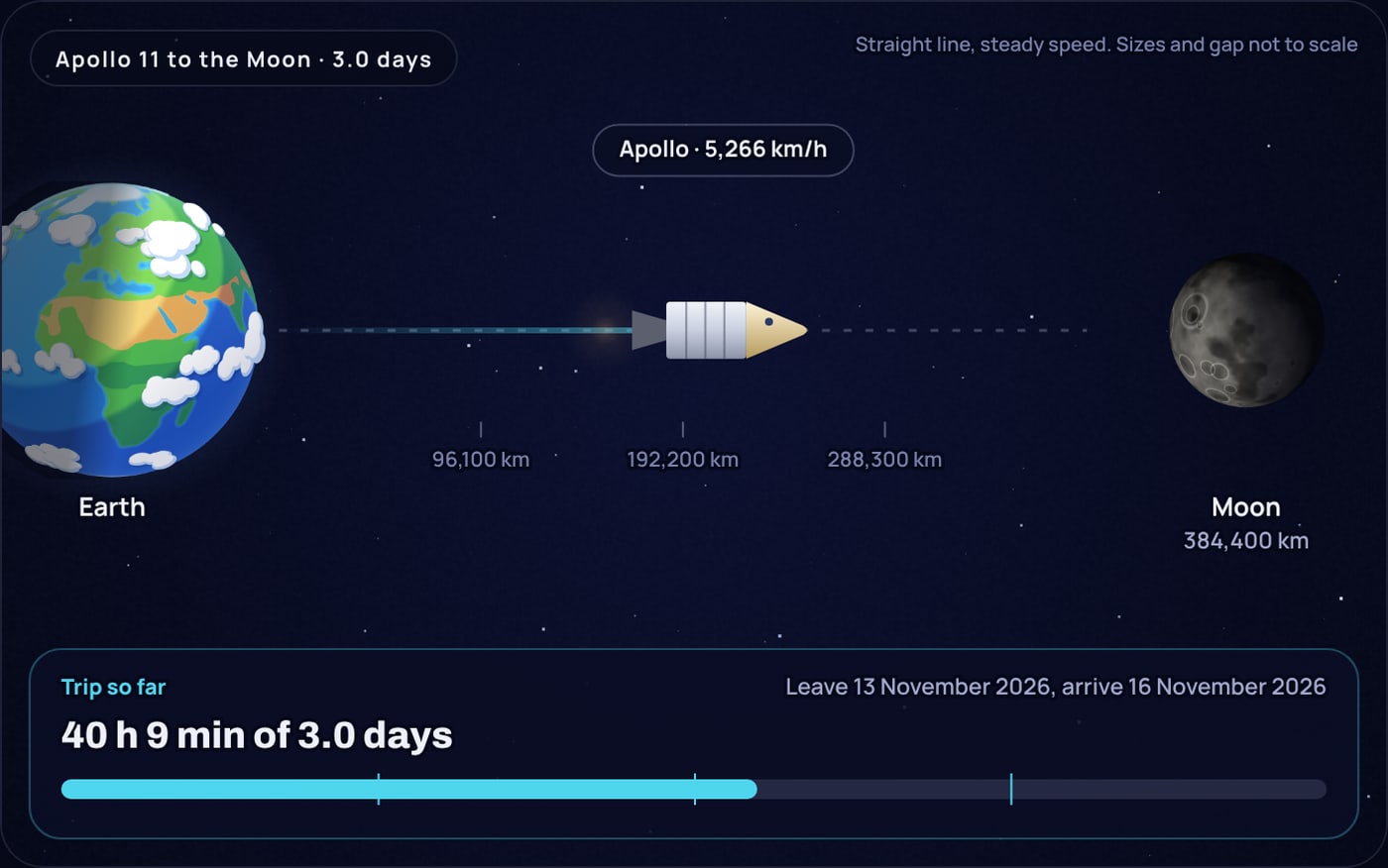
| Apollo 11 (average) | 5,266 km/h | 3.0 days |
| New Horizons (launch speed) | 58,536 km/h | 6 h 34 min |
| Parker Solar Probe (top speed) | 700,000 km/h | 32 min 57 s |
| Light | 299,792 km/s | 1.28 seconds |
New Horizons' figure is its launch speed, which NASA calls the highest launch velocity of any human-made object. At that speed the Moon would be under seven hours away, though a real launch takes time to build up speed. Parker Solar Probe's is its speed at closest approach to the Sun, about 700,000 km/h, which NASA says would carry it from Philadelphia to Washington, D.C. in one second.
How long did Apollo 11 take to get to the Moon?
About three days, and the timing is precise. NASA's record of the mission gives launch at 13:32 UT on 16 July 1969. After one and a half orbits of Earth, the third stage fired at 16:16:16 UT for 5 minutes 48 seconds, the translunar injection burn that sent the spacecraft towards the Moon. Lunar orbit insertion came at 17:21:50 UT on 19 July.
Example 3: Apollo 11's average speed
About 1.46 km/s on average, roughly 53 times faster than the car.
That average hides how uneven the trip was. Apollo 11 left the injection burn far faster than its average and then slowed for most of the way out as Earth's gravity pulled back on it, before the Moon's gravity sped it up again near the end. The engine was off for nearly all of those 73 hours. A car keeps its speed by burning fuel the whole way; a spacecraft gets almost all its speed at the start and coasts.
Could you really drive to the Moon in a straight line?
Even as a thought experiment, no. The Moon is not parked. NASA's fact sheet gives its mean orbital speed as 1.022 km/s and its orbit round Earth as 27.32 days. During a 160-day drive it would go round Earth 5.9 times. Aim at where it is now and you would arrive at an empty patch of sky.
Real missions handle this by aiming ahead. Apollo pointed at the place the Moon would be three days later, and the path was a long curve rather than a line. The straight-line times in the calculator are a way to feel the distance, not a flight plan.
The same goes further out, only more so. The planets all move round the Sun, so missions follow curved transfer orbits and launch when the planets line up. A straight-line drive to Mars at its closest would take 62 years, but a real spacecraft gets there in 6 to 8 months; the post on how long it takes to get to Mars and the Mars transfer simulation show why.
How long would it take to drive to the Sun or Pluto?
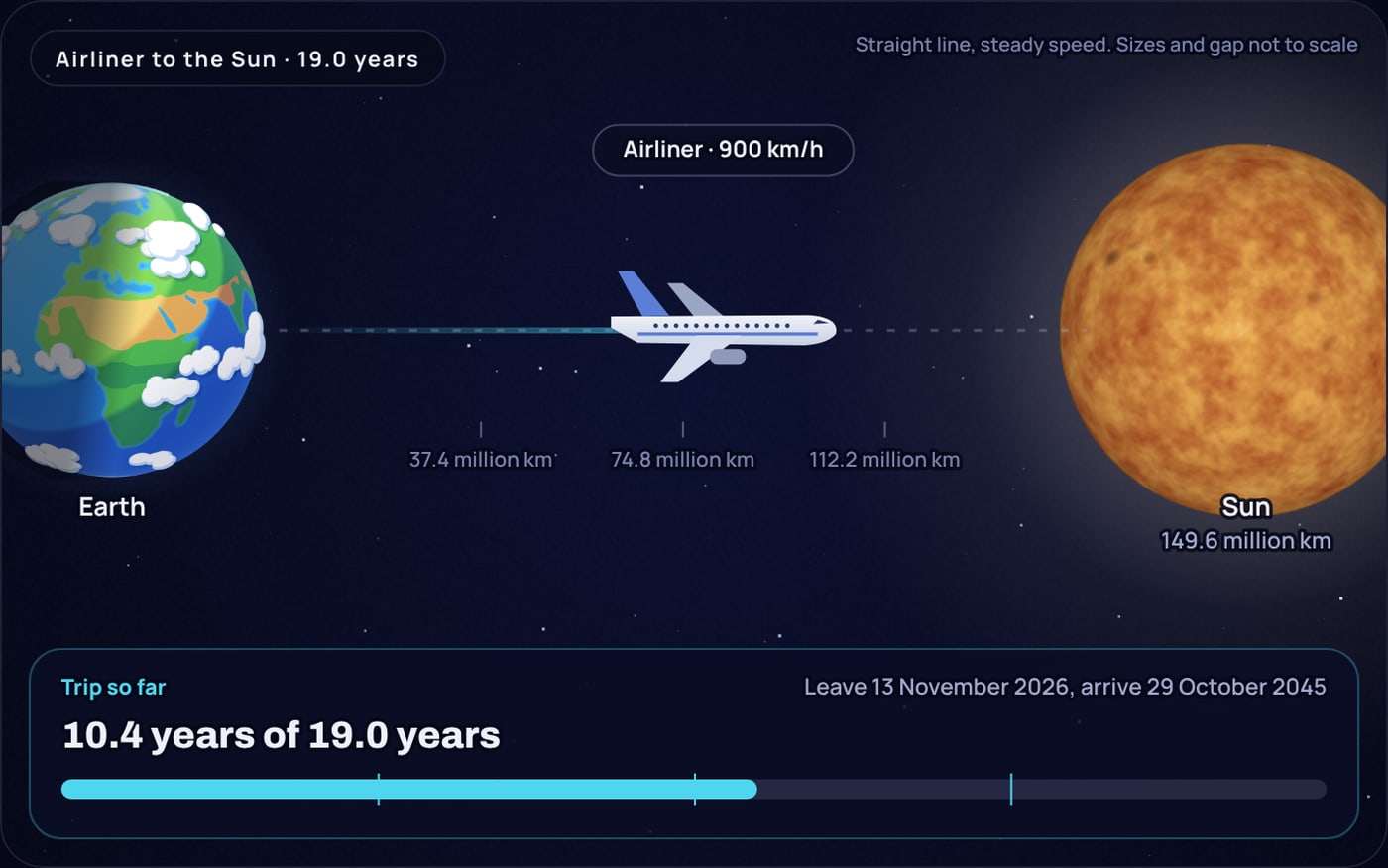
Keep the cruise control at 100 km/h and the numbers stop being months. The Sun, 149.6 million km away, is 171 years of driving, longer than any human life. Pluto, 6.09 billion km away on average, is about 6,900 years. The nearest star, Proxima Centauri, is 45.8 million years.
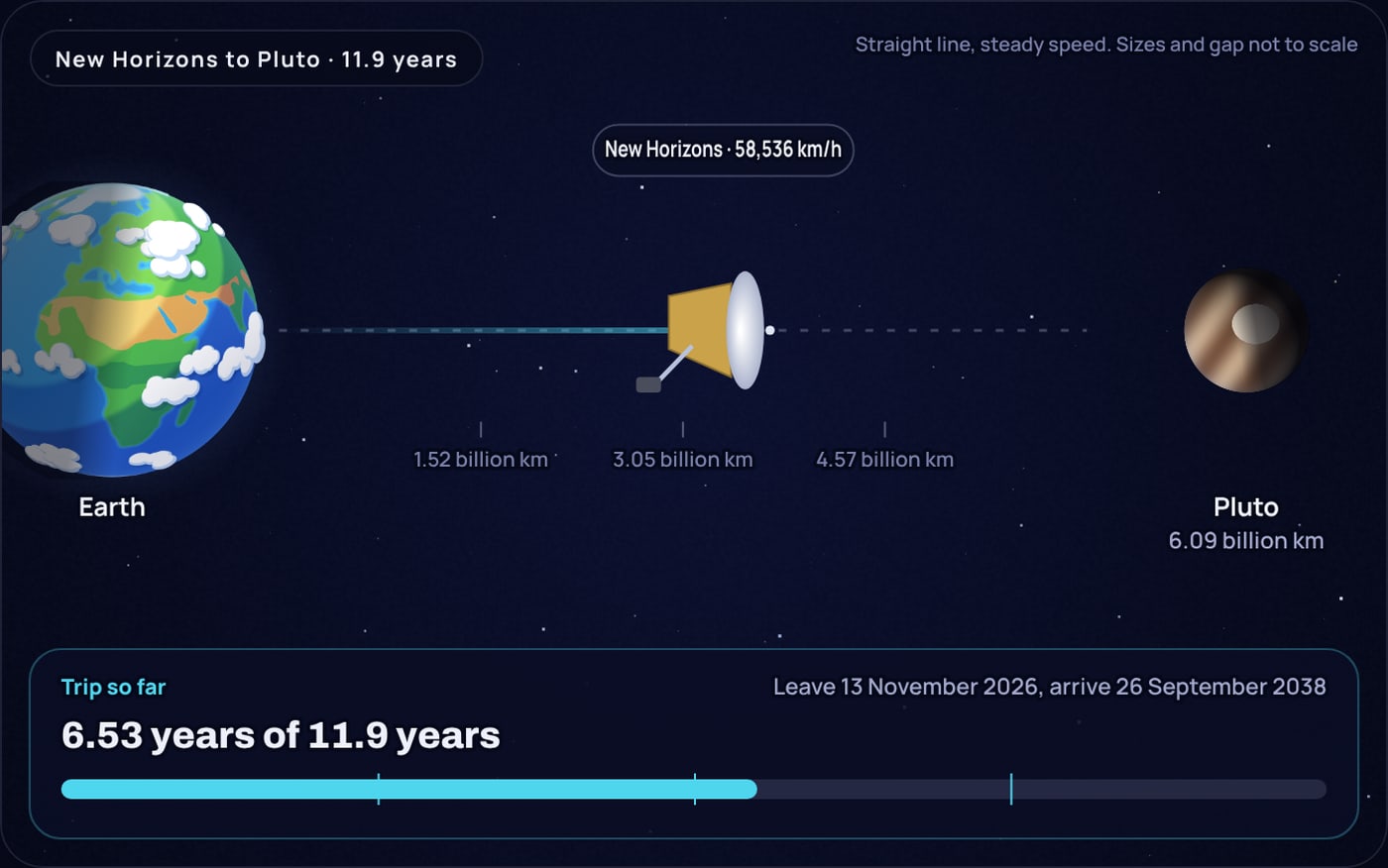
Even the fastest spacecraft barely dent those figures. At New Horizons' launch speed, Pluto's average distance is 11.9 years away in a straight line. The real New Horizons left on 19 January 2006 and flew past Pluto on 14 July 2015, nine and a half years later, helped by a swing past Jupiter that NASA says cut three years off the trip. Light, for comparison, does the Sun in 8 minutes 19 seconds; the post on how long sunlight takes to reach Earth works through that one.
Try it yourself
Open the space travel time calculator set to a drive to the Moon, then switch the destination to Mars and press "Closest", or change the vehicle to Parker Solar Probe and pick Proxima Centauri. The list under the results shows the same trip for every way of travelling at once.
Sources
- NASA NSSDCA, Moon fact sheet: semimajor axis 384,400 km, perigee 363,300 km, apogee 405,500 km, mean radius 1,737.4 km, mean orbital velocity 1.022 km/s, orbital period 27.3217 days.
- NASA NSSDCA, Earth fact sheet: mean radius 6,371 km, mean distance from the Sun 149.6 million km.
- NASA NSSDCA, Apollo 11 mission record: launch 13:32 UT on 16 July 1969, translunar injection at 16:16:16 UT for 5 min 48 s, lunar orbit insertion at 17:21:50 UT on 19 July.
- NASA Science, New Horizons: launch on 19 January 2006 at 58,536 km/h, Jupiter gravity assist, Pluto flyby on 14 July 2015.
- NASA Science, Parker Solar Probe: about 700,000 km/h at closest approach.
Frequently asked questions
How long would it take to drive to the Moon?
About 160 days, or 5.3 months, at a steady 100 km/h without stopping. The Moon’s average distance is 384,400 km, and 384,400 divided by 100 is 3,844 hours.
How long would it take to drive to the Moon at 60 mph?
About 166 days. The Moon is 238,855 miles away on average, which is 3,981 hours at 60 mph.
How long would it take to walk to the Moon?
About 8.8 years at 5 km/h without a single rest. Walking eight hours a day, it would take about 26 years.
How long did it take Apollo 11 to get to the Moon?
About three days. It launched on 16 July 1969, left Earth orbit that afternoon, and entered lunar orbit on 19 July after a 73-hour coast. The landing followed on 20 July.
Could you drive to the Moon in a straight line?
Not really, even in a thought experiment. The Moon moves round Earth at about 1 km/s and completes an orbit every 27.3 days, so during a 160-day drive it would go round almost six times. You would have to aim at where it will be.