How gravity assists speed up or slow down a spacecraft
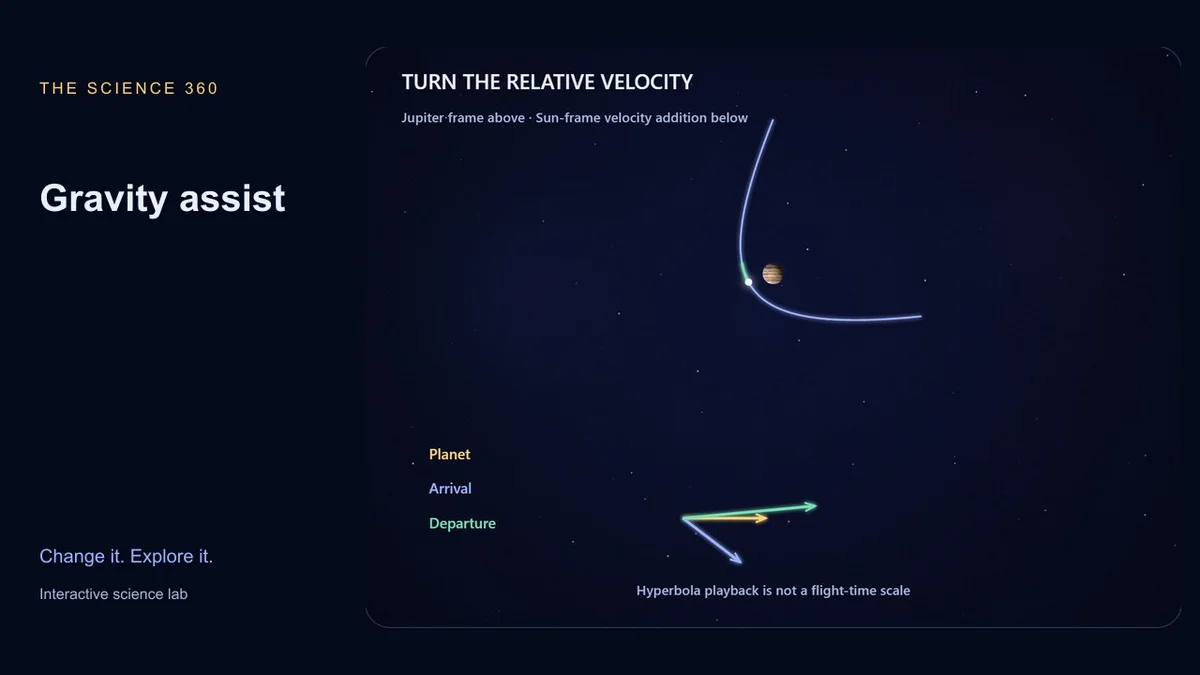
A spacecraft falling toward Jupiter speeds up, but it slows down again as it climbs away. How can the encounter still increase its speed around the Sun? The answer depends on which frame measures the velocity.
Try the Jupiter gravity assist simulator. Its path is drawn relative to Jupiter, while the velocity diagram explicitly adds Jupiter’s motion around the Sun. Keeping those two descriptions separate resolves the apparent contradiction.
Begin with the planet’s frame
Far before an ideal unpowered encounter, let the spacecraft approach Jupiter at 8 km/s relative to the planet. Far afterward, it still has 8 km/s in that frame. Gravity has changed the direction of the velocity vector, not its asymptotic length.
The path is a hyperbola. Its eccentricity e determines the turn angle δ:
e = 1 + rp v∞² / GM
δ = 2 asin(1/e)
rp is the closest distance from Jupiter’s centre, so it includes the planet’s radius as well as altitude. The symbol v∞ denotes the far-away relative speed. It is not the faster speed at closest approach.
Add the planet’s motion
The model uses a Jupiter orbital velocity of 13.07 km/s along a fixed direction. Add that vector to the incoming relative velocity, then add it to the turned outgoing relative velocity.
If the outgoing relative vector points more nearly along Jupiter’s motion, the total solar-frame vector can become longer. If it points less nearly along Jupiter’s motion, the spacecraft can lose solar-frame speed.
Load Gain speed, note both heliocentric readings, then load Lose speed. Both cases preserve the 8 km/s planet-relative asymptotic speed. They differ in the arrival direction and therefore in the vector sum.
A closer pass turns harder
Keep the incoming speed fixed and raise the closest altitude. The periapsis radius increases, eccentricity rises and the deflection angle becomes smaller. The high-altitude preset makes this effect easy to compare with the original pass.
Do not infer that the lowest available altitude is a sensible mission choice. A real flyby must consider the atmosphere, radiation, navigation uncertainty, moons and spacecraft constraints. Those effects are outside this two-body encounter model.
Where the energy comes from
The spacecraft exchanges a tiny amount of orbital energy and momentum with the moving planet. Treating Jupiter’s velocity as unchanged is an excellent teaching approximation because the spacecraft is so much less massive. It is not a claim that energy appears from nowhere.
The animated point moves along a sampled geometric path; its playback speed is not a physical flight-time prediction. Similarly, the solar-frame speed change is not automatically the launch fuel saved. A complete mission must connect the arrival and departure trajectories.
For a follow-up, compare this encounter with the Earth–Mars transfer simulation and identify which part of an interplanetary mission each model describes.
The live challenge asks for at least 10 km/s of solar-frame speed gain while keeping incoming relative speed at or below 8 km/s and closest altitude at or above 100,000 km. Start with the gain-speed preset and adjust the incoming direction. Explain your successful vector geometry before saving its link.
Sources and further reading
 5 amazing physics experiment for your kids
 50 Hilarious Physics Jokes That Will Make You Laugh