How can a moving planet give a spacecraft more speed?
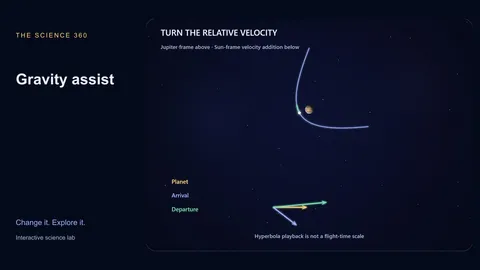
A gravity assist changes a spacecraft’s velocity relative to the Sun by turning its path around a moving planet. In an ideal unpowered flyby, its speed far from the planet is unchanged in the planet’s frame.
Choose an arrival direction and closest altitude. The orbit panel uses Jupiter’s frame; the velocity diagram explicitly adds Jupiter’s 13.07 km/s orbital velocity. The challenge is to gain at least 10 km/s with an incoming relative speed no greater than 8 km/s and an altitude of at least 100,000 km.
Read the companion article for a worked investigation, or continue with mars transfer.
What to look for
- The Jupiter-relative incoming and outgoing speeds have equal magnitude.
- A closer flyby or slower approach generally allows a larger turn angle.
- The heliocentric speed can rise or fall depending on the arrival direction and turn side.
Experiments to try
Load a complete preset, predict what will change, then adjust one control and compare the live measurements.
Gain speed
Guided experimentThe outgoing Jupiter-relative velocity points more nearly along Jupiter’s motion. Adding the planet’s velocity produces a larger outgoing heliocentric speed. The relative speed far before and after the encounter remains 8 km/s.
Lose speed
Guided experimentThe incoming relative velocity initially aligns with Jupiter’s motion. Turning it away lowers heliocentric speed. Gravity assists can remove orbital energy as well as add it; this is useful when heading inward.
Distant flyby
Guided experimentA higher periapsis weakens the turn. Compare the angle and velocity difference with the close pass. This experiment constrains the flyby altitude but does not design the interplanetary arrival or departure transfer.
Compare the cases
| What changes? | Planet frame | Sun frame |
|---|---|---|
| Velocity direction | Turns through δ | Changes |
| Far-away speed | Unchanged | Can increase or decrease |
| Closest approach | Hyperbolic periapsis | Part of a solar trajectory |
Rounded values and classifications refer to the model and assumptions on this page.
How the model works
The encounter is a two-body hyperbola with periapsis radius equal to Jupiter’s radius plus the selected altitude. Its eccentricity determines the deflection between the incoming and outgoing asymptotes.
A patched-conic velocity addition treats Jupiter’s solar velocity as constant during the encounter. The rendered hyperbola is sampled geometrically; playback along it is for explanation and is not proportional to physical flight time.
What the model leaves out
- No atmospheric drag, powered burns, radiation limits, moons or solar tidal acceleration.
- Jupiter is a spherical point-mass field outside its stated radius.
- Flyby speed change is not the same as saved launch delta-v or a complete mission trajectory.
Common misconceptions
A stationary planet cannot supply a net asymptotic speed increase in its own frame during an unpowered encounter. A gain in the solar frame comes with an imperceptibly small exchange of the planet’s orbital energy.
Frequently asked questions
Is the spacecraft faster at closest approach?
Yes, gravity accelerates it on approach and decelerates it afterward in the planet’s frame. The readouts compare the far-away asymptotic speeds, not periapsis speed.
Can the same planet slow a spacecraft?
Yes. Change the incoming direction or turn side and compare the solar-frame velocity vector lengths.
Keep learning
How gravity assists speed up or slow down a spacecraft
Resolve the gravity-assist puzzle by comparing planet-relative and Sun-relative velocities during a simplified Jupiter flyby.