Why do planets move faster when they are closer to their star?
A planet speeds up as it falls towards its star and slows down as it climbs away, and the speed follows an exact rule. Johannes Kepler found three laws for it. Orbits are ellipses with the star at one focus. The line from the star to the planet sweeps out equal areas in equal times. And the square of the orbital period equals the cube of the average distance divided by the star’s mass: T² = a³ ÷ M, with T in years, a in AU and M in Suns.
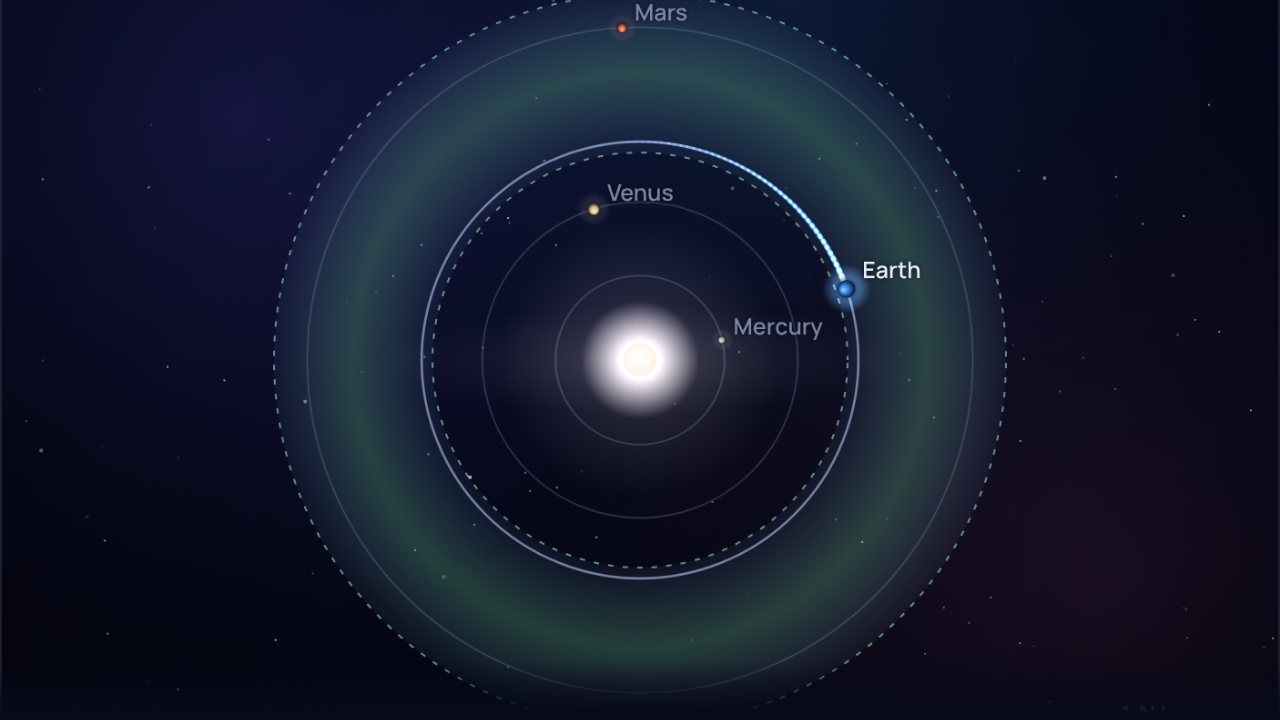
Drag the planet above and let go. It is launched sideways from that spot, and the eccentricity slider sets how fast, from a perfect circle up to escape. One AU is the Earth–Sun distance, about 150 million km, so Earth is simply a = 1, T = 1 and M = 1. The two shaded wedges cover the same stretch of time, so they have the same area even though one is short and fat and the other long and thin. That is the second law, drawn.
Key results from the simulation
- Speed: the vis-viva equation, v² = GM(2/r − 1/a), gives the speed at any distance r. A planet is fastest at its closest point, by a factor of (1 + e) ÷ (1 − e) over its slowest. For Halley’s comet that factor is about 60.
- Equal areas: the area swept per year is constant for each orbit. Earth sweeps about 3.14 AU² per year, Mercury about 1.9 and Halley’s comet about 3.4.
- Period: T = a^1.5 ÷ √M. Put a planet 4 times farther out and its year is 8 times longer. Double the star’s mass and the year shrinks by a factor of √2.
- Shape: e = 0 is a circle, e between 0 and 1 is an ellipse, and e = 1 is exactly escape speed. Escape speed is √2 times circular speed: 42.1 against 29.8 km/s at 1 AU from the Sun.
Six orbits to try
Each button loads the orbit above: the star, the closest distance and the eccentricity. Your own drags and slider moves then take over.
A circular orbit at 1 AU
e = 0 · the simplest caseIn a circle the speed never changes. At 1 AU around the Sun it is √(GM ÷ r) = 29.8 km/s, and one lap takes exactly one year. Circular speed falls with distance: about 47.9 km/s at Mercury’s distance, 13.1 at Jupiter’s and 5.4 at Neptune’s.
With e at 0 the velocity arrow keeps one length all the way round, and the two wedges have the same shape as well as the same area. Real orbits are never perfectly round, but Venus (e = 0.007) and Neptune (e = 0.009) come close.
Earth’s own orbit
e = 0.0167 · almost a circleEarth’s orbit is an ellipse, but only just. In early January Earth is 0.983 AU from the Sun and moves at 30.29 km/s. In early July it is 1.017 AU away and moves at 29.29 km/s, a change of only about 3.4 percent.
The path looks round on screen, yet the Sun sits visibly off-centre. This distance difference does not cause the seasons: Earth is nearest the Sun in northern winter. The seasons come from the 23.4 degree tilt of its axis.
Related reading: Top 20 interesting facts about our solar system
Mercury, the fast and lopsided one
e = 0.206 · a = 0.387 AUMercury has the most eccentric orbit of the eight planets. Its semi-major axis is 0.387 AU, so T = 0.387^1.5 = 0.241 years, which is 88 days. It swings between 0.307 and 0.467 AU from the Sun, moving at 58.98 km/s at the closest point and 38.86 km/s at the farthest.
That ratio of 1.52 equals (1 + e) ÷ (1 − e). Small orbits are quick because gravity is stronger close in, so a planet must move faster to avoid falling into the star. The same rule explains the brown dwarf in this report, which circles its star in 2.3 hours.
Halley’s comet, a very long ellipse
e = 0.967 · a ≈ 17.8 AUHalley’s comet comes within 0.586 AU of the Sun, between Mercury and Venus, and heads out to about 34.9 AU, beyond Neptune. With a ≈ 17.8 AU, T = 17.8^1.5 ≈ 75 years. The real period varies from about 74 to 79 years because Jupiter and Saturn tug on it, which this model leaves out.
It moves at 54.6 km/s at the closest point and only 0.92 km/s at the farthest, a factor of about 60. Compare the wedges: the one near the Sun is long and thin, the one on the far side short and wide, yet their areas match. By the same law the comet spends about 93 percent of its time beyond Saturn’s distance, and rushes through the inner solar system.
Earth’s orbit around a star twice the Sun’s mass
M = 2 · same shape, faster clockKeep Earth’s orbit but put a 2 solar mass star in the middle. The path keeps its size and shape, which depend only on the closest distance and eccentricity. The timing changes: speeds rise by √2 to 41.4–42.8 km/s, and the year drops to 1 ÷ √2 = 0.707 years, or 258 days.
Doubling the mass does not double the speed or halve the year, because speed depends on √(GM). Such a star would also be about 16 times brighter. That side of the story is in the Replace the Sun simulation and the post What if we replace the Sun?.
Escape speed at 1 AU
e = 1 · the edge between bound and freeAt e = 1 the planet is launched at exactly escape speed, √(2GM ÷ r) = √2 × circular speed, which is 42.1 km/s at 1 AU from the Sun. The path is a parabola. The planet slows as it leaves, to 13.3 km/s at 10 AU and 4.2 km/s at 100 AU, but never quite stops or returns.
Slide into the orange zone above 1 and the path becomes a hyperbola: the planet leaves with speed to spare. There is no period then, so the panel shows that leftover speed instead. The simulation relaunches the planet once it has left the view.
Kepler’s third law across the solar system
| Body | a (AU) | T (yr) | T² (yr²) | a³ (AU³) | Circular speed at a (km/s) |
|---|---|---|---|---|---|
| Mercury | 0.387 | 0.241 | 0.058 | 0.058 | 47.9 |
| Venus | 0.723 | 0.615 | 0.378 | 0.378 | 35.0 |
| Earth | 1.000 | 1.000 | 1.000 | 1.000 | 29.8 |
| Mars | 1.524 | 1.881 | 3.540 | 3.540 | 24.1 |
| Jupiter | 5.203 | 11.87 | 140.9 | 140.9 | 13.1 |
| Saturn | 9.537 | 29.45 | 867.4 | 867.4 | 9.6 |
| Neptune | 30.07 | 164.9 | 27,189 | 27,189 | 5.4 |
| Halley’s comet | 17.8 | 75.1 | 5,640 | 5,640 | 7.1 |
Periods are computed from T = a^1.5 for a star of 1 solar mass, so T² and a³ match by construction. They agree with measured periods to within a fraction of a percent. The last column is the speed of a circular orbit at that distance; Halley’s comet is not circular, so its real speed runs from 0.92 to 54.6 km/s.
How the simulation works
The planet really falls under gravity. Each frame the simulation integrates Newton’s law, with acceleration GM ÷ r² towards the star and GM = 4π² M in AU³ per year². That constant is Kepler’s third law for Earth. Fourth-order Runge-Kutta steps of about 1.2 percent of the local orbital time keep the error far too small to see, so the ellipse and the equal areas come out of the motion instead of being drawn in.
When you let go at distance q, the planet is launched sideways at v = √(GM(1 + e) ÷ q). From that follow a = q ÷ (1 − e), the farthest distance Q = a(1 + e) and T = 2π √(a³ ÷ GM). The dashed line is the exact curve r = q(1 + e) ÷ (1 + e cos θ). Wedge areas are measured from the recorded path with the shoelace formula, so the numbers in the corner are measurements. Playback speed adjusts so a lap takes seconds, and the clock shows the ratio.
What the model leaves out
- Other planets: real orbits are pulled by neighbours and slowly turn. Neptune was found because Uranus drifted off its predicted path, as covered in Top 20 interesting facts about our solar system.
- Relativity: Newton’s law misses about 43 arcseconds per century of the turning of Mercury’s orbit, which general relativity explains.
- Planet mass: the star and planet both circle their common centre of mass. For the Sun and Jupiter that point lies just outside the Sun. The model treats the planet as weightless.
- Size and drag: stars and planets are points, with no collisions, tides or air resistance, and are not drawn to scale.
- Flat, sideways launches: the orbit stays in one plane and you always launch sideways. Every orbit has a closest point where its motion is exactly sideways, so this covers every shape.
Common misconceptions
“Planets travel at a steady speed.” Only a circle does. Every other orbit speeds up near the star, and Halley’s comet changes speed by a factor of 60.
“The star sits in the middle of the ellipse.” It sits at one focus, off to one side. For an orbit as long as Halley’s that is almost at one end.
“Escape speed is one fixed number.” It depends on where you are: √(2GM ÷ r). It is 42.1 km/s at 1 AU from the Sun but only 13.3 km/s at 10 AU.
Frequently asked questions
Why do planets speed up when they get closer to the star?
Two views of one fact. Falling inward turns gravitational energy into motion. Also, gravity pulls straight at the star and cannot twist the orbit, so distance times sideways speed stays constant: halve the distance and the sideways speed doubles. That constant is Kepler’s second law.
What is eccentricity?
It measures how stretched an orbit is: e = (Q − q) ÷ (Q + q), where Q is the farthest and q the closest distance. A circle has e = 0, Earth 0.017, Mercury 0.206 and Halley’s comet 0.967. At e = 1 the orbit opens into a parabola and the planet escapes.
How do I use T² = a³ in practice?
Put T in years and a in AU for a star of one solar mass. Mars has a = 1.524 AU, so T = 1.524^1.5 = 1.88 years. It works backwards too: Jupiter’s 11.86 year period gives a = 11.86^(2/3) = 5.20 AU. For another star, divide a³ by its mass in Suns.
Does this work for moons, exoplanets and binary stars?
Yes, for anything orbiting under gravity. Use the combined mass of both bodies, in solar masses, for M. The 2.3 hour orbit in this report follows the same T² = a³ ÷ M rule, with a very small a.
Is escape speed the same as e = 1?
Yes. Launched sideways at √2 times circular speed, the planet has exactly zero total energy and follows a parabola. Any slower and it stays bound on an ellipse. Any faster and it follows a hyperbola and keeps some speed forever.
Why does the simulation always launch sideways from where I let go?
That point becomes the orbit’s closest point, where the planet moves exactly sideways. Every flat orbit has one, so a closest distance q and an eccentricity e describe every shape, and only the orientation depends on where you let go. Launches that start with the planet moving towards or away from the star give the same ellipses, just reached from another point.
Keep learning
Top 20 Interesting Facts About Our Solar System
Here, we'll delve into the top 10 interesting facts about our solar system that will leave you in awe of the cosmos
What if we Replace the SUN?
What if we dared to swap out the Sun for some of the most massive and intriguing objects in the cosmos? let's find out
Bizarre object is orbiting a distant star at most speed
This object, known as WD0032-317B, is a brown dwarf that's hotter than our sun and orbits a distant star at an astonishing speed...