What is the difference between elastic and inelastic collisions?
In every collision the total momentum is the same before and after. In an elastic collision the total kinetic energy is also kept; in an inelastic one some of it turns into heat, sound and deformation. The coefficient of restitution e, the separation speed divided by the approach speed, measures where a collision sits: e = 1 is elastic, e = 0 means the bodies stick together.
The simulation solves the two equations that decide every head-on collision, conservation of momentum and the restitution condition, and shows the result as moving trolleys, momentum and energy bars, and the equations with your numbers in them. Two equal 1 kg trolleys at 2 m/s and at rest swap velocities when e = 1, and move off together at 1.00 m/s when e = 0, losing 50% of the kinetic energy. Try the car crash and the Newton’s cradle presets, and read how Newton’s cradle works for the full story of the toy.
Key results from the simulation
- Equal masses, elastic: the moving trolley stops dead and the other leaves at the same 2.00 m/s. Momentum (2.00 kg·m/s) and kinetic energy (2.00 J) are both unchanged.
- Equal masses, sticky: they move off together at 1.00 m/s. Momentum is still 2.00 kg·m/s, but kinetic energy falls from 2.00 J to 1.00 J.
- Heavy hits light: a 4 kg trolley at 2 m/s sends a 1 kg one off at 3.20 m/s and carries on at 1.20 m/s. Light hits heavy: the 1 kg trolley bounces back at 1.20 m/s.
- Car crash at 50 km/h: a 1,500 kg car hitting a parked 1,000 kg car, locking together, leaves at 8.34 m/s (30 km/h) and 57,963 J, 40% of the kinetic energy, goes into crushing metal.
- Energy lost = (1 − e²) × ½μ(u₁ − u₂)²: it depends only on the reduced mass μ, the closing speed and e. With e = 0.9 equal trolleys lose 10%; with e = 0.5, 38%.
Six collisions worth trying
Each setup shows the numbers the simulation computes and what to look for. Velocities are positive to the right. The button loads the setup.
Equal masses, elastic: a perfect handover
e = 1A 1 kg trolley at 2 m/s hits an identical one at rest with springy bumpers. Momentum says 1 × 2 = 1 × v₁ + 1 × v₂. Restitution with e = 1 says v₂ − v₁ = 2. The only answer is v₁ = 0 and v₂ = 2.00: the first trolley stops and the second takes all the motion.
This is the whole trick of a Newton’s cradle and of a cue ball that stops dead after a straight shot in snooker. In the centre of mass frame, which moves at 1.00 m/s, both trolleys simply reverse.
Perfectly inelastic: half the energy disappears
e = 0Swap the springs for Velcro and the same two trolleys stick. Momentum still has to be 2.00 kg·m/s, now carried by 2 kg, so they move off at 1.00 m/s. Kinetic energy is ½ × 2 × 1.00² = 1.00 J, down from 2.00 J.
The missing 1.00 J warmed the Velcro and the trolleys and made the noise. For a moving body hitting an equal one at rest, a perfectly inelastic collision always loses exactly half. In general the loss is m₂ ÷ (m₁ + m₂) of the starting energy when the target is at rest.
Heavy hits light, light hits heavy
e = 1, masses 4 kg and 1 kgA 4 kg trolley at 2 m/s hitting a 1 kg trolley elastically keeps going at 1.20 m/s and fires the small one off at 3.20 m/s, faster than it arrived. The formulas are v₁ = (m₁ − m₂) ÷ (m₁ + m₂) × u₁ and v₂ = 2m₁ ÷ (m₁ + m₂) × u₁; as the big mass gets heavier, v₂ approaches twice u₁. That is why a bat sends a ball off faster than the bat is swinging, and why a spacecraft swinging past a moving planet comes away faster, as the gravity assist simulator shows.
Reverse the masses and the 1 kg trolley rebounds at 1.20 m/s while the 4 kg one creeps forward at 0.80 m/s. Momentum still balances: 1 × (−1.20) + 4 × 0.80 = 2.00 kg·m/s.
Head on at e = 0.5
Opposite directionsA 2 kg trolley at 1.5 m/s meets a 1 kg trolley coming the other way at 2 m/s. Total momentum is 2 × 1.5 + 1 × (−2) = 1.00 kg·m/s, small because the two nearly cancel. They close at 3.5 m/s and, with e = 0.5, separate at 1.75 m/s.
Solving gives -0.25 m/s for the heavy trolley (it reverses) and 1.50 m/s for the light one. Kinetic energy falls from 4.25 J to 1.19 J, a loss of 72%: head-on collisions are destructive because most of their energy is relative motion, which is the part a collision can remove.
A 50 km/h crash into a parked car
Perfectly inelasticA 1,500 kg car at 13.9 m/s (50 km/h) runs into a parked 1,000 kg car and the two lock together. Momentum is 1,500 × 13.9 = 20,850 kg·m/s, shared by 2,500 kg, so the wreck moves off at 8.34 m/s, 30 km/h.
The parked car goes from 0 to 30 km/h in the tenth of a second or so the crash lasts, which is what injures its occupants. Kinetic energy falls from 144,908 J to 86,945 J; the 57,963 J lost, 40%, is roughly the energy needed to lift the bigger car about 4 metres, and it goes into the crumple zones. Crumple zones are designed to absorb it slowly.
Newton’s cradle: one in, one out
Five steel ballsLift one ball and let go. With e = 1 the moving ball hands its velocity to the next, which hands it on, until the last ball swings out to the same height. Two balls in gives two balls out, because that is the only outcome that keeps both momentum and kinetic energy.
Set e to 0.9 with the Real cradle preset and the middle balls start to move. After 10 seconds the model has 20% of its energy left with all five balls swinging together: one ball’s momentum shared by five balls carries exactly one fifth of the energy.
Related reading: How Newton’s cradle works
Coefficient of restitution of real objects
| Object | Test | Coefficient of restitution e | Energy kept in a bounce |
|---|---|---|---|
| Table tennis ball | Dropped 30.5 cm onto steel, rebounds 24 to 26 cm | 0.89 to 0.92 | 79% to 85% |
| Golf driver face | USGA limit for a ball fired at the club face | at most 0.83 | not a drop test |
| Basketball | FIBA: 1,800 mm drop, rebounds 1,035 to 1,085 mm | 0.76 to 0.78 | 57% to 60% |
| Tennis ball | ITF: 254 cm drop, rebounds 135 to 147 cm | 0.73 to 0.76 | 53% to 58% |
| Cars in a crash | Crumple and often lock together | close to 0 | little |
For a drop test onto a heavy floor, e = √(rebound height ÷ drop height), and the share of kinetic energy kept is e². Values come from the governing bodies’ ball specifications; see the sources in the companion post.
How the simulation works
Two equations decide a head-on collision between bodies of mass m₁ and m₂ moving at u₁ and u₂. Momentum is conserved: m₁u₁ + m₂u₂ = m₁v₁ + m₂v₂. The bodies separate at e times the speed they approached at: v₂ − v₁ = e(u₁ − u₂). Solving them gives v₁ = (m₁u₁ + m₂u₂ + m₂e(u₂ − u₁)) ÷ (m₁ + m₂) and v₂ = (m₁u₁ + m₂u₂ + m₁e(u₁ − u₂)) ÷ (m₁ + m₂). The panel shows these with your numbers.
The kinetic energy lost is (1 − e²) × ½μ(u₁ − u₂)², where μ = m₁m₂ ÷ (m₁ + m₂) is the reduced mass. Only the motion relative to the centre of mass can be lost; the centre of mass keeps moving at (m₁u₁ + m₂u₂) ÷ (m₁ + m₂) whatever happens.
The stage replays each collision on a loop: the bodies approach at their starting velocities, touch at the centre, and leave at the computed velocities, with faint strobe images every half second. The bumpers change with e (springs when bouncy, Velcro when sticky). The bars stack each body’s share; the dashed rose block is the kinetic energy lost. For cars the mass sliders read in tonnes.
The Newton’s cradle is five 30 cm pendulums integrated in small time steps. When two neighbouring balls touch while approaching, they collide with the chosen e, and the code repeats the pairwise collisions until no touching pair is still closing. That sequential model is the standard explanation of the cradle and reproduces one in, one out.
What the model leaves out
- Only head-on collisions: everything moves along one line. Glancing collisions need momentum conserved in two directions.
- e is treated as fixed: real coefficients of restitution fall as impact speed rises, so a ball dropped from higher bounces back a slightly smaller fraction.
- Friction and rolling: the trolleys roll without friction and the balls do not spin.
- Collision time: the bodies change velocity instantly. Real impacts take milliseconds, and the forces involved depend on that time.
- Real cradles: the gaps between balls, their alignment and wave effects in the steel all matter; in a well made cradle the motion lasts much longer than the e = 0.9 preset suggests.
Common misconceptions
"In an inelastic collision momentum is lost." No. Momentum is conserved in every collision, elastic or not, as long as no outside force acts. It is kinetic energy that is lost.
"Energy is destroyed in an inelastic collision." Total energy is conserved; the kinetic energy turns into heat, sound and the work of deforming the bodies.
"A Newton’s cradle could keep going forever." Even the best cradle loses a little energy at every hit, to sound, heat and air drag, and eventually all the balls swing together and then stop.
Frequently asked questions
What is the difference between elastic and inelastic collisions?
Both conserve momentum. An elastic collision also conserves kinetic energy, so the bodies bounce apart as fast as they came together. An inelastic collision turns some kinetic energy into heat, sound and deformation. A perfectly inelastic collision is one where the bodies stick together.
What is the coefficient of restitution?
The speed the bodies separate at divided by the speed they approached at, e = (v₂ − v₁) ÷ (u₁ − u₂). It runs from 0 (they stick) to 1 (elastic). For a ball dropped on a hard floor, e = √(bounce height ÷ drop height): a tennis ball meeting the ITF test has e of 0.73 to 0.76.
Is momentum conserved in an inelastic collision?
Yes. Total momentum is conserved in every collision when no outside force acts. In the sticky trolley preset momentum is 2.00 kg·m/s before and after, while kinetic energy drops from 2.00 J to 1.00 J.
How much kinetic energy is lost in a perfectly inelastic collision?
If the target is at rest, the fraction lost is m₂ ÷ (m₁ + m₂): half for equal masses, 40% for a 1,500 kg car hitting a parked 1,000 kg car. In general the loss is ½μ(u₁ − u₂)², with μ the reduced mass.
Why does a Newton’s cradle send out the same number of balls?
For equal steel balls in nearly elastic collisions, the only way to conserve both momentum and kinetic energy is for the same number of balls to leave at the same speed. Two balls out at half speed would carry the right momentum but only half the energy.
Why do cars have crumple zones if momentum is conserved anyway?
Momentum fixes how much each car’s velocity changes, but not how quickly. A crumple zone stretches the collision over a longer time and distance, so the same change of momentum needs a smaller force on the people inside.
Keep learning
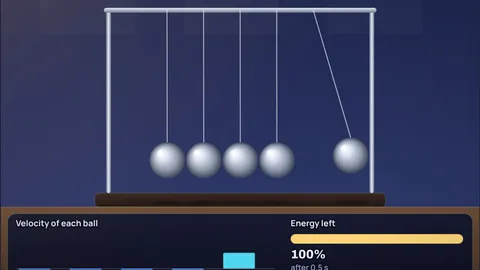
How Newton's Cradle Works, and Why Momentum Is Conserved
Lift one ball and exactly one flies out. Two balls at half speed would carry the same momentum but only half the energy. The physics, with numbers.
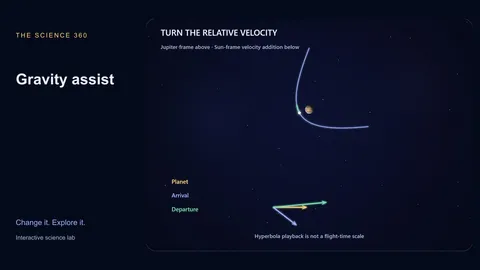
How gravity assists speed up or slow down a spacecraft
Resolve the gravity-assist puzzle by comparing planet-relative and Sun-relative velocities during a simplified Jupiter flyby.

Is Kessler Syndrome Real? Gravity's Debris vs Reality
Is Kessler syndrome real? Yes, but it unfolds over decades, not Gravity's 90 minutes. Real debris counts, collision speeds and impact energies, computed.
5 amazing physics experiment for your kids
Physics is a fascinating subject that explores the fundamental laws governing the universe. Teaching physics to kids can be a challenging task