How Newton's Cradle Works, and Why Momentum Is Conserved
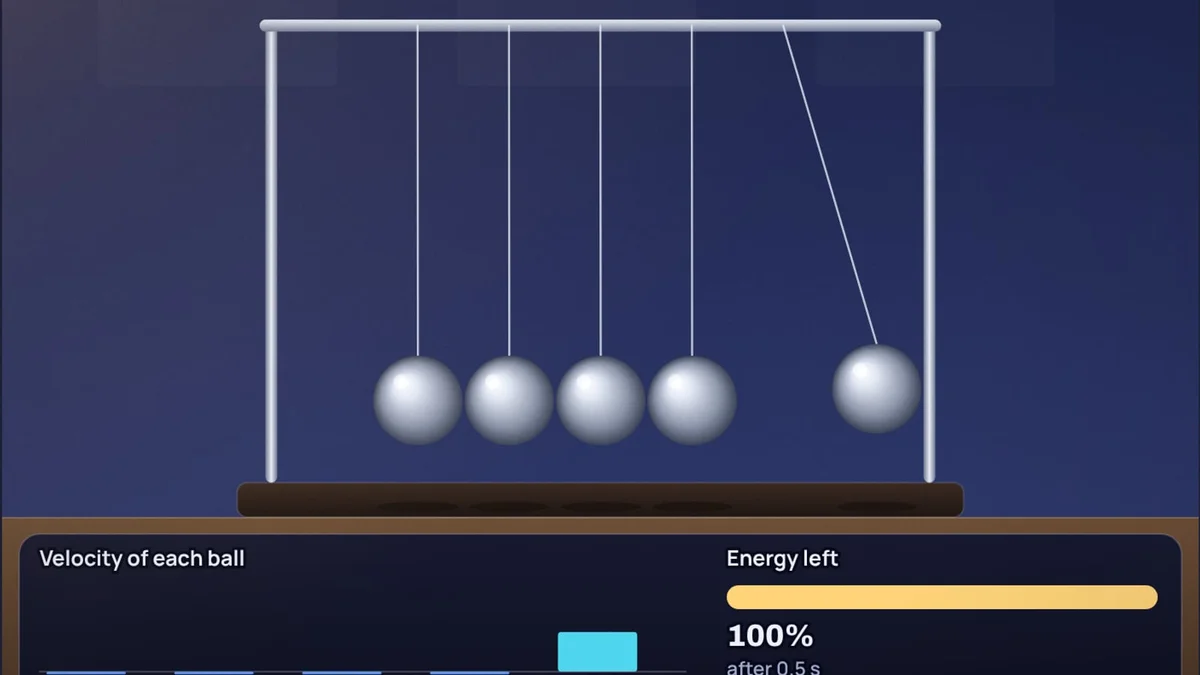
Lift the end ball of a Newton's cradle a few centimetres and let go. It clacks into the row, stops dead, and the ball at the far end flies out to almost the same height. Lift two, and two fly out. Nobody is surprised any more, but it is worth asking why it is never one ball out at double speed, or two balls out at half speed. Both of those would carry exactly the right momentum.
The answer needs two conservation laws working together, and it is the same physics that decides every collision, from snooker balls to car crashes. The collision and Newton's cradle simulator lets you change masses, speeds and the bounciness of every collision and watch the momentum and energy bars.
Why is momentum conserved in a collision?
Newton's third law. While two balls are touching, ball A pushes on ball B with some force and B pushes back on A with an equal force in the opposite direction, for exactly the same time. Force times time is the change in momentum (the impulse), so whatever momentum B gains, A loses:
Nothing in that argument cares whether the balls bounce, stick, or crumple. Momentum is conserved in every collision as long as no outside force acts during the impact. Kinetic energy is a different story.
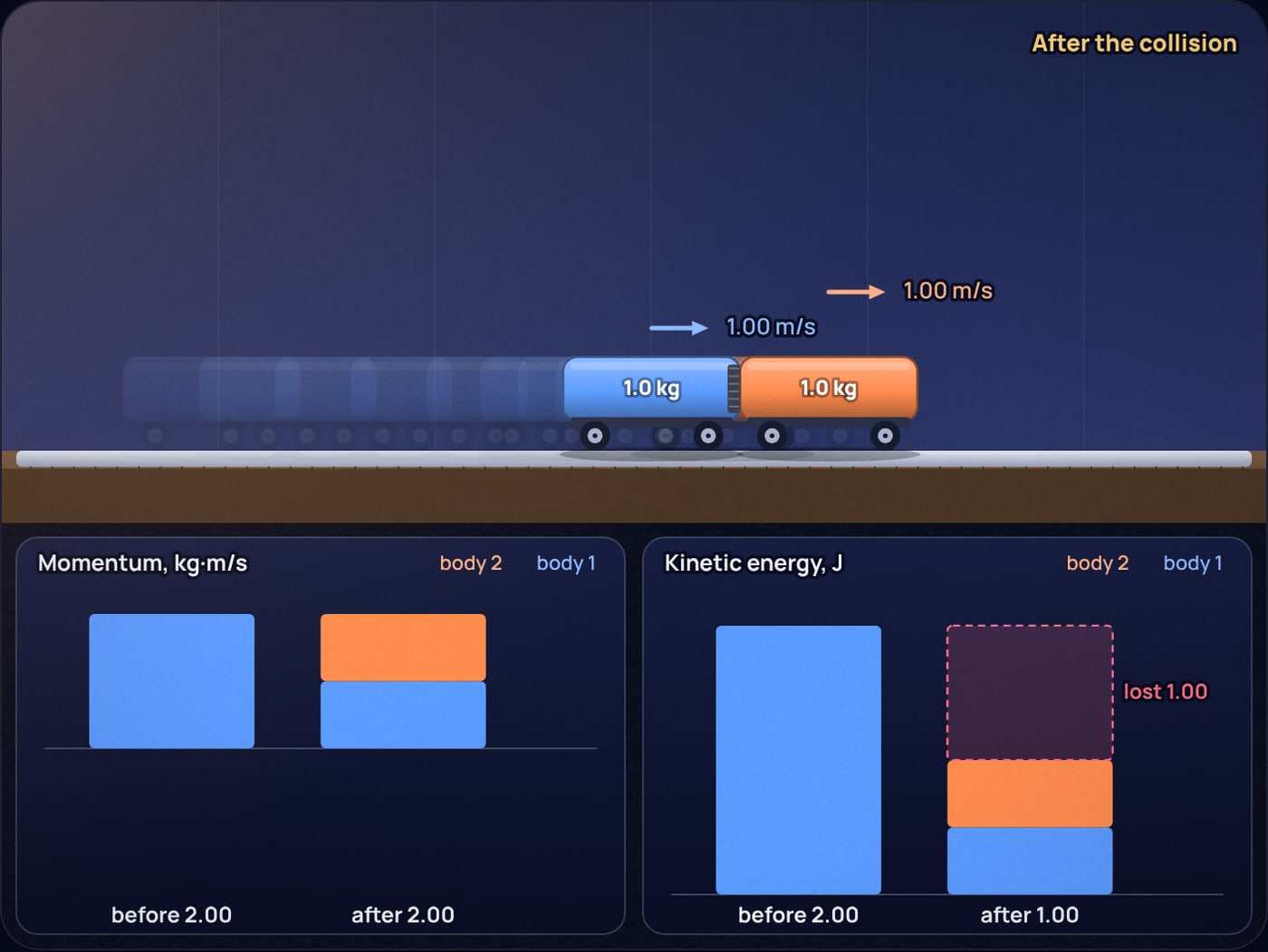
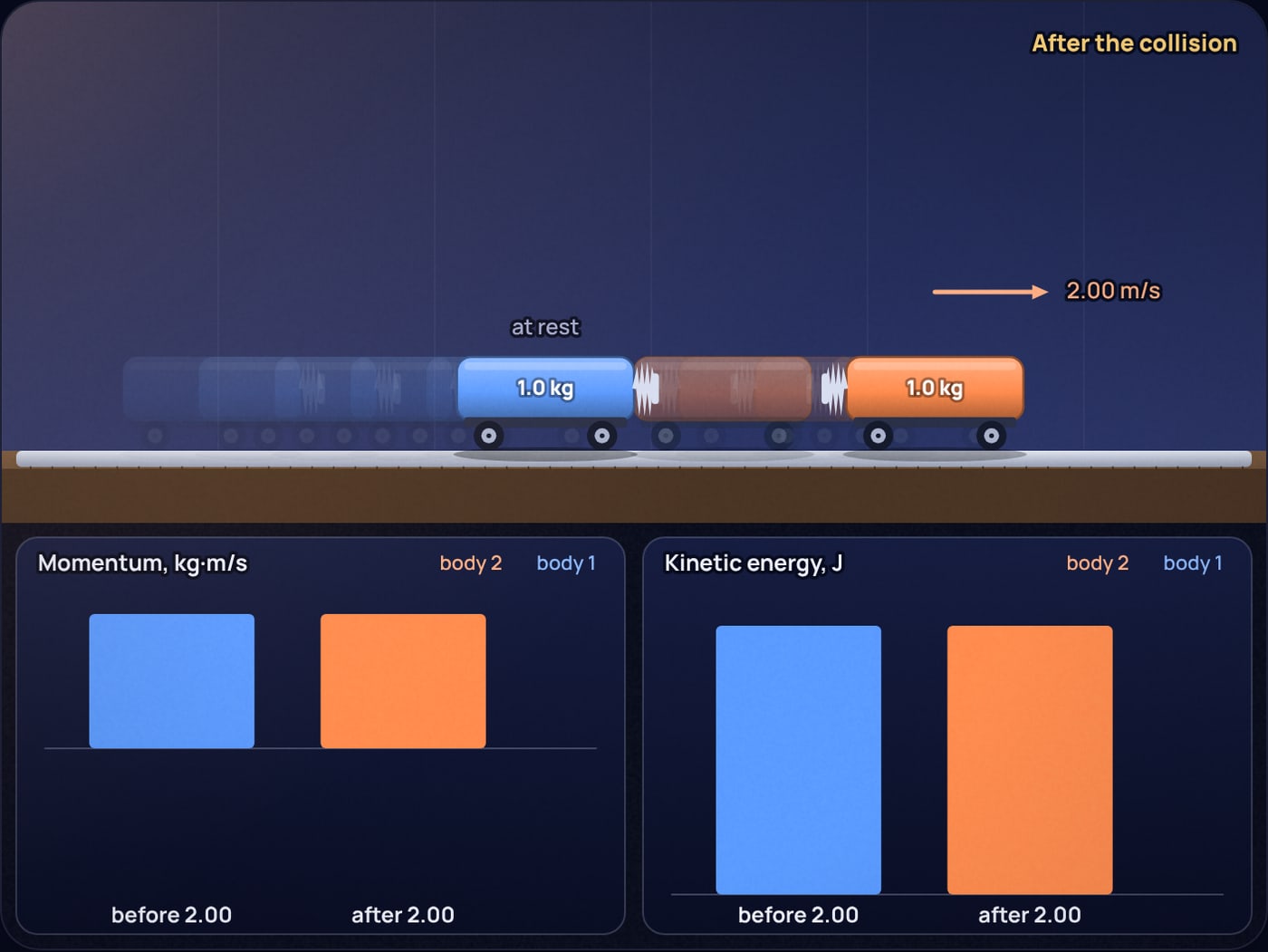
A 1 kg trolley at 2 m/s hits an identical trolley at rest, and Velcro holds them together.
Momentum before: . After, 2 kg share it: .
Kinetic energy before: . After: .
Momentum is unchanged; half the kinetic energy has become heat and sound.
What decides how much a collision bounces?
One number, the coefficient of restitution : the speed the bodies separate at, divided by the speed they approached at.
With they fly apart as fast as they came together and kinetic energy is conserved (an elastic collision). With they stick. Everything real sits in between. Together with momentum conservation, this second equation fixes both final velocities, and the kinetic energy lost comes out as
For a ball bouncing on a hard floor, is easy to measure: the rebound speed over the impact speed is the square root of the rebound height over the drop height. Sports bodies specify it, in effect, in their ball rules.
The ITF drops a tennis ball from 254 cm and requires a rebound of 135 to 147 cm.
to .
The share of kinetic energy kept in the bounce is : 53% to 58%. Almost half goes into flexing the rubber and the gas inside.
| Object | Test | Coefficient of restitution |
|---|---|---|
| Table tennis ball | 30.5 cm drop onto steel, 24 to 26 cm rebound | 0.89 to 0.92 |
| Golf driver | USGA limit for a ball fired at the club face | at most 0.83 |
| Basketball | FIBA: 1,800 mm drop, 1,035 to 1,085 mm rebound | 0.76 to 0.78 |
| Tennis ball | ITF: 254 cm drop, 135 to 147 cm rebound | 0.73 to 0.76 |
| Cars in a crash | crumple, often lock together | close to 0 |
Why does one ball in make exactly one ball out?
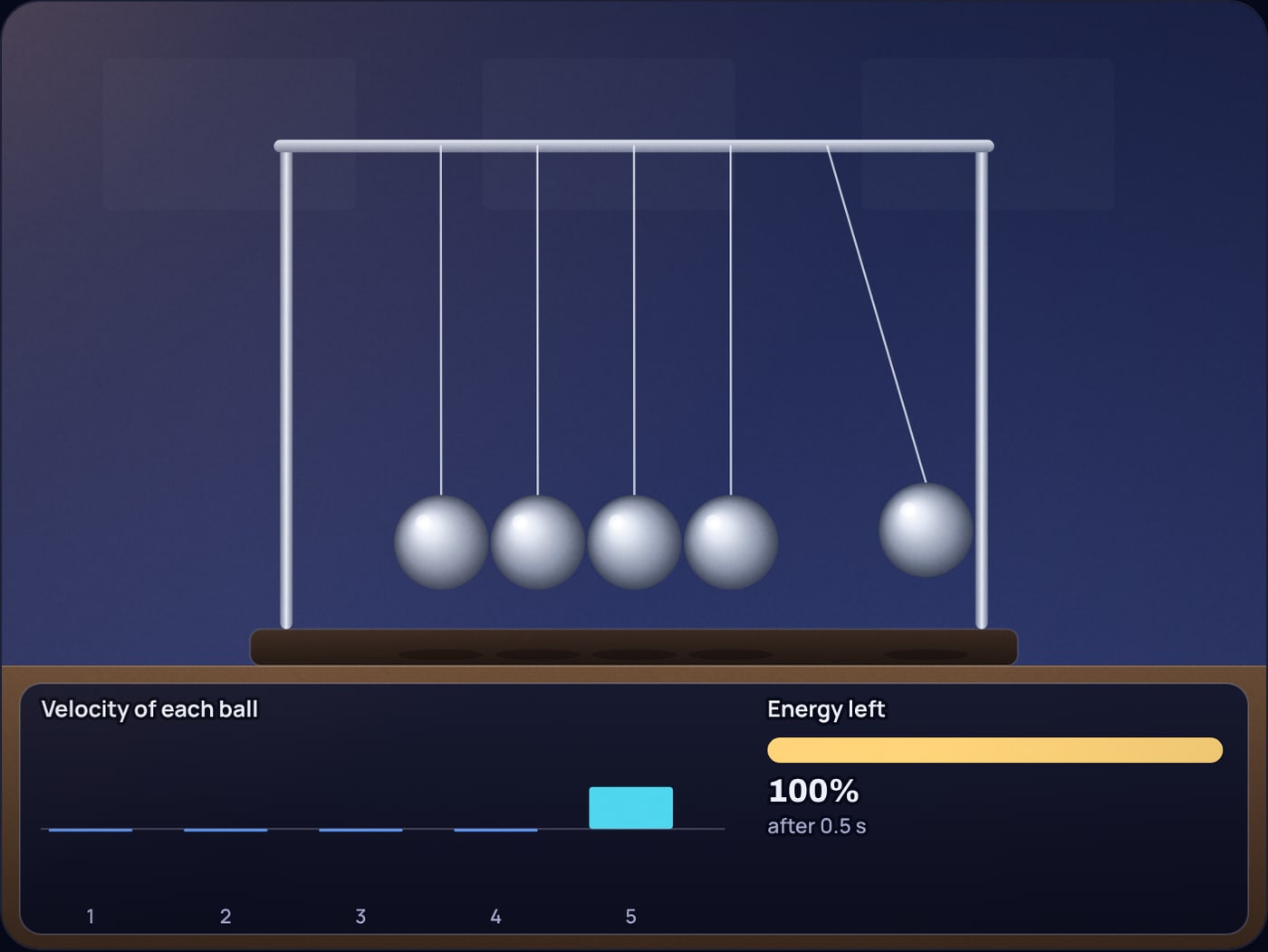
For two equal masses with , solving the two equations gives a neat result: the balls swap velocities. A ball arriving at speed stops, and the ball it hits leaves at . In a cradle with small gaps between the balls, that handover runs down the row, ball by ball, until the last ball has nobody to pass it to and swings out.
Now test the alternatives the toy never shows you. Suppose one ball of mass arrives at .
Coming in: momentum , kinetic energy .
Two balls out at : momentum , which matches. Kinetic energy , half of what came in.
One ball out at : momentum , kinetic energy . Both match.
With the simulator's 30 cm strings and a 9 cm pull-back, at the bottom of the swing.
Two balls out at half speed would quietly throw away half the energy, which nearly elastic steel cannot do. Only one ball out at full speed satisfies both laws. Lift two and the same logic demands two out.
Is the ball by ball picture really what happens?
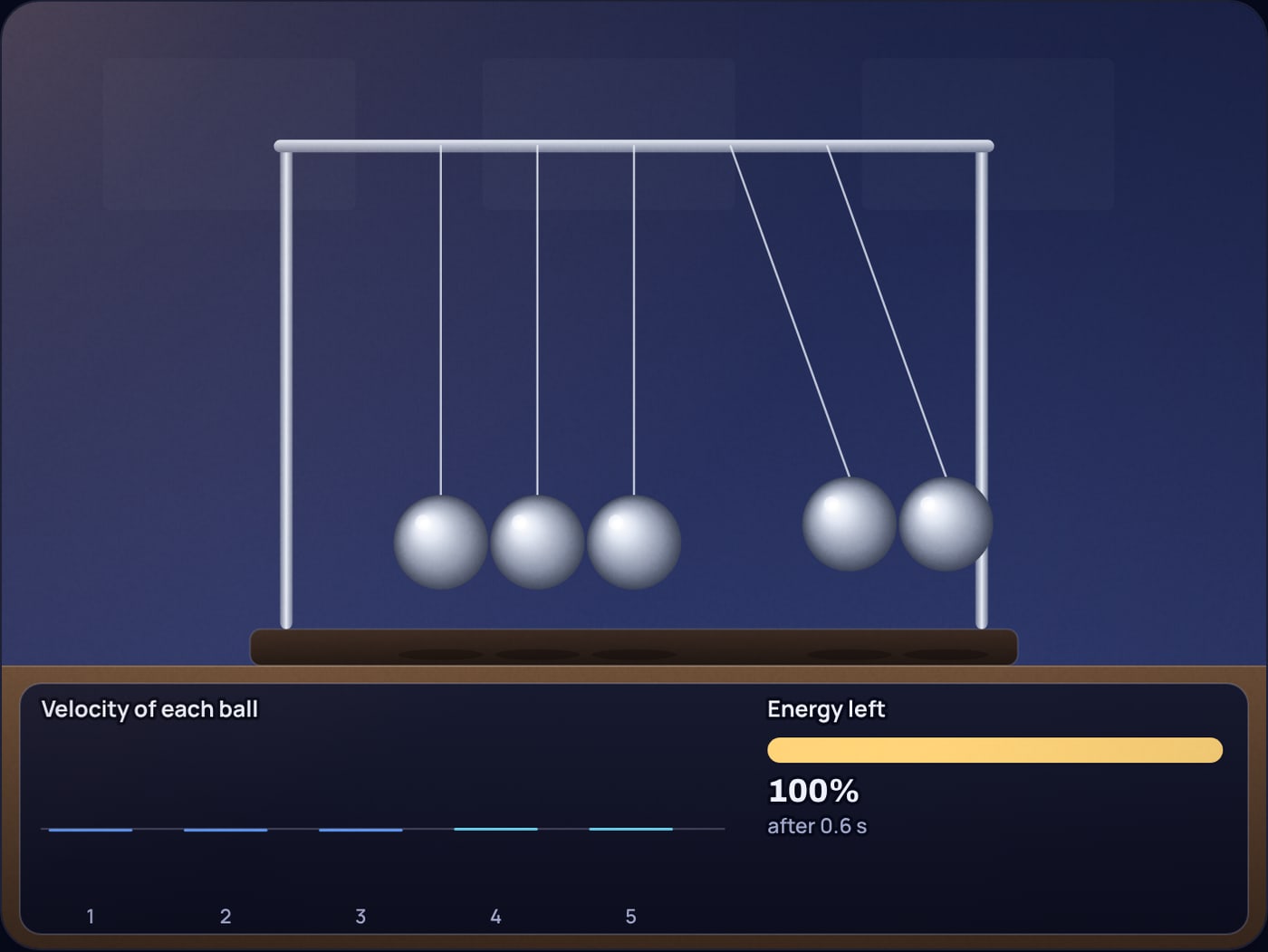
It is the standard explanation and it is right when the balls hang with tiny gaps, so each collision involves only two of them. In a real cradle the balls usually touch, and the push travels through the row as a compression wave in the steel. The full treatment uses Hertz's contact mechanics, which describes how two steel spheres squash slightly where they meet. That more careful picture predicts, and experiments confirm, that the middle balls are not perfectly still: the fourth ball moves a little and the first ball recoils slightly. Those small departures are one reason a real cradle's clean one in, one out pattern slowly smears.
The name, incidentally, is not Newton's. The principle was demonstrated by Edme Mariotte in the 17th century, and the name "Newton's cradle" was coined in 1967 by Simon Prebble for a wooden version his company sold.
Why does a real cradle end up swinging as one?
Because every clack is a little inelastic. Each impact turns some kinetic energy into the sound you hear and a little heat in the steel, so is slightly below 1. Once a collision is not perfectly elastic, the moving ball no longer stops dead; it keeps a little velocity, and the middle balls begin to move. The pattern drifts until all five swing together.
When all five balls move together, the original momentum is shared by , so .
Kinetic energy: .
Exactly one fifth of the starting energy is left, with momentum fully conserved. The simulator, with , reaches this state within about 6 seconds and shows 20% on its energy meter.
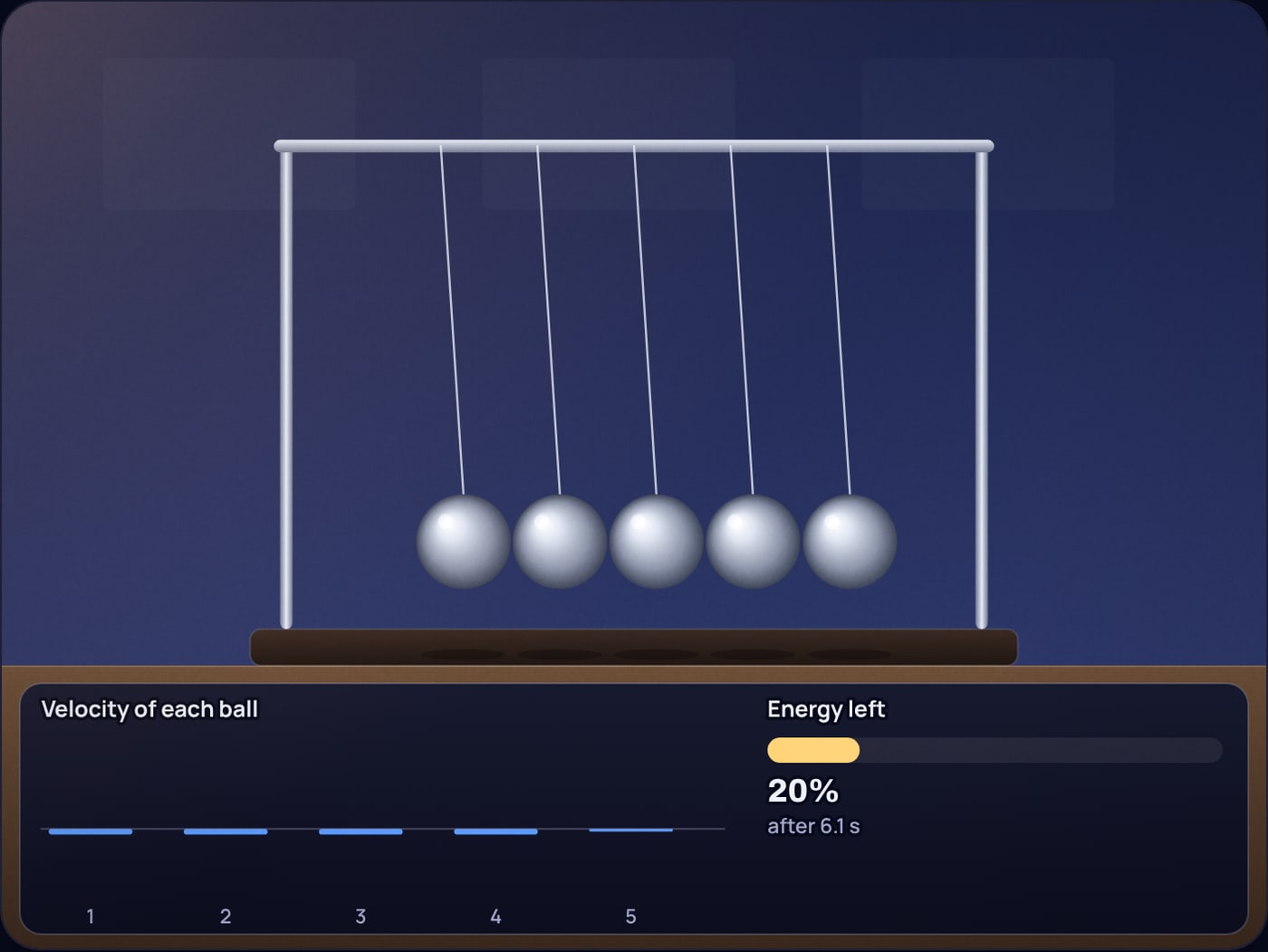
After that, air drag and the flexing of the strings bring it to rest. A Newton's cradle is a beautiful demonstration of conservation laws, but not a perpetual motion machine.
The misconception: “momentum is lost in an inelastic collision”
It is very common to see momentum and kinetic energy treated as if they rise and fall together. They do not. Momentum is a vector and its conservation follows from Newton's third law, so it survives any collision, however crumpled the result. Kinetic energy is only conserved in the special, elastic case. The sticky trolleys above keep all 2 kg m/s of their momentum while losing half their kinetic energy, and the cradle that ends up swinging as one has kept all its momentum and lost four fifths of its energy.
What does this have to do with car crashes?
Everything. A car crash is a collision with close to zero: the metal crumples and the cars often lock together.
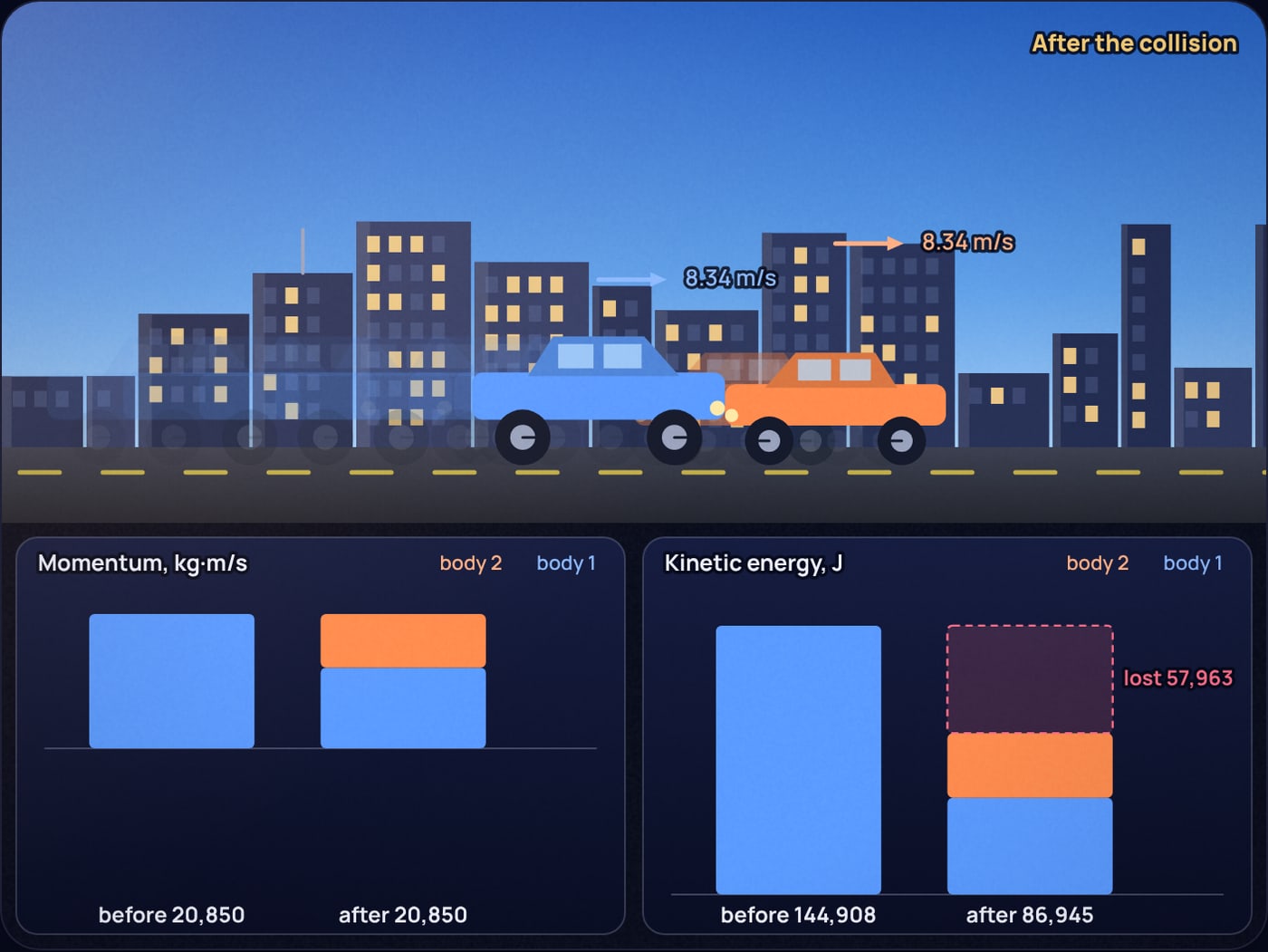
A 1,500 kg car at 13.9 m/s (50 km/h) hits a parked 1,000 kg car and they move off together.
Momentum: , shared by 2,500 kg, so (30 km/h).
Kinetic energy: 144,908 J before, 86,945 J after. The 57,963 J lost, 40%, goes into bending metal: about the energy needed to lift the bigger car 3.9 m.
Momentum fixes how much each car's velocity changes, but not how fast. A crumple zone stretches the change over a longer time, so the force on the people inside is smaller for the same change of momentum. The same impulse idea shows up on a planetary scale in a gravity assist, which is an elastic collision between a spacecraft and a planet that never touch.
Try it yourself
Open the simulator on the elastic trolleys and slide slowly from 1 down to 0, watching the dashed "lost" block grow while the momentum bars stay level. Then load the light hits heavy preset to see a bounce back, and finish with the real cradle to watch the row settle into one block. For a kitchen-table version of these ideas, our physics experiments for kids post has a few.
Sources
- Newton’s cradle: mechanism, Hertzian contact, history (Mariotte, Prebble)
- Coefficient of restitution: collision formulas, energy loss, USGA 0.83 limit, table tennis and FIBA rebound specifications
- Tennis ball: ITF 254 cm drop and 135 to 147 cm rebound
Frequently asked questions
How does Newton’s cradle work?
The lifted ball hits the row and hands its velocity on from ball to ball. For equal steel balls in nearly elastic collisions, each ball stops and passes its full velocity to the next, so the last ball swings out with the speed the first one arrived with. Momentum and kinetic energy are both carried through.
Why does one ball in make exactly one ball out?
It is the only outcome that conserves both momentum and kinetic energy. Two balls leaving at half speed would carry the right momentum but only half the kinetic energy. One ball at full speed matches both.
Is momentum conserved in an inelastic collision?
Yes. Momentum is conserved in every collision where no outside force acts, because the two bodies push on each other with equal and opposite forces for the same time. Only kinetic energy is lost in an inelastic collision, into heat, sound and deformation.
Why does a Newton’s cradle stop?
Each impact turns a little kinetic energy into sound and heat, and air drag and the strings take a little more. As the collisions become less than perfectly elastic the middle balls start moving, the row ends up swinging together, and friction then brings it to rest. It is not a perpetual motion machine.
What is the coefficient of restitution?
The speed at which two bodies separate after a collision divided by the speed at which they approached. It is 1 for an elastic collision and 0 when they stick. For a ball dropped on a hard floor, it is the square root of the bounce height over the drop height.
 Charging a Capacitor: Where Half the Energy Goes
 Could an Iron Man Arc Reactor Work? The Fusion Numbers