Is Kessler Syndrome Real? Gravity's Debris vs Reality

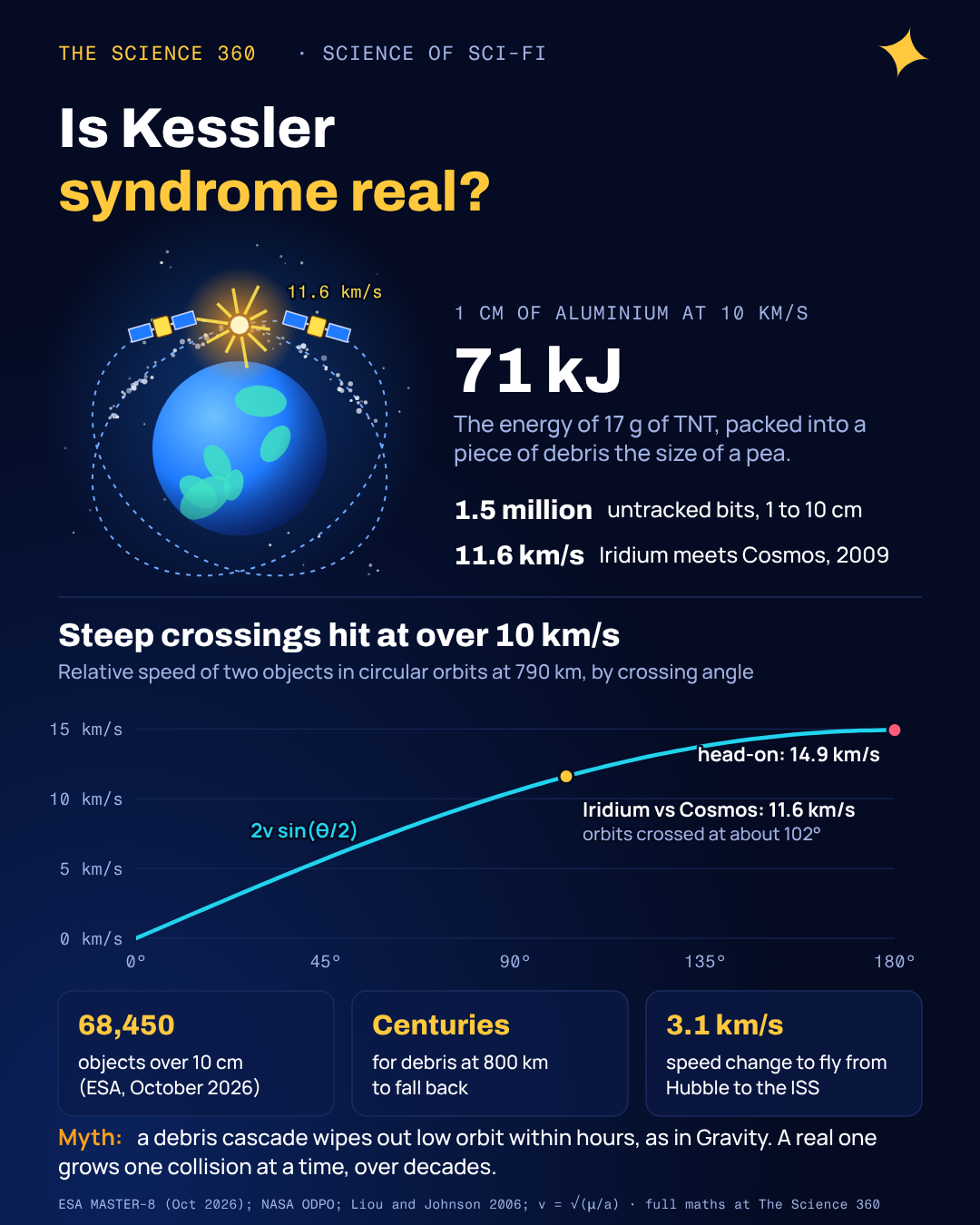
On 10 February 2009, at 16:56 GMT, over northern Siberia, a working Iridium communications satellite and a dead Russian military satellite called Cosmos 2251 met at 790 km altitude. Their orbits crossed at close to a right angle. The 560 kg Iridium and the roughly 900 kg Cosmos hit at about 11.6 km/s, and by January 2013 the US Space Surveillance Network had catalogued 2,201 pieces of them. It was the first accidental collision between two intact satellites, and it is the closest thing we have to the opening of the film Gravity.
In the film, a Russian missile strike on a satellite sets off a chain reaction that shreds the Space Shuttle, Hubble, the ISS and China's Tiangong station within a few hours, with the debris lapping the Earth every 90 minutes. Searches for "is Kessler syndrome real" tend to land on two kinds of answer: breathless "it could end space travel" articles, or a newer wave saying the whole thing is a myth. Both miss the key number, which is time. The Kessler syndrome is real, and on current models it has already started in some altitude bands. It just runs on a clock of decades.
What is the Kessler syndrome?
In 1978 two NASA scientists, Donald Kessler and Burton Cour-Palais, published "Collision frequency of artificial satellites: the creation of a debris belt" in the Journal of Geophysical Research. The argument is a balance between a source and a sink. The sink is atmospheric drag, which slowly pulls things down. The source is collisions, and the collision rate scales roughly with the square of the number of objects, because each object can hit any other. At low density the sink wins. Past a critical density, each collision creates enough new fragments to cause more than one further collision before drag removes them, and the population grows even if nobody launches anything.
That is a statement about rates, and the rates are slow. NASA's J.-C. Liou and Nicholas Johnson ran 200-year simulations for Science in 2006 under a deliberately optimistic assumption: no launches at all after 2004. Their result was stark. "The current debris population in the LEO region has reached the point where the environment is unstable," they wrote, driven mainly by collisions between 900 and 1000 km. In that band the number of objects 10 cm and larger triples over the 200 years, and the collision probability rises tenfold. That is the real Kessler syndrome: not a flash flood, a slowly rising tide.
How much space debris is there right now?
ESA's Space Debris Office publishes model estimates from its MASTER-8 population. The update of 23 October 2026 gives:
- About 68,450 objects larger than 10 cm, of which about 11,300 are working satellites.
- About 1.5 million pieces between 1 and 10 cm.
- About 230 million pieces between 1 mm and 1 cm.
- More than 660 break-ups, explosions and collisions that produced fragments, and more than 17,400 tonnes of material in orbit.
Only the first group is tracked routinely: the US network generally follows objects larger than about 10 cm and, as of August 2026, had catalogued more than 34,000 objects in total, according to NASA. Everything smaller is known statistically, from radar sampling and from the pits found on surfaces returned from orbit. Those smaller pieces do not sound like much until you put them at orbital speed.
How fast does space debris hit?
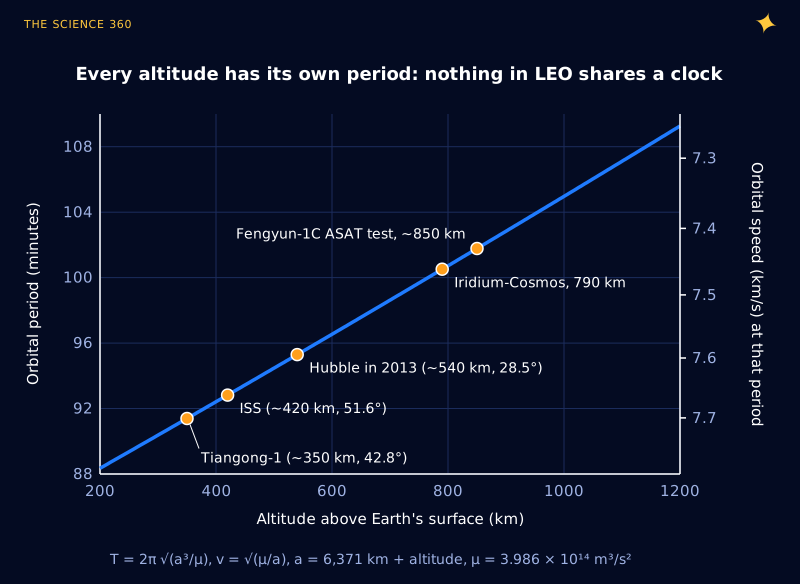
Everything in low Earth orbit moves at 7 to 8 km/s; the exact value is set by altitude alone, . Two objects at the same altitude are moving at the same speed, so what decides the impact speed is the angle between their paths. For two circular orbits crossing at angle , the relative speed is .
Iridium 33 vs Cosmos 2251, 790 km
Right-angle crossing: . The reported collision speed was 11.6 km/s, so
Head-on () would be 14.9 km/s.
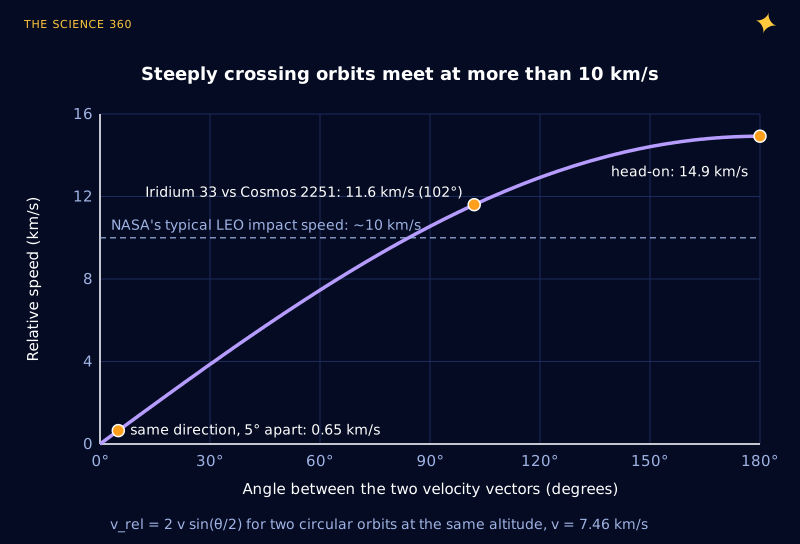
NASA's Orbital Debris Program Office quotes about 10 km/s as a typical impact speed between debris and a spacecraft in low orbit. At that speed, kinetic energy per kilogram is ½v² = 5 × 10⁷ J/kg, about twelve times the energy in a kilogram of TNT. Every piece of debris is effectively its own explosive.
A 1 cm aluminium sphere at 10 km/s
Same energy as a 1 tonne car at 43 km/h, delivered by something the size of a pea.
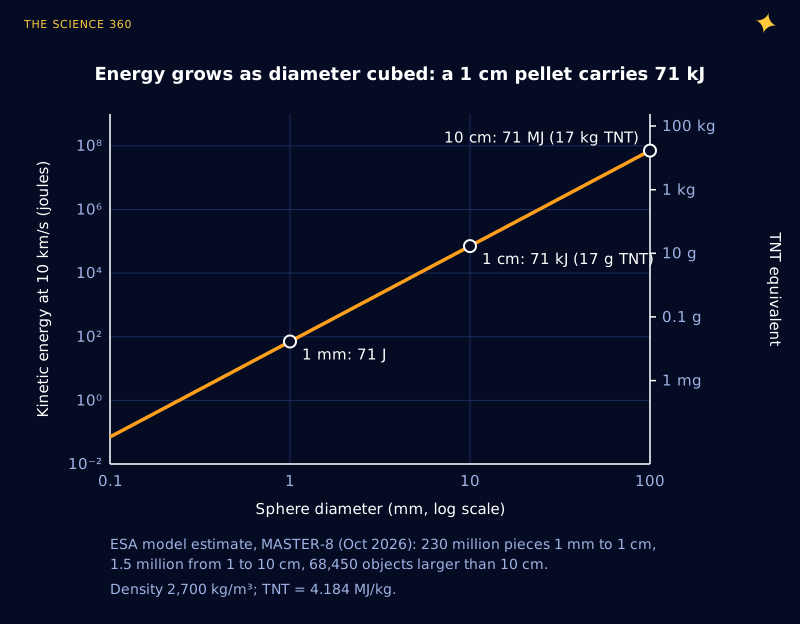
That is the real shape of the hazard. The 10 cm and larger objects are tracked, so operators can dodge them; the ISS performed three debris-avoidance manoeuvres in 2012 alone, and in March 2012 a Cosmos 2251 fragment was spotted too late to dodge and the crew sheltered in their Soyuz. The millimetre grains are a sandblasting problem that shielding handles. The 1.5 million pieces in between are untracked and carry from 71 J to 71 MJ each: 17 g of TNT at 1 cm, 17 kg at 10 cm.
The worst debris events so far
Two events dominate the catalogue. In January 2007 China destroyed its own Fengyun-1C weather satellite at about 850 km with an anti-satellite missile, the scenario that starts Gravity. Two years later came Iridium and Cosmos. NASA's January 2013 summary counted 3,378 catalogued Fengyun-1C fragments, 1,603 from Cosmos 2251 and 598 from Iridium 33, and found that together they made up about half of all catalogued objects below 1000 km. NASA expected their effects to "continue to be felt for decades to come."
Altitude is everything for how long the mess lasts. NASA's debris office gives rough lifetimes: below 600 km, debris falls back "within several years"; at 800 km decay "often takes centuries"; above 1000 km, objects keep orbiting "for 1,000 years or more." The Fengyun-1C and Iridium-Cosmos debris sits squarely in the centuries band, which is why those two events are still, nearly two decades later, the largest contributions to the catalogue in their shells. The Iridium fragments are decaying faster than the Cosmos ones, because the Iridium used light composite materials and its pieces have more drag for their mass.
What does Gravity get wrong?
Quite a lot of the spaceflight is good. The astronauts' weightlessness is correct (they are falling, not out of gravity's reach; see why there is gravity on the ISS), the silence is correct, and the idea that a deliberate satellite kill can spray thousands of fragments is exactly what Fengyun-1C showed. The orbital mechanics of the disaster is where it falls apart.
The three stations are not on one orbit. When the film was made, Hubble flew at about 540 km with an inclination of 28.5°, the ISS at about 420 km with 51.6°, and Tiangong-1 at about 350 km with 42.8°. Their orbits are tilted differently and drift relative to each other, so they are almost never close. Sandra Bullock's character travels from Hubble to the ISS on a jetpack and then to Tiangong. The plane change alone is brutal:
Moving from Hubble's orbit to the ISS's
Change in inclination: 51.6° − 28.5° = 23.1°. Plane-change at about 7.6 km/s:
Dropping from 540 km to 420 km adds roughly
Total ≈ 3.1 km/s, comparable to the of a rocket's upper stage, not a backpack.
For why Δv numbers like that translate into enormous rockets, see why rockets are mostly fuel.
The debris is fast and periodic at the same time. This is the subtle one. If debris crosses your orbit at a steep angle, it hits at 10 km/s, as in the film. Can it also come back every 90 minutes? Partly. Two orbits with the same period that cross at a point will both return to that point one period later. So fragments with exactly your period would meet you again at the crossing. The problem is that a breakup does not produce fragments with one period. It throws them out with a spread of speeds, and a spread of speeds is a spread of periods.
How fast a debris cloud smears out
A fragment pushed along its orbit by changes its period by
Its position drifts relative to the parent at (backward if pushed forward, since the orbit rises and slows). For fragments spread over ±100 m/s, the cloud lengthens at 6 × 100 = 600 m/s.
After one 92.8 minute orbit (5,568 s):
After 19.8 hours it wraps the whole 42,700 km orbit at 420 km.
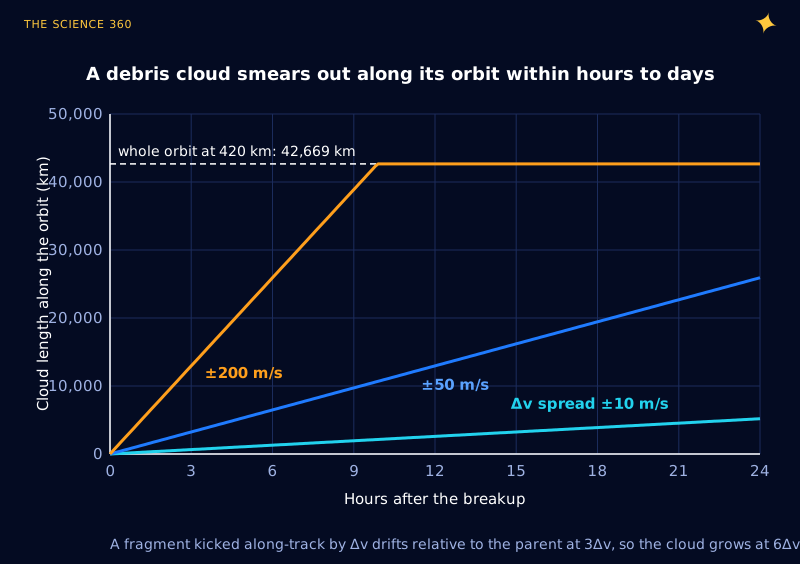
So on the second lap the "storm" in Gravity would have been thousands of kilometres long and much thinner, not a wall arriving on the minute. And because the stations are at different altitudes and inclinations, the stream that crosses one does not cross the others at the same moment. What a real cascade looks like is Figure 4 repeated over decades: rings of debris settling into shells, raising the odds of the next collision in that shell by a little each year.
The timescale. In the film the entire low orbit environment becomes unusable within a day. The actual cascade proceeds one collision at a time. Even on Liou and Johnson's numbers, the accelerating collisions in the 900 to 1000 km band add up over a century or more. That is still a serious problem, because a 70 kJ pellet does not care that it is slow-burning on a planetary timescale.
Is the Kessler syndrome a myth, then?
No. The physics of the source-and-sink argument is not in dispute, and the two big fragmentation events of 2007 and 2009 are exactly what it predicts. What gets overstated is speed and totality: a runaway cascade does not make all of space unusable at once, and it does not trap us on the ground. A rocket heading to the Moon or to JWST's orbit at L2 crosses the crowded shells in a few minutes; the chance of a hit during that short crossing is small. The people who pay are satellite operators who need to sit for years at 700 to 1000 km, where collision rates climb and every avoidance manoeuvre costs fuel.
What also matters is that the modelled tipping point was computed for the 2005 population. Since then the number of working satellites has grown enormously, mostly in large constellations. ESA's own estimate of active payloads among objects above 10 cm is now about 11,300. Many of the new ones fly in low shells where drag clears dead hardware within years, and debris-mitigation guidelines now call for postmission disposal (Liou and Johnson cite the 25-year limit then advocated by NASA, the Department of Defense and others). That combination is why many debris experts talk about managing the Kessler syndrome rather than either ignoring it or treating it as an apocalypse. The fixes that matter most are boring: do not blow up satellites, deorbit dead ones, and remove a handful of the heaviest derelicts in the 800 to 1000 km band, which are the objects most likely to seed the next Iridium-Cosmos.
Orbital speeds are fast on human scales but not on astronomical ones: the Earth itself carries all of this debris around the Sun at 30 km/s (see how fast Earth is moving). The danger comes from the fact that, in low orbit, two objects can meet from very different directions.
FAQ
Is Kessler syndrome real?
Yes, as a slow process. Donald Kessler and Burton Cour-Palais showed in 1978 that above a critical density, collisions create debris faster than drag removes it. NASA modelling published in 2006 found some low Earth orbit bands, especially 900 to 1000 km, already past that point. The growth plays out over decades, not hours as in the film Gravity.
How much space debris is there?
ESA's October 2026 model estimate is about 68,450 objects larger than 10 cm (including roughly 11,300 working satellites), 1.5 million pieces between 1 and 10 cm, and 230 million between 1 mm and 1 cm. Only objects larger than about 10 cm are routinely tracked.
How fast does space debris travel?
Everything in low Earth orbit moves at about 7 to 8 km/s. What matters for damage is relative speed, which depends on the angle between two orbits and averages about 10 km/s, according to NASA. The 2009 Iridium 33 and Cosmos 2251 collision happened at about 11.6 km/s.
Could the debris in Gravity really hit every 90 minutes?
Only loosely. Debris that shares your orbital period does return to the same crossing point each orbit, but a real breakup spreads fragments over a range of periods, so within hours the cloud stretches into a long smear around the orbit. And Hubble, the ISS and Tiangong-1 were at different altitudes and inclinations, so one debris stream could not sweep all three in turn.
Would Kessler syndrome stop us going to space?
Not in the sense of trapping us on Earth. A rocket crosses the crowded shells in minutes, so the risk per launch stays small. The damage is to satellites that must live for years in the worst altitude bands, which would become more expensive and shorter-lived to operate there.
Related on The Science 360
Sources
- D. J. Kessler and B. G. Cour-Palais, "Collision frequency of artificial satellites: the creation of a debris belt", Journal of Geophysical Research 83, 2637 (1978): doi.org/10.1029/JA083iA06p02637
- J.-C. Liou and N. L. Johnson, "Risks in space from orbiting debris", Science 311, 340 (2006): PDF copy
- ESA Space Debris Office, Space Environment Statistics, last update 23 October 2026 (MASTER-8, reference population 02/2026): sdup.esoc.esa.int/discosweb/statistics
- NASA Orbital Debris Program Office, Frequently Asked Questions (typical impact speed about 10 km/s, orbital lifetimes, tracking threshold, catalogue size): orbitaldebris.jsc.nasa.gov/faq
- NASA Orbital Debris Quarterly News 13(2), April 2009, "Satellite collision leaves significant debris clouds" (790 km, masses, more than 11 km/s): odqnv13i2.pdf
- NASA Orbital Debris Quarterly News 17(1), January 2013, "An update of the FY-1C, Iridium 33, and Cosmos 2251 fragments" and ISS avoidance manoeuvres in 2012: odqnv17i1.pdf
- P. Anz-Meador and J.-C. Liou, "Analysis and consequences of the Iridium 33 Cosmos 2251 collision", NASA NTRS (relative velocity 11.647 km/s): ntrs.nasa.gov/citations/20100008433
- Wikipedia, "Hubble Space Telescope" (inclination 28.47°), "International Space Station" (51.64°, 413 to 422 km) and "Tiangong-1" (about 350 km, 42.7° to 42.8°): en.wikipedia.org/wiki/Tiangong-1
- ScienceABC, "How scientifically accurate is the movie Gravity?" (Hubble at roughly 540 km in the film era): scienceabc.com
Method note: orbital periods and speeds use μ = 3.986 × 10¹⁴ m³/s² and a mean Earth radius of 6,371 km. Impact energies assume solid aluminium spheres (2,700 kg/m³) at 10 km/s. Cloud spreading uses the linearised along-track drift of 3Δv for along-track velocity kicks and ignores radial kicks, drag and orbital precession.
Header image: NASA (image iss074e0540224), regraded for this article.