Do Rockets Need to Reach Escape Velocity? No. Here's Why
When the Apollo 11 S-IVB stage relit for the trip to the Moon, it had already been circling Earth for two and a half hours, doing about 7.8 km/s in a parking orbit 190 km up. The burn added around 3 km/s. At no point did any rocket on that mission go 11.2 km/s, the famous "escape velocity" of Earth.
That number gets repeated as if it were a speed limit you have to beat to get off the planet. One of the top results for this question, a university explainer, is headlined "Why does a rocket have to go 25,000 mph to escape Earth?" The physics behind the number is right. The way it is used is not. Escape velocity is a coasting speed: the speed an object with no engine needs so that it never falls back. A rocket has an engine. It can leave Earth at any speed it likes, including walking pace, as long as it keeps pushing. What it cannot avoid is the energy bill, and the question of how fast to go turns out to decide how big that bill is.
Where does 11.2 km/s come from?
Throw a ball up and it slows down, because gravity takes kinetic energy away and stores it as height. Throw it harder and it goes higher. Gravity weakens with distance (as 1/r²), so the total energy needed to climb all the way out is finite. Escape velocity is simply the launch speed whose kinetic energy matches that total.
Escape velocity from Earth's surface
Energy to climb from radius to infinity, per kg, is . Kinetic energy per kg is . Set them equal:
(NASA Earth fact sheet), (mean radius).
That speed is about 25,000 mph.
Two things in that derivation matter for everything that follows. The mass of the object cancels, so 11.2 km/s applies to a pebble and to a space station alike. And there is no direction in it. Throw the ball straight up, sideways or at 45°, and as long as it misses the ground and the air, 11.2 km/s gets it away.
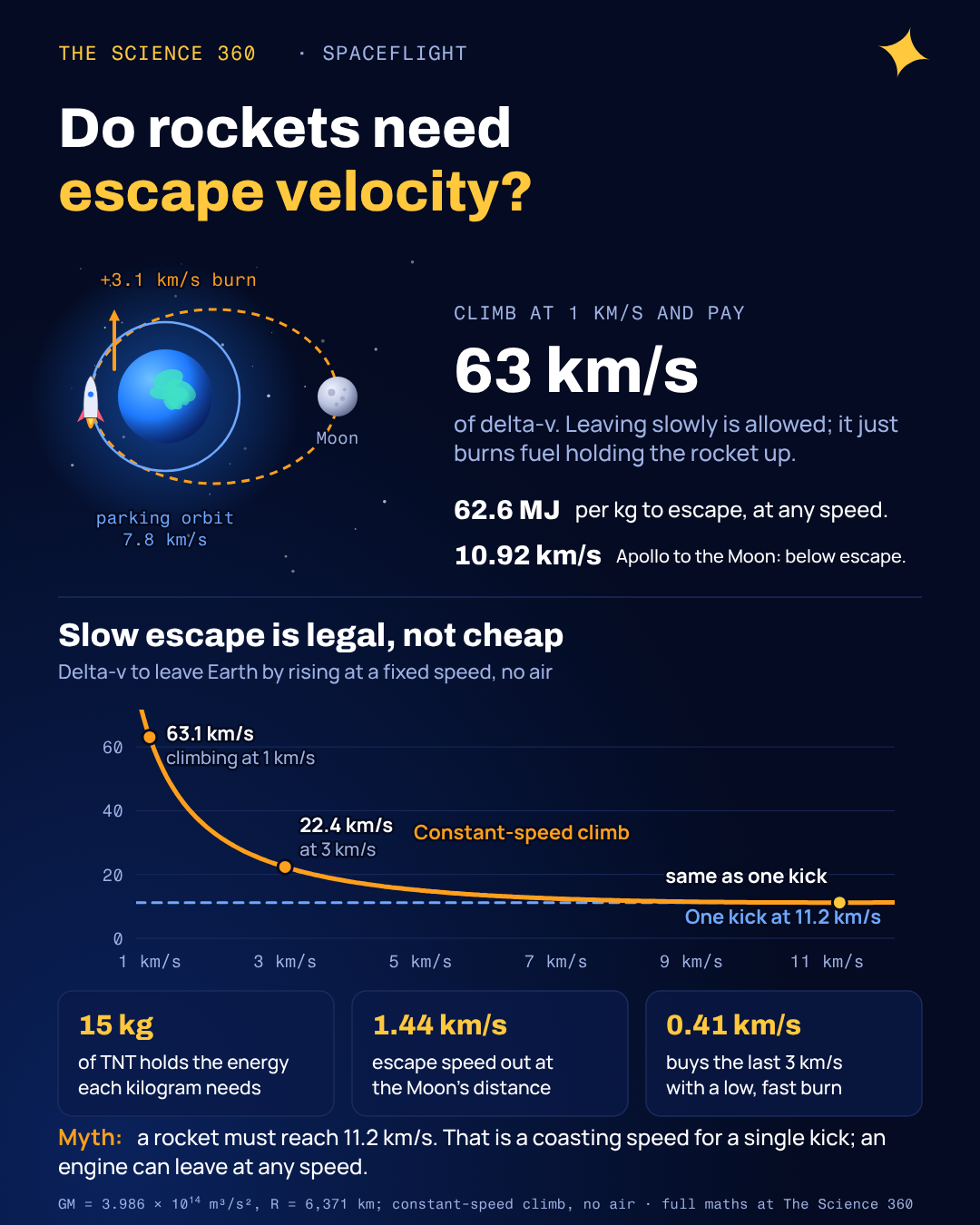
For a sense of scale, 62.6 MJ is the chemical energy in about 15 kg of TNT (at 4.184 MJ/kg), or in about 1.4 kg of petrol. Every kilogram that leaves Earth for good has to carry away that much energy, one way or another. That is the part of the bill nobody can dodge.
Escape velocity is not a single number
The 11.2 km/s figure is for a launch from the surface. Replace with your actual distance from Earth's centre and the escape speed drops. At the height of a typical parking orbit it is 11.0 km/s, at geostationary orbit 4.35 km/s, and at the Moon's distance only 1.44 km/s. Next to it, the speed of a circular orbit at the same distance is always smaller by a factor of .
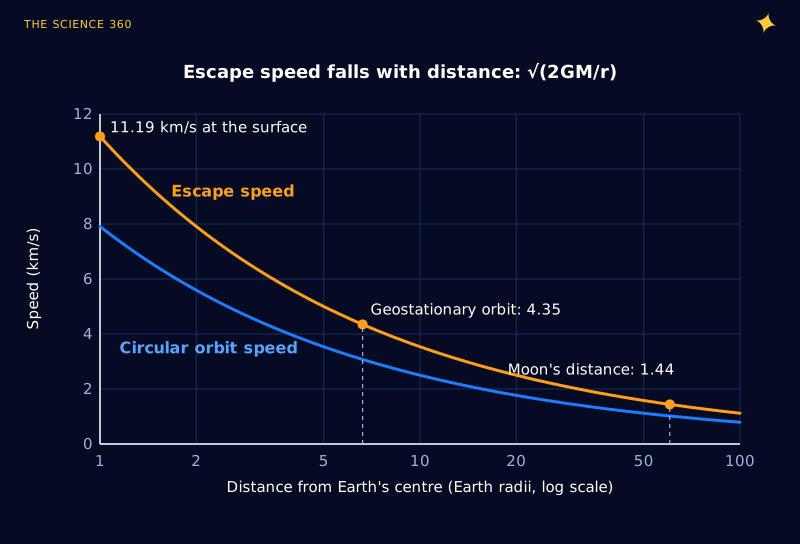
So a rocket that has already climbed somewhere high has a much easier target. That alone shows the "you must hit 11.2 km/s" version cannot be right: a rocket that hovered its way up to the Moon's distance would only need 1.44 km/s there.
The misconception: escape velocity as a launch requirement
Escape velocity answers one specific question: if all you can do is give an object a single kick and then let it coast, how hard must the kick be? Cannonballs, thrown balls and meteorites fit that description. Rockets do not, because they burn for minutes and can burn again later. The Wikipedia article puts the correction in one line: under continuous or intermittent thrust an object "can attain escape at any non-zero speed, but the minimum amount of energy required to do so is always the same."
Read that carefully, because both halves matter. Yes, you can leave at any speed. No, you do not save any energy by doing it slowly. In fact, for a rocket, going slowly is catastrophic, for a reason the energy picture hides.
Why can’t a rocket just climb slowly?
A rocket does not pay in energy. It pays in propellant, and the currency for propellant is delta-v: the total change in velocity the engine produces, which is what the rocket equation turns into a mass of fuel. (We go through that conversion in why rockets are mostly fuel.) Every second a rocket spends thrusting just to hold itself up against gravity costs delta-v without making it go any faster. Engineers call this gravity loss.
Imagine a rocket that accelerates to some modest speed v, then thrusts just hard enough to cancel gravity and hold that speed as it rises. Once it gets far enough out that the local escape speed has dropped to v, it can cut the engine and coast away. The delta-v that costs is easy to work out.
Delta-v for a constant-speed climb (vertical, no air)
Thrust needed per kg to hold speed is ; time spent per metre climbed is . Delta-v spent fighting gravity from to :
The engine cuts off where , so . Total:
All speeds in km/s; 11.19 km/s is the escape speed. Climbing at the escape speed costs the same as one kick; 1 km/s is 3,600 km/h. At 1.4 m/s (walking pace), Δv ≈ 44,700 km/s, 15% of the speed of light.
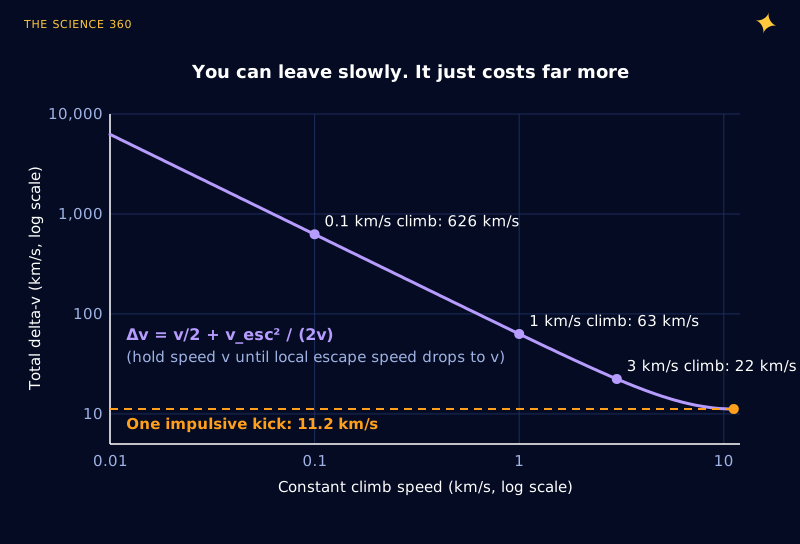
Now put those numbers through the rocket equation. With a hydrogen-oxygen engine and an exhaust speed of about 4.4 km/s, a delta-v of 11.2 km/s needs a starting mass times the final mass. Hard, which is why we use stages, but doable. A 1 km/s climb needing 63 km/s gives . You would need 1.6 tonnes of rocket, almost all of it propellant, for every gram that leaves. That is the real reason rockets go fast: not to beat a threshold, but because time spent near Earth is paid for in fuel.
This also squares the books with the "energy is always the same" statement. The payload ends up with the same 62.6 MJ/kg either way. In the slow climb, the extra propellant energy goes into the exhaust, shot downward to hold the rocket up. It is wasted on the ground rather than delivered to the spacecraft.
Orbit first: how rockets actually leave Earth
Real launches turn sideways early. Going sideways fast enough is what an orbit is: you fall toward Earth all the time, but you move sideways so quickly that the ground curves away beneath you. (This is also why astronauts on the ISS float even though gravity there is about 90% of surface strength, which we cover in is there gravity on the ISS.) Once in orbit, gravity is no longer fighting the engine head-on, so gravity loss stops.
It is worth separating the two things a launch buys. Figure 2 compares the energy needed to lift a kilogram to a given altitude and leave it there at rest, against the energy needed to put it in a circular orbit at that altitude.
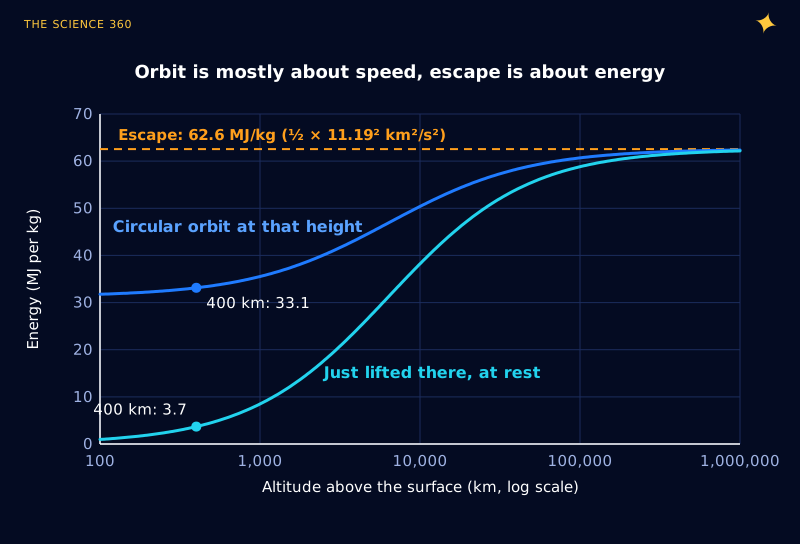
The 400 km height of the ISS costs only 3.7 MJ/kg. Being in orbit there costs 33.1 MJ/kg, because the kinetic energy of 7.7 km/s is ½ × 7,670² ≈ 29.4 MJ/kg. So the hard part of reaching orbit is the speed, and once you are there you are more than halfway to escaping in energy terms.
Getting that 7.8 km/s takes more delta-v than 7.8 km/s, because the rocket still suffers some gravity loss in the near-vertical first minutes and has to push through the air.
Rough delta-v budget to low Earth orbit
Orbital speed at about 200 km: 7.8 km/s. Gravity loss, steering loss and drag: about 1.5 to 2 km/s. Help from Earth's rotation for an eastward launch at the equator:
Typical total quoted: about 9.4 km/s.
Did Apollo reach escape velocity?
Apollo is a nice test case because it went far but did not, strictly, escape. From a parking orbit about 190 km up, the translunar injection burn put the spacecraft on a long ellipse whose far point was at the Moon's distance. We can work out the speed that needs.
Apollo-style translunar injection (two-body, Moon's gravity ignored)
Perigee radius ; apogee .
Local escape speed at 190 km:
Circular speed there is 7.79 km/s, so the burn adds about 3.1 km/s.
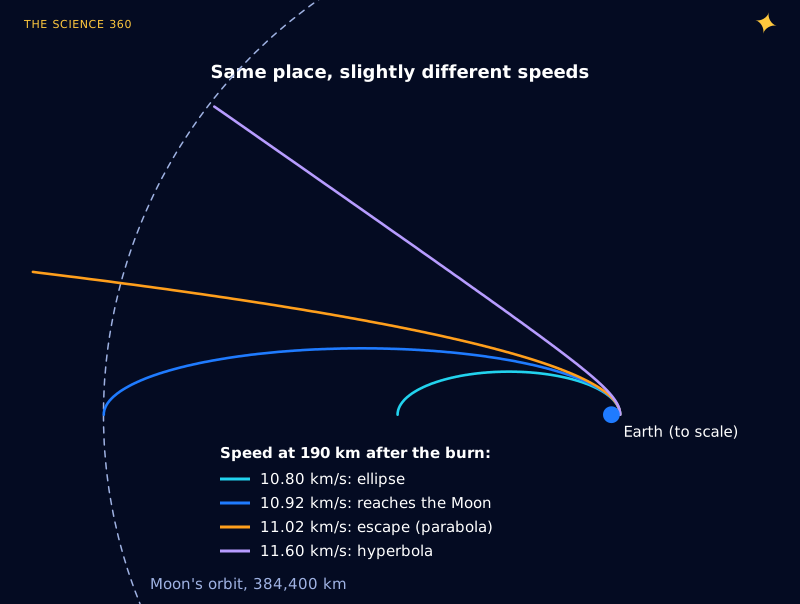
So the speed needed to reach the Moon is within 1% of escape, but still below it. A spacecraft that never met the Moon would have swung out for about five days and been back near Earth about ten days after the burn (half of a 10-day orbital period each way, from Kepler's third law with a semi-major axis of 195,500 km). Figure 4 shows how sensitive the outcome is to the last hundred metres per second.
The Oberth effect: why the escape burn happens low and fast
If escape is about energy, why not climb to a high orbit first, where escape speed is lower, and burn there? Because a rocket burn is worth more when the rocket is already moving fast. The kinetic energy a burn adds is roughly v × Δv per kilogram, so the same Δv at higher speed adds more energy. Deep in Earth's gravity well, in low orbit, is where a spacecraft moves fastest. This is the Oberth effect, named after the rocket pioneer Hermann Oberth.
Target: leave Earth with 3 km/s to spare (hyperbolic excess speed)
From a 200 km circular orbit: , .
From the same orbit, just escaping (excess 0) needs 11.01 − 7.78 = 3.22 km/s. So the last 3 km/s of departure speed costs only 0.41 km/s extra.
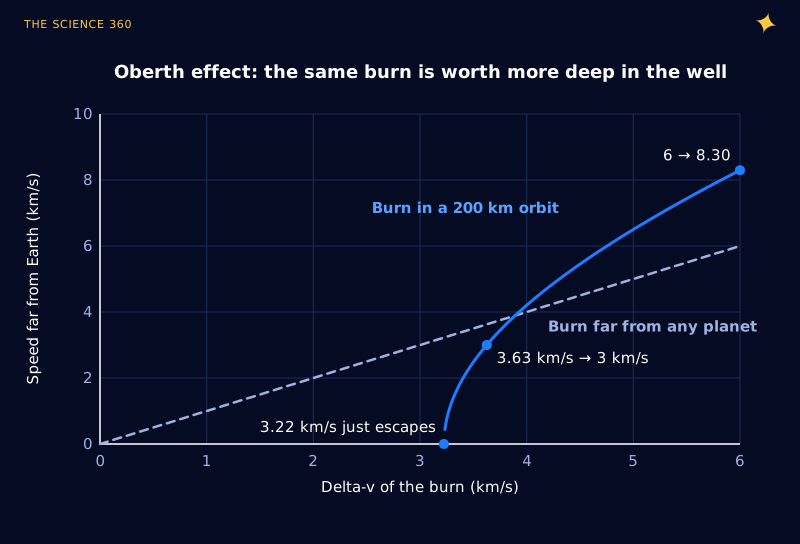
This is why interplanetary missions all use the same pattern: launch to a low parking orbit, coast to the right point, then fire a single burn that takes them from about 7.8 km/s to somewhat over 11 km/s. A trip to Mars needs a departure excess speed of a few km/s, and how long it then takes is a separate story, told in how long it takes to get to Mars.
Can you leave Earth without ever going fast?
Yes, at least on paper, if something other than your own propellant does the climbing. The classic example is a space elevator: a tether from the equator to beyond geostationary orbit, rotating with Earth. A climber riding up it never needs any rocket speed. Its speed relative to the ground stays small, but its speed through space is the tether's rotation, ωr, which grows with height. Let go at a high enough point and you are flung away.
Release height for escape from a space elevator
Escape when , so :
That is about 46,700 km up. Speed through space there:
equal to the local escape speed.
The energy bill is still 62.6 MJ per kilogram. The elevator just pays it with electricity spread over a slow climb, and borrows rotational energy from the whole Earth, instead of burning it in a few minutes. That is the cleanest illustration that escape is an energy problem, not a speed problem. Nobody can build the tether yet, because no material has been made strong enough, in bulk, over that length.
So what speed do real rockets reach?
For most launches the answer is about 7.8 km/s, orbital speed, and no more. Communication satellites, the ISS, Starlink and nearly every other payload never come close to escape. Missions to the Moon reach just under escape speed, and planetary missions reach a bit over it, but always from orbit, where the local value is 11.0 km/s rather than 11.2. The Voyagers and other outer-planet probes then picked up much of their speed from gravity assists by Jupiter and Saturn, which is how Voyager 1 got a light-day away without carrying the propellant for it.
So the honest version of the textbook line is this: escape velocity tells you how much energy leaving Earth takes. Rockets go fast because that is the cheapest way to deliver that energy, and they do the final, fastest burn as low as they can because the Oberth effect rewards it.
FAQ
Do rockets need to reach escape velocity to leave Earth?
No. Escape velocity, 11.2 km/s at Earth's surface, is the speed an unpowered object would need to coast away forever. A rocket that keeps thrusting can leave at any speed. What it cannot avoid is the energy: 62.6 MJ for every kilogram it sends away, and slow climbs waste far more propellant than fast ones.
What is the difference between orbital velocity and escape velocity?
Circular orbital velocity is the speed that keeps you falling around Earth at a constant height, about 7.8 km/s in low orbit. Escape velocity is larger by a factor of the square root of 2, about 11.0 km/s at the same height. Between the two you are on an ellipse that always comes back.
Why is escape velocity 11.2 km/s?
It is the speed whose kinetic energy, , equals the energy needed to climb out of Earth's gravity well, . Solving gives . With and , that is 11.19 km/s.
Did the Apollo missions reach escape velocity?
Not quite. Apollo burned out of a parking orbit about 190 km up to roughly 10.9 km/s, about 1% below the local escape speed of 11.0 km/s. That put the spacecraft on a long ellipse reaching the Moon's distance. The Moon's gravity then took over.
Why do rockets go to orbit first before leaving Earth?
A parking orbit gives time to line up the departure, and burning while moving fast deep in Earth's gravity well is more efficient. This is the Oberth effect: a 3.6 km/s burn in low orbit leaves you with 3 km/s far from Earth, more than the same burn would give in deep space after subtracting the escape cost.
Related on The Science 360
Sources
- NASA Goddard, NSSDC Earth Fact Sheet (GM = 0.39860 × 10⁶ km³/s², mean radius 6,371.000 km, equatorial radius 6,378.137 km, escape velocity 11.186 km/s, sidereal rotation 23.9345 h): nssdc.gsfc.nasa.gov
- Wikipedia, "Escape velocity" (escape at any non-zero speed under thrust with the same minimum energy; about 11.0 km/s from a 200 km orbit; Oberth effect at periapsis): en.wikipedia.org/wiki/Escape_velocity
- Wikipedia, "Delta-v budget" (about 9.4 km/s to reach the ISS's initial orbit; 1.5 to 2 km/s of drag and gravity losses, marked citation needed): en.wikipedia.org/wiki/Delta-v_budget
- Georgia Tech Research, "Why does a rocket have to go 25,000 mph to escape Earth?" (the coasting-speed explanation this post refines): news.research.gatech.edu
- Oikofuge, "How Apollo got to the Moon" (190 km parking orbit, 7.8 km/s to about 10.8 km/s at translunar injection; our two-body calculation gives 10.9 km/s): oikofuge.com
Method note: all curves use two-body Newtonian gravity with GM = 398,600.44 km³/s², ignoring air drag, Earth's oblateness and the Moon's pull. The constant-speed climb is an idealised vertical ascent in vacuum, used to show how gravity loss scales, not a flight profile anyone would fly.
Header image: NASA/Joel Kowsky (image NHQ202211160030), regraded for this article.