Space 01
Why Are Planets Round but Asteroids Aren't? The Math
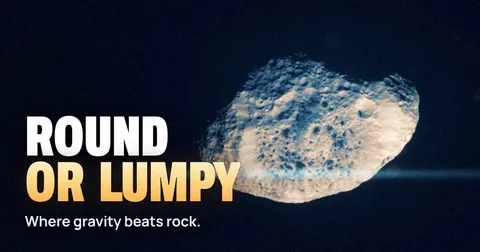
Gravity rounds a world once its central pressure beats the strength of rock or ice. We compute the threshold: about 200 km for ice, 300 km for rock.
Escape velocity is 11.2 km/s, but no rocket needs it to leave Earth. It is a coasting speed, not a launch requirement. The real cost is energy and delta-v.
A station needs about 30/√r rpm for 1 g. Why small stations feel wrong: head-to-foot gradient, Coriolis, and the radius you really need. Worked numbers.
Gravity at the ISS is 89% of Earth's surface value. Astronauts float because they fall 4.35 m every second and keep missing. Here are the numbers.
At a stellar black hole's horizon the stretch is 21 million g. At Sgr A* it is 0.0001 g. Tidal math, your clock and what outsiders see, worked out.
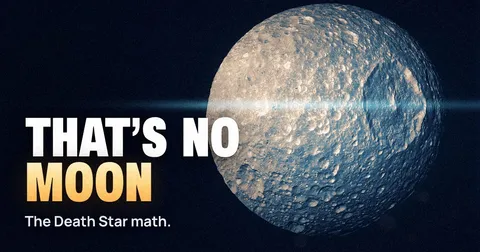
Blowing Earth apart takes 2.49×10³² J, 11% more than the textbook figure, or 7.5 days of the Sun's whole output. The Death Star math, layer by layer.
The station, crew and loose objects fall together. Weightlessness is about the missing support force, not gravity switching off above the atmosphere.