What If You Jumped Into a Hole Through the Earth?
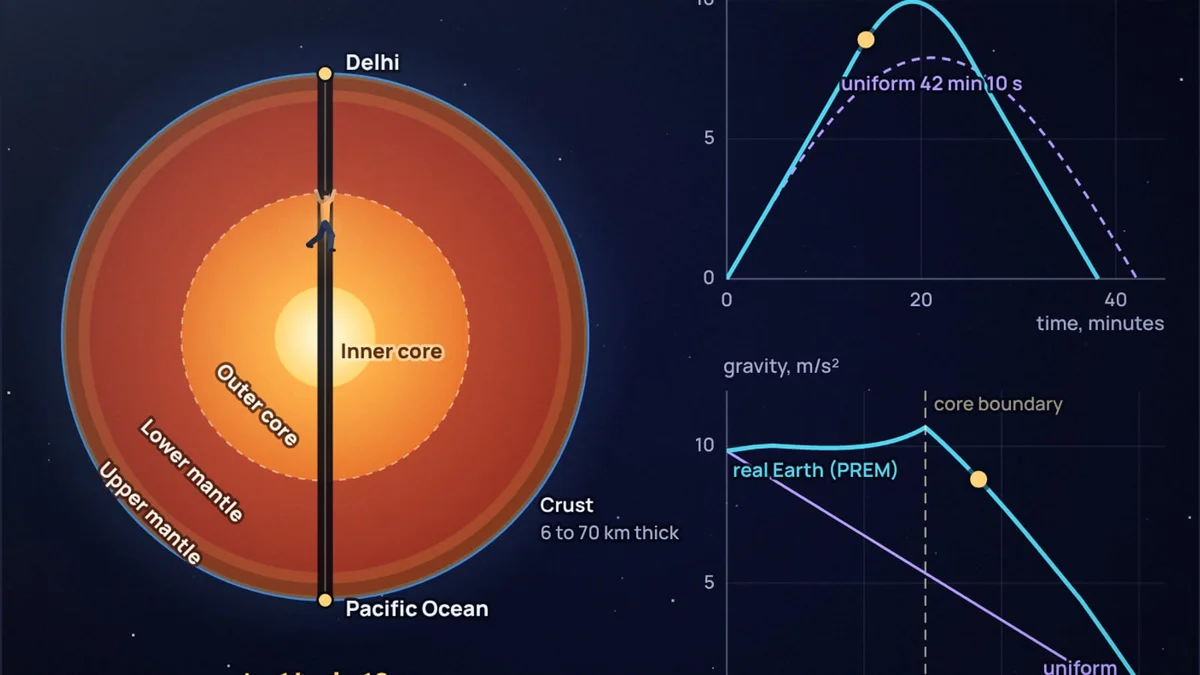
Dig a hole straight down from Delhi, through the crust, the mantle and the iron core, and out the other side. Pump out the air, step off the edge, and let go. What happens next is one of the oldest puzzles in physics, and it has a surprisingly tidy answer: you fall for about 19 minutes, flash through the centre of the Earth at close to 10 km/s, coast up the far side, and arrive at the surface 38 minutes after you jumped, at a standstill, floating in the southeastern Pacific.
The fall through the Earth simulator runs this trip with the real density of the Earth layer by layer. Pick a tunnel, straight through or a chord between two cities, and it plots your speed and the strength of gravity at every depth. This post walks through the numbers behind it.
Where would you come out if you dug through from India?
A straight line through the centre ends at the antipode, the point exactly opposite. You find it by flipping the sign of the latitude and moving the longitude by 180°. Delhi sits at about 28.6° N, 77.2° E, so its antipode is 28.6° S, 102.8° W. That is open water in the southeastern Pacific, about 670 km from Easter Island and some 3,000 km off the coast of Chile. Mumbai's antipode, 19.1° S, 107.1° W, is in the same empty stretch of ocean.
That is no accident. Most of the land on Earth sits opposite ocean, and the Indian subcontinent maps almost entirely onto the Pacific west of South America. So the first practical problem with the tunnel is that the far end opens into the deep sea floor.
How long does the fall take in a simple Earth?
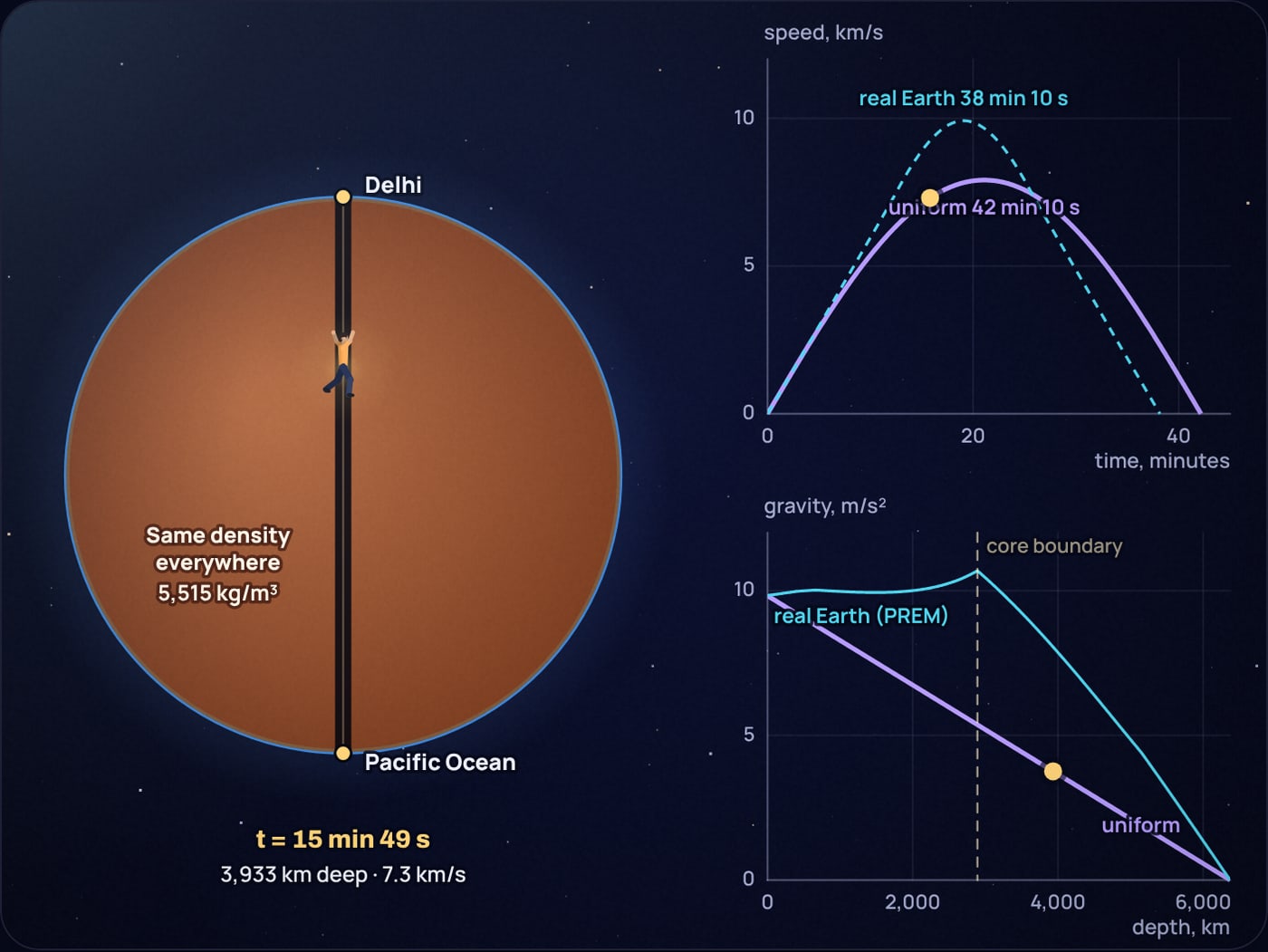
Start with the textbook version, an Earth of the same density all the way through. Inside a uniform ball, only the mass closer to the centre than you pulls on you overall. The shells outside you cancel, a result Newton proved and now called the shell theorem. That inner mass shrinks as the cube of your distance from the centre, while gravity weakens as the inverse square, so the net pull falls in a straight line to zero at the centre:
A force that grows in proportion to your distance from a central point is exactly the force of an ideal spring. The motion is simple harmonic, the same as a mass bouncing on a spring or a pendulum making small swings, and its timing does not depend on how far it travels.
Surface gravity , radius
Angular frequency:
One crossing is half an oscillation:
Top speed at the centre:
Two things in that result are worth a second look. The top speed, 7.9 km/s, is the speed a satellite needs to orbit just above the ground. And the crossing time is exactly half the period of such an orbit, 84.3 minutes. A satellite skimming the surface and a person dropped into the hole at the same moment would arrive at the far side together, because the faller's motion is just the shadow of the circular orbit projected on to a straight line.
Why the real Earth is faster: about 38 minutes
The Earth is not uniform. Its average density is 5,515 kg/m³, but the rocks near the surface are around 2,700 to 3,400 kg/m³ while the iron core is roughly 10,000 to 13,000 kg/m³. Seismologists have mapped this with the Preliminary Reference Earth Model, PREM, published by Dziewonski and Anderson in 1981, which gives density as a function of depth from the crust to the centre. The simulator integrates that profile, and as a check its total mass comes out at 5.974 × 10²⁴ kg, within 0.04% of the measured mass of the Earth.
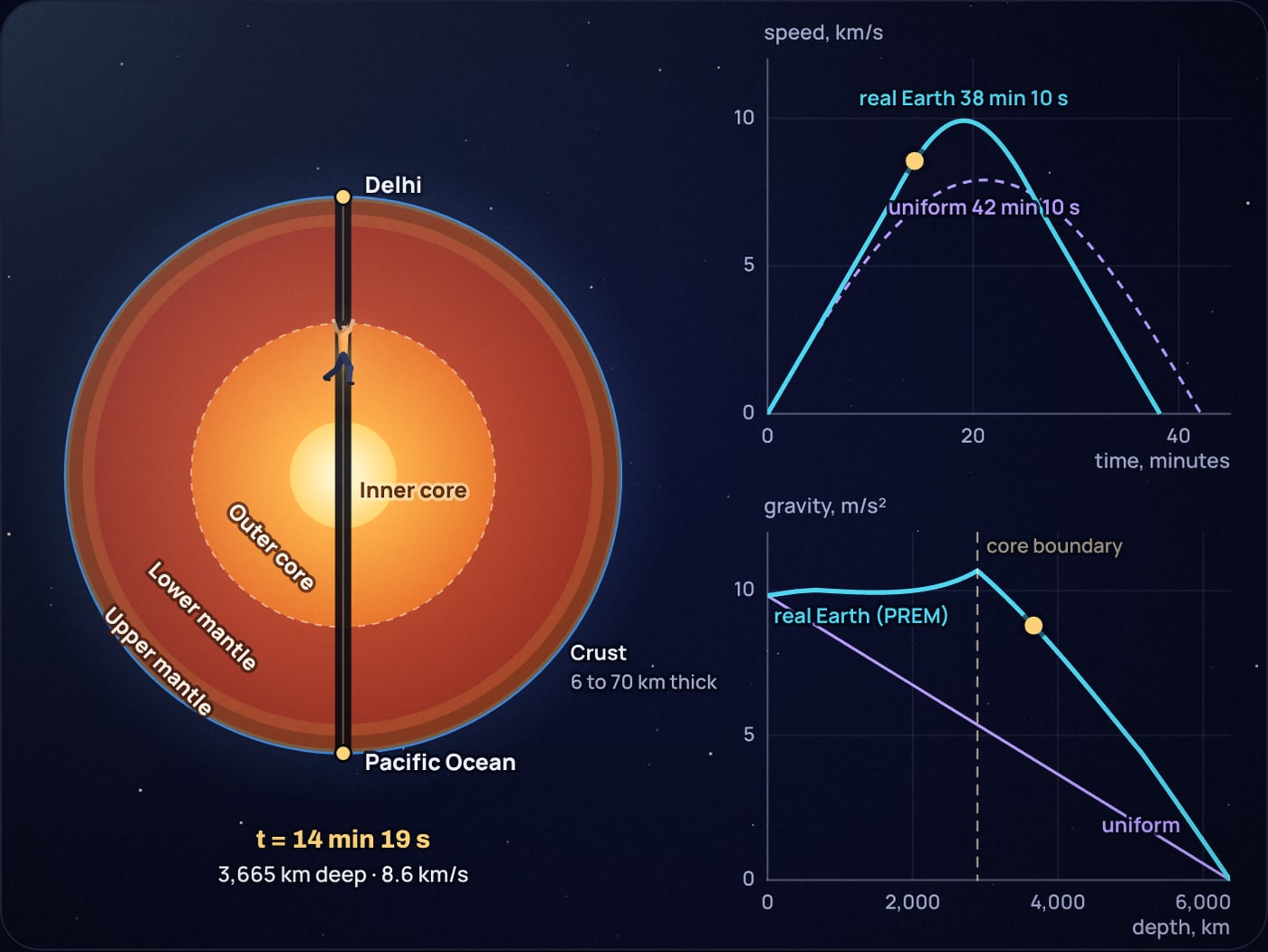
With so much mass packed into the core, something surprising happens as you fall through the mantle: gravity does not weaken. The outer shells you leave behind are light, and you are getting closer to the heavy core, so the pull actually grows. It peaks at about 10.7 m/s² at the core-mantle boundary, 2,891 km down, about 1.09 times surface gravity. Only once you are inside the core does it fall away, almost in a straight line, to zero at the centre.
| Depth | Where you are | Gravity, real Earth | Gravity, uniform Earth |
|---|---|---|---|
| 0 km | Surface | 9.82 m/s² | 9.82 m/s² |
| 1,000 km | Lower mantle | 9.97 m/s² | 8.28 m/s² |
| 2,891 km | Core-mantle boundary | 10.69 m/s² | 5.37 m/s² |
| 5,150 km | Inner core boundary | 4.40 m/s² | 1.88 m/s² |
| 6,371 km | Centre | 0 | 0 |
Stronger gravity over the first half of the fall means you pick up speed faster and cover the distance sooner. Running the fall step by step through the PREM profile gives:
- You reach the core-mantle boundary after 12 min 45 s, already moving at 7.6 km/s.
- You pass the centre after 19 min 10 s at 9.92 km/s, about 35,700 km/h.
- You arrive at the far surface 38 min 10 s after jumping, with your speed back to zero.
Alexander Klotz worked this out in the American Journal of Physics in 2015 and got 38 min 11 s, a second away from the simulator's figure. He also noticed that a simple model of constant gravity, 9.8 m/s² all the way to the centre, gets very close at 38 min 0 s, because the rise in the mantle and the drop in the core nearly balance. The famous 42 minutes is the uniform Earth, which is the one Earth we know we do not live on.
Does a tunnel between two cities work too?
You do not need to go through the centre. Any straight tunnel between two points on the surface runs downhill to its midpoint and uphill after it, so a train on frictionless rails would roll from one city to the other with no engine at all. This is the gravity train. Robert Hooke described an object accelerating inside a planet in a letter to Isaac Newton, and the physicist Paul Cooper revived the idea in the American Journal of Physics in 1966.
In a uniform Earth every such trip takes the same 42 min 10 s, whether the tunnel is 100 km long or goes through the centre. A short tunnel is only gently sloped, so the push along it is weak, but the distance is short in exact proportion. The real Earth breaks this neat result, because a short chord stays in the light outer rock and never feels the strong pull near the core.
Surface distance , so the half angle at the centre is
Tunnel length:
Deepest point:
Top speed, uniform Earth:
Simulator, real Earth: 4.15 km/s and 41 min 18 s, versus 42 min 10 s uniform
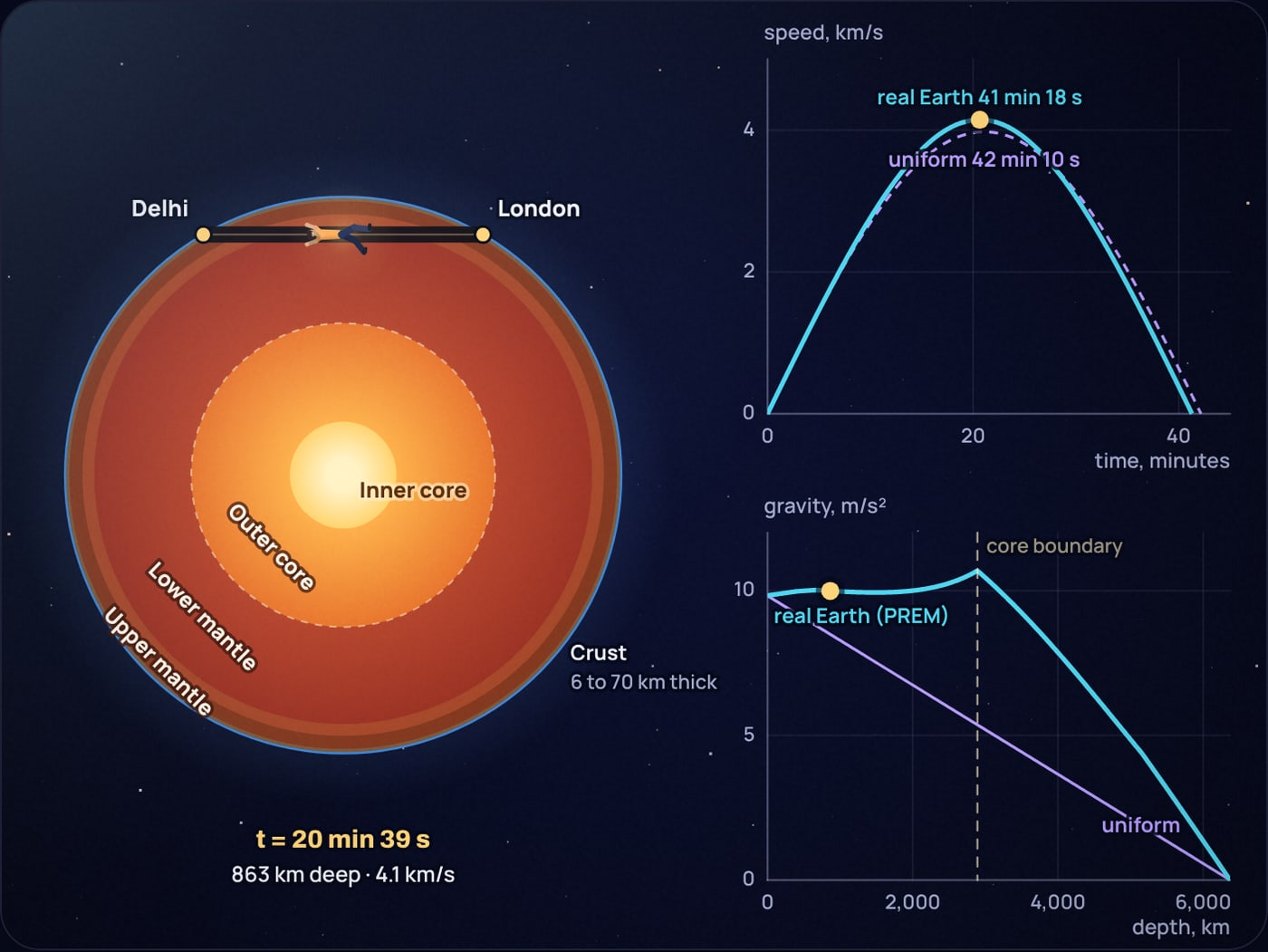
The longer the chord, the deeper it dips and the faster the trip. Klotz found the time drops from about 42 minutes for short chords to 38 minutes for the full diameter.
| Tunnel | Surface distance | Deepest point | Top speed | Trip time, real Earth |
|---|---|---|---|---|
| Delhi to Mumbai | 1,148 km | 26 km | 0.71 km/s | 42 min 8 s |
| Delhi to London | 6,711 km | 863 km | 4.15 km/s | 41 min 18 s |
| Mumbai to New York | 12,538 km | 2,843 km | 7.56 km/s | 39 min 39 s |
| Delhi to its antipode | 20,015 km | 6,371 km | 9.92 km/s | 38 min 10 s |
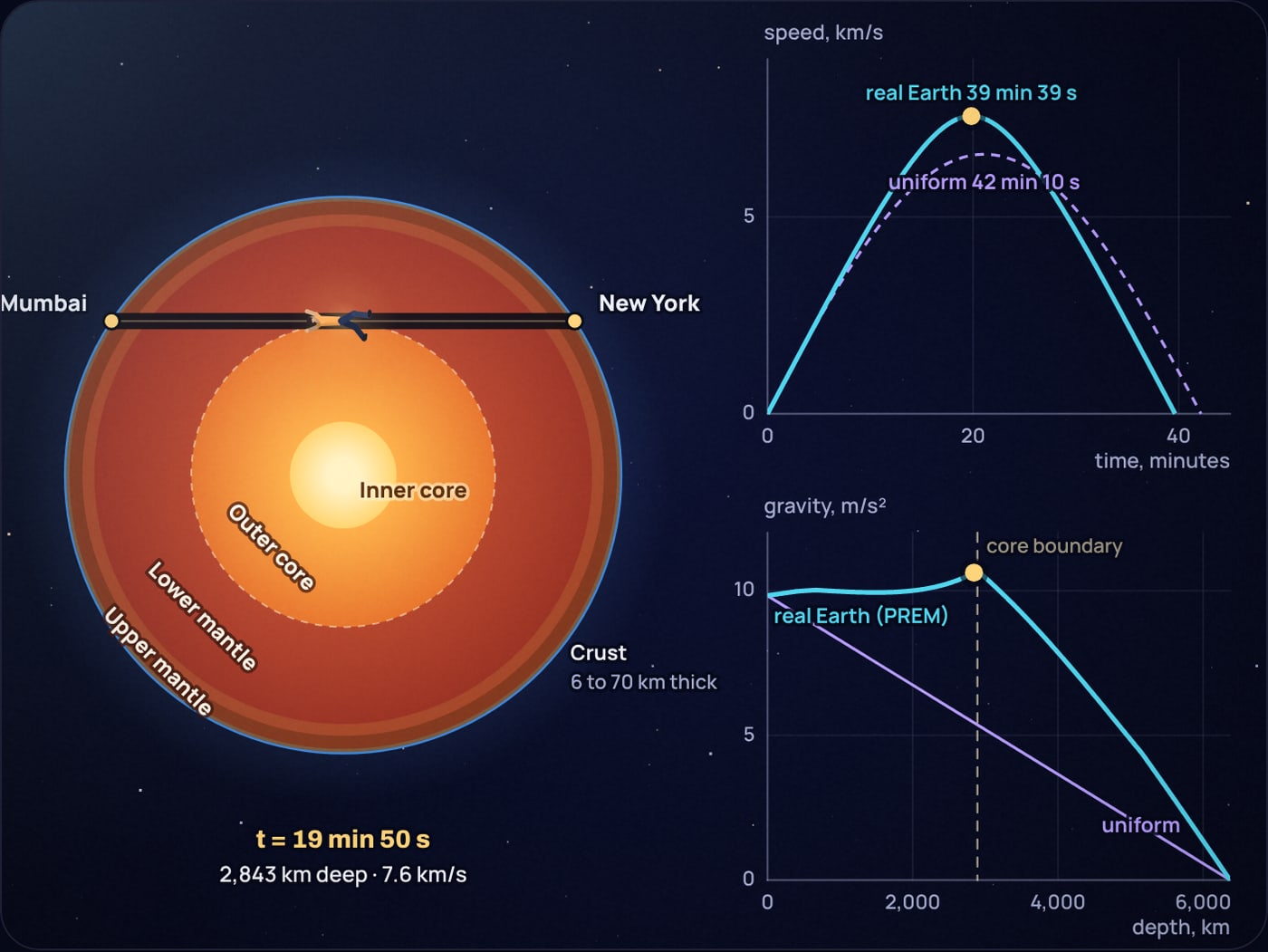
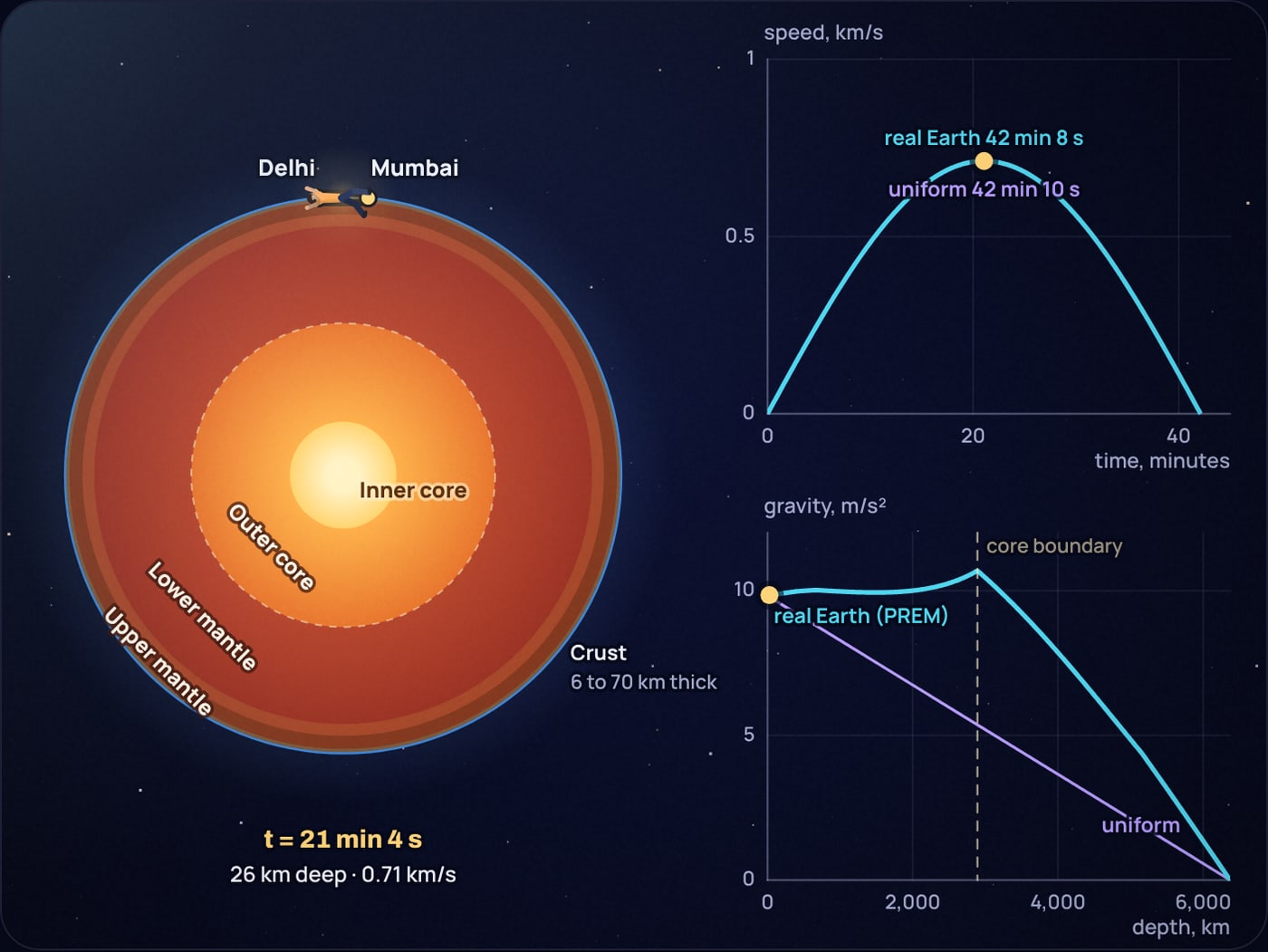
A 42 minute trip from Delhi to Mumbai with no fuel sounds wonderful until you remember the tunnel would be 1,147 km of straight bore running 26 km deep, far beyond anything ever drilled. The deepest hole humans have made, the Kola Superdeep Borehole in Russia, reached 12,262 m in 1989, and drilling on a later branch was stopped by rock temperatures of about 180 °C.
Would you stop at the centre?
A common guess is that you would fall to the centre and stop, since gravity is zero there. In a vacuum you would not. Zero force at the centre means zero acceleration, not zero speed. You arrive there at your fastest and sail straight through, then gravity on the far side slows you down by exactly as much as it sped you up. You just reach the far surface, momentarily stop, and fall back. Without losses, you would oscillate between Delhi and the Pacific forever, one round trip every 76 minutes.
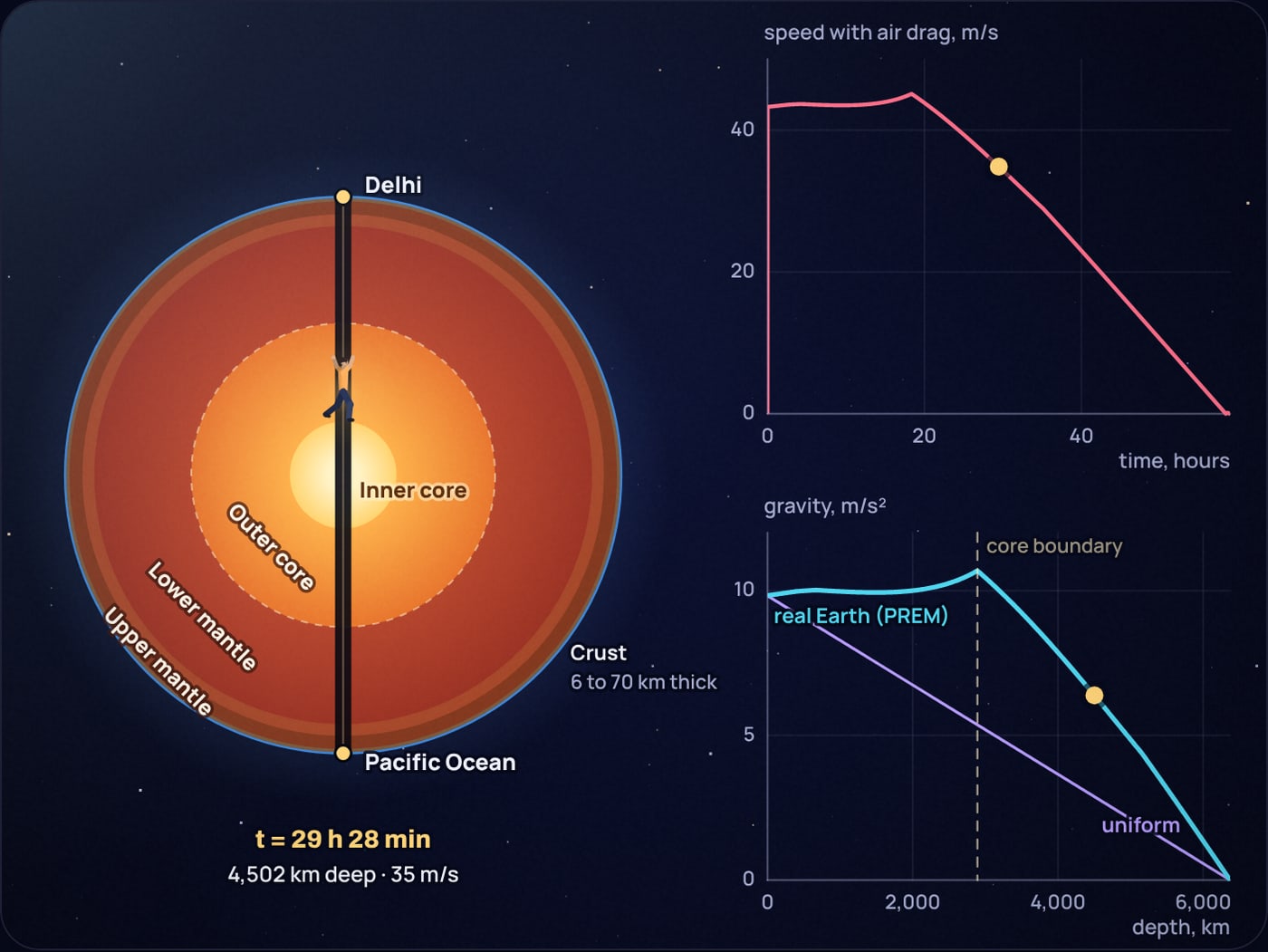
Air changes everything. A falling person in sea-level air reaches a terminal speed where drag balances weight:
Mass , air density , drag area
At that pace 6,371 km takes , about 41 hours
In the simulator, which lets gravity change with depth, terminal speed creeps up to 45 m/s near the core boundary, then falls as gravity weakens in the core. You reach the centre about 58 hours after jumping, with almost no speed left to climb back, and settle there. Real air would be far worse, because a column of air 6,371 km deep would be crushed to enormous density at the bottom, and long before then you would have to survive the heat.
What the simple picture leaves out
Even an airless tunnel through the real Earth has a few complications. The Earth spins. Delhi moves east at about 408 m/s, and as you fall towards the axis your sideways speed no longer matches the rock around you, the same effect that sets the direction of cyclones. In a straight tunnel you would press against the east wall the whole way down. A tunnel from pole to pole avoids this. Klotz estimates that rotation changes the timing of a roughly 40 minute trip by only about 4 s, and that the Earth's slightly flattened shape changes it by about 10 s.
The other problems are less polite. The core is thousands of degrees hot, the pressure at the centre is millions of times that of the atmosphere, and no material could hold a tunnel open through either. The experiment stays in the head, and on the screen. If you are curious about why you feel weightless the whole way down, the same idea explains why astronauts float in orbit, and how much gravity there really is on the ISS.
Try it yourself
Open the fall through the Earth simulator and drag the distance slider from a short hop to the full 20,015 km diameter. Watch the trip time fall from 42 to 38 minutes as the tunnel dips towards the core. Then switch to the uniform model and see every tunnel snap to the same 42 min 10 s. For a sense of how much energy holds a planet together in the first place, read how much energy it would take to blow up the Earth.
Sources
- Klotz, A. R. (2015), The gravity tunnel in a non-uniform Earth, American Journal of Physics 83, 231 (arXiv 1308.1342)
- Preliminary reference Earth model, Wikipedia (Dziewonski and Anderson 1981, Physics of the Earth and Planetary Interiors 25, 297)
- Gravity train, Wikipedia (Hooke, Cooper, 42 minute uniform figure)
- Kola Superdeep Borehole, Wikipedia (12,262 m in 1989)
Frequently asked questions
How long would it take to fall through the Earth?
About 38 minutes through an airless tunnel along a diameter, using the measured density of the real Earth. The simulator gives 38 min 10 s and Klotz (2015) gives 38 min 11 s. The textbook answer of 42 minutes assumes an Earth of uniform density.
How fast would you be going at the centre of the Earth?
About 9.9 km/s, or roughly 35,700 km/h, in the real Earth. In a uniform Earth the top speed would be 7.9 km/s, the same as the speed of a satellite skimming the surface.
Would you stop at the centre of the Earth?
Not in a vacuum. You would shoot through the centre at full speed, slow down on the way up, and just reach the far surface before falling back. With air in the tunnel you would fall at about 45 m/s and, after more than two days, end up floating at the centre.
Where would you come out if you dug straight through from India?
In the southeastern Pacific Ocean. The point opposite Delhi is at 28.6° S, 102.8° W, about 670 km from Easter Island. Almost all of India’s antipodes are open ocean west of South America.
Is gravity stronger or weaker inside the Earth?
Both, depending on depth. Gravity rises slightly as you go down through the mantle, to about 10.7 m/s² at the core boundary 2,891 km down, about 1.09 times surface gravity, because the dense core dominates. Then it falls to zero at the centre.
 Why the 2027 Solar Eclipse Lasts 6 Minutes 23 Seconds
 How We Know 3I/ATLAS Is Interstellar: Orbit Math