How long would it take to fall through the Earth?
About 38 minutes. In a frictionless tunnel straight through the real Earth you would fall for 38 min 10 s, pass the centre at 9.9 km/s (35700 km/h) and come to a stop just as you reach the far side. The classic textbook answer, 42 min 10 s, assumes the Earth has the same density all the way through. It does not: the iron core is so dense that gravity gets stronger as you fall, peaking at 10.69 m/s² at the core boundary, and that shaves four minutes off the trip.
The simulation integrates the fall using the Preliminary Reference Earth Model (PREM) of Dziewonski and Anderson (1981), the standard seismic model of the Earth's interior, and reproduces the 38 minute result that Alexander Klotz published in the American Journal of Physics in 2015. Pick a tunnel straight through, or a chord between two cities, and compare it with the uniform Earth.
Key results from the simulation
- Straight through: 38 min 10 s in the real Earth, 42 min 10 s in a uniform one. Top speed 9.9 km/s against 7.9 km/s.
- Gravity rises before it falls: from 9.82 m/s² at the surface it climbs to 10.69 m/s² at the core-mantle boundary, 2,891 km down, then drops to zero at the centre.
- Any straight tunnel, about the same time: in the uniform model every chord takes exactly 42 min 10 s. In the real Earth a Delhi to London tunnel takes 41 min 18 s and a Delhi to Mumbai tunnel 42 min 8 s.
- Air ruins it: with air at sea-level density in the tunnel you fall at about 45 m/s and drift to the centre after 58 h 12 min, never reaching the far side.
Six tunnels through the Earth
Each case loads a preset. The tunnel is a vacuum unless stated, the Earth does not rotate, and you start from rest at the surface.
Straight down from Delhi: out in the Pacific
Diameter, real Earth (PREM)Drill straight down from Delhi and the far end comes out at 28.6° S, 102.8° W, in the open Pacific about 670 km from Easter Island. You would need a boat waiting. The fall takes 38 min 10 s: 19 min 10 s down to the centre and the same back up.
For the first 12 minutes you fall through the mantle with gravity close to its surface value, slightly rising. At 12 min 45 s you cross into the liquid iron outer core moving at 7.6 km/s, and from there gravity drops away fast. You pass the centre at 9.9 km/s, about 40 times the speed of an airliner.
The textbook answer: a uniform Earth
Diameter, constant densityIf the Earth had its average density of 5,515 kg/m³ everywhere, the pull on you would fall in proportion to your distance from the centre. That is the force law of a spring, so you would oscillate in simple harmonic motion with a one-way time of π√(R/g) = 42 min 10 s.
That is exactly half the period of a satellite skimming the surface, 84 minutes. The coincidence is not an accident: a circular orbit seen edge on is the same simple harmonic motion. Paul Cooper made the point in the American Journal of Physics in 1966, proposing gravity trains.
A gravity train from Delhi to London
Chord, 6,711 km along the surfaceA straight tunnel from Delhi to London is a chord 6,405 km long that dips 863 km below the surface at its midpoint. Released from rest, a frictionless train would roll downhill, reach 4.1 km/s at the midpoint, and coast up to London in 41 min 18 s, with no engine at all.
In a uniform Earth it would take 42 min 10 s, the same as falling straight through. In the real Earth a shallow chord stays in the mantle, where gravity is close to its surface value, so it gets little help from the dense core.
Mumbai to New York: grazing the core
Chord, 12,538 km along the surfaceMumbai and New York are 12,538 km apart over the surface. The tunnel between them goes 2,843 km deep, almost to the core boundary at 2,891 km. The trip takes 39 min 39 s with a top speed of 7.6 km/s.
The deeper the chord, the more of the dense core it feels and the faster the trip, sliding from about 42 minutes for short hops towards 38 minutes for the diameter. That is the signature of the real Earth that Klotz pointed out: crossing time depends on the route.
Delhi to Mumbai in 42 minutes, downhill
Chord, 1,148 km along the surfaceA straight tunnel between Delhi and Mumbai only dips 26 km below the surface. A frictionless train would top out at 0.7 km/s (2600 km/h) and arrive after 42 min 8 s, almost exactly the uniform-Earth time.
Short tunnels stay in rock whose gravity is close to the surface value, so they behave like the uniform model. The catch is everything else: building a 1,150 km vacuum tunnel 26 km deep, through rock hot enough to glow.
With air in the tunnel you never come out
Diameter, air at sea-level densityFill the tunnel with ordinary air and you hit terminal velocity within a minute, about 45 m/s for a person falling feet first. At that speed the 6,371 km to the centre takes 58 h 12 min, and you barely overshoot before settling there.
Even this is optimistic. Real air in a tunnel thousands of kilometres deep would be squeezed by the weight of the air above it until it was denser than water, so you would slow to a crawl long before the core. The vacuum is not a detail.
Inside the Earth: density and gravity with depth
| Depth | Layer | PREM density | Gravity, real Earth | Gravity, uniform Earth |
|---|---|---|---|---|
| 0 km | Surface | 1,020 kg/m³ | 9.82 m/s² | 9.82 m/s² |
| 371 km | Upper mantle | 3,526 kg/m³ | 9.97 m/s² | 9.25 m/s² |
| 670 km | Top of the lower mantle | 4,381 kg/m³ | 10.02 m/s² | 8.79 m/s² |
| 1,371 km | Lower mantle | 4,790 kg/m³ | 9.94 m/s² | 7.71 m/s² |
| 2,371 km | Lower mantle | 5,307 kg/m³ | 10.17 m/s² | 6.17 m/s² |
| 2,891 km | Core-mantle boundary | 9,903 kg/m³ | 10.69 m/s² | 5.37 m/s² |
| 3,371 km | Outer core | 10,602 kg/m³ | 9.56 m/s² | 4.63 m/s² |
| 4,371 km | Outer core | 11,655 kg/m³ | 6.78 m/s² | 3.08 m/s² |
| 5,150 km | Inner core boundary | 12,764 kg/m³ | 4.40 m/s² | 1.88 m/s² |
| 5,871 km | Inner core | 13,034 kg/m³ | 1.83 m/s² | 0.77 m/s² |
| 6,371 km | Centre | 13,088 kg/m³ | 0.00 m/s² | 0.00 m/s² |
Density is the PREM value just below that depth (the boundary rows show the denser side). Gravity is computed from the mass enclosed, ignoring Earth’s rotation and flattening.
How the simulation works
Gravity inside the Earth. By Newton's shell theorem, a spherical shell exerts no net force on anything inside it. So at a distance r from the centre only the mass M(r) closer in pulls you, and g(r) = GM(r)/r². The simulation integrates the PREM density polynomials layer by layer for M(r). The total comes to 5.974 × 10²⁴ kg, within 0.04 percent of the measured mass of the Earth.
The tunnel. A straight tunnel between two places a surface distance d apart is a chord whose closest point to the centre is R cos(d/2R). Only the component of gravity along the tunnel accelerates you; the rest presses you against the wall. The equations of motion are integrated with a fourth-order Runge-Kutta step of half a second, and the crossing time is when you come to rest at the far end.
The uniform model. Constant density makes g proportional to r, so the acceleration along any chord is proportional to the distance from the chord's midpoint. That is simple harmonic motion with period 2π√(R/g), and every chord takes the same 42 min 10 s.
Air drag. The air option uses sea-level density, 1.2 kg/m³, a drag area of 0.7 m² and an 80 kg person. It is a toy that shows why the vacuum matters, not a model of a real tunnel full of compressed air.
What the model leaves out
- Earth’s rotation: a hole through the poles avoids it. Anywhere else, the faster-spinning surface gives you sideways speed that the slower deep tunnel does not have, so you would scrape the east wall all the way down (the Coriolis effect). Klotz estimated rotation changes the time by only seconds if you slide frictionlessly.
- Heat and pressure: the centre is about as hot as the surface of the Sun and the pressure is over three million times atmospheric. No tunnel wall survives that. The simulation treats the tunnel as a perfect frictionless vacuum tube.
- Earth’s shape: the Earth is slightly flattened and its gravity field is lumpy. Klotz estimated the flattening changes the diameter crossing by about 10 seconds.
- Your arrival: you reach the far side at zero speed, and if nobody catches you, you fall back and repeat the trip forever in a perfect vacuum.
Common misconceptions
"Gravity gets weaker as soon as you go underground." Not in the real Earth. The rock above you stops pulling, but you get closer to the very dense core, and for the first 2,891 km the second effect wins. Gravity rises from 9.82 to 10.69 m/s² before it falls.
"You would stop at the centre." In a vacuum you pass the centre at top speed, because gravity has been pulling you the whole way down. Only friction or air would leave you there.
"A tunnel to a nearby city would be quick." In a uniform Earth every straight tunnel takes the same 42 minutes. The shorter tunnel is also shallower, so it is less steep, and the two effects cancel exactly.
Frequently asked questions
How long would it take to fall through the Earth?
About 38 min 10 s through a vacuum tunnel along the diameter, using the real density profile of the Earth (PREM). If the Earth had uniform density it would be 42 min 10 s.
How fast would you be going at the centre of the Earth?
About 9.9 km/s, or 35700 km/h, in the real Earth, and 7.9 km/s in a uniform one. That is close to orbital speed, which is no coincidence.
Is gravity stronger inside the Earth?
For a while, yes. Because the core is so dense, gravity increases from 9.82 m/s² at the surface to about 10.69 m/s² at the core-mantle boundary, 2,891 km down, and then falls to zero at the centre.
What is a gravity train?
A train running in a straight frictionless tunnel between two cities, powered only by gravity: it falls downhill to the midpoint and coasts uphill to the other end. In a uniform Earth every such trip takes 42 min 10 s. In the real Earth, Delhi to London would take 41 min 18 s.
Where would you come out if you dug straight down from India?
In the southeastern Pacific Ocean. The point opposite Delhi is at 28.6° S, 102.8° W, about 670 km from Easter Island. Most of India's antipodes are open ocean.
Keep learning
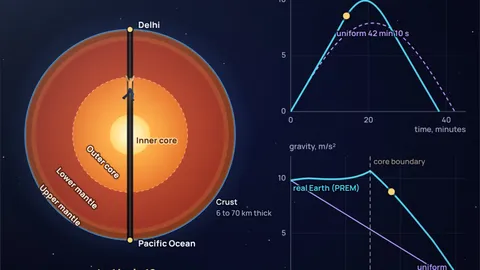
What If You Jumped Into a Hole Through the Earth?
Jump into a vacuum tunnel from Delhi and you pop out in the Pacific 38 minutes later at up to 9.9 km/s. The physics of falling through the Earth, with real numbers.

Gravity is still strong at the space station. Why do astronauts float?
The station, crew and loose objects fall together. Weightlessness is about the missing support force, not gravity switching off above the atmosphere.

Is There Gravity on the ISS? Yes: 89% of Earth's
Gravity at the ISS is 89% of Earth's surface value. Astronauts float because they fall 4.35 m every second and keep missing. Here are the numbers.

This much Energy can Blown up Entire Earth
There are super Weapons in The Star Wars Franchise. That can Release Enough energy to Blow up a Planet. But how much energy does it take?