Why Don't You Feel the Gravity of the Person Next to You?
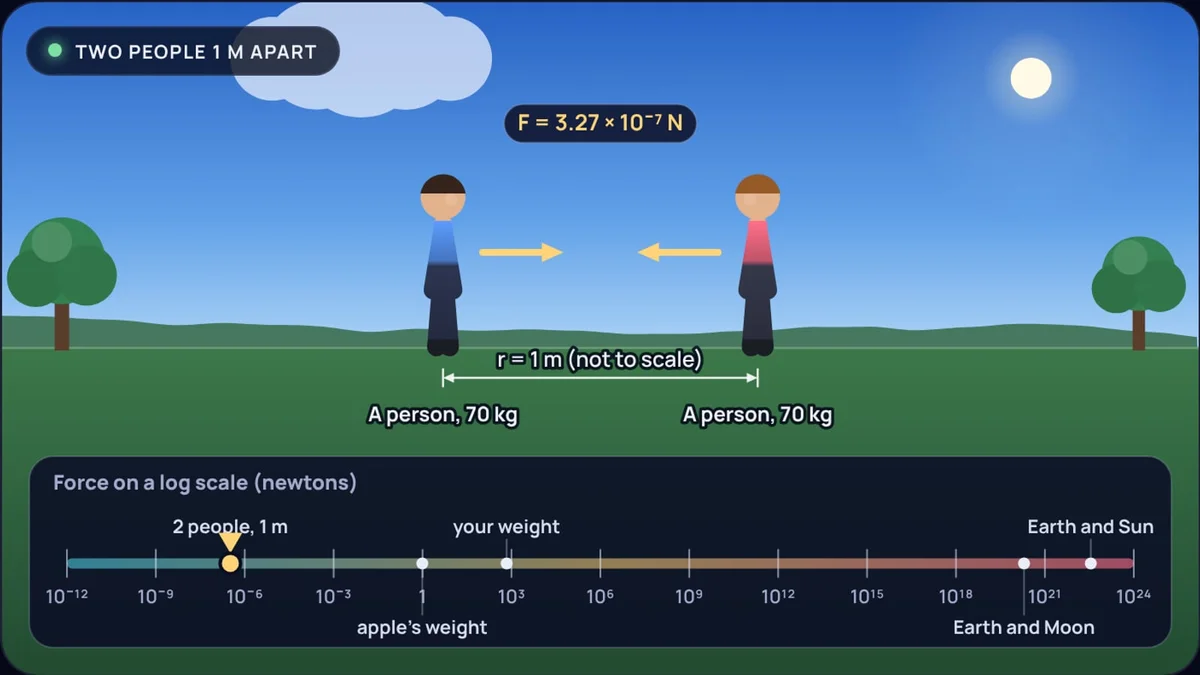
The person sitting next to you on the bus is pulling you towards them right now. So is the bus, the building you just passed and the coffee cup in your hand. Every mass in the universe attracts every other mass. The reason you have never noticed is in the numbers: two people standing 1 m apart pull on each other with 0.000 000 33 newtons, about the weight of 33 micrograms.
This post works out that number, compares it with the pull of Earth, the Moon and the Sun, and looks at what it would take to actually notice it. You can change the masses and distance yourself in the gravitational force calculator, which writes out the working and places the answer on a scale running from two people to Earth and the Sun.
How strong is the pull between two people?
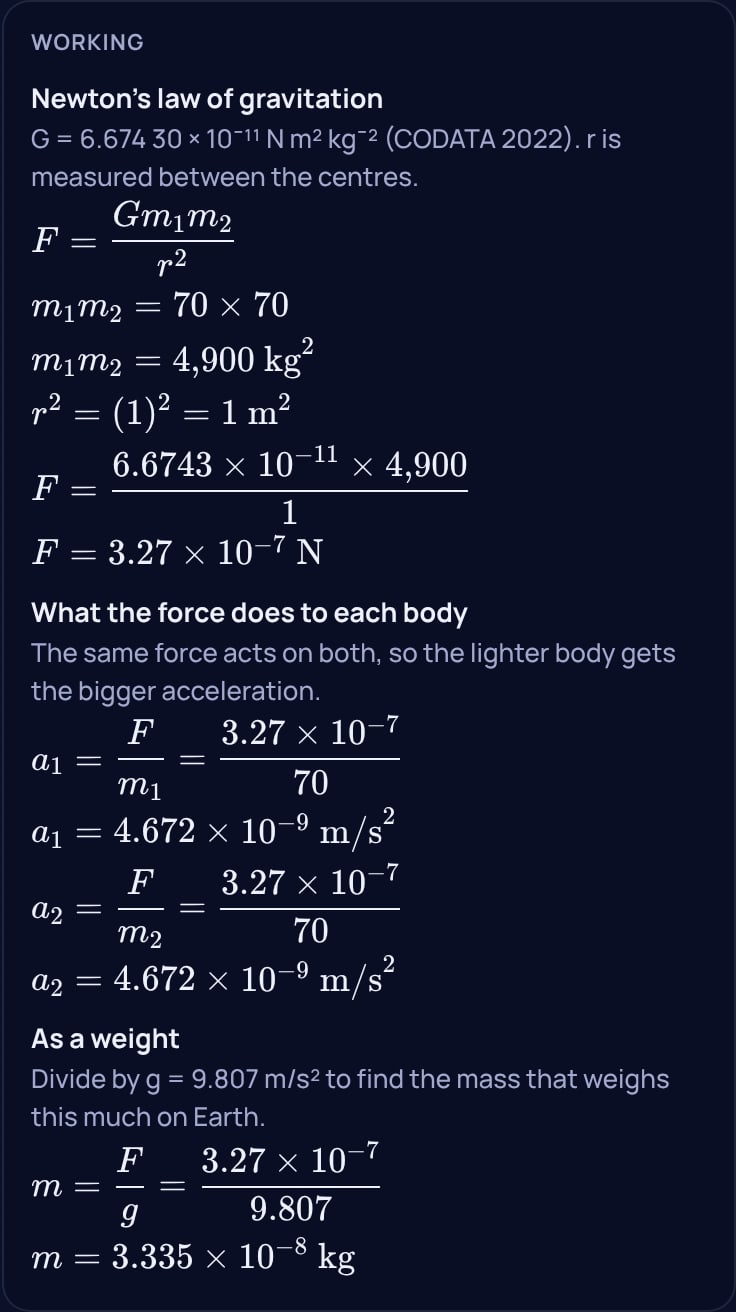
Newton's law of universal gravitation gives the force between two masses and whose centres are a distance apart:
The gravitational constant is , the CODATA 2022 value published by NIST. Each body feels the same force, pointing towards the other.
Worked example 1: two 70 kg people, 1 m apart
As a weight, divide by g:
Each person's acceleration is . Starting from rest, that would move you less than a hundredth of a millimetre in a minute.
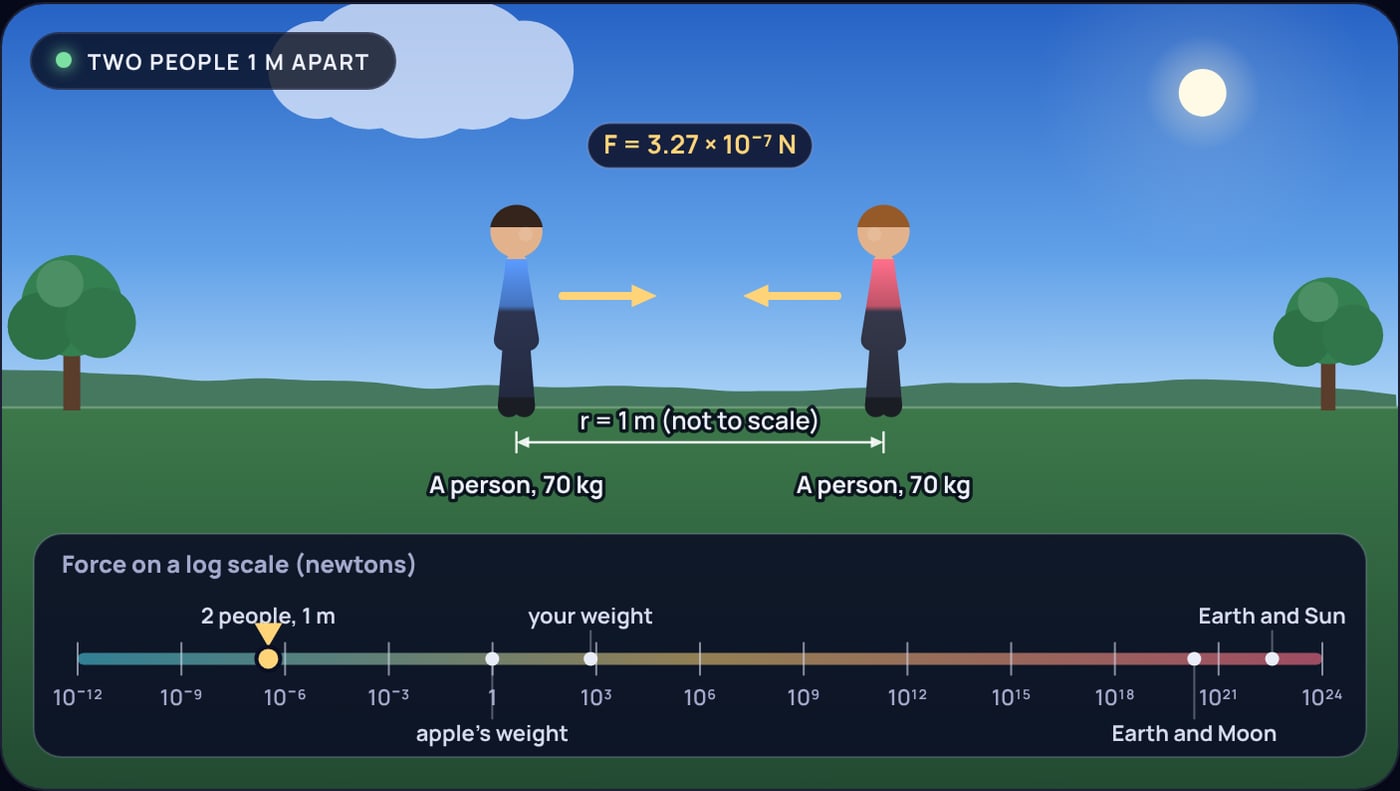
One caution about this number. Newton's formula is exact for spheres and for objects far apart compared with their size. People are neither: a body is roughly as wide as the 1 m gap, so treating each person as a point at their centre is a rough approximation. The true force could differ by a factor of a few, which changes nothing about the conclusion.
Why is Earth’s pull so much stronger?
Run the same formula for you and Earth. A sphere pulls on things outside it as if all its mass sat at its centre, so the distance is Earth's mean radius, 6,371 km, and the mass is NASA's 5.9722 × 10²⁴ kg.
Worked example 2: a 70 kg person and Earth
Dividing by 70 kg gives 9.82 m/s², the familiar g.
Compare the two answers: 687 N against 3.27 × 10⁻⁷ N, a ratio of about 2.1 billion. Two things fight in that ratio. Earth is 8.5 × 10²² times more massive than a person, which helps it enormously. But its centre is 6.371 million metres away instead of 1 m, and squaring that distance weakens the pull by a factor of 4.1 × 10¹³. Mass wins by about nine powers of ten.
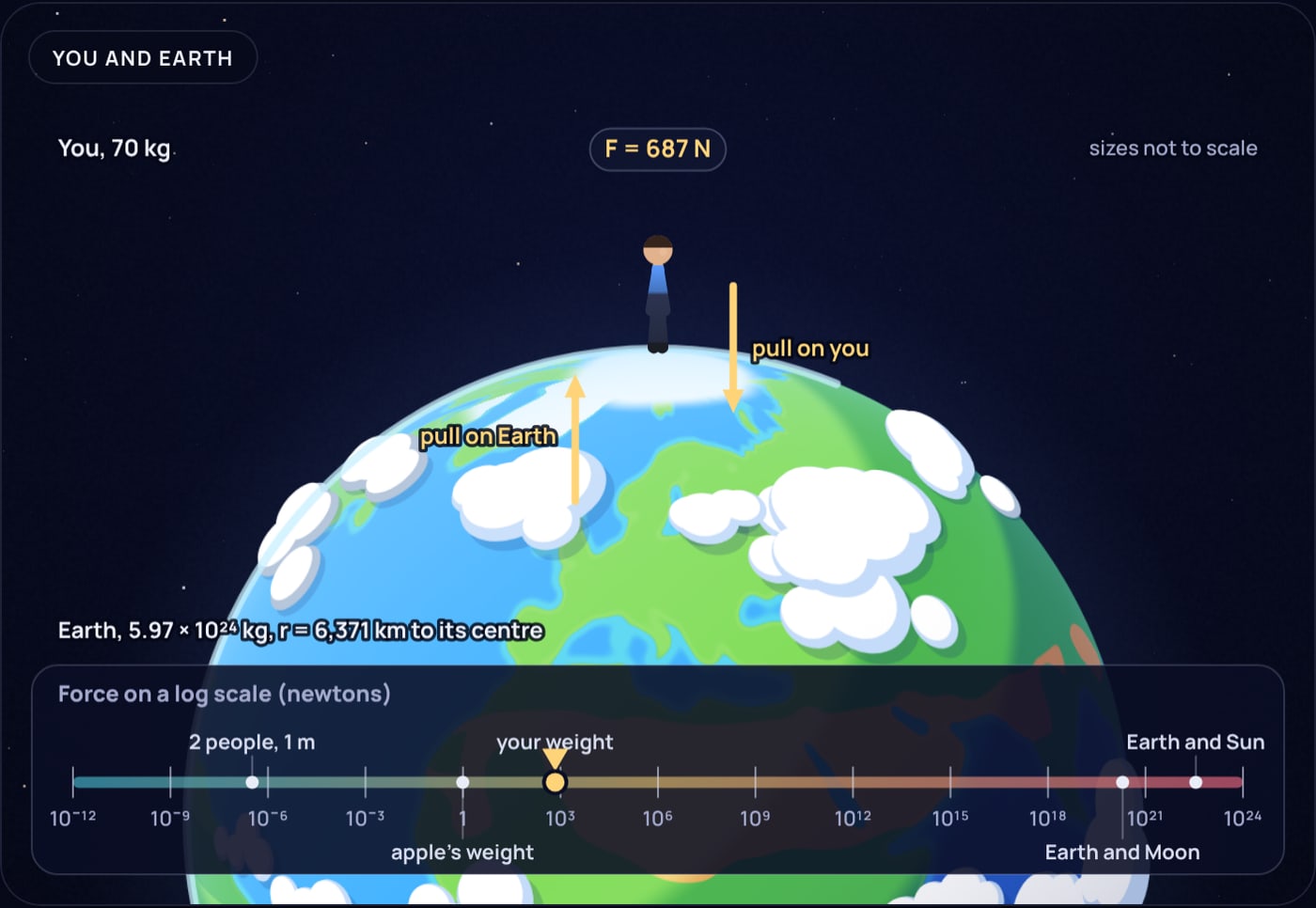
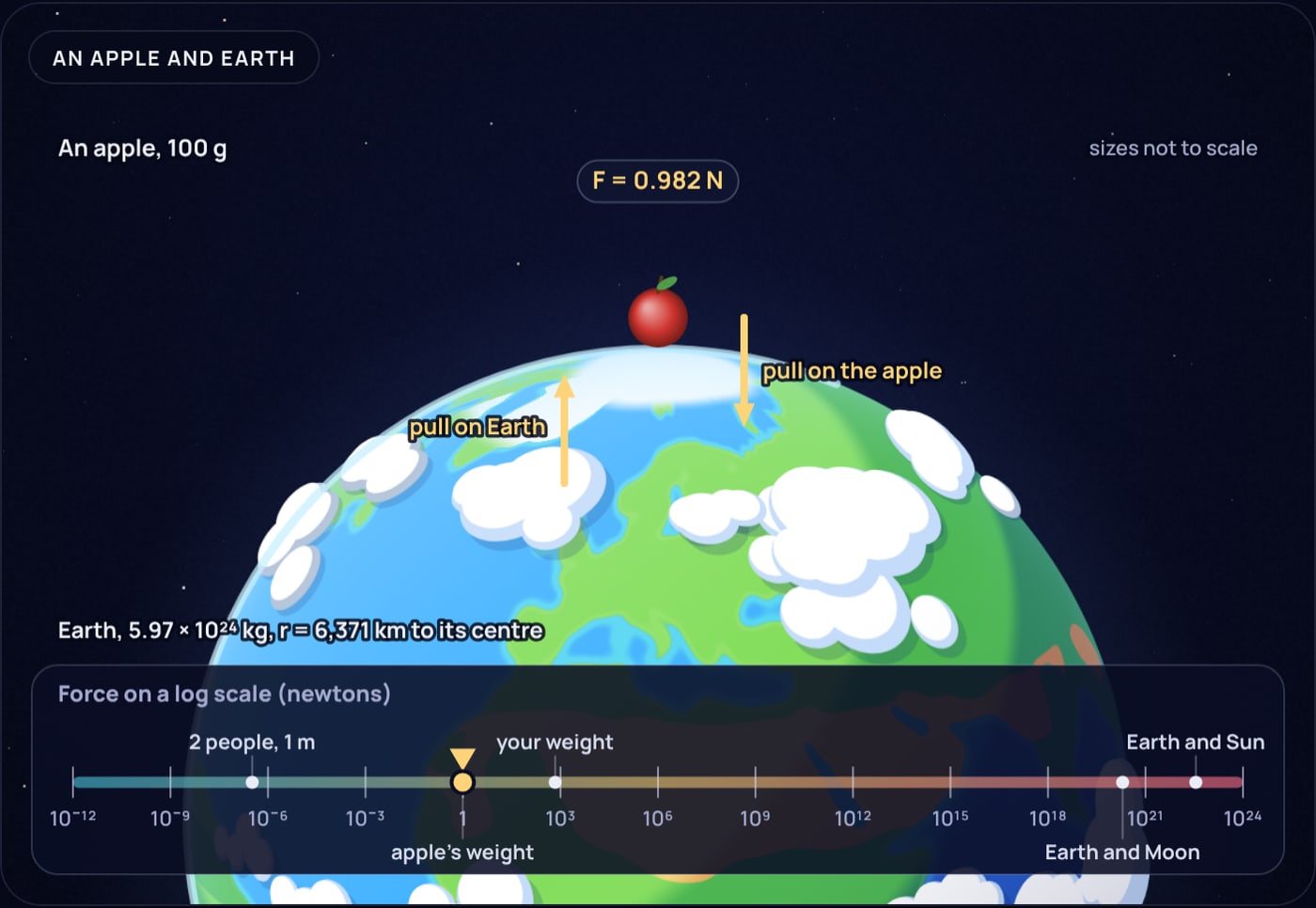
Notice the arrows in the figure. Earth is pulled towards you with the same 687 N, as Newton's third law requires. Its acceleration is 687 N divided by 6 × 10²⁴ kg, about 10⁻²² m/s², so nobody has ever noticed the planet jumping up to meet a falling apple.
Why is G so small?
G sets the strength of gravity, and in everyday units it is tiny. To get a pull of just one newton between two equal masses 1 m apart, each would need about 122,000 kg, or 122 tonnes, from . That is why gravity only becomes something you can feel when at least one of the masses is the size of a moon or a planet.
The smallness of G also makes it hard to measure. Laboratory measurements have to detect the attraction between masses of a few kilograms, forces of the same size as the pull between two people. NIST quotes G with a relative uncertainty of 2.2 × 10⁻⁵, about 22 parts per million, which is loose by the standards of precision physics.
Could you ever feel it?
Standing on the ground, never. The pull of the person beside you has to compete with friction under your feet. Shoes on a wooden floor have a static friction coefficient of about 0.9 in the OpenStax table, so the floor can hold you in place against a sideways force of up to 0.9 × 687 = 618 N. That is about 1.9 billion times the 3.27 × 10⁻⁷ N gravity is offering. The block-on-a-slope version of the same comparison is in block on an inclined plane with friction.
Take friction away and things change. Two people floating at rest in deep space, 1 m apart, really would drift together. Treating them as points, the time for two masses to fall together from rest is
Worked example 3: drifting together in space
Real bodies touch before their centres meet, so the meeting would come a little sooner, at roughly 2.8 hours if their centres are 40 cm apart when they bump. Either way it is hours of slow drift, and a single breath or a waved hand would push them far harder than gravity does. Astronauts on a space station never see it, which ties in with why astronauts float in the first place.
How do the Moon and the Sun compare?
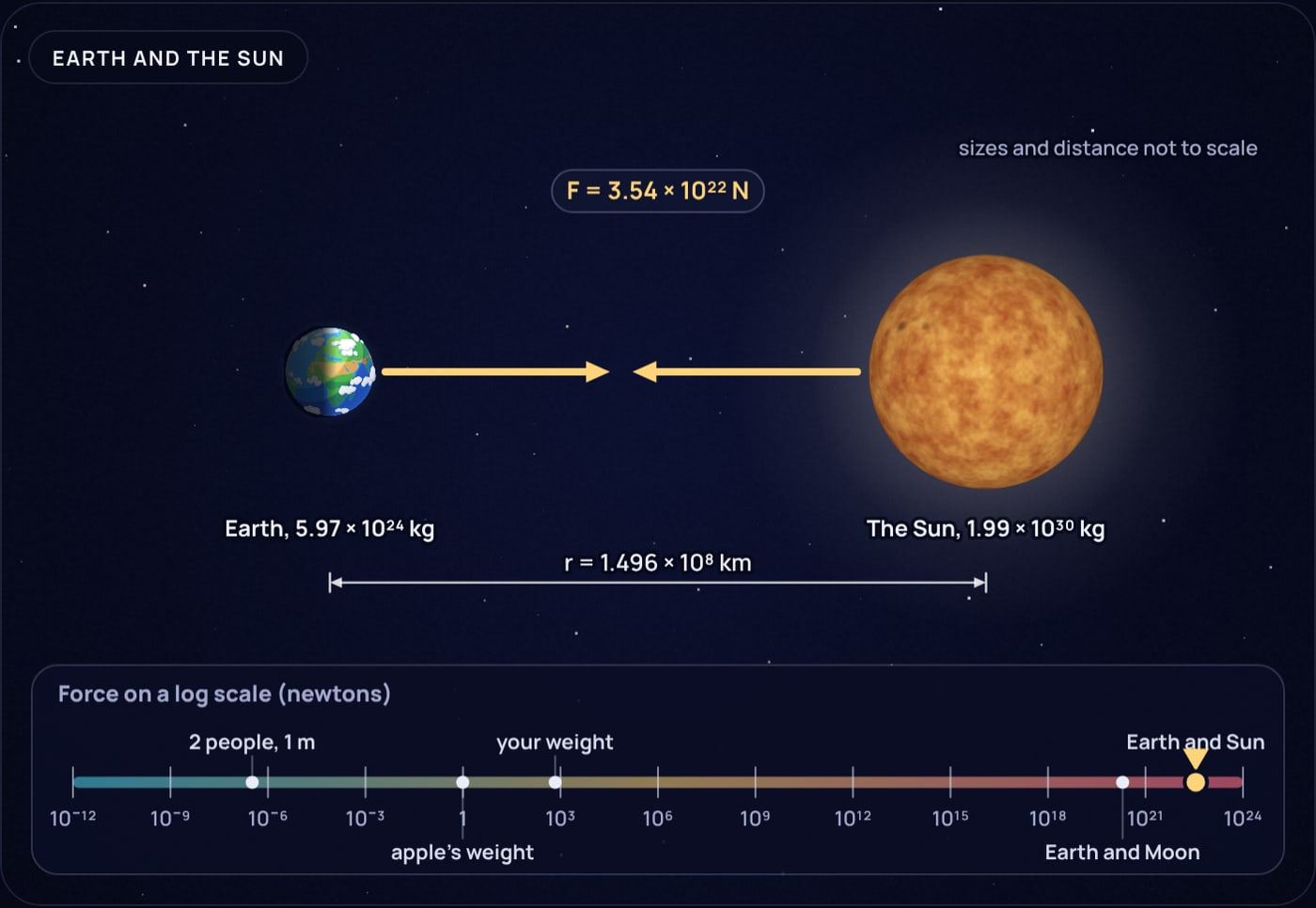
The Moon and the Sun are huge but far away. Their pulls on a 70 kg person sit between the person next to you and Earth:
| Pull on a 70 kg person from | Distance | Force |
|---|---|---|
| Another 70 kg person | 10 m | 3.27 × 10⁻⁹ N |
| Another 70 kg person | 1 m | 3.27 × 10⁻⁷ N |
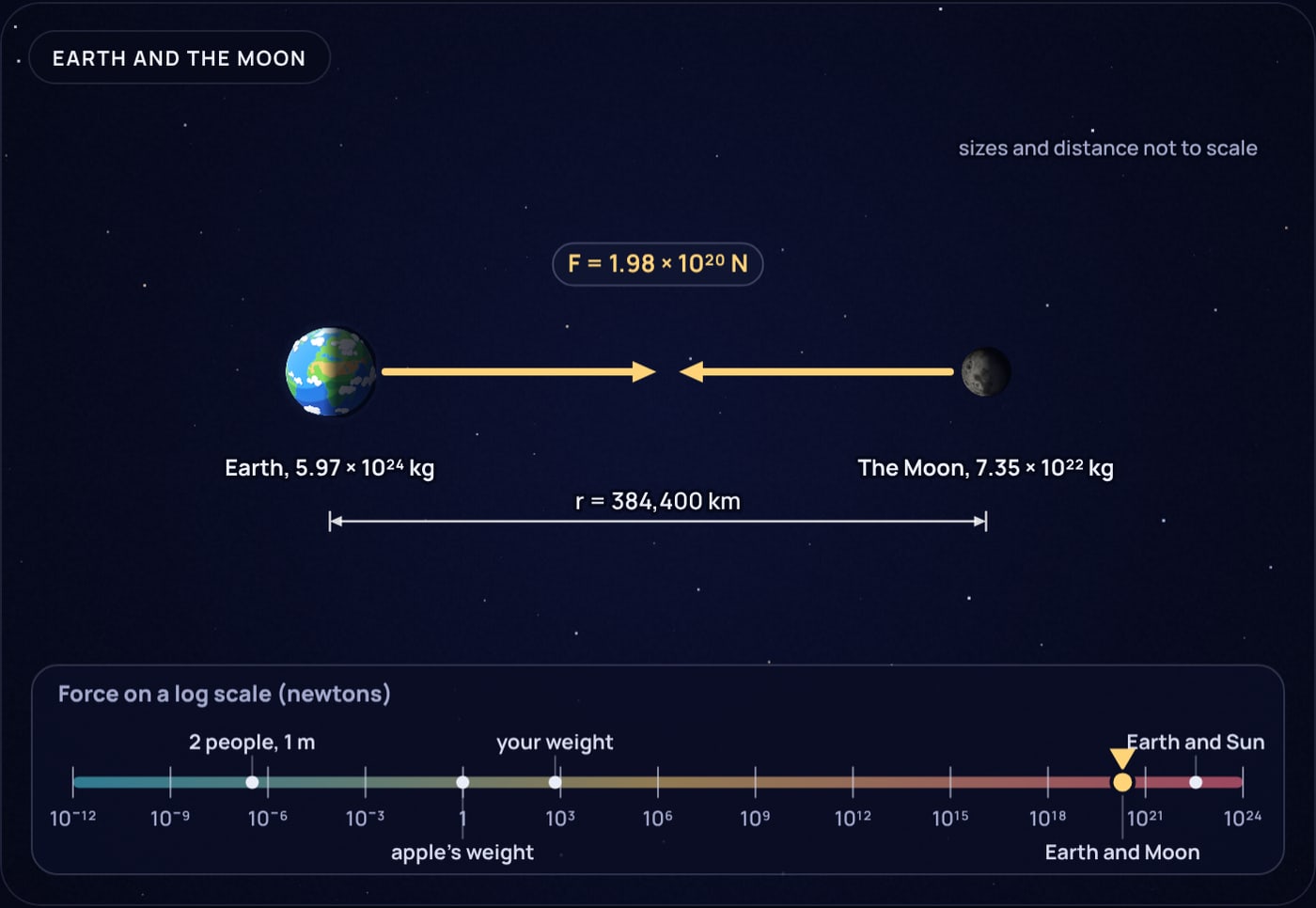
| The Moon | 384,400 km | 0.00232 N |
| The Sun | 149.6 million km | 0.415 N |
| Earth | 6,371 km to the centre | 687 N |
The Sun's pull on you, 0.415 N, is over a million times stronger than the person beside you. So why don't you feel that? Because the Sun gives Earth exactly the same acceleration it gives you, 0.0059 m/s², since the acceleration does not depend on the mass being pulled. You and the planet fall around the Sun together, and a fall you share with your surroundings cannot be felt. Only the small difference in the pull across Earth's width survives, and that shows up as tides.
How does distance change the pull?
The force falls with the square of the distance. Step back from 1 m to 2 m and the pull between two people drops to a quarter, 8.2 × 10⁻⁸ N. At 10 m it is a hundredth, 3.3 × 10⁻⁹ N. The same rule works on the scale of the solar system, and it gives a neat check of the whole law.
Worked example 4: the Moon falls towards Earth
The Moon is 384,400 ÷ 6,371 = 60.3 Earth radii from Earth's centre. If gravity falls as 1/r², its acceleration towards Earth should be g divided by 60.3²:
Calculated directly from the Moon's mass and Newton's law, the Earth and Moon pull on each other with 1.98 × 10²⁰ N, and dividing by the Moon's 7.346 × 10²² kg gives the same 0.00270 m/s². The apple on a tree and the Moon in the sky obey one rule; the Moon is simply falling sideways fast enough to keep missing Earth.
What does this tell us about gravity?
Gravity is the weakest force you meet in daily life, yet it runs the solar system. Both statements come from the same formula. For small objects, G makes the force negligible. For planets and stars, the masses are so large that nothing else matters, because they are electrically neutral overall and gravity, which only ever attracts, adds up across every kilogram. The pull of the person next to you is real. It is just one part in two billion of what holds you to the floor, and you can find out how much your weight changes in orbit in is there gravity on the ISS.
Try it yourself
Open the two people preset in the gravitational force calculator and change the distance to 0.5 m, then 10 m, and watch the pointer move along the ruler. Then put in your own mass and a 1,500 kg car 2 m away: about 1.8 × 10⁻⁶ N, still far below anything you could feel.
Sources
- NIST, Newtonian constant of gravitation G, CODATA 2022: 6.674 30(15) × 10⁻¹¹ m³ kg⁻¹ s⁻², relative standard uncertainty 2.2 × 10⁻⁵.
- NASA Goddard, Earth fact sheet (mass 5.9722 × 10²⁴ kg, mean radius 6,371 km, mean surface gravity 9.820 m/s², semimajor axis 149.598 million km), Moon fact sheet (mass 0.07346 × 10²⁴ kg, semimajor axis 384,400 km) and Sun fact sheet (mass 1,988,400 × 10²⁴ kg).
- OpenStax, College Physics 2e, Table 5.1 (shoes on wood, μs about 0.9).
Frequently asked questions
Do people really attract each other by gravity?
Yes. Every mass attracts every other mass. Two 70 kg people 1 m apart pull on each other with about 3.3 × 10⁻⁷ newtons, roughly the weight of 33 micrograms. It is real but about two billion times weaker than Earth’s pull on each of them.
Why is Earth’s gravity so much stronger than a person’s?
Earth has about 8.5 × 10²² times the mass of a 70 kg person. Its centre is 6,371 km away, which weakens the pull by a factor of about 4 × 10¹³ compared with 1 m, but the mass wins by far: Earth’s pull on you is about 2.1 billion times the pull of a person 1 m away.
Why don’t we feel the Sun’s gravity?
The Sun pulls a 70 kg person with about 0.42 N, but it pulls Earth with exactly the same acceleration, 0.0059 m/s². You and Earth fall around the Sun together, so you feel nothing. Only the small difference across Earth’s size shows up, as tides.
Could two people floating in space drift together by gravity alone?
In principle, yes. Treated as points, two 70 kg people starting at rest 1 m apart would meet in roughly three hours. Any tiny push, air current or breath would swamp the effect long before that.
How do you calculate the gravitational force between two people?
Use F = Gm₁m₂/r² with G = 6.674 × 10⁻¹¹ N m² kg⁻². For two 70 kg people 1 m apart: F = 6.674 × 10⁻¹¹ × 70 × 70 ÷ 1² = 3.27 × 10⁻⁷ N.