How do you calculate the gravitational force between two objects?
Multiply the two masses, divide by the square of the distance between their centres, and multiply by the gravitational constant G = 6.674 × 10⁻¹¹ N m² kg⁻²: F = Gm₁m₂/r². Two 70 kg people standing 1 m apart pull on each other with F = 6.674 × 10⁻¹¹ × 70 × 70 ÷ 1² = 3.27 × 10⁻⁷ N, while Earth pulls each of them with 687 N. Both bodies feel the same force, in opposite directions.
Enter the masses in kg, g, lb or tonnes and the distance in m, km, ft or miles. The calculator converts to SI units, shows every step with your numbers, draws the two bodies with equal and opposite arrows on a log scale, and marks where your answer sits among everyday forces. For why the pull of the person next to you goes unnoticed, read why you don't feel the gravity of the person next to you.
Key results from the calculator
- Two people, 70 kg each, 1 m apart: 3.27 × 10⁻⁷ N, the weight of about 0.0333 mg. Each accelerates at 4.67 × 10⁻⁹ m/s².
- You (70 kg) and Earth: 687 N. That is your weight: 9.82 m/s² is g at Earth's mean radius.
- Earth and the Moon: 1.98 × 10²⁰ N at the mean distance of 384,400 km.
- Earth and the Sun: 3.54 × 10²² N, enough to bend Earth's path into its yearly orbit.
Five examples, worked
Each uses G = 6.674 30 × 10⁻¹¹ (CODATA 2022) and NASA values for Earth, the Moon and the Sun. The button loads it.
Two people standing 1 m apart
70 kg, 70 kg, 1 mF = 6.674 × 10⁻¹¹ × 70 × 70 ÷ 1² = 3.27 × 10⁻⁷ N. That is the weight of a mass of 0.0333 mg, and about 2.1 × 10⁹ times smaller than each person's weight.
Treating people as points is rough at 1 m, because their mass is spread over a body about as wide as the gap. The answer is right to within a factor of a few, which does not change the conclusion: you cannot feel it. Step back to 10 m and it falls a hundredfold, to 3.27 × 10⁻⁹ N.
You and Earth
70 kg, Earth, 6,371 kmEarth acts as if all of its 5.97 × 10²⁴ kg sat at its centre, 6,371 km below your feet. F = 6.674 × 10⁻¹¹ × 70 × 5.97 × 10²⁴ ÷ (6.371 × 10⁶)² = 687 N.
Divide by your mass and you get 9.82 m/s², the familiar g. Earth is pulled towards you with the same 687 N, but its acceleration is 1.15 × 10⁻²² m/s².
An apple and Earth: Newton's example
100 g, Earth, 6,371 kmA 100 g apple at the surface: F = 6.674 × 10⁻¹¹ × 0.1 × 5.97 × 10²⁴ ÷ (6.371 × 10⁶)² = 0.982 N, about one newton.
The apple accelerates at 9.82 m/s², the same as you, because g does not depend on the falling mass. Earth accelerates towards the apple at 1.64 × 10⁻²⁵ m/s².
Earth and the Moon
5.97 × 10²⁴ kg, 7.35 × 10²² kg, 384,400 kmF = 6.674 × 10⁻¹¹ × 5.97 × 10²⁴ × 7.35 × 10²² ÷ (3.844 × 10⁸)² = 1.98 × 10²⁰ N.
The Moon's acceleration towards Earth is 0.0027 m/s², which is exactly what keeps it on its curved orbit. Earth's is 3.32 × 10⁻⁵ m/s², about 81 times smaller, because the Moon has about 1/81 of Earth's mass.
Earth and the Sun
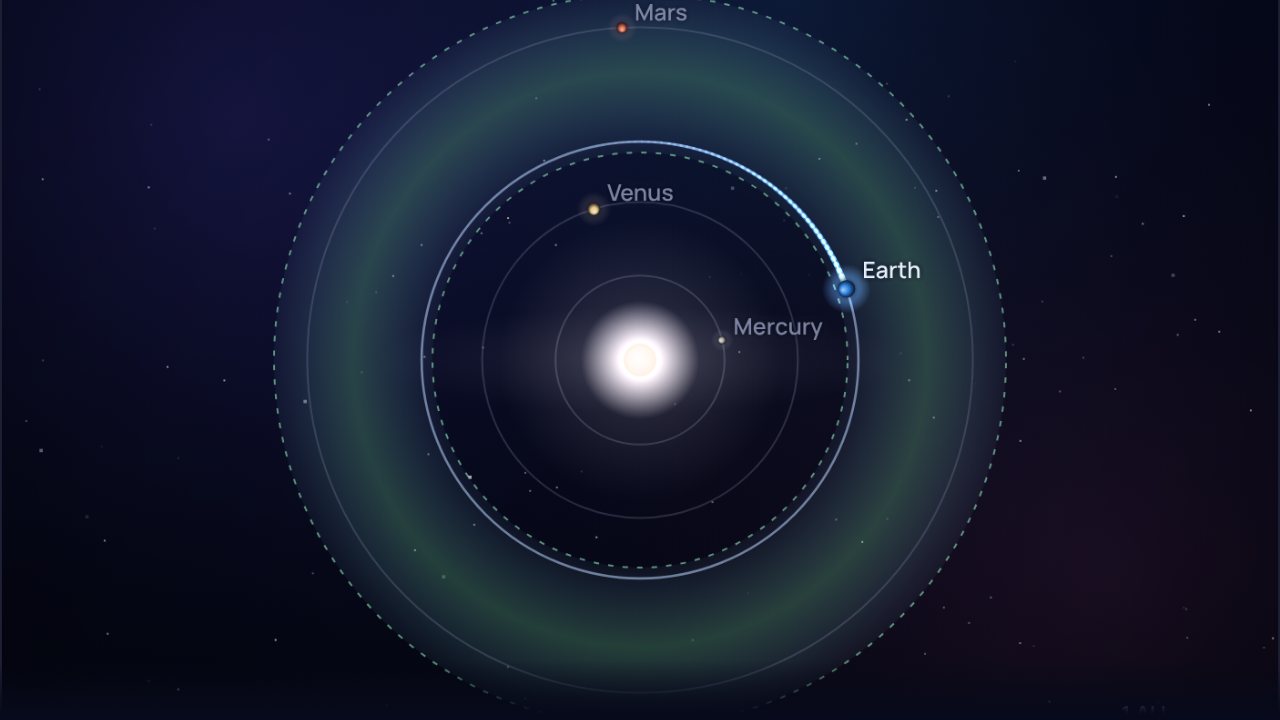
5.97 × 10²⁴ kg, 1.99 × 10³⁰ kg, 1 AUF = 6.674 × 10⁻¹¹ × 5.97 × 10²⁴ × 1.99 × 10³⁰ ÷ (1.496 × 10¹¹)² = 3.54 × 10²² N, the largest force on this page.
Even so, Earth's acceleration towards the Sun is only 0.00593 m/s², because Earth is so massive. The same Sun pulls on you with 0.415 N, more than a hundred times the Moon's pull on you, 0.00232 N.
Gravitational forces compared
| Pair | Masses | Distance | Force |
|---|---|---|---|
| Two people | 70 kg, 70 kg | 10 m | 3.27 × 10⁻⁹ N |
| Two people | 70 kg, 70 kg | 1 m | 3.27 × 10⁻⁷ N |
| You and the Moon | 70 kg, Moon | 384,400 km | 0.00232 N |
| You and the Sun | 70 kg, Sun | 149.6 million km | 0.415 N |
| An apple and Earth | 0.1 kg, Earth | 6,371 km | 0.982 N |
| You and Earth | 70 kg, Earth | 6,371 km | 687 N |
| Earth and the Moon | Earth, Moon | 384,400 km | 1.98 × 10²⁰ N |
| Earth and the Sun | Earth, Sun | 149.6 million km | 3.54 × 10²² N |
G = 6.674 30 × 10⁻¹¹ m³ kg⁻¹ s⁻² (CODATA 2022). Earth 5.9722 × 10²⁴ kg, Moon 7.346 × 10²² kg, Sun 1.9884 × 10³⁰ kg, Earth's mean radius 6,371 km and the mean distances from the NASA fact sheets. People are treated as points, which is rough at 1 m.
How the calculator works
Masses are converted to kilograms (grams ÷ 1,000, pounds × 0.45359237, tonnes × 1,000) and the distance to metres (km × 1,000, feet × 0.3048, miles × 1,609.344). The force is F = Gm₁m₂/r² with G = 6.674 30 × 10⁻¹¹ m³ kg⁻¹ s⁻², the CODATA 2022 value published by NIST, which has a relative uncertainty of 2.2 × 10⁻⁵.
The distance is between the centres. A sphere, or a planet made of spherical shells, pulls on things outside it as if all its mass were at its centre, so for "you and Earth" r is Earth's radius. People and apples are treated as points.
Each body is pulled towards the other with the same force (Newton's third law), so the calculator also gives each one's acceleration, F ÷ m. To make tiny and huge forces easier to picture, it also gives the mass that would weigh the same on Earth, F ÷ 9.80665 m/s².
The arrows on the stage have equal lengths, and that length grows with the logarithm of the force, so a force a million times larger gets a longer arrow, not one a million times longer. The ruler underneath runs from 10⁻¹² N to 10²⁴ N and marks five reference forces. Sizes and distances in the picture are not to scale.
What the model leaves out
- Shape: the point-mass formula is exact for spheres, approximate for people and boulders. At distances much larger than the objects it is excellent.
- Other bodies: the calculator gives the force between two bodies only. On Earth's surface you are also pulled by the Moon and the Sun, which is where tides come from.
- Earth's spin and shape: your measured weight is slightly less than Gm₁m₂/r² because of Earth's rotation, and Earth is not a perfect sphere, so g varies between about 9.78 and 9.83 m/s².
- Relativity: near black holes or neutron stars, or for very precise orbits such as Mercury's, Newton's law needs corrections from general relativity.
Common misconceptions
"The bigger body pulls harder." Both pull with exactly the same force. The bigger body just accelerates less.
"Gravity stops in space." The Sun pulls on Earth from 150 million km away. Astronauts float because they are falling around Earth, not because gravity has gone.
"Doubling the distance halves the force." It quarters it. The force falls with the square of the distance.
Frequently asked questions
What is the formula for gravitational force?
F = Gm₁m₂/r², where m₁ and m₂ are the masses in kilograms, r is the distance between their centres in metres and G = 6.674 × 10⁻¹¹ N m² kg⁻². The answer is in newtons.
What is the value of G?
The CODATA 2022 value published by NIST is 6.674 30 × 10⁻¹¹ m³ kg⁻¹ s⁻², with a standard uncertainty of 0.000 15 × 10⁻¹¹. That is a relative uncertainty of about 22 parts per million.
How strong is the gravitational pull between two people?
About 3.27 × 10⁻⁷ N for two 70 kg people 1 m apart: roughly the weight of 0.0333 milligrams. That is about 2.1 × 10⁹ times weaker than Earth's pull on each of them.
What is the gravitational force between Earth and the Moon?
About 1.98 × 10²⁰ N at the average distance of 384,400 km, using Earth's mass 5.97 × 10²⁴ kg and the Moon's 7.35 × 10²² kg.
What happens to gravitational force if you double the distance?
It drops to a quarter. Gravity follows an inverse square law: triple the distance and the force falls to a ninth, ten times the distance and it falls to a hundredth.
Keep learning
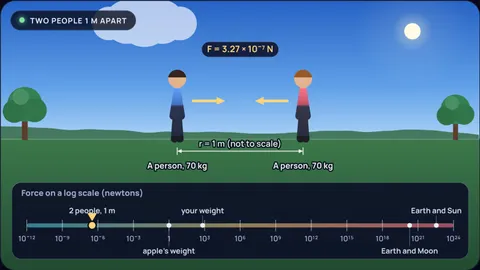
Why Don't You Feel the Gravity of the Person Next to You?
Two people 1 m apart attract each other with 3.3 × 10⁻⁷ N. Here is the calculation, why Earth wins by a factor of two billion, and when the pull matters.
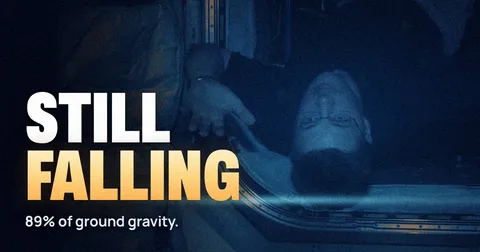
Is There Gravity on the ISS? Yes: 89% of Earth's
Gravity at the ISS is 89% of Earth's surface value. Astronauts float because they fall 4.35 m every second and keep missing. Here are the numbers.
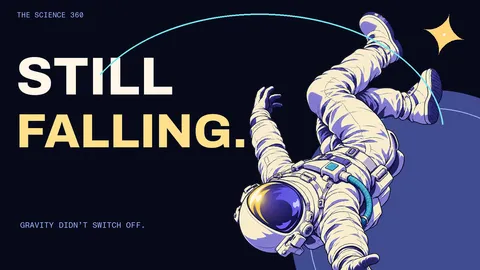
Gravity is still strong at the space station. Why do astronauts float?
The station, crew and loose objects fall together. Weightlessness is about the missing support force, not gravity switching off above the atmosphere.
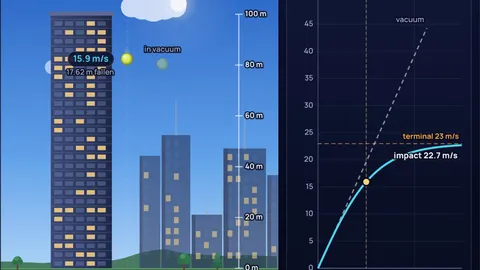
How Long Does It Take to Fall From a Height?
Fall time and landing speed for drops from 1 m to 1 km, the one formula behind them, worked examples, and when air resistance starts to matter.