How do you solve a SUVAT problem?
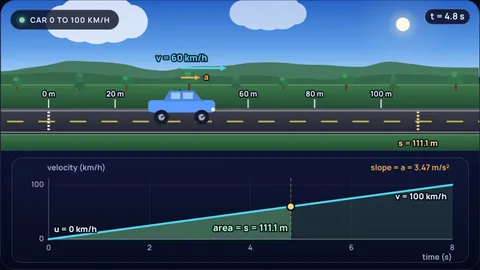
Write down which three of s, u, v, a and t you know, then use the equation that leaves out the unknown you are not looking for. A car that goes from 0 to 100 km/h in 8 s has a = (27.78 − 0) ÷ 8 = 3.47 m/s², found with v = u + at because it has no s in it, and it covers s = ½(0 + 27.78) × 8 = 111.1 m, found with the equation that has no a. Five quantities, five equations, each missing exactly one: that is the whole trick.
Type your three values in the boxes above and leave two empty. The calculator converts km/h, mph, feet and minutes to SI units, says which equation it used for each unknown and why, and shows every line of the working with your numbers substituted. When a question has two answers (a ball passing the same height twice), it shows both. For the full method with more examples, read SUVAT equations explained with worked examples.
Key results from the calculator
- 0 to 100 km/h in 8 s: a = 3.47 m/s² (about 0.35 g) over 111 m.
- Braking from 70 mph in the Highway Code's 75 m: a = −6.53 m/s², taking 4.79 s. The 30 mph figure (14 m) gives almost the same deceleration, −6.42 m/s².
- 30 m of skid marks at 6.5 m/s²: the car was doing 19.7 m/s, which is 71.1 km/h or 44.2 mph.
- A cyclist coasting up a hill at 8 m/s, slowing at 1 m/s²: reaches 24 m up the road at 4 s and passes the same spot rolling back at 12 s. Both answers are real.
Six worked examples you can load
Each example gives the numbers the calculator shows, which equation it uses and why. The button loads the three known values so you can see the working line by line, then change one and watch the answer move.
A car accelerating from 0 to 100 km/h in 8 seconds
Known u, v, t · find a and sFirst convert: 100 km/h ÷ 3.6 = 27.78 m/s. The unknowns are a and s. To find a, use v = u + at, because it is the equation with no s in it. That gives a = (27.78 − 0) ÷ 8 = 3.47 m/s².
For s, use s = ½(u + v)t, the equation with no a. It needs only the numbers you were given, so a rounding slip in a cannot creep in: s = ½ × 27.78 × 8 = 111.1 m. On the graph that is the area of the shaded triangle under the line. The average speed is half the top speed, 50 km/h, because the acceleration is constant.
Braking from 70 mph in the Highway Code distance
Known s, u, v · find a and tThe UK Highway Code gives a typical braking distance of 75 m from 70 mph on a dry road. With u = 70 mph = 31.29 m/s, v = 0 and s = 75 m, the equation with no t is v² = u² + 2as, so a = (0 − 31.29²) ÷ (2 × 75) = −6.53 m/s². The minus sign means the car is slowing down.
For t, the equation with no a is s = ½(u + v)t, so t = 2 × 75 ÷ 31.29 = 4.79 s. Run the same sums on the 30 mph figure of 14 m and you get −6.42 m/s²: the Highway Code table assumes the same deceleration at every speed, which is why braking distance grows with the square of speed. Double the speed and you need four times the road.
How fast was the car going? Speed from skid marks
Known s, v, a · find u and tA car leaves 30 m of skid marks and stops. Take a deceleration of 6.5 m/s², the figure the Highway Code braking distances imply. The unknowns are u and t, so use v² = u² + 2as, which has no t: u² = 0 − 2 × (−6.5) × 30 = 390, so u = ±19.75 m/s.
The square root gives two signs. The negative one would need a negative time, t = (0 − (−19.75)) ÷ (−6.5), so it is rejected, and the calculator says so. The car was doing 19.7 m/s, which is 71.1 km/h or 44.2 mph, and it took 3.04 s to stop. Real accident reconstruction measures the road's grip on the day, because a wet road can halve the deceleration.
A cyclist coasting up a hill: when is t a quadratic?
Known s, u, a · find v and tA cyclist stops pedalling at 8 m/s on a slope that slows them at 1 m/s². When are they 24 m up the road? The equation with no v is s = ut + ½at², and with t unknown it is a quadratic: −0.5t² + 8t − 24 = 0. Its two roots are t = 4 s and t = 12 s.
Both are positive, so both are physical. At 4 s the cyclist is still climbing at v = 4 m/s; at 12 s they pass the same spot rolling back down at v = −4 m/s. The graph shows it plainly: the line crosses zero at 8 s, the area above the axis is +32 m and the area below is −8 m, net 24 m. Use the Answer 1 and Answer 2 buttons to switch between them.
A sprinter covering 20 m in 4 s from the blocks
Known s, u, t · find v and aStarting from rest, a runner covers 20 m in 4 s. For v, use s = ½(u + v)t, the equation with no a: v = 2 × 20 ÷ 4 − 0 = 10 m/s. For a, use s = ut + ½at², the one with no v: a = 2 × (20 − 0) ÷ 4² = 2.5 m/s².
Real sprinters do not accelerate uniformly: they push hardest in the first few strides and the acceleration fades as they approach top speed. SUVAT gives the constant acceleration that would produce the same distance in the same time, which is a useful average but not a description of the stride-by-stride motion.
Joining a motorway: 30 to 70 mph at 2.5 m/s²
Known u, v, a · find s and tA car leaves a roundabout at 30 mph and needs 70 mph to merge, accelerating at 2.5 m/s². Convert first: 30 mph = 13.41 m/s and 70 mph = 31.29 m/s (1 mph is exactly 0.44704 m/s). For t, use v = u + at: t = (31.29 − 13.41) ÷ 2.5 = 7.15 s.
For s, use v² = u² + 2as, which has no t: s = (31.29² − 13.41²) ÷ (2 × 2.5) = 160 m. That is why slip roads are long: the distance grows with the difference of the squares of the speeds, not the difference of the speeds.
Which SUVAT equation to use
| Equation | Leaves out | Use it when you want | Example |
|---|---|---|---|
| v = u + at | s | v, u, a or t and the distance is not involved | 0 to 100 km/h in 8 s: a = 3.47 m/s² |
| s = ut + ½at² | v | a distance or time and the final speed is not given | stone dropped for 3 s: s = 44.1 m |
| s = vt − ½at² | u | a distance or time and the starting speed is not given | rarely needed, but it saves a step |
| v² = u² + 2as | t | a speed or distance and the time is not involved | skid marks: u = 19.7 m/s |
| s = ½(u + v)t | a | a distance or time and the acceleration is not given | sprint: v = 10 m/s |
Each of the five equations contains four of the five quantities. Look for the one that leaves out the quantity you neither know nor want. Values from the calculator with g = 9.81 m/s² where gravity is involved.
How the calculator works
Every value you type is converted to SI units first: km to metres (× 1000), feet to metres (× 0.3048), km/h to m/s (÷ 3.6), mph to m/s (× 0.44704), ft/s² to m/s² (× 0.3048), g to m/s² (× 9.80665) and minutes to seconds (× 60). The working shows each conversion. Answers are converted back into whatever units you chose for the empty boxes.
With three knowns there are ten possible pairs of unknowns. For each pair the calculator finds the first unknown with the equation that does not contain the second, and the second with the equation that does not contain the first. Both then use only your original numbers, so no rounding error is carried from one step to the next. When the second unknown would need a quadratic, it uses v = u + at with the first answer instead, which gives the sign correctly.
Two cases can have two answers: finding t from s = ut + ½at² (a quadratic in t) and finding u or v from v² = u² + 2as (a square root has two signs). The calculator keeps every answer with a positive time, rejects the others with the reason, and lets you switch between valid answers. If the numbers are impossible, for example a negative value under the square root, it says so instead of printing nonsense.
The road shows the motion played back in 2.5 to 6 seconds of real time, with the velocity arrow in cyan and the acceleration arrow in orange. The graph below plots velocity against time: a straight line, because the acceleration is constant. The slope of the line is a and the shaded area under it is s, with area below the axis counting as negative displacement.
What the model leaves out
- Changing acceleration: SUVAT only holds when a is constant. A real car accelerates harder in low gears, and a falling object with air resistance slows its acceleration. For those you need calculus or a step-by-step simulation, such as the terminal velocity simulation.
- Two or three dimensions: the equations here are for a straight line. For a thrown ball, apply them separately to the horizontal and vertical motions, as in the projectile motion simulation.
- Sign convention: the calculator takes the first direction of motion as positive. If you take up as positive, gravity is a = −9.81 m/s²; if down is positive it is +9.81 m/s². Mixing the two in one problem is the most common SUVAT mistake.
- Reaction time: the braking examples use braking distance only. The Highway Code adds a thinking distance, travelled at constant speed before the brakes come on.
Common misconceptions
"Displacement and distance are the same." Only if the object never turns round. The cyclist on the hill has a displacement of 24 m at 12 s but has travelled 40 m: 32 m up and 8 m back.
"A negative answer means I made a mistake." A negative acceleration just points backwards, which for a forward-moving car means braking. A negative time, though, is unphysical and should be thrown away.
"Average velocity is always (u + v) ÷ 2." Only for constant acceleration. For any other motion the average is the total displacement divided by the total time.
Frequently asked questions
What are the 5 SUVAT equations?
v = u + at, s = ut + ½at², s = vt − ½at², v² = u² + 2as and s = ½(u + v)t. Here s is displacement, u initial velocity, v final velocity, a acceleration and t time. Each equation leaves out one of the five quantities, which is how you choose between them.
How do I know which SUVAT equation to use?
List the three quantities you know and the one you want. The fifth quantity is the one you neither have nor need: pick the equation that does not contain it. For example, with u, v and s known and a wanted, t is not involved, so use v² = u² + 2as.
Why does the calculator give two answers for time?
When t is found from s = ut + ½at², the equation is a quadratic and can have two positive roots. Both are real: the object passes that displacement twice, once going out and once coming back. A ball thrown up at 20 m/s is 15 m high at 0.991 s on the way up and again at 3.09 s on the way down.
Can SUVAT be used for free fall?
Yes, if air resistance is small. Use a = 9.81 m/s² (or −9.81 m/s² with up as positive). A stone dropped from rest falls 44.1 m in 3 s and reaches 29.4 m/s. For long falls, drag matters and SUVAT overestimates the speed; the free fall calculator has an air resistance mode.
Do I need to convert km/h to m/s for SUVAT?
Use one consistent set of units. The safest is SI: metres, seconds, m/s and m/s². Divide km/h by 3.6 to get m/s, and multiply mph by 0.44704. This calculator does the conversion for you and shows it in the working.
Keep learning
SUVAT Equations Explained, With Worked Examples
The five SUVAT equations, how to pick the right one, where they come from, and four worked examples with real numbers, including two-answer cases.

Can a Penny From the Empire State Building Kill You?
A tumbling penny tops out at 11 m/s and lands with 0.15 J, about 100 times too little to crack a skull. Here is the drag math, and what would be dangerous.

How Many G Can a Human Survive? Duration and Direction
5 g knocks out a relaxed person; 46 g didn't kill John Stapp; 214 g didn't kill Kenny Bräck. The difference is duration and direction. Here is the physics.

Gravity is still strong at the space station. Why do astronauts float?
The station, crew and loose objects fall together. Weightlessness is about the missing support force, not gravity switching off above the atmosphere.