How do you solve a block on an inclined plane?
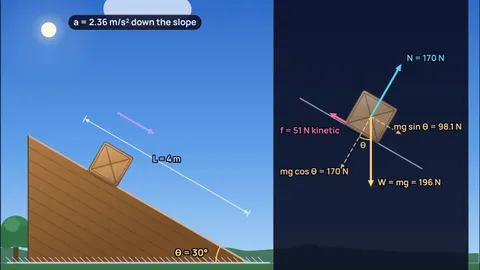
Split the weight mg into a part along the slope, mg sin θ, and a part into the slope, mg cos θ. The normal force balances the second, N = mg cos θ. Friction can hold the block if mg sin θ is no more than μs N; otherwise it slides with a = g(sin θ − μk cos θ). A 20 kg wooden crate on a 30° wooden ramp (μs = 0.5, μk = 0.3) has 98.1 N pulling it down the slope against at most 85 N of static friction, so it slides, and accelerates at 2.36 m/s².
Set the angle, the mass in kg or lb, the surfaces (wood on wood, rubber on concrete, ice on ice, waxed wood on snow, or your own coefficients) and any push along the slope in newtons or pound-force. The calculator draws the free-body diagram to scale, shows every step with your numbers, and slides the crate down the ramp in real time if it moves. For the method written out slowly, read block on an inclined plane with friction: how to solve it.
Key results from the calculator
- Wood on wood holds up to 26.6°: the steepest angle a block can rest at is tan⁻¹ μs, whatever it weighs. At 20° the crate stays put; at 30° it slides at 2.36 m/s².
- Rubber on dry concrete holds up to 45°: a rubber block sits on a 40° slope with static friction giving 126 N of a possible 150 N.
- Ice on ice slides above 5.71°: at 10° an ice block accelerates at 1.41 m/s² and covers 4 m in 2.38 s.
- Pushing a 50 kg crate up 25°: it takes more than 430 N to get it moving. A 400 N push does nothing; 450 N moves it up at 2.19 m/s².
Six examples, worked
Each example gives the numbers the calculator shows, with g = 9.81 m/s² and the friction coefficients from the OpenStax table. The button loads it.
A wooden crate on a 30° wooden ramp
20 kg, μs 0.5, μk 0.3Weight W = 20 × 9.81 = 196 N. Along the slope: 196 × sin 30° = 98.1 N. Into the slope: 196 × cos 30° = 170 N, so N = 170 N.
Static friction can give at most 0.5 × 170 = 85 N. That is less than 98.1 N, so the crate slides. Kinetic friction is 0.3 × 170 = 51 N, the net force is 98.1 − 51 = 47.1 N, and a = 47.1 ÷ 20 = 2.36 m/s². It slides 4 m in 1.84 s and leaves at 4.34 m/s.
The same crate at 20°: friction holds
20 kg, μs 0.5, μk 0.3At 20° the pull down the slope is 196 × sin 20° = 67.1 N and the normal force is 184 N, so static friction can supply up to 92.2 N.
Only 67.1 N is needed, so static friction supplies exactly that and the crate stays put. Static friction is not always μs N: it is whatever is needed, up to that limit.
An ice block on a 10° ice slope
20 kg, μs 0.1, μk 0.03Ice on ice has μs = 0.1, so the critical angle is tan⁻¹ 0.1 = 5.71°. At 10° the pull down the slope, 34.1 N, beats the 19.3 N static friction can give.
Kinetic friction is only 0.03 × 193 = 5.8 N, so a = 1.41 m/s², most of the frictionless value g sin 10° = 1.7 m/s².
A rubber block on a 40° concrete slope
20 kg, μs 1.0, μk 0.7Rubber on dry concrete has μs = 1.0, so it holds on any slope up to tan⁻¹ 1 = 45°. At 40° the pull down the slope is 126 N and static friction can give up to 150 N.
It stays put. Tip it past 45° and it slides; once moving, kinetic friction (μk = 0.7) is weaker, so once it is moving it keeps speeding up on any slope steeper than tan⁻¹ 0.7 = 35°.
Pushing a 50 kg crate up a 25° ramp
50 kg, wood on wood, 450 N pushGravity pulls the crate down the slope with 207 N and the normal force is 445 N, so static friction can resist with up to 222 N. To start the crate moving up you need more than 207 + 222 = 430 N.
A 400 N push leaves it still, with friction pointing down the slope. A 450 N push moves it: kinetic friction 133 N acts down the slope, the net force is 450 − 207 − 133 = 109 N, and a = 2.19 m/s² up the slope. Once it is moving, 341 N keeps it going at a steady speed.
A waxed sled on a 15° snow slope
70 kg, μs 0.14, μk 0.1, 20 mWaxed wood on wet snow has μs = 0.14 (critical angle 7.97°) and μk = 0.1. On a 15° slope a 70 kg sled and rider feel 178 N down the slope against 66.3 N of kinetic friction.
a = 9.81 × (sin 15° − 0.1 × cos 15°) = 1.59 m/s². Over 20 m that takes 5.01 s and ends at 7.98 m/s, about 28.7 km/h, ignoring air resistance.
Friction coefficients and the steepest slope each can hold
| Surfaces | μs | μk | Steepest slope at rest | Slides at 30° with a = |
|---|---|---|---|---|
| Rubber on dry concrete | 1.0 | 0.7 | 45° | holds |
| Rubber on wet concrete | 0.7 | 0.5 | 35° | holds |
| Wood on wood | 0.5 | 0.3 | 26.6° | 2.36 m/s² |
| Waxed wood on wet snow | 0.14 | 0.1 | 7.97° | 4.06 m/s² |
| Ice on ice | 0.1 | 0.03 | 5.71° | 4.65 m/s² |
| Steel on ice | 0.04 | 0.02 | 2.29° | 4.74 m/s² |
Coefficients are the approximate values in OpenStax College Physics 2e, Table 5.1, which gives them to one or two digits because real values vary a lot with surface condition. The steepest slope at rest is tan⁻¹ μs; the acceleration at 30° is g(sin 30° − μk cos 30°) with g = 9.81 m/s². Neither depends on the mass.
How the calculator works
Inputs are converted to SI first: pounds to kilograms (× 0.45359237), pound-force to newtons (× 4.4482216) and feet to metres (× 0.3048). The weight is W = mg with g = 9.81 m/s².
The weight is split along the slope, W sin θ, and into it, W cos θ. The normal force equals W cos θ, because the block neither sinks into the surface nor lifts off. A push along the slope (positive up, negative down) adds to the force along the slope but does not change N.
The block starts at rest. Static friction can supply anything up to μs N, in whichever direction stops the motion. If the push along the slope, F − mg sin θ, is no bigger than μs N, the block stays put and friction exactly cancels it. Otherwise the block slides that way and kinetic friction μk N acts against the motion: a = (F − mg sin θ ∓ μk N) ÷ m.
For the ramp length you enter, the time to slide from rest is √(2L ÷ a) and the speed at the end is √(2aL). The free-body diagram is drawn to scale, with the weight components dashed, and the crate on the ramp slides in real time.
What the model leaves out
- Real friction is messier: the coefficients are approximate textbook values. Real ones change with dirt, moisture, temperature and speed, and can differ by a factor of two between two samples of "wood".
- Tipping: a tall, narrow block can topple before it slides. The calculator treats the block as a point that can only slide.
- Pushes at an angle: the push here is along the slope. A push at an angle to the slope would change the normal force too.
- Air resistance and rolling: ignored. A rolling object is a different problem, with no sliding friction at all if it rolls without slipping.
Common misconceptions
"Friction always equals μN." Only kinetic friction does. Static friction is whatever is needed to stop motion, up to μs N. A crate resting on a gentle slope may use only a small part of the friction available.
"The normal force equals the weight." On a slope it is mg cos θ, smaller than mg. At 30° it is 87% of the weight.
"Heavier blocks slide more easily." Weight scales both the pull down the slope and the friction, so the mass cancels: the critical angle tan⁻¹ μs and the acceleration g(sin θ − μk cos θ) are the same for a light block and a heavy one of the same material.
Frequently asked questions
What is the formula for acceleration down an inclined plane with friction?
a = g(sin θ − μk cos θ), for a block that is already sliding down with no other push. For a 30° wooden ramp with μk = 0.3, a = 9.81 × (0.5 − 0.3 × 0.866) = 2.36 m/s².
How do you find the normal force on an incline?
N = mg cos θ, as long as the only other forces act along the slope. A 20 kg block on a 30° slope has N = 20 × 9.81 × cos 30° = 170 N.
At what angle does a block start to slide?
When tan θ is more than the coefficient of static friction μs. The critical angle is tan⁻¹ μs: 26.6° for wood on wood (μs = 0.5) and 45° for rubber on dry concrete (μs = 1.0). It does not depend on the mass.
What is the difference between static and kinetic friction?
Static friction acts while surfaces are not sliding and can take any value up to μs N. Kinetic friction acts once they slide and is roughly constant at μk N. μk is usually smaller, which is why something is harder to start moving than to keep moving.
How much force does it take to push a box up a ramp?
To start it moving: more than mg sin θ + μs N. To keep it moving at a steady speed: mg sin θ + μk N. For a 50 kg wooden crate on a 25° wooden ramp that is 430 N to start and 341 N to keep it going.
Keep learning
Block on an Inclined Plane With Friction: How to Solve It
How to solve a block on an inclined plane with friction: the free-body diagram, weight components, normal force, whether it slides, and worked examples.

SUVAT Equations Explained, With Worked Examples
The five SUVAT equations, how to pick the right one, where they come from, and four worked examples with real numbers, including two-answer cases.

Kinetic Energy vs Potential Energy: Examples With Numbers
Kinetic and potential energy worked through with real numbers: a skater, a roller coaster, a car at 50 and 100 km/h, a runner and the Moon.

How Long Does It Take to Fall From a Height?
Fall time and landing speed for drops from 1 m to 1 km, the one formula behind them, worked examples, and when air resistance starts to matter.