Block on an Inclined Plane With Friction: How to Solve It
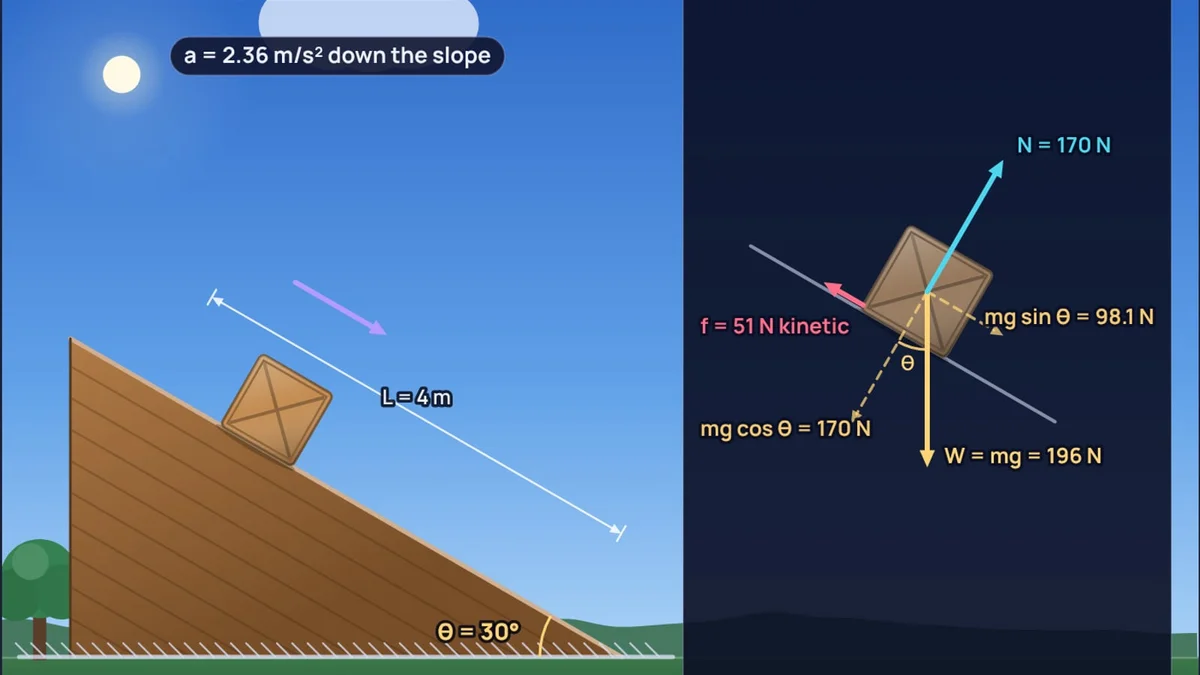
Put a wooden crate on a wooden ramp at 20° and it sits there. Tilt the ramp to 30° and it slides off, picking up speed at 2.36 m/s². Somewhere in between, at 26.6°, it lets go, and that angle is the same whether the crate weighs 2 kg or 200 kg. Every inclined plane problem in a physics course is a version of this one, and every one of them is solved with the same four steps.
This post works through those steps with real numbers: draw the forces, split the weight, find the normal force, then decide whether friction can hold. Each example opens in the inclined plane calculator, which draws the free-body diagram to scale, writes out the working with your numbers and slides the crate if it moves.
What forces act on a block on a slope?
With no push, only three forces act on a block resting or sliding on a ramp:
- Weight, , straight down towards the centre of the Earth.
- The normal force, , from the ramp, at right angles to its surface.
- Friction, , from the ramp, along its surface, against the way the block moves or would move.
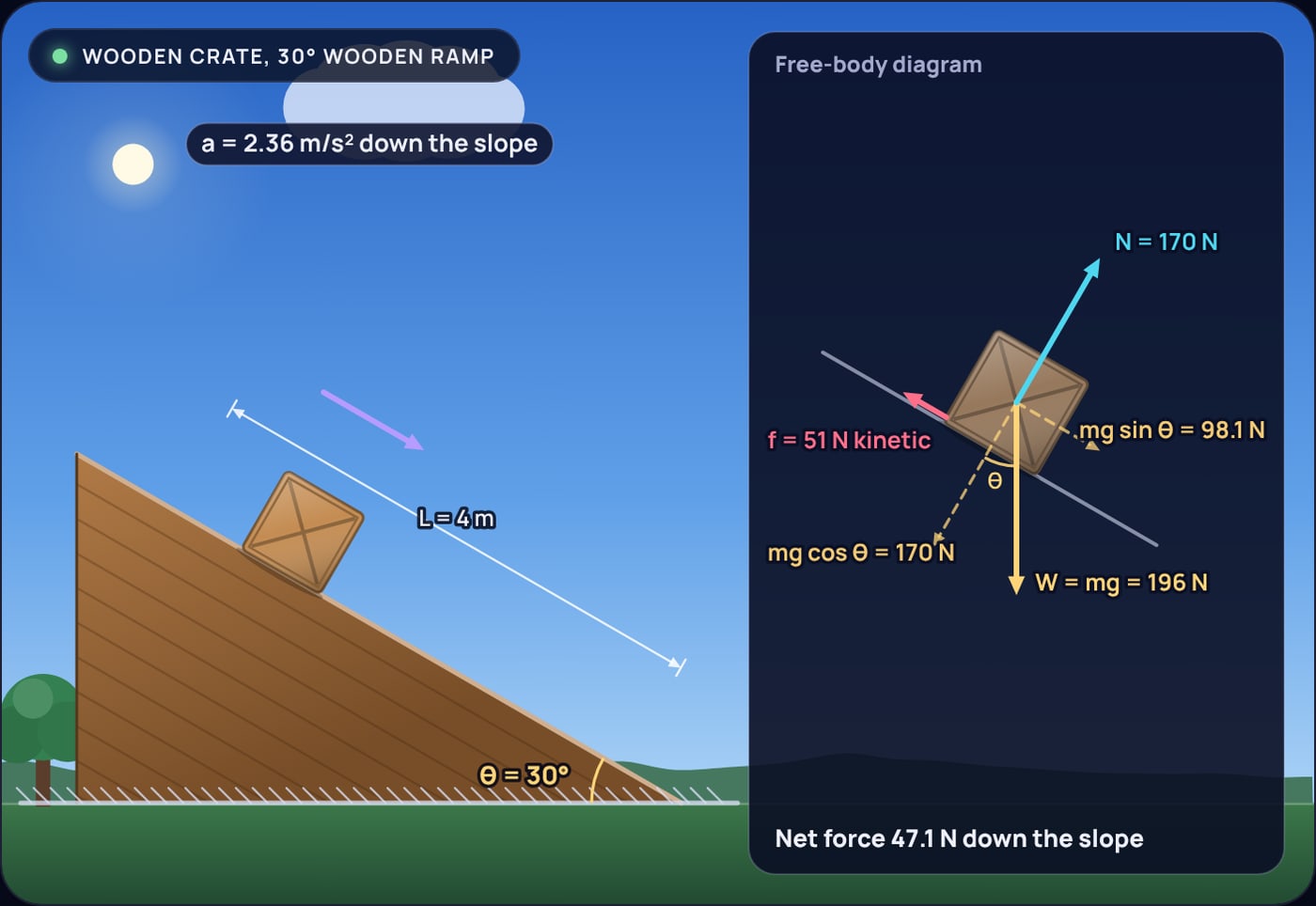
A free-body diagram draws the block on its own with one arrow per force, starting from the block. The trick that makes slopes easy is to choose axes that tilt with the slope: one along the surface and one at right angles to it. Then the normal force and friction each lie along one axis, and only the weight has to be split.
How do you split the weight into components?
The weight points straight down, at an angle to both slope axes. Its two components are
where acts down the slope, presses into it, and θ is the angle of the slope above horizontal. The reason the same θ appears is geometry: the weight is at right angles to the ground and the perpendicular axis is at right angles to the slope, so the angle between the weight and the perpendicular axis equals the angle between the ground and the slope. That is the small θ marked between the dashed arrows in the diagram.
Two checks catch most mistakes. At θ = 0 the slope is flat, so nothing should pull the block along it: , correct. At θ = 90° the slope is a wall, so all of the weight should act along it: , correct. If your sin and cos are the other way round, one of these checks fails.
How do you find the normal force?
The block does not sink into the ramp or float off it, so there is no acceleration at right angles to the surface. The forces along that axis must balance:
This is smaller than the weight. At 30° the normal force is 86.6% of mg, and at 60° it is half. Because friction depends on the normal force, a steeper slope reduces the friction available at the same moment as it increases the pull down the slope. Both effects push the block towards sliding.
The formula holds only when every other force acts along the slope. A push or a rope pulling at an angle to the surface has a component at right angles to it, and that component adds to or takes away from N.
How do you tell whether the block will slide?
Friction comes in two kinds. Static friction acts while the surfaces are not moving relative to each other, and it can take any value up to a limit:
Kinetic friction acts once the block slides, and is roughly constant:
The test for sliding compares the pull down the slope with the limit of static friction. If , static friction holds the block still, supplying exactly and no more. If the pull is bigger, the block slides and kinetic friction takes over.
Worked example 1: a 20 kg crate on a 30° wooden ramp
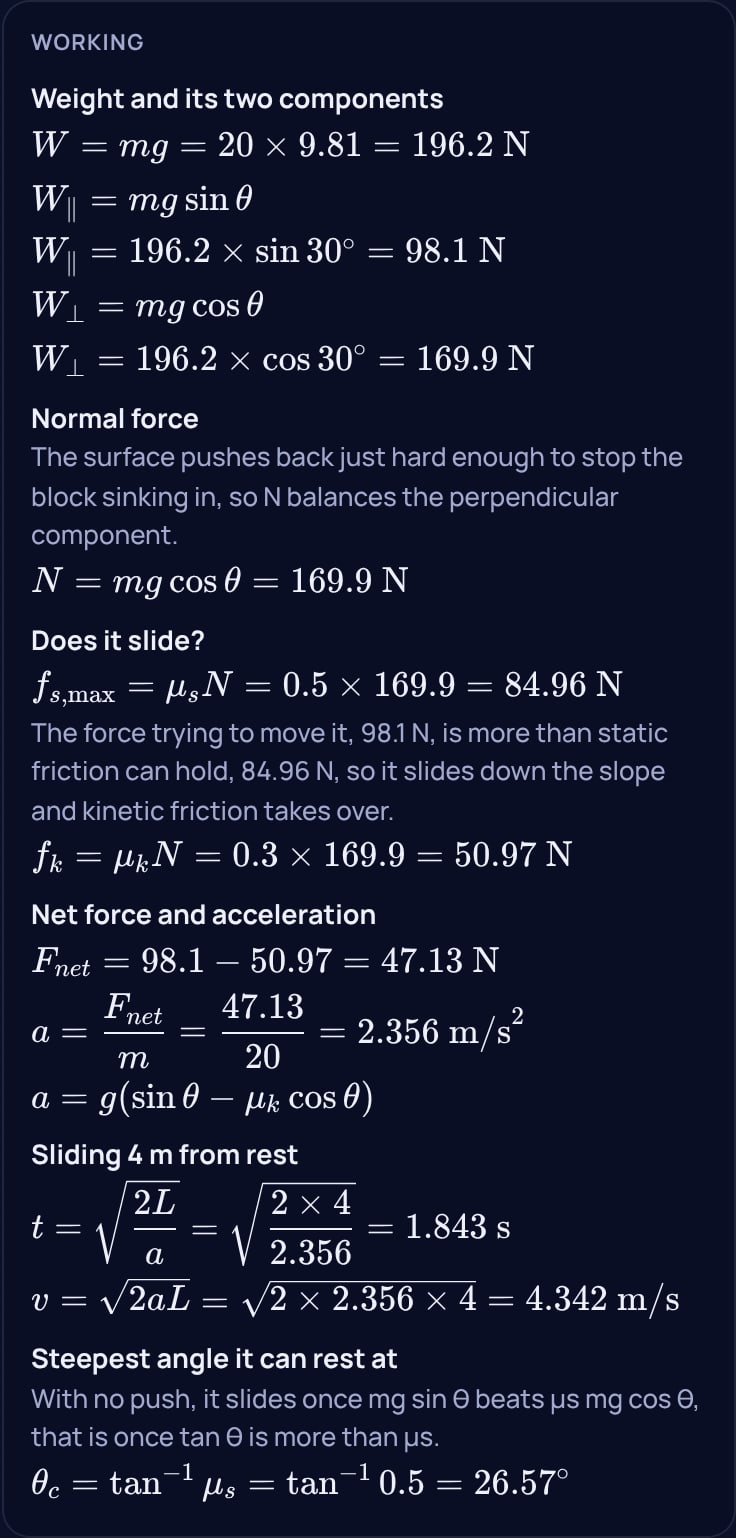
Wood on wood has μs = 0.5 and μk = 0.3.
98.1 N is more than 84.96 N, so the crate slides. Now kinetic friction acts:
On a 4 m ramp that acceleration gets the crate to the bottom in , leaving at 4.34 m/s. The calculator's working panel lays out the same steps, so you can check a homework answer line by line.
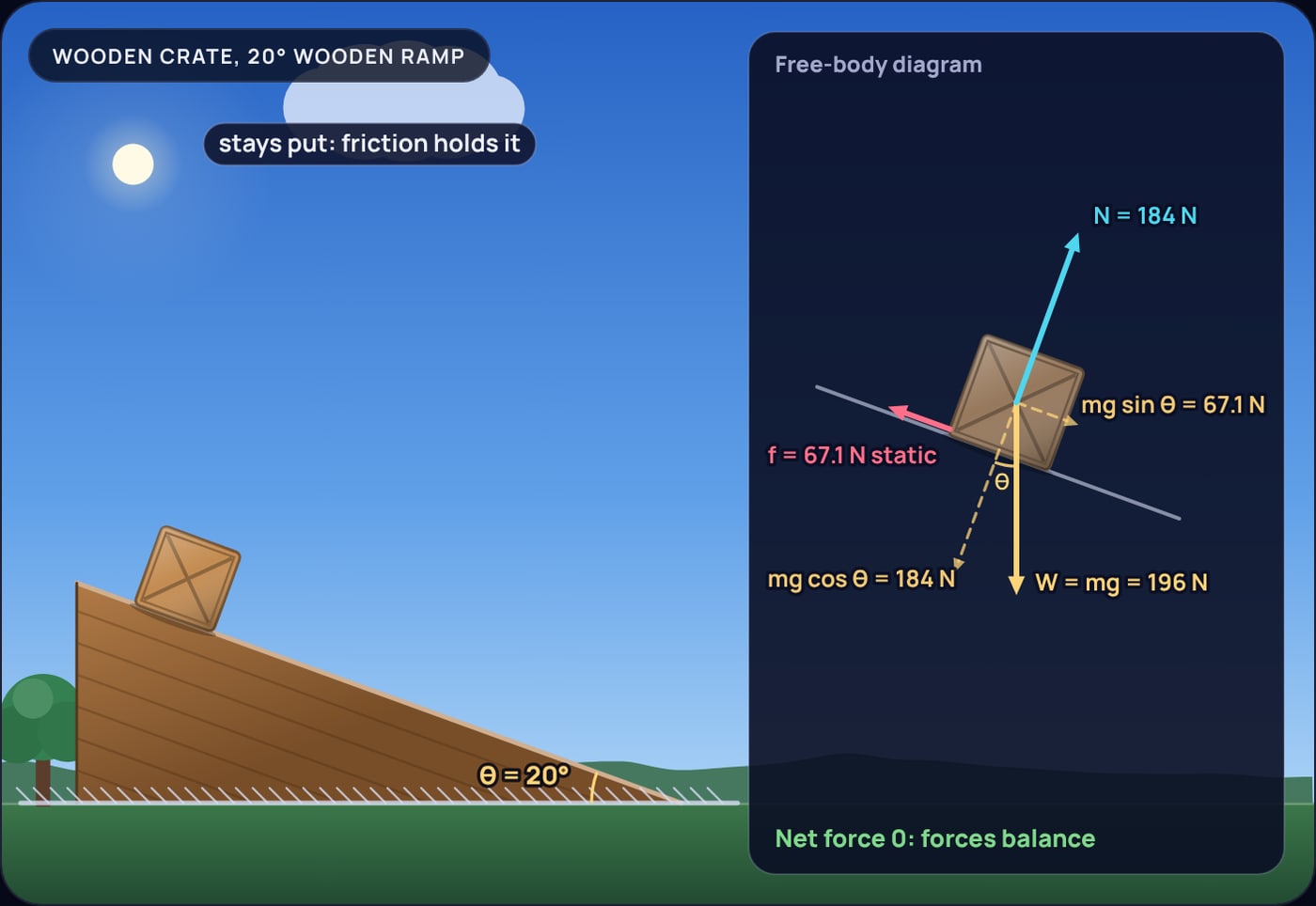
Lower the same ramp to 20° and the answer changes. The pull down the slope falls to 67.1 N and the normal force rises to 184.4 N, so static friction can give up to 92.2 N. Only 67.1 N is needed, so static friction supplies exactly 67.1 N and the crate stays put. Static friction is not "μs N"; it is "whatever is needed, up to μs N".
What is the acceleration once it slides?
Put the pieces together for a block sliding down with nothing else pushing it. The net force along the slope is the pull minus kinetic friction, and dividing by m gives the acceleration:
The mass has gone. A 2 kg block and a 200 kg block of the same material slide down the same ramp side by side. With no friction at all, μk = 0 and the formula becomes , the frictionless incline from introductory courses.
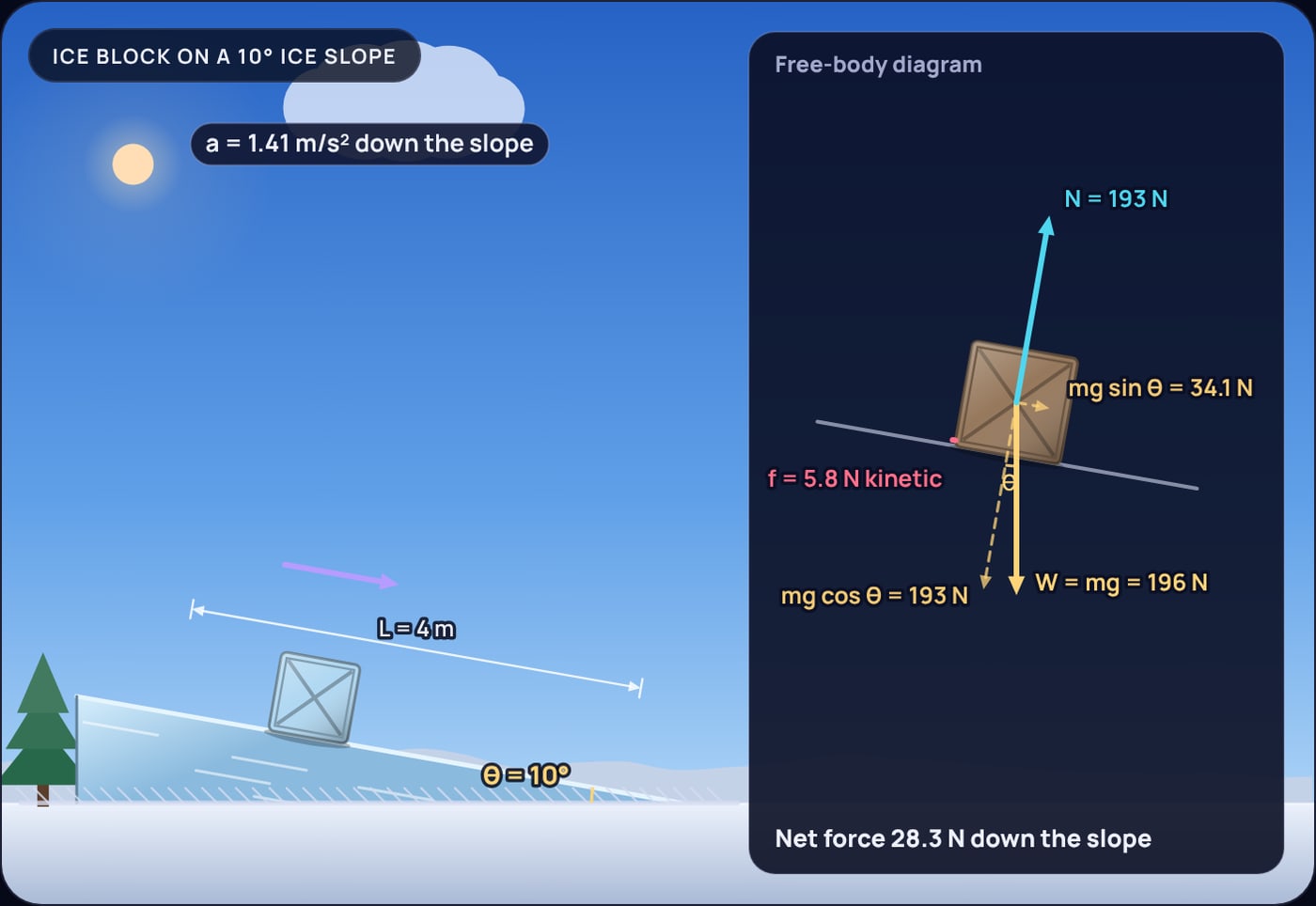
Worked example 2: an ice block on a 10° ice slope
Ice on ice has μs = 0.1 and μk = 0.03. First the sliding test, using tan 10° = 0.176, which is more than 0.1, so it slides. Then
That is close to the frictionless value of . On ice, friction barely matters once the block is moving. It is the tiny static coefficient that matters most: the slope only has to pass 5.7° before the block lets go.
At what angle does a block start to slide?
Set the pull down the slope equal to the limit of static friction and solve for the angle:
This critical angle, sometimes called the angle of repose, depends only on the two surfaces. It is also the standard way to measure μs: tilt a board slowly until the block on it moves, and take the tangent of the angle.
| Surfaces | μs | μk | Steepest slope at rest |
|---|---|---|---|
| Rubber on dry concrete | 1.0 | 0.7 | 45° |
| Rubber on wet concrete | 0.7 | 0.5 | 35.0° |
| Wood on wood | 0.5 | 0.3 | 26.6° |
| Waxed wood on wet snow | 0.14 | 0.1 | 7.97° |
| Ice on ice | 0.1 | 0.03 | 5.71° |
| Steel on ice | 0.04 | 0.02 | 2.29° |
The coefficients come from the OpenStax College Physics table, which gives them to only one or two digits on purpose: real values change with dirt, moisture and wear, so treat the angles as rough guides rather than precise limits.
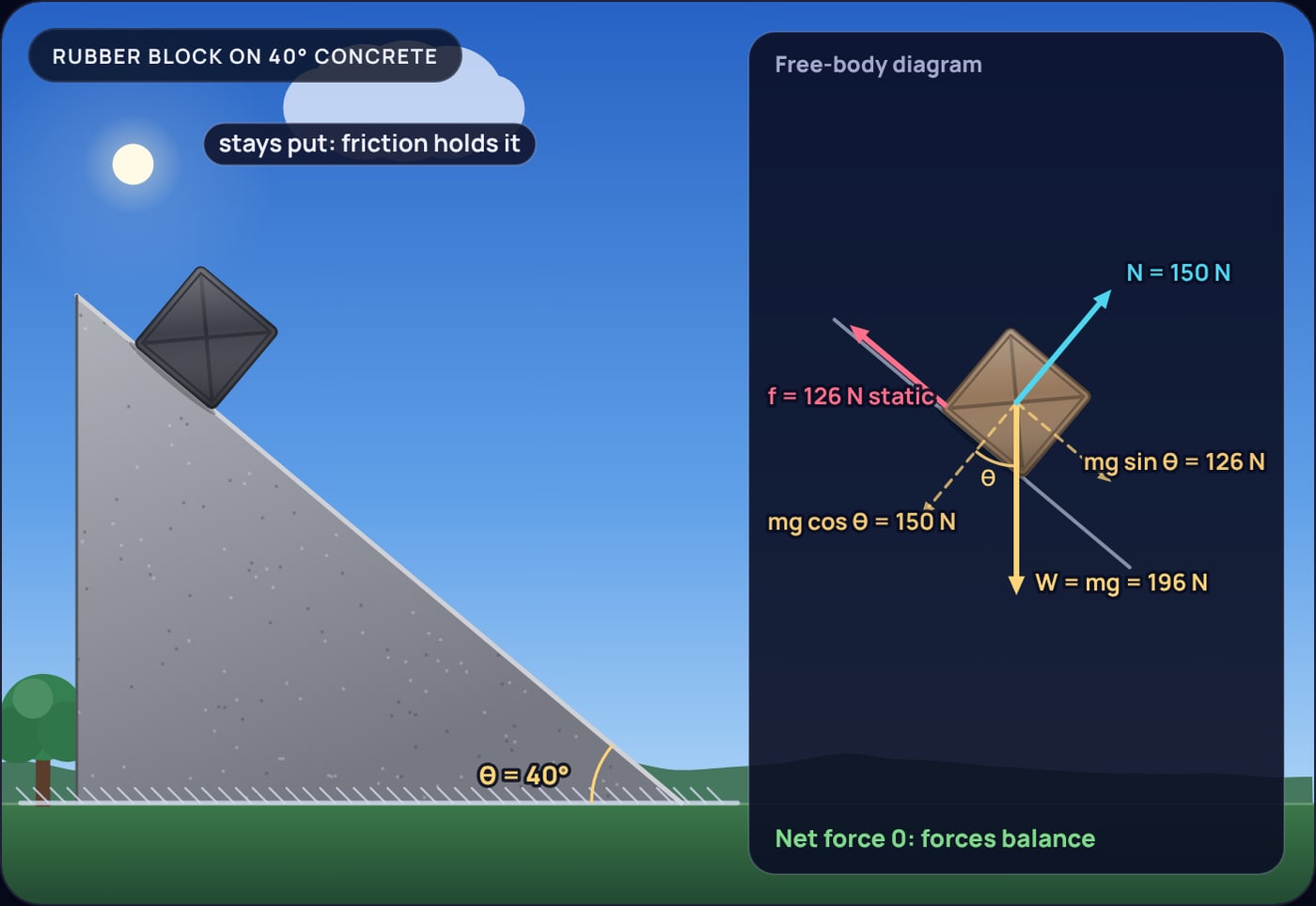
Because μk is smaller than μs, a block that has started to slide keeps speeding up even on a slope slightly gentler than the one that started it. Rubber on dry concrete has to be tilted past 45° to start, but once moving it keeps accelerating on anything steeper than .
How much force does it take to push a block up a ramp?
Pushing up the slope reverses the direction friction acts. Now the block tends to move up, so friction points down the slope and adds to the pull of gravity. To get the block moving you must beat both:
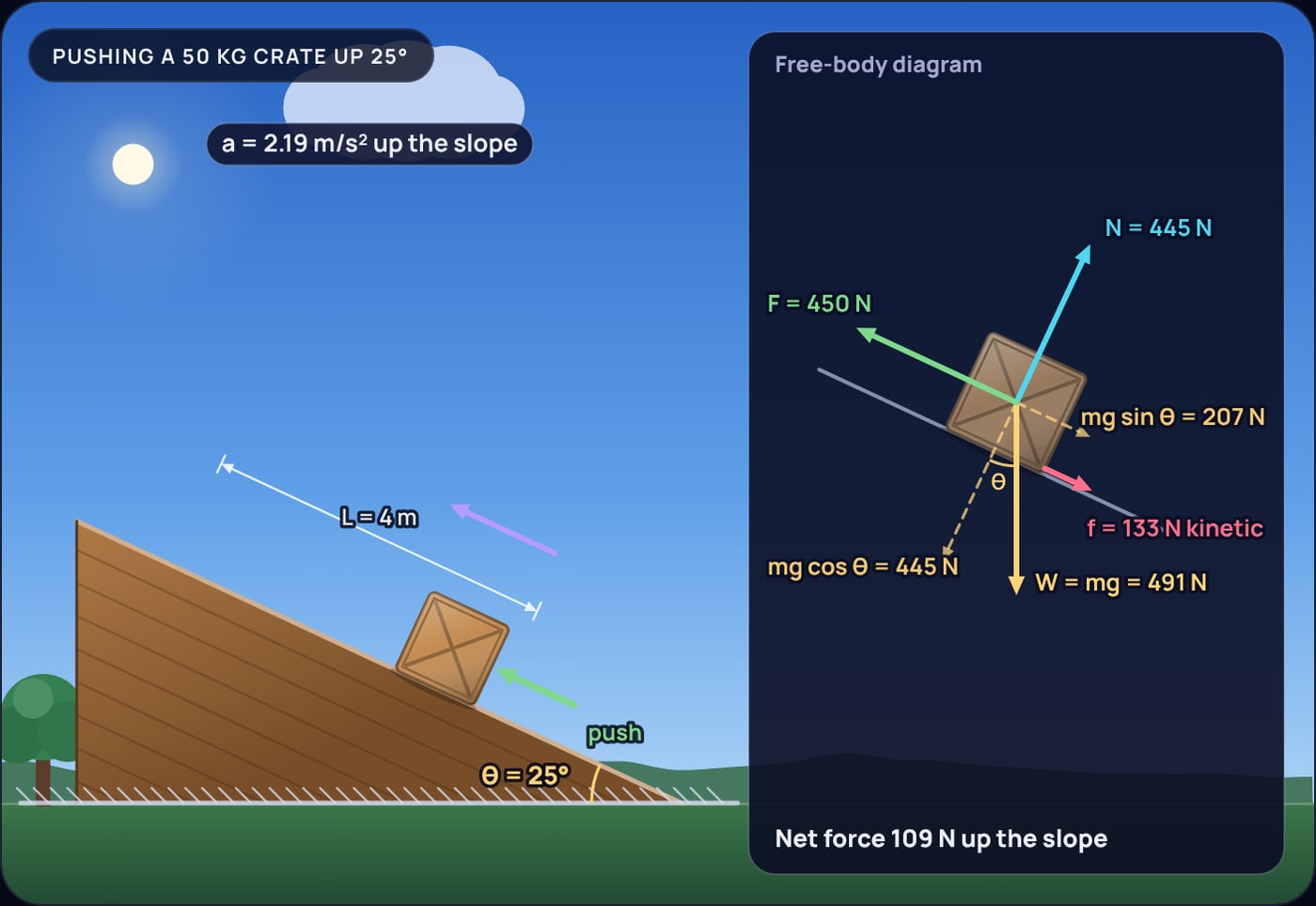
Worked example 3: pushing a 50 kg crate up a 25° wooden ramp
So the push must be more than 207.3 + 222.3 = 429.6 N. A 400 N push does nothing. With 450 N:
With 400 N the crate is in a strange state worth noticing: the push beats gravity by 192.7 N, so static friction points down the slope and supplies 192.7 N to hold it. Once the crate is moving, kinetic friction is smaller, and a push of 340.7 N keeps it going at a steady speed. That is why shoving something heavy up a ramp takes a hard start and then gets easier.
What are the most common mistakes?
Using N = mg. On a slope the normal force is mg cos θ. Using mg overestimates friction, by 15% at 30° and by 41% at 45°.
Always writing f = μs N. That is the limit, not the value. If the block is at rest, friction equals whatever the other forces along the slope add up to.
Swapping sin and cos. Check with θ = 0: the component along a flat surface must be zero.
Pointing friction the wrong way. Friction opposes the motion, or the motion that would happen without it. Sliding down, it points up the slope. Pushed up, it points down.
Forgetting units. If the mass is in pounds, convert to kilograms before multiplying by 9.81 m/s². The calculator accepts kg or lb, newtons or pound-force, and metres or feet, and shows the conversion as the first step.
What does the textbook model leave out?
The model treats the block as a point with constant friction coefficients. Real coefficients vary with surface condition, temperature and speed, and two samples of "wood" can differ by a factor of two. A tall, narrow block can tip over before it slides. Air resistance is ignored, which is fine at the speeds of a crate on a ramp. Once you know the acceleration, the constant-acceleration equations in SUVAT equations explained give distances, times and speeds, and kinetic vs potential energy shows the same ramp from the energy side, where friction turns some of the height into heat.
Try it yourself
Open the 20° wooden ramp in the inclined plane calculator and drag the angle slider up slowly. Watch the friction arrow grow to match the pull down the slope, then switch from static to kinetic as the crate lets go at 26.6°. Change the mass and nothing about the angle changes, which is the clearest demonstration that mass cancels.
Sources
- OpenStax, College Physics 2e, section 5.1 Friction, Table 5.1, coefficients of static and kinetic friction (approximate values).
- NIST, standard acceleration of gravity, 9.80665 m/s² (exact); this post rounds it to 9.81 m/s².
- NIST Special Publication 811, Appendix B.8 conversion factors (1 lb = 0.45359237 kg, 1 lbf = 4.448222 N, 1 ft = 0.3048 m).
Frequently asked questions
What is the formula for acceleration down an incline with friction?
a = g(sin θ − μk cos θ), for a block sliding down with no other push. On a 30° wooden ramp with μk = 0.3 that gives 9.81 × (0.5 − 0.26) = 2.36 m/s². The mass cancels, so a heavy block and a light one of the same material accelerate together.
Why is the normal force mg cos θ on an incline?
The surface only pushes at right angles to itself, and the block does not sink in or lift off, so the normal force balances the part of the weight that presses into the slope. That part is mg cos θ, which is smaller than mg on any slope.
How do you know if a block on an incline will slide?
Compare the pull down the slope, mg sin θ, with the most static friction can give, μs N. If mg sin θ is bigger, it slides. With no other forces this is the same as asking whether tan θ is bigger than μs.
Is static friction always equal to μs times N?
No. μs N is the maximum. Static friction supplies only as much as is needed to stop the block moving. A crate resting on a 20° wooden ramp needs 67 N of friction and gets exactly 67 N, although up to 92 N is available.
Does mass affect whether a block slides down a ramp?
No. The pull down the slope and the maximum friction both grow in proportion to the mass, so the mass cancels. The block slides if tan θ is more than μs, whether it weighs 1 kg or 1 tonne.