Kinetic Energy vs Potential Energy: Examples With Numbers
A car at 100 km/h carries the same energy it would pick up by falling off a 39 m cliff. Halve the speed to 50 km/h and the matching drop is not 19.5 m but only 9.8 m. That single comparison holds most of what you need to know about kinetic and potential energy: one depends on speed squared, the other on height, and an object that moves up or down simply swaps one for the other.
This post works through six everyday cases with the numbers written out: a skater on a ramp, a roller coaster, a car, a runner, an apple and a skater on the Moon. Every example can be opened in the kinetic and potential energy calculator, which shows the working with your numbers and lets you slide the rider along the track to watch the two energies trade.
What are kinetic and potential energy?
Kinetic energy is the energy an object has because it is moving. For a mass at speed :
Gravitational potential energy is the energy an object has because it is raised above some reference level. Near the Earth's surface, where the pull of gravity is close to constant, lifting a mass through a height stores
with . Both come out in joules when the mass is in kilograms, the speed in metres per second and the height in metres. One joule is roughly the energy needed to lift an apple 1 metre, which is the fifth example below.
The two are linked by conservation of energy. If friction and air resistance are small, the sum stays fixed as the object moves:
Going down, height falls and speed rises. Going up, the reverse. Every example in this post is that one line applied to a different object.
How do kinetic and potential energy trade on a ramp?
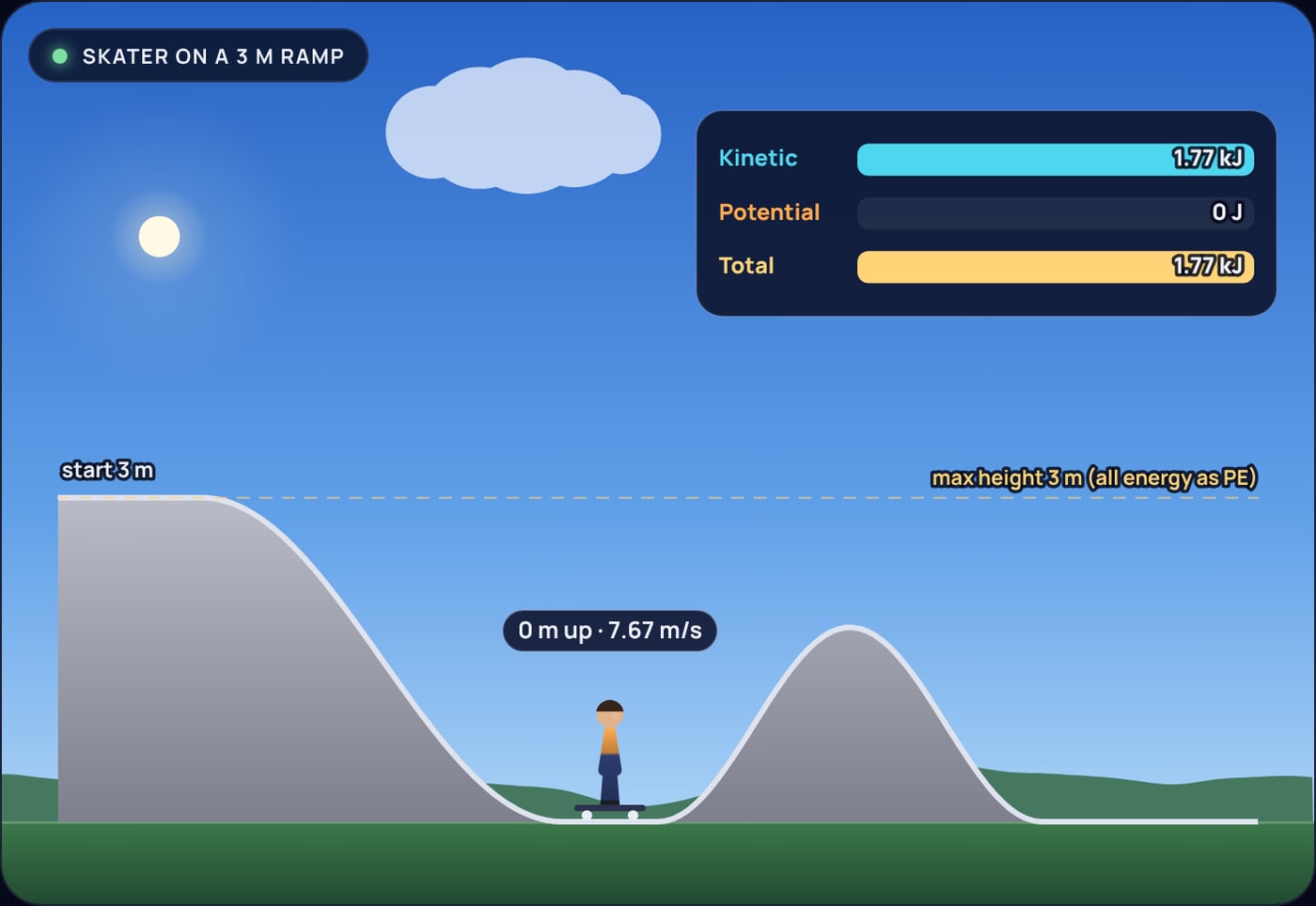
Start with a 60 kg skater standing still at the top of a 3 m ramp. At the top the speed is zero, so all the energy is potential.
Worked example: a skater dropping in from 3 m
At the bottom the height is zero, so the full 1,766 J is kinetic:
That is 27.6 km/h. Halfway down, at 1.5 m, the skater has 883 J of each kind. The total line in the calculator stays flat while the two bars swap.
Notice what happens to the mass when you solve for speed. It appears on both sides and cancels:
A 30 kg child and a 90 kg adult on the same smooth ramp reach the same 7.67 m/s at the bottom. The adult carries three times the energy at that speed, which is why the adult is harder to stop, but neither one is faster. This is the same result as for a dropped object in how long it takes to fall from a height: landing speed depends on the drop, not the mass.
How fast is a roller coaster at the bottom of a 40 m drop?
A roller coaster is the classic example because almost nothing drives it after the lift hill. A chain or launch does work to give the train potential energy at the top, and gravity spends it for the rest of the ride.
Take a 600 kg car, riders included, cresting a 40 m drop at a slow 2 m/s.
Worked example: a coaster over a 40 m drop
At the bottom all of that is kinetic:
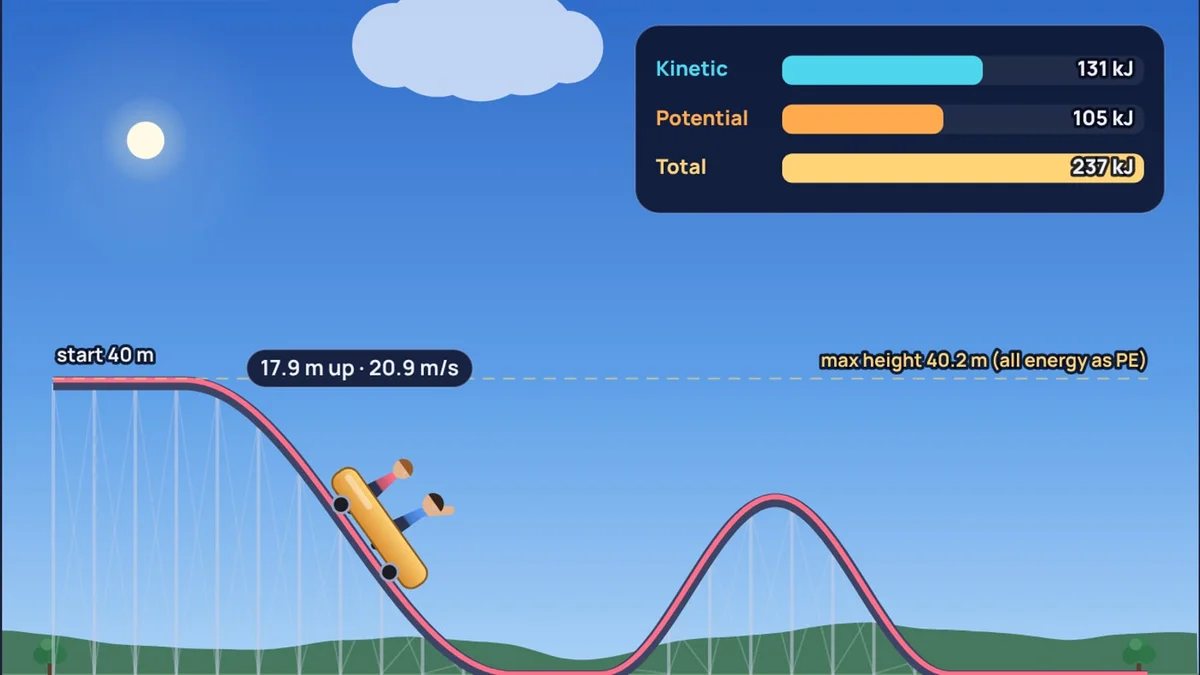
The 2 m/s at the top barely matters: it adds 1,200 J to a total of more than 236,000 J. Gravity does nearly all the work. Partway down, at 17.9 m above the bottom, the car has 105 kJ of potential energy left and 131 kJ of kinetic, doing 20.9 m/s.
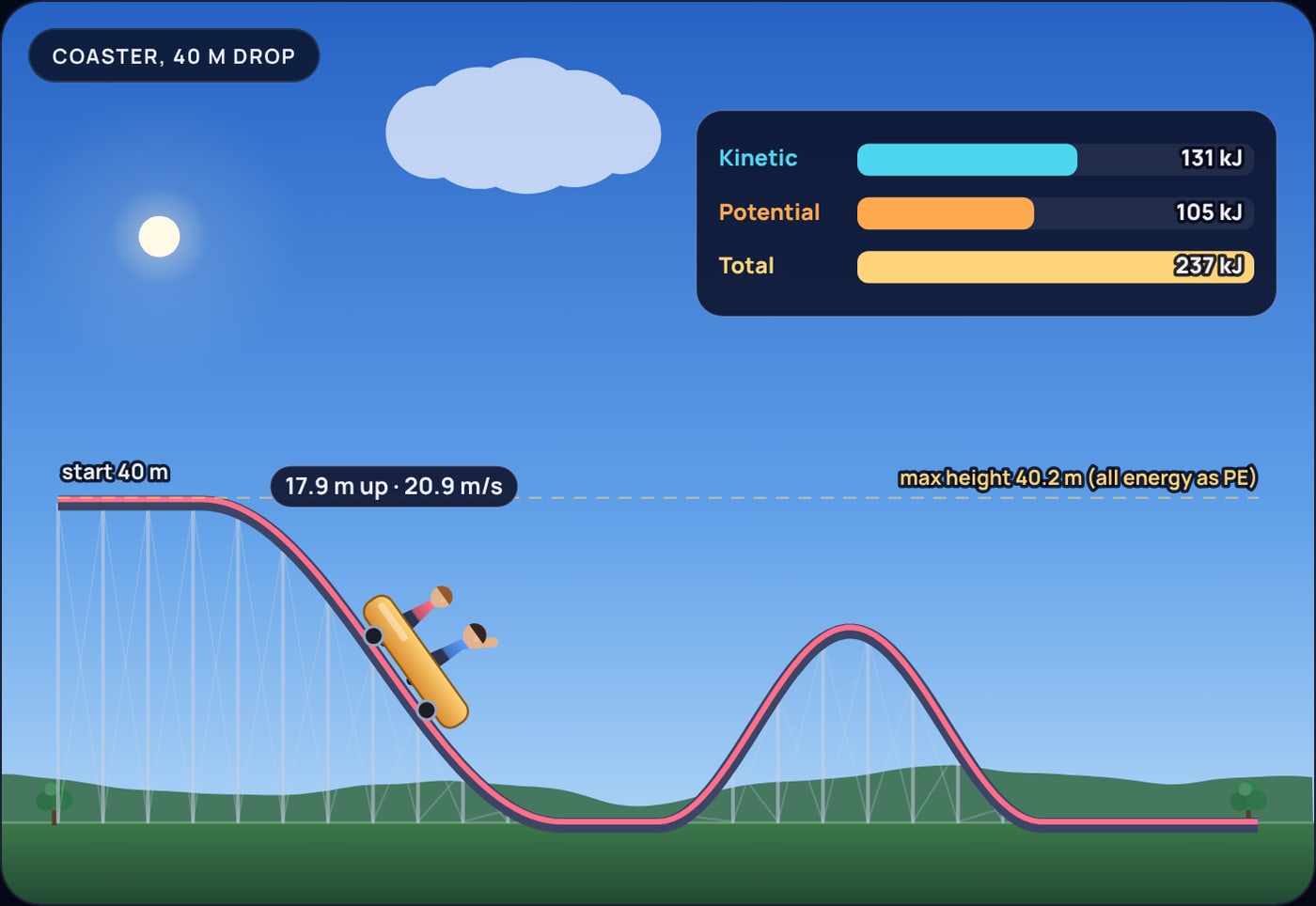
A real coaster arrives a little slower than 101 km/h because wheel friction and air drag take some energy as heat and sound. That is also why the second hill on any coaster is lower than the first: the car could never climb back to 40 m with less than its starting energy. The calculator leaves friction out, so treat its numbers as the upper limit.
Why does speed matter so much more than mass?
Mass enters kinetic energy once; speed enters squared. Double the mass and the energy doubles. Double the speed and it goes up four times. For a 1,500 kg car:
Worked example: a car at 50 km/h and at 100 km/h
The ratio is exactly 4. The brakes have to turn four times as much energy into heat, and at the same braking force the stopping distance is four times as long. A useful way to feel these numbers is to ask what drop would give the same speed. Setting gives , and the mass cancels again:
| Speed | In m/s | KE of a 1,500 kg car | Same as a fall of |
|---|---|---|---|
| 30 km/h | 8.33 | 52 kJ | 3.5 m |
| 50 km/h | 13.89 | 145 kJ | 9.8 m |
| 100 km/h | 27.78 | 579 kJ | 39.3 m |
| 130 km/h | 36.11 | 978 kJ | 66.5 m |
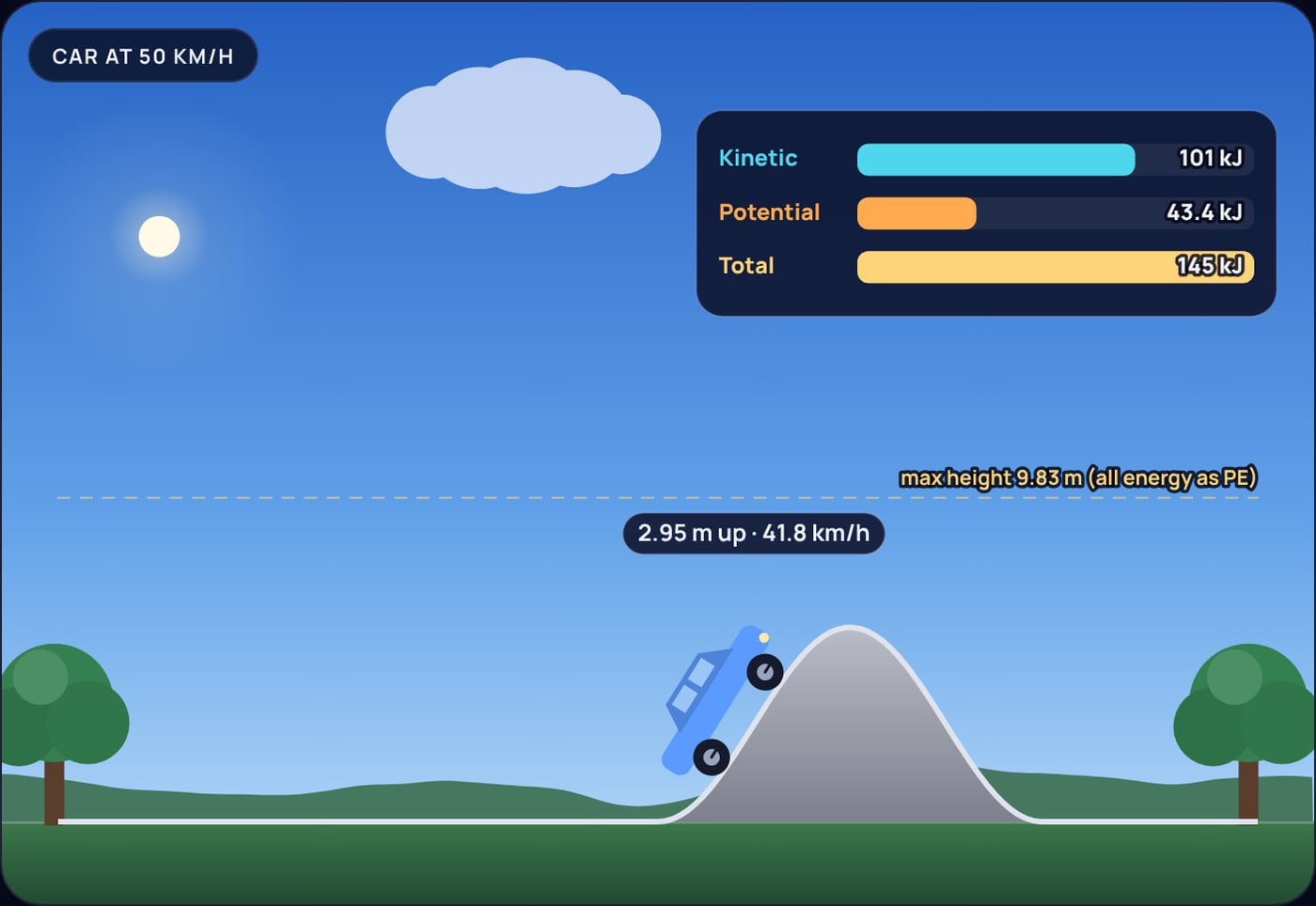
Run the conversion the other way and the car at 50 km/h could, with the engine off and no friction, coast up a hill 9.83 m high before stopping. The calculator draws that dashed line and shows the car partway up, trading speed for height.
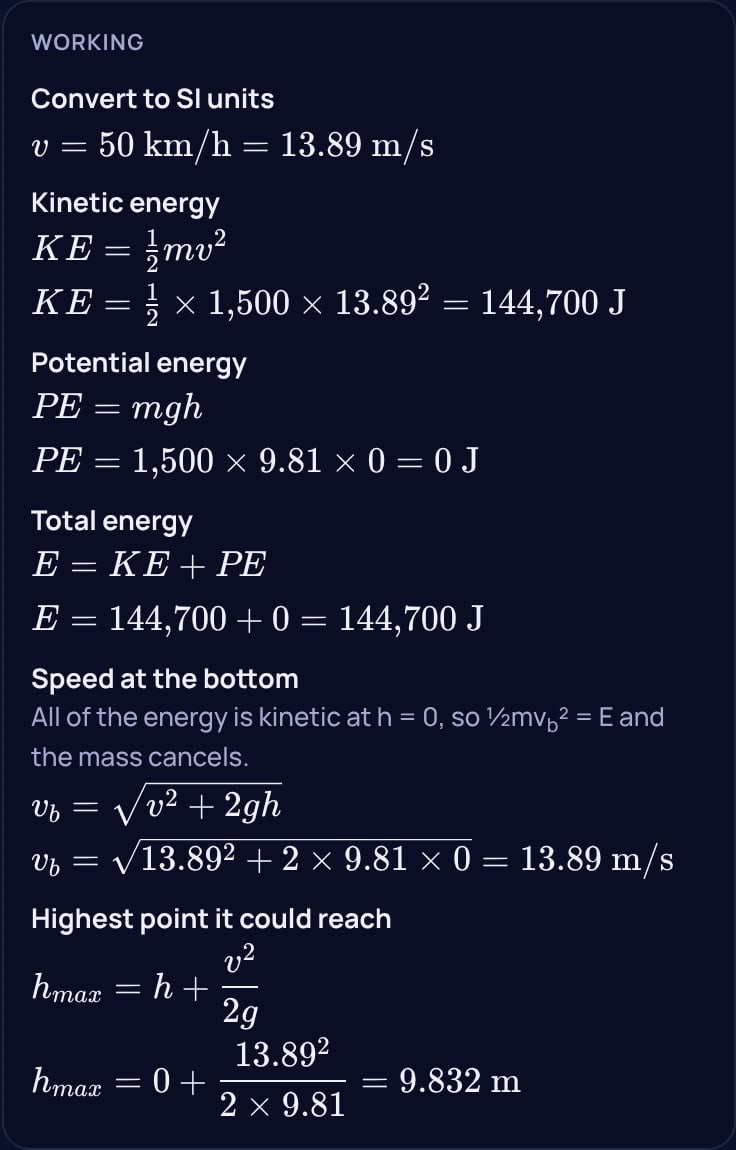
The calculator writes out every step, starting with the unit conversion. Most wrong answers in kinetic energy problems come from putting km/h straight into the formula, which makes the energy 3.6² ≈ 13 times too big.
How high could a runner at 9 m/s rise?
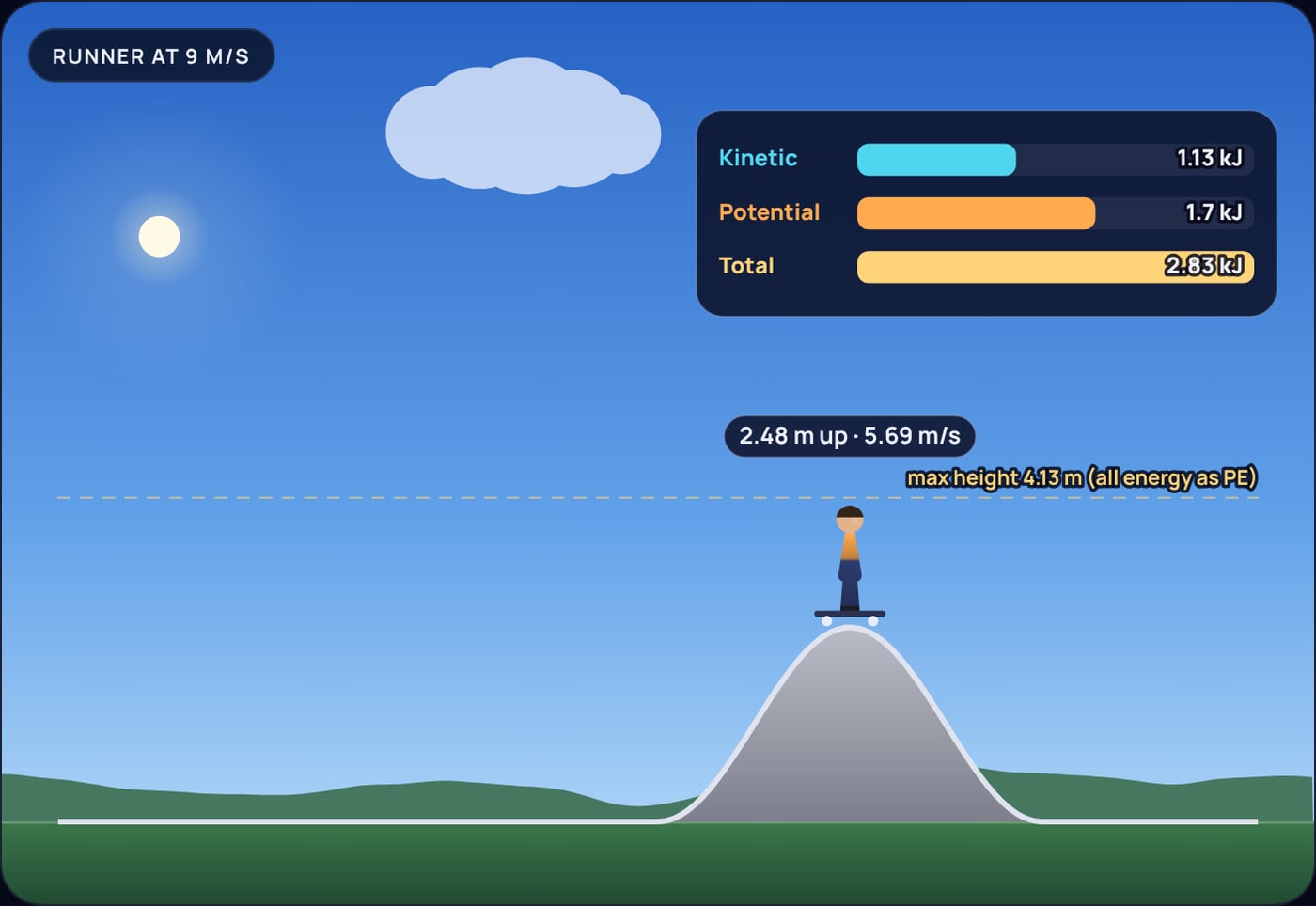
Turning kinetic energy into height is the idea behind the pole vault. The pole stores the runner's kinetic energy as it bends and gives it back as the vaulter rises. For a 70 kg runner at 9 m/s:
Worked example: speed into height
That 4.13 m is the rise of the runner's centre of mass if every joule went into height, with none left over as forward speed and none lost in the pole. It is a simplified model. A real vaulter starts with the centre of mass about a metre off the ground, pushes with the arms at the top and must keep some forward speed to clear the bar, so the bar height and this number are related but not equal.
What does one joule feel like?
A joule is small. Lift a 100 g apple from the floor onto a 1 m table and you give it
Knock it off and it hits the floor with that 0.981 J as kinetic energy, at . Compare that with the 145,000 J of the car at 50 km/h and the scale of road crashes becomes clearer. For a sense of where the really large numbers live, the energy locked in one gram of mass is about 90 trillion joules.
Does the same ramp work differently on the Moon?
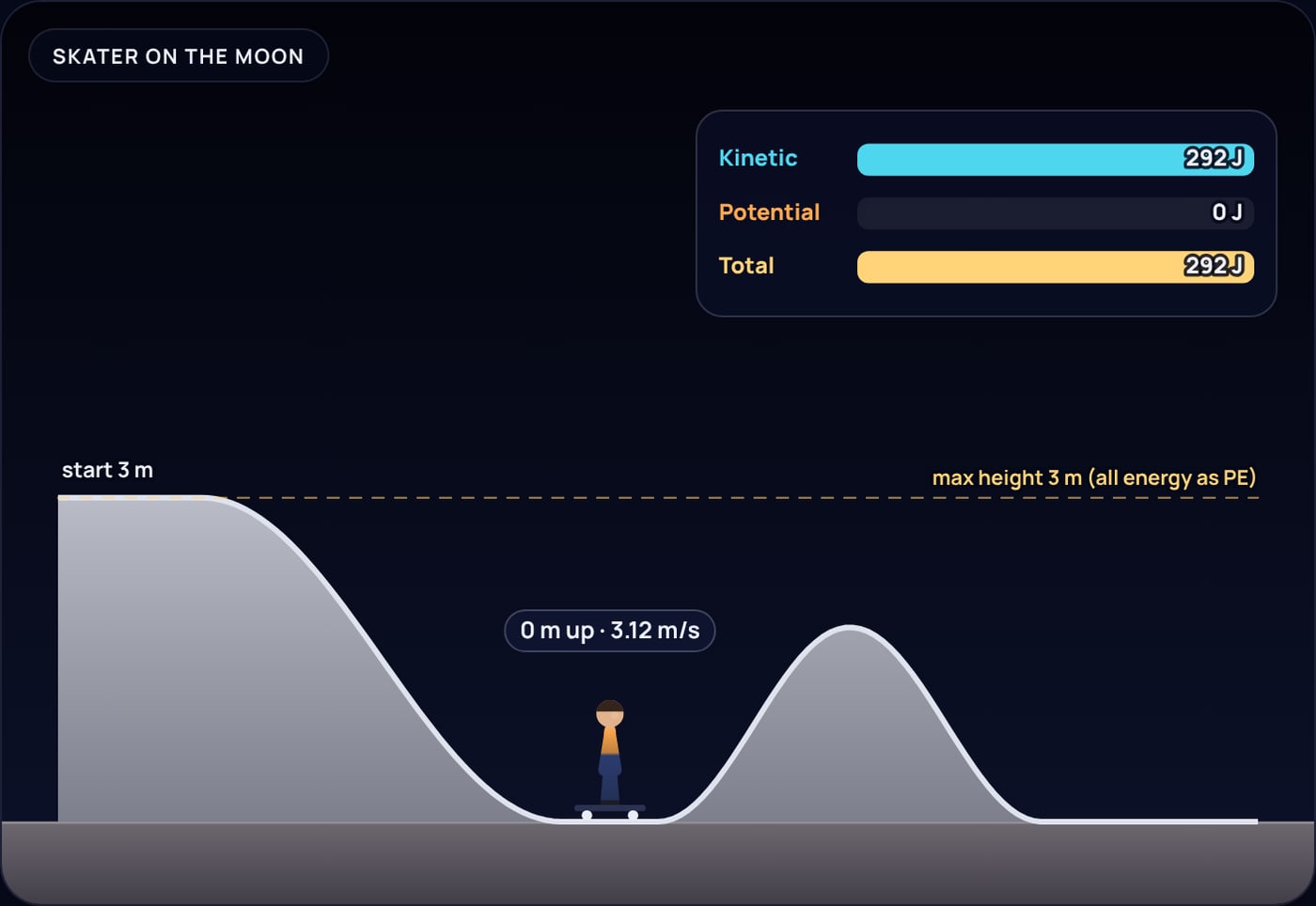
Potential energy depends on , so the same ramp stores less energy where gravity is weaker. On the Moon , about a sixth of Earth's.
Worked example: the 3 m ramp on the Moon
The energy is a sixth of the Earth value, but the speed is only about 2.5 times smaller (7.67 against 3.12 m/s), because speed goes with the square root of the energy. Kinetic energy itself does not depend on gravity at all: a skater moving at 3.12 m/s has the same 292 J on the Moon, on Earth or in deep space.
Kinetic vs potential energy at a glance
| Kinetic energy | Gravitational potential energy | |
|---|---|---|
| Comes from | Motion | Height in a gravity field |
| Formula | ½mv² | mgh |
| Doubling mass | Doubles it | Doubles it |
| Doubling speed or height | Four times as much | Twice as much |
| Depends on g | No | Yes |
| Can be negative | Never | Yes, below the chosen zero level |
The last row trips people up. Potential energy is measured from a level you choose, usually the ground or the lowest point of the track. Pick a different zero and every PE value shifts by the same amount, but the changes, which are what set the speeds, stay exactly the same.
What does this simple model leave out?
The formulas here assume three things. First, friction and air resistance are small; on a real track they turn some energy into heat, so real speeds at the bottom are lower. Second, is constant, which holds to a fraction of a percent for heights of a few kilometres but not for rockets or satellites. Third, the object slides rather than rolls. A rolling ball or a bicycle wheel stores part of its kinetic energy as spin, so it reaches the bottom of a slope slower than . A solid ball reaches about 85% of that speed.
For motion where you also need the time, not just the speed, the constant-acceleration equations in SUVAT equations explained pick up where energy leaves off: energy tells you how fast, SUVAT tells you when.
Try it yourself
Open the roller coaster preset in the kinetic and potential energy calculator and press Play to watch the bars trade on the way down and back up the second hill. Then change the mass to 1,200 kg: both energies double, and the speed at every point stays the same. Switch the world to the Moon and the whole ride slows to a crawl.
Sources
- NIST, standard acceleration of gravity, 9.80665 m/s² (exact); this post rounds it to 9.81 m/s².
- NIST Special Publication 811, Appendix B.8 conversion factors (1 lb = 0.45359237 kg, 1 ft = 0.3048 m, 1 mph = 0.44704 m/s, all exact).
- NASA Goddard, Moon fact sheet (surface gravity 1.62 m/s²) and Mars fact sheet (3.73 m/s²).
Frequently asked questions
What is the difference between kinetic and potential energy?
Kinetic energy is energy an object has because it is moving, KE = ½mv². Gravitational potential energy is energy it has because of its height, PE = mgh. As an object falls, potential energy turns into kinetic energy, and the total stays the same if friction and air resistance are small.
How much kinetic energy does a car have at 50 km/h?
A 1,500 kg car at 50 km/h (13.89 m/s) has ½ × 1,500 × 13.89² = 144,700 J, about 145 kJ. At 100 km/h it has 579 kJ, four times as much, because kinetic energy grows with the square of the speed.
Does a heavier object reach the bottom of a slope faster?
Not if friction and air resistance are small. Mass cancels when you set mgh equal to ½mv², so the speed at the bottom is √(2gh) for any mass. A heavier object does carry more energy at that speed.
Can an object have kinetic and potential energy at the same time?
Yes. A roller coaster halfway down a drop is both moving and above the ground, so it has some of each. On a coaster that started 40 m up, at 17.9 m it carries about 131 kJ of kinetic and 105 kJ of potential energy.
How high can you go with a given speed?
If all the kinetic energy becomes potential energy, the height is h = v² ÷ 2g. A runner at 9 m/s could in principle raise their centre of mass by 4.13 m, and a car at 50 km/h could coast up 9.83 m with the engine off and no friction.